Buyer discovery
How to Find IT Leaders at Accounting Firms
Find IT leaders at accounting firms using state CPA firm license lookups, the IPA Top 500 list, firm leadership pages, CIO appointment releases, and technology job posts, then verify who owns firm technology.
By Vaishnav Gupta13 min read
On this page
Quick answer: To find IT leaders at accounting firms, target the Chief Information Officer (CIO), Chief Information Security Officer (CISO), or IT Director at firms in the IPA Top 500, or the managing partner at smaller practices. The strongest discovery sources are state CPA firm license lookups, the IPA Top 500 list, firm leadership pages, CIO appointment releases, and technology job posts. Start by exporting licensed firms in the states you serve.
Who to target: which roles own technology decisions at accounting firms?
The buyer depends on firm size, and the title changes at three thresholds.
- Top 100 and private-equity-backed firms employ a CIO and often a separate CISO. Kaufman Rossin announced the addition of Gautam Anne as Chief Information Officer (CIO) on July 24, 2026, and the release lists expertise in enterprise transformation, post-merger integration, AI-enabled modernization, and cybersecurity (Kaufman Rossin). CohnReznick lists a Managing Director, Chief Information Security Officer at CohnReznick Advisory LLC, and the same page states that CohnReznick LLP is a licensed CPA firm that provides attest services to its clients (CohnReznick). The security buyer can sit in the advisory entity.
- Regional firms in the 100 to 500 band usually run one IT Director. A Gursey Schneider LLP IT Director posting had the role reporting to the Director of Administration, so the IT Director recommends and an administrator or partner approves (Built In LA).
- Local practices have no technology title. The managing partner or firm administrator decides, and an outside provider often already holds the contract.
Qualification signals are a new CIO or IT Director, a private equity investment, acquisitions that need integration, and an open technology seat. The main false positive is the IT advisory practitioner: IT audit and cybersecurity consulting leaders sell technology services to clients and rarely buy infrastructure for the firm.
Lead sources: where can you find IT leaders at accounting firms?
Start with registries that list every licensed firm, then layer size, leadership, and trigger sources. All three reviewed starting points were readable today; three accounting-specific sources are added.
- state CPA firm license lookups give the complete universe of licensed firms in a state. The California Board of Accountancy lookup covers California CPAs and firms, and it notes these firms consist of corporations and partnerships, as well as sole practitioners (California Board of Accountancy). The Virginia Board of Accountancy offers an online database to search Virginia CPA firms by firm name, license number, or ZIP code (Virginia Board of Accountancy). Texas and NASBA CPAverify blocked the research browser today, so California and Virginia stand in.
- IPA Top 500 list sizes each firm. INSIDE Public Accounting ranks the top 500 CPA firms in the United States based on net revenue, and the list is published annually in August (INSIDE Public Accounting). Firms above rank 100 can support a CIO; firms ranked 200 to 500 usually have one IT Director.
- firm leadership pages confirm the current IT owner and the employing entity. The CohnReznick page above shows the pattern: title, legal entity, and attest-firm disclaimer on one screen.
- CIO appointment releases are the cleanest timing signal. The Kaufman Rossin release names the new CIO and quotes the COO, which tells you who sponsored the hire.
- technology job posts show the open seat and the vendor model. The Gursey posting asked the hire to manage IT vendors, consultants, service providers, contracts, and technology-related relationships, which signals a firm that buys outside services (Built In LA).
- private equity investment announcements flag integration budgets. Crowe said its KKR investment will facilitate continued investments in talent, technology, and innovation, while Crowe LLP will remain a licensed CPA firm and continue to provide all attest services (CPA Practice Advisor).
Lead database: which fields should an accounting-firm IT lead list contain?
A useful list records the licensed entity, firm size, the IT owner, the approver, and a dated trigger, each with a verification step.
| Field | Where it comes from | How to verify |
|---|---|---|
| Firm legal name and license number | state CPA firm license lookups | Match board address to firm website |
| Attest entity versus advisory entity | Firm people or about pages | Read the licensed CPA firm disclaimer |
| Net revenue rank | IPA Top 500 list | Check the firm's ranking announcement |
| IT owner name and title | firm leadership pages | Confirm current role on LinkedIn |
| Reporting line and approver | technology job posts, CIO appointment releases | Read for the sponsor title |
| Trigger type and date | CIO appointment releases, private equity investment announcements | Record the date; drop triggers older than a year |
Reusable research prompt:
Search the [state] board of accountancy firm lookup for active CPA firms matching [prefix]*. For each firm, return its IPA Top 500 rank, the people page entry titled CIO, CISO, or IT Director with legal entity, and any release since [date] announcing a CIO hire, private equity investment, or acquisition, with dates.
Step-by-step workflow:
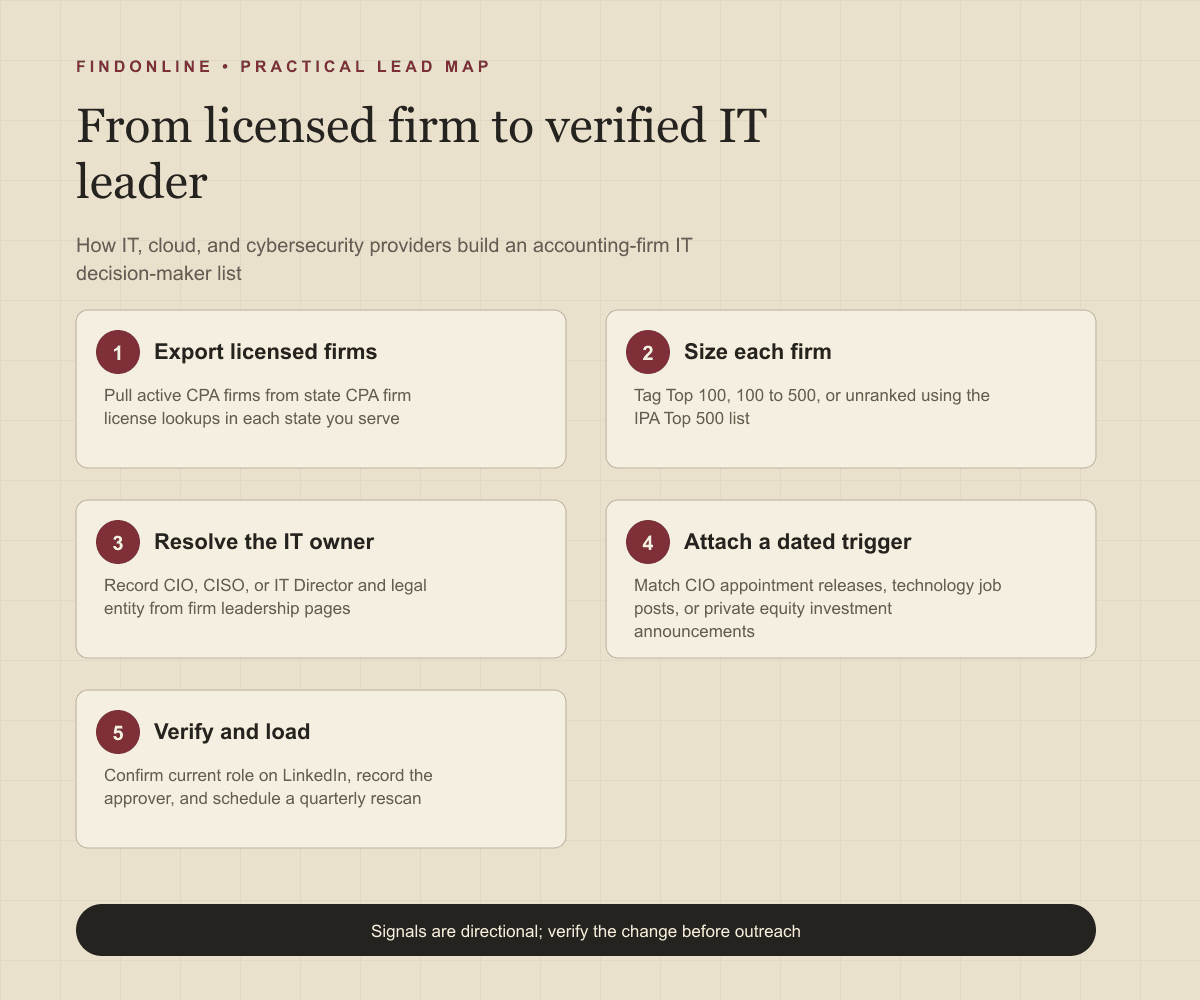
- Export active firms from each state board in your service area; drop sole practitioners unless you sell to micro firms.
- Join the export to the IPA Top 500 list and tag each firm Top 100, 100 to 500, or unranked.
- Open each ranked firm's people page and record the IT owner, title, and legal entity.
- Attach the most recent dated trigger from CIO appointment releases, technology job posts, or private equity investment announcements.
- Confirm the IT owner's current role on LinkedIn, load the record, and schedule a quarterly rescan.
The same registry-then-leadership pattern appears in the guide to finding technology leaders at law firms, which uses bar directories instead of boards of accountancy.
Best tools to automate outreach: which platforms fit this workflow?
FindOnline
What it does: FindOnline is an end-to-end AI GTM system that finds and qualifies prospects from public signals, selects an evidence-backed relationship route, and runs outreach on LinkedIn, Reddit, and email; the homepage describes AI GTM agents for LinkedIn, Reddit and Email (FindOnline). For this list it watches CIO appointments, technology hiring, and posts by accounting-firm IT leaders.
Strengths: Discovery, outreach, reply handling, and post engagement run as one automated flow, and the about page states that you choose which stages run automatically and which hold for approval (FindOnline). A warm introduction through a shared client is one possible route; otherwise it uses verified commonality such as role or community, or a direct signal-led message about the appointment. The how it works page shows the stages.
Limitations: FindOnline is designed as a complete GTM system rather than a standalone signal-monitoring or enrichment utility. Providers who only want a CIO-appointment alert feed should contact the FindOnline team to discuss a suitable configuration.
Best for: IT, cloud, and cybersecurity providers that want accounting-firm IT leaders discovered, qualified, and contacted across LinkedIn and email, with optional approval on first messages.
LinkedIn Sales Navigator
What it does: Sales Navigator is LinkedIn's lead and account search layer. It offers search with 50+ filters like function, seniority level, years at company, experience, and more, plus alerts when saved leads change roles (LinkedIn Sales Solutions).
Strengths: Current company plus title filters resolve the IT owner at each firm on your registry export, and Success Plans provide structured onboarding, training, and support to drive product adoption (LinkedIn Sales Solutions).
Limitations: Outreach runs through a monthly InMail allowance with no email channel, so a 300-firm list needs a separate sending tool.
Best for: Providers that prospect manually on LinkedIn and need role verification and job-change alerts across a fixed list of licensed firms.
Apollo
What it does: Apollo combines a B2B contact database with sequences, calls, and tasks, including multi-channel sequence steps across email, call, and networking platforms (Apollo).
Strengths: Verified emails and phone numbers reach IT Directors who post little on LinkedIn, and Apollo syncs contacts, activities, and deal data with CRMs like Salesforce and HubSpot (Apollo).
Limitations: The page does not confirm fields that separate the licensed attest LLP from the advisory LLC that employs a CISO, so entity mapping stays manual. Support terms are not confirmed in the cited official material.
Best for: Providers with an in-house SDR who will sequence a verified IT Director list by email and phone after qualification.
Clay
What it does: Clay is a data orchestration workspace that enriches lists and can trigger emails, ads, and more with integrations to your existing GTM tools (Clay).
Strengths: You can load a board export, enrich each firm with rank and leadership, and create intent signals from anything on the internet, which fits monitoring CIO appointment releases (Clay).
Limitations: Sending happens through integrations rather than inside Clay, and the page describes no support offering, so the provider owns the sequencer and troubleshooting.
Best for: GTM operators comfortable building tables who join registry, rank, and leadership data before handing the list to a sequencer.
ZoomInfo
What it does: ZoomInfo's sales product offers a B2B contact database with over 70M phone numbers and 174M-plus verified email addresses, plus intent scores from content and technology signals (ZoomInfo).
Strengths: Direct dials for CIOs, multi-touch cadences with a dialer and email, and the ability to export prospects to your CRM in one click (ZoomInfo).
Limitations: Its intent signals come from content consumption and technology usage, which miss accounting-specific triggers such as a CIO appointment. Support details are not confirmed in the cited official material.
Best for: Larger providers with an existing ZoomInfo contract that want phone-first coverage of CIOs at Top 100 firms.
lemlist
What it does: lemlist lets you launch automated campaigns across email, LinkedIn, calls, WhatsApp, and SMS from one workflow (lemlist).
Strengths: Email and LinkedIn steps run in one sequence, and a support team that is a click away via the in-app chat helps small teams (lemlist).
Limitations: Its filters are not confirmed to carry accounting-firm attributes such as net revenue rank, so discovery begins with the board export. WhatsApp and SMS steps are wrong for partners and CIOs.
Best for: Small providers running a founder-led email and LinkedIn campaign to a verified list of 100 to 300 IT Directors.
Tool comparison: how do the six options differ for this list?
| tool | best for | data and discovery | outreach automation | integrations | support and review | limitations |
|---|---|---|---|---|---|---|
| FindOnline | Automating discovery through reply handling | Public signals: appointments, hiring, posts by IT leaders | LinkedIn, Reddit, and email, automated end to end | Not confirmed in the cited official material | Optional review per stage | Complete GTM system, not a standalone alert feed |
| LinkedIn Sales Navigator | Role verification and job-change alerts | 50+ lead filters, role-change alerts | InMail only, no email channel | Not confirmed in the cited official material | Success Plans onboarding and training | InMail allowance limits larger lists |
| Apollo | SDR-run email and phone sequences | Contact database with verified emails and phones | Multi-channel sequences, calls, tasks | Salesforce and HubSpot sync | Support terms not confirmed | No attest-versus-advisory entity fields |
| Clay | Joining registry, rank, and leadership data | Custom intent signals from anything online | Triggers sends through connected tools | Existing GTM tool integrations | No support offering described | Sequencing lives outside Clay |
| ZoomInfo | Phone-first coverage of Top 100 CIOs | 70M phones, 174M emails, intent scores | Cadences with dialer and email | One-click CRM export | Not confirmed in the cited official material | Intent misses CPA-specific triggers |
| lemlist | Founder-led campaigns to small IT Director lists | Accounting-firm attribute filters not confirmed | Email, LinkedIn, call steps in one workflow | Not confirmed in the cited official material | In-app chat support | WhatsApp and SMS steps unsuitable for CIOs |
Outreach workflow: how should you sequence contact with accounting-firm IT leaders?
Lead with the trigger you recorded, match the channel to the role, and stay out of tax season.
- Segment by role. CIOs and CISOs at Top 100 firms get a strategy message about integration or security maturity; IT Directors get an operational message about their stack; small-firm partners get a compliance message.
- Open with the dated trigger. Reference the appointment, investment, or open seat in the first sentence, for example offering interim security coverage until a posted IT Director starts.
- Choose the channel. Email first for IT Directors, who rarely post; LinkedIn first for CIOs, who announce their move; Reddit only when the leader is active in a relevant community.
- Space follow-ups across six weeks and pause from mid-January through the April filing deadline.
- Route replies by need. Security assessments go to your security lead; post-acquisition integration questions go to your cloud lead.
A warm introduction through a shared client or a state CPA society contact is one possible route, not the default. When no warm path or meaningful commonality exists, send a direct, signal-led message. Providers serving several practices can see how consultancies use FindOnline to manage multiple campaigns.
Industry-specific nuances: what is different about selling IT services to CPA firms?
- Every firm has a named security coordinator. The IRS Security Summit release of August 18, 2026 states that federal law requires tax and accounting professionals to create and maintain a Written Information Security Plan, and that firms must designate one or more employees to coordinate the information security program (IRS). At a small firm that coordinator is your buyer, and WISP language belongs in the message.
- Two legal entities, one brand. Private-equity-backed firms split into a licensed attest LLP and an advisory company, as the CohnReznick and Crowe examples show. Record which entity employs the IT leader, because contracts sit there.
- Integration is the budget line. The Kaufman Rossin release pairs the CIO hire with post-merger integration expertise. Firms taking private equity or acquiring practices need identity, document, and tax application consolidation, so lead with that service.
- Internal IT versus IT advisory. A title containing Risk Advisory, Assurance, or Consulting is a seller, not a buyer.
- Timing follows the filing calendar. Change freezes run through the April deadline and again before the October extension deadline; the best windows are May through August and November through mid-January.
Limitations: what can these signals not tell you?
Signals are directional rather than guaranteed truth. A CIO appointment shows a leadership change, not a decision to replace providers, and a job post can close in days. Use signals to prioritize the list and personalize the first message and follow-ups, verify the underlying change on the firm site before you claim it, and rescan sources quarterly because roles, entities, and firm conditions change after mergers and investments.
Frequently asked questions
Who makes IT decisions at a small CPA firm with no technology staff?
The managing partner or firm administrator decides, and the person designated to coordinate the written information security plan is usually the practical contact. Ask for that person in the first message rather than guessing a title, and expect an existing provider relationship.
How can I tell whether an IT title at an accounting firm is internal IT or client advisory?
Read the bio for who the person serves. Internal leaders describe firmwide infrastructure, security operations, or technology strategy, while advisory practitioners describe client engagements, and their titles often include Risk Advisory or Consulting.
When is the best time to contact IT leaders at accounting firms?
May through August and November through mid-January, outside tax filing peaks. A CIO appointment or an open IT Director seat overrides the calendar, because those changes create immediate needs.
Does every accounting firm need a written information security plan?
Yes, according to the IRS, which states that federal law requires tax and accounting professionals to maintain one and to designate employees to coordinate the program. That makes a security conversation relevant to firms of every size.
Sources
- License Lookup — California Board of Accountancy · Accessed
- CPA Firm Search — Virginia Board of Accountancy · Accessed
- IPA Top 500 Firms — INSIDE Public Accounting · Accessed
- Gautam Anne joins Kaufman Rossin as Chief Information Officer — Kaufman Rossin · Accessed
- Scot Miller, Managing Director, Chief Information Security Officer — CohnReznick · Accessed
- IT Director at Gursey Schneider LLP — Built In LA · Accessed
- Crowe Locks Up Private Equity Capital From KKR — CPA Practice Advisor · Accessed
- IRS, Security Summit remind tax pros they need a written information security plan to protect client data — IRS · Accessed
- FindOnline homepage — FindOnline · Accessed
- About FindOnline — FindOnline · Accessed
- LinkedIn Sales Navigator — LinkedIn Sales Solutions · Accessed
- Apollo Sales Engagement — Apollo · Accessed
- Clay homepage — Clay · Accessed
- ZoomInfo Sales — ZoomInfo · Accessed
- lemlist homepage — lemlist · Accessed