Buyer discovery
How to Find IT Leaders at Credit Unions
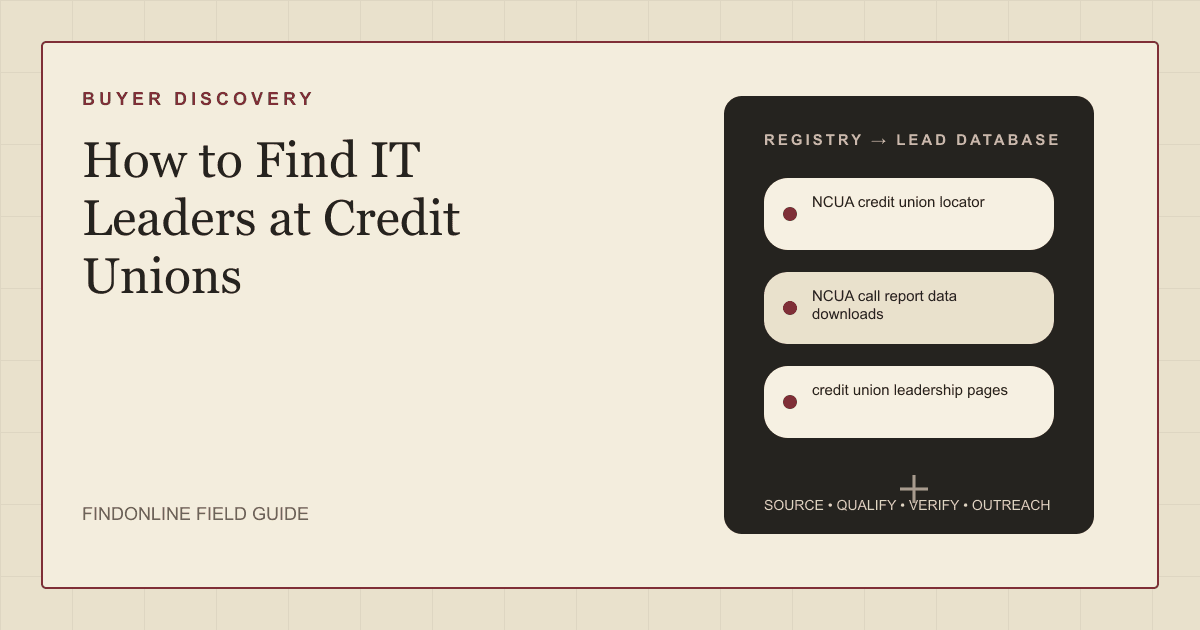
Find IT leaders at credit unions using the NCUA credit union locator, NCUA call report data downloads, credit union leadership pages, and LinkedIn current-role profiles, then verify who owns infrastructure and security.
By Vaishnav Gupta14 min read
On this page
Quick answer: To find IT leaders at credit unions, build the institution list from the National Credit Union Administration (NCUA) credit union locator and call report data downloads, then resolve the Chief Information Officer (CIO), VP of Information Technology, or Information Security Officer (ISO) on each credit union leadership page and LinkedIn current-role profile. First action: download the latest quarterly NCUA call report file and filter by state and asset size.
Who to target: which roles own IT decisions at a credit union?
Target the CIO or VP of Information Technology for infrastructure, cloud, and managed services, the ISO or Chief Information Security Officer (CISO) for security programs, and the CEO or COO at small credit unions where one manager runs technology. Titles vary with asset size, so verify each one rather than filtering on a single title.
Larger credit unions split the roles. Community First Credit Union's leadership page lists a CIO who "is responsible for Information Technology, Cyber Security, Core System Operations/Support, and Application Development" alongside a separate Chief Information Security Officer and a Chief Risk Officer (Community First Credit Union leadership). Vendor risk reviews for security services often route through risk as well as IT.
Security ownership follows examinations. The NCUA's Information Security Examination evaluates management's ability to "recognize, assess, monitor, and manage information systems and technology-related risks" (NCUA Information Security Examination), so the ISO or CISO answers for vendor oversight and testing when examiners arrive.
Decision rules for IT, cloud, and cybersecurity providers:
- Combined title such as Chief Technology and Information Officer: one buyer for infrastructure and security.
- Separate CIO and CISO: assessments go to the CISO, cloud and infrastructure to the CIO, and migrations need both.
- Named outsourced CISO or managed vendor in a job post: an incumbent exists, but the ISO still owns oversight and renewal.
- No technology executive listed: the CEO, COO, or CFO approves spend and a manager runs it.
Lead sources: where do you find credit unions and their IT leaders?
Start with official NCUA data for the institution list, then use first-party pages and professional profiles for the people.
- NCUA credit union locator - the NCUA's official search tool, which finds a credit union "by searching a credit union by name, address, zip code or charter number" (NCUA locator announcement). The interactive map did not respond to our research browser, so the NCUA announcement is cited instead. Use it for charter numbers and branch footprints.
- NCUA call report data downloads - quarterly files for every federally insured credit union, delivered as "comma delimited text files that can be easily imported into a spreadsheet or database program" (NCUA call report data). Assets, members, state, and charter type come from here.
- credit union leadership pages - the first-party record of the current CIO, CISO, or VP of IT and their stated remit.
- LinkedIn current-role profiles - confirm the person still holds the role. LinkedIn Help notes "If you select Update my headline, you can display your current experience in your introduction section" (LinkedIn Help: Experience section).
- NCUA CUSO Registry - credit union service organizations (CUSOs) that deliver shared services, including technology. The NCUA states "The public can access the following information on registered CUSOs," including services offered (NCUA CUSO Registry).
- credit union IT job posts - an open VP of IT, IT director, or ISO role means the seat is empty or expanding. The CUES job board and CUInsight blocked the research browser, so read each credit union's own careers page for named vendors and reporting lines.
- core conversion announcements - core platform changes trigger infrastructure, integration, and security work. CU Broadcast reported on July 8, 2026 that nine credit unions selected Corelation's KeyStone core and that "These credit unions range in assets from $78 million to $59 billion" (CU Broadcast).
Lead database: which fields should a credit union IT leader list contain?
A useful list joins NCUA institution data to a verified person and a dated trigger.
| Field | Where it comes from | How to verify |
|---|---|---|
| Legal name and charter number | NCUA credit union locator | Match charter number in the call report file |
| Charter type, assets, members | NCUA call report data downloads | Use latest quarter; note growth |
| IT leader name and title | credit union leadership pages | Confirm on LinkedIn current-role profiles |
| Security owner and model | Leadership page, ISO job posts | In-house, dual-hatted, or outsourced |
| Core platform and stage | core conversion announcements, member FAQ pages | Record signing and conversion dates |
| Open IT leadership roles | credit union IT job posts | Postings under 90 days old |
| Technology CUSO relationships | NCUA CUSO Registry | Match services to your service line |
| Trigger type and last verified | All sources | Rescan after each quarterly release |
Reusable research prompt:
Using the latest NCUA call report file, list credit unions in [state] with assets between [minimum] and [maximum]. For each, record the CIO, VP of Information Technology, or Information Security Officer from the leadership page with a LinkedIn current-role match. Note any 2026 core conversion, open IT leadership posting, or technology CUSO relationship, and flag outsourced CISO arrangements.
Step-by-step workflow:
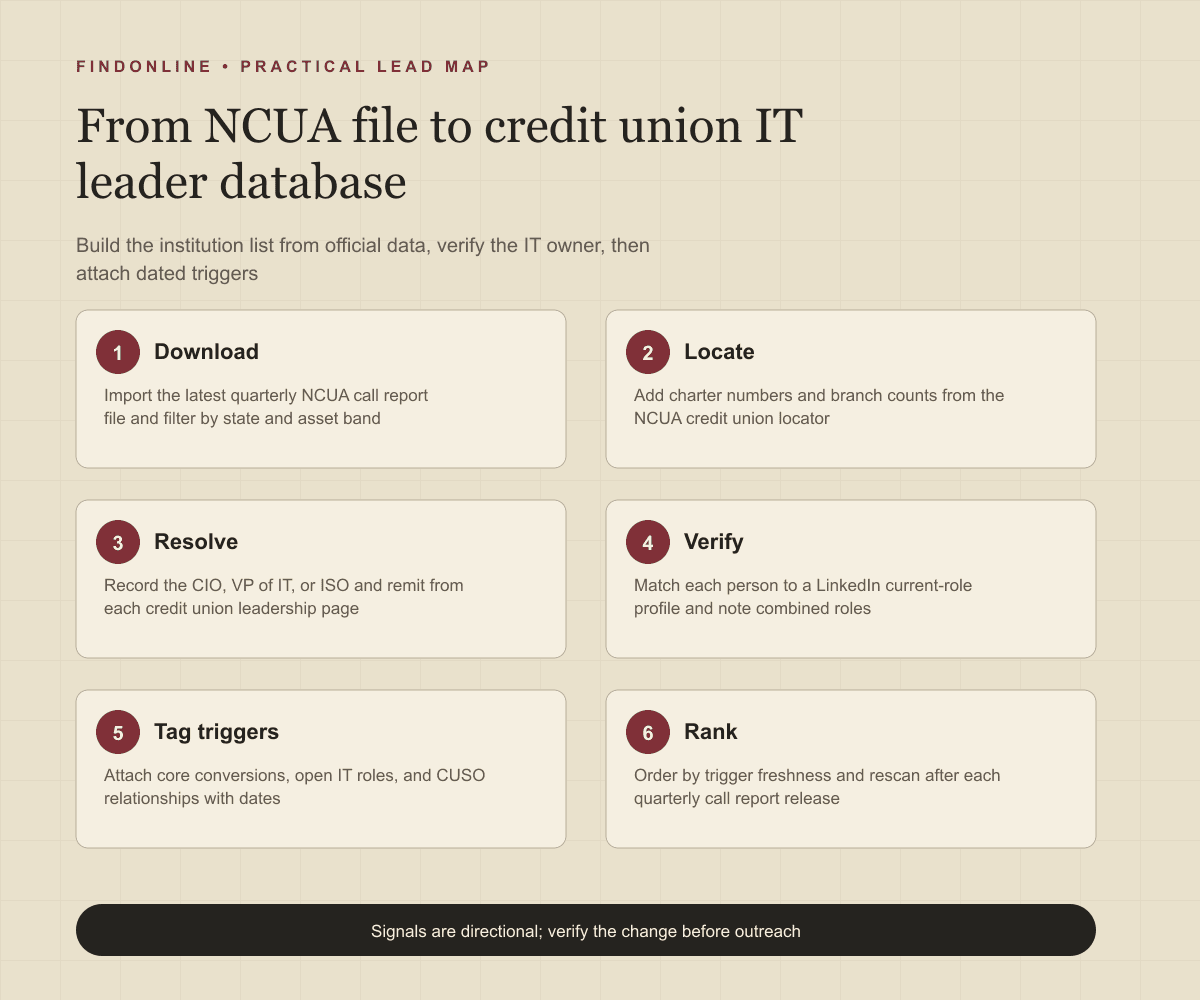
- Download the latest quarterly ZIP from the NCUA call report page and import the credit union file.
- Filter by state and the asset band that fits your delivery model.
- Add charter numbers and branch counts from the NCUA credit union locator.
- Record IT and security executives from each credit union leadership page.
- Confirm each person on LinkedIn current-role profiles and note combined roles.
- Attach dated triggers from core conversion announcements, credit union IT job posts, and the NCUA CUSO Registry, then rank.
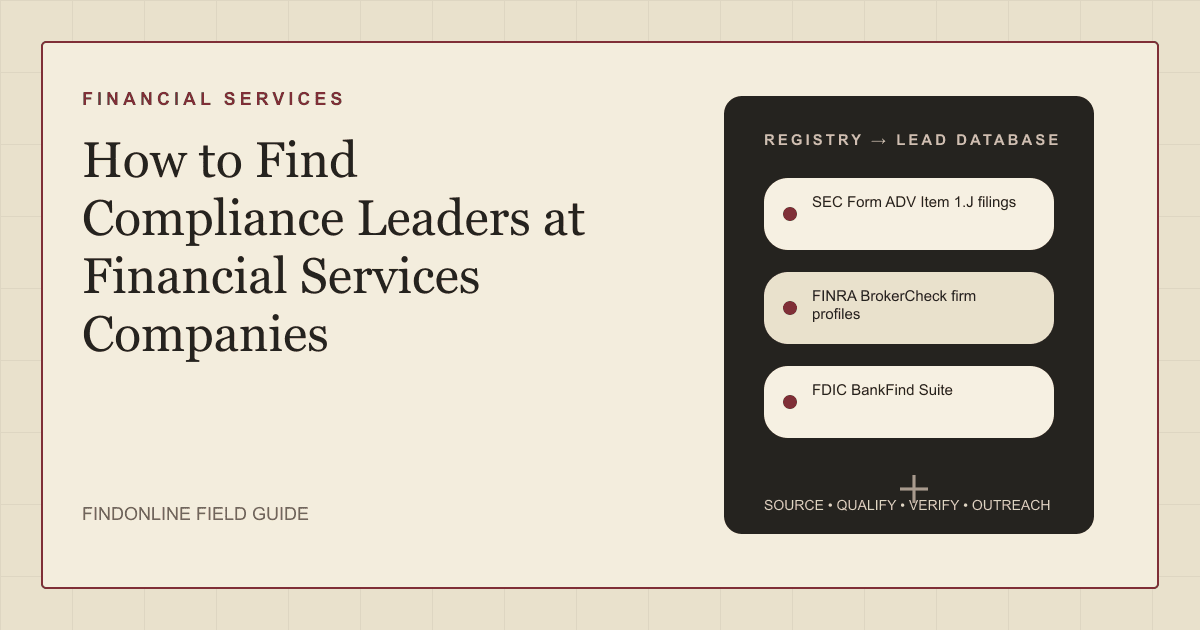
The same registry-first logic appears in our guide to finding compliance leaders at financial services companies.
Best tools to automate outreach: which tools fit credit union IT prospecting?
FindOnline covers discovery through outreach; the five alternatives each cover part of the path.
FindOnline
What it does: FindOnline is an end-to-end AI GTM system with "AI GTM agents for LinkedIn, Reddit and Email" (FindOnline). Its agent "finds and contacts high-intent prospects, engages with their posts, tracks their professional events" (FindOnline how it works), so a new credit union CIO appointment, a core conversion post, or an ISO job post becomes a public signal that feeds qualification and outreach.
Strengths: Public-signal discovery, evidence-backed relationship routing, and automated LinkedIn, Reddit, and email outreach run in one system. "You choose which stages run automatically and which hold for approval" (FindOnline about), so a provider can hold the first CISO message for optional review while discovery runs unattended.
Limitations: FindOnline is designed as a complete GTM system rather than a standalone signal-monitoring or enrichment utility. A team that only wants NCUA list enrichment should contact the FindOnline team to discuss a suitable configuration.
Best for: IT, cloud, and cybersecurity providers who want credit union IT leaders found, qualified by public signals, and worked across LinkedIn, Reddit, and email in one system.
LinkedIn Sales Navigator
What it does: Sales Navigator searches LinkedIn "with 50+ filters like function, seniority level, years at company, experience, and more," alerts you when saved leads change roles, and its Success Plans include "structured onboarding, training, and support" (LinkedIn Sales Navigator).
Strengths: Fastest route from a credit union name to named technology and security contacts, with alerts that catch new CIO appointments.
Limitations: Discovery stays inside LinkedIn and cannot join NCUA asset, charter, or conversion data; sparse profiles at small credit unions hide combined roles.
Best for: Providers who already prospect on LinkedIn and need current-role verification for credit union IT leaders.
Apollo
What it does: Apollo runs "Multi-channel sequence steps across email, call, and networking platforms" and "syncs contacts, activities, and deal data with CRMs like Salesforce and HubSpot" (Apollo sales engagement). Its support model is not confirmed in the cited official material.
Strengths: Contact database and sequence engine in one place, with CRM sync keeping the credit union list and activity together.
Limitations: The database is general B2B, so coverage of IT managers at smaller credit unions is uneven; import the NCUA-derived list rather than relying on its filters.
Best for: Providers with a sales development rep running email-first sequences to a verified list.
Clay
What it does: Clay is a data orchestration workspace offering "One contract to buy data from 200+ data and AI vendors" with waterfall enrichment, and it can "Write 1:1 messaging for every prospect programmatically" (Clay). Support channels are not confirmed in the cited official material.
Strengths: Suited to enriching an imported NCUA call report file with leadership data and emails, then generating conversion-specific opening lines.
Limitations: It is a build-your-own workflow with no ready credit union table; someone must design and maintain the enrichment logic.
Best for: GTM operators comfortable building tables who want the NCUA list enriched at scale.
ZoomInfo
What it does: ZoomInfo provides contact data with intent and technology signals, lets teams "Export prospects to your CRM in one click," runs phone and email cadences, and offers "White glove services for large-scale and complex data requests" (ZoomInfo Sales).
Strengths: Strong direct-dial coverage at larger credit unions and one-click CRM export.
Limitations: Coverage skews toward larger organizations, so many small credit unions have few IT contacts; org charts were not confirmed in the cited official material.
Best for: Providers targeting billion-dollar credit unions who need phone-first outreach.
Lemlist
What it does: Lemlist lets teams "Launch automated campaigns across email, LinkedIn, calls, WhatsApp, and SMS from one workflow," connects with HubSpot and Salesforce, and says "our support team is just a click away via the in-app chat" (Lemlist).
Strengths: Multichannel execution with deliverability tooling included, simple enough for conversion-timed campaigns.
Limitations: It is an execution layer with no NCUA registry match or leadership page verification, so qualification must happen before import.
Best for: Small providers who built the list manually and want chat-supported campaigns.
Tool comparison: how do the six options differ for credit union IT outreach?
FindOnline is the only option here that runs discovery through outreach in one system; the others cover search, enrichment, data, or execution.
| tool | best for | data and discovery | outreach automation | integrations | support and review | limitations |
|---|---|---|---|---|---|---|
| FindOnline | End-to-end credit union IT outreach | Public signals: appointments, posts, hiring, professional events | Automated LinkedIn, Reddit, and email outreach with reply handling | Not confirmed in the cited official material | Optional review; choose which stages hold for approval | Complete GTM system, not a standalone enrichment utility |
| LinkedIn Sales Navigator | Current-role verification on LinkedIn | 50+ filters, saved-lead role-change alerts | None; alerts and LinkedIn messaging only | Advanced CRM Integrations | Help Assistant, Success Plans | Cannot join NCUA asset or conversion data |
| Apollo | Email-first sequences to a verified list | General B2B contact database | Multichannel sequences across email, call, networking | Salesforce and HubSpot sync | Not confirmed in the cited official material | Uneven coverage of small credit union IT staff |
| Clay | Enriching the NCUA file at scale | 200+ data vendors, waterfall enrichment | Programmatic 1:1 messaging | CRM enrichment | Not confirmed in the cited official material | Build-your-own tables, no ready credit union list |
| ZoomInfo | Phone-first outreach to large credit unions | Contact data, intent and technology signals | Phone and email cadences | One-click CRM export | White glove data services | Coverage skews to larger organizations |
| Lemlist | Chat-supported multichannel campaigns | None specific to credit unions | Email, LinkedIn, calls, WhatsApp, SMS campaigns | HubSpot and Salesforce | In-app chat support | Execution only; no registry match |
Outreach workflow: how do you approach credit union IT leaders?
Lead with the verified trigger, offer one outcome tied to the examination or conversion calendar, and keep the first message short. Credit union IT leaders answer to boards and examiners, so vague capability pitches rarely land.
- Rank by trigger freshness. A CIO appointed within 90 days, a signed core conversion, or an open ISO role ranks above a static record.
- Check for a warm path. A shared technology CUSO or a peer at another credit union is one possible route, not the default.
- Use verified commonality when no warm path exists. Shared industry, a conference both attended, or the same core platform are legitimate context; never invent familiarity or a shared fact.
- Otherwise send a direct signal-led message. Example: "Congratulations on the CIO role at [credit union]. Teams moving to [core platform] often need network segmentation and vendor risk reviews before conversion weekend. Would a 20-minute readiness checklist help?"
- Sequence across channels. LinkedIn connection with a one-line reason, email with the checklist, then a follow-up after the next quarterly call report.
- Route replies by role. Security conversations go to the ISO, infrastructure conversations to the CIO.
For how discovery, routing, and outreach run in one system, see how FindOnline runs discovery and outreach end to end. Advisory firms can also review our page for consultancies.
Industry-specific nuances: what makes credit union IT buying different?
Credit union IT buying is shaped by examination cycles, cooperative governance, and shared service models, so timing and framing matter more than in most mid-market segments.
- Examinations set the agenda. The NCUA states "In 2023, the NCUA implemented the Information Security Examination (ISE) procedures" (NCUA Information Security Examination). Frame penetration tests and vendor reviews as examination readiness and ask when the next examination is scheduled.
- Governance is cooperative. Community First's page lists a volunteer Board of Directors and Supervisory Committee beside the executives (Community First Credit Union leadership). Large contracts often need board approval, so ask who presents to the board.
- CUSOs change who buys. CUSOs "must update and reaffirm their listings in the system annually" (NCUA CUSO Registry). A credit union served by a technology CUSO may route your proposal there, so decide whether to sell to the CUSO or the credit union.
- Core conversions are the largest trigger. Approach at signing: network and identity readiness early, integration and security testing mid-project, monitoring after cutover.
- Asset size predicts structure. Credit unions above a few hundred million dollars in assets usually have a dedicated IT team and security officer; smaller ones rely on a CUSO or managed provider.
- False positives. The NCUA employs a CIO but is a regulator. Corporate credit unions serve other credit unions, not members. Confirm the charter number before outreach.
For a related regulated segment, see finding security leaders at fintech companies.
Limitations: how much should you trust these signals?
Signals from NCUA files, leadership pages, job posts, and conversion announcements are directional, not guaranteed truth. A leadership page may lag an appointment, a job post may be a backfill, and a core signing may be years from conversion. Use signals to prioritize which credit unions to contact first and to personalize openings and follow-ups, verify the underlying change on a second source, and rescan after each quarterly call report release because titles, vendors, and asset bands change.
Frequently asked questions
Who is the IT decision-maker at a credit union?
At larger credit unions it is the CIO or VP of Information Technology, with a separate CISO or ISO owning security. At smaller credit unions one manager holds both roles and the CEO or CFO approves spending. Check the leadership page and a LinkedIn current-role profile before deciding.
How do I get a list of all credit unions in a state?
Download the latest quarterly ZIP from the NCUA call report data page and filter the credit union file by state. It covers every federally insured credit union with assets and members, and the NCUA locator adds charter numbers and branch locations.
What buying signals matter most for IT services at credit unions?
A new CIO or ISO appointment, a signed core conversion, and an open IT leadership posting are the strongest signals. Examination cycles create steady demand for risk assessments and vendor reviews, so ask about examination timing early in the conversation.
Are CUSOs competitors or prospects for IT providers?
Both. A technology CUSO can be the incumbent provider for its member credit unions or a channel partner that resells services. The NCUA CUSO Registry lists services offered, so check whether a CUSO already covers your service line before contacting its credit unions.
Sources
- NCUA's Credit Union Locator Has New Look, Search and Mapping Functions — NCUA · Accessed
- Credit Union and Corporate Call Report Data — NCUA · Accessed
- CUSO Registry — NCUA · Accessed
- NCUA's Information Security Examination and Cybersecurity Assessment Program — NCUA · Accessed
- Leadership - Community First Credit Union — Community First Credit Union · Accessed
- Manage your profile Experience section — LinkedIn Help · Accessed
- Corelation Signs Nine Credit Unions in Second Quarter 2026 — CU Broadcast · Accessed
- FindOnline - AI GTM agents for LinkedIn, Reddit and Email — FindOnline · Accessed
- About FindOnline — FindOnline · Accessed
- How FindOnline Works — FindOnline · Accessed
- LinkedIn Sales Navigator — LinkedIn · Accessed
- Apollo Sales Engagement — Apollo · Accessed
- Clay - Go to market with unique data — Clay · Accessed
- ZoomInfo Sales — ZoomInfo · Accessed
- lemlist - Multichannel outreach platform — Lemlist · Accessed