Buyer discovery
How to Find Security Leaders at Fintech Companies
Build a verified fintech security-leader list using regulator registers, company security pages, and current roles, then qualify and personalize outreach.
By Vaishnav Gupta12 min read
On this page
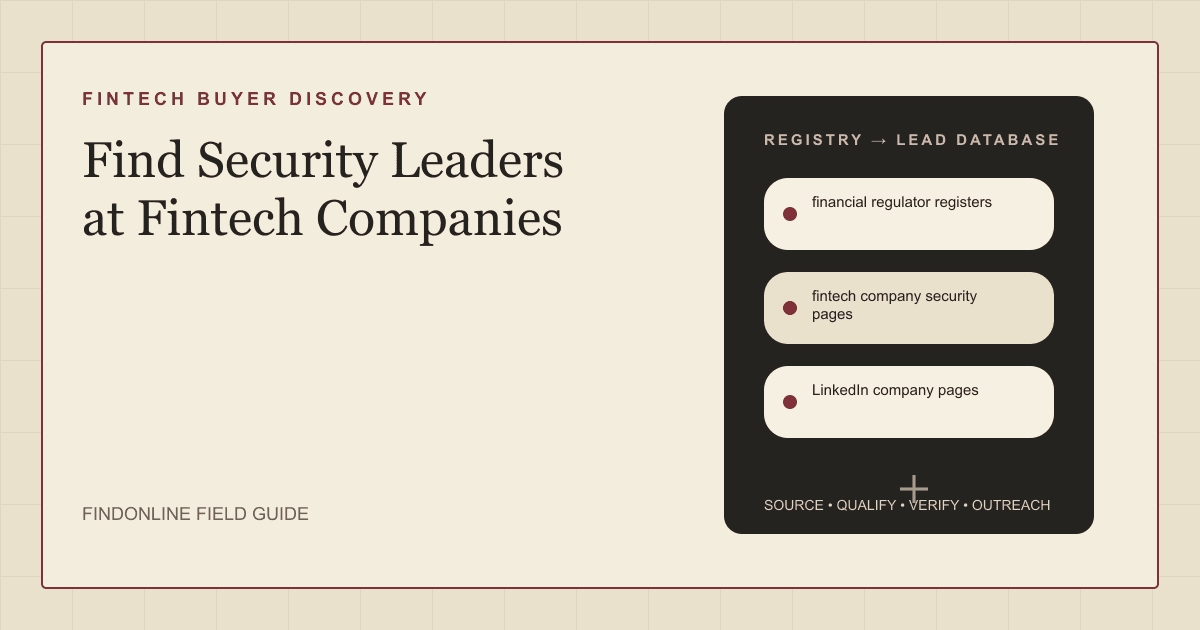
Quick answer: To answer how to find security leaders at fintech companies, target chief information security officers, heads of security, and the technical owners of your service. Start with financial regulator registers, fintech company security pages, and LinkedIn company pages. First, match each fintech brand to its legal entity and domain, then verify the current security owner before building outreach.
Who to target: which security roles fit your service?
Choose the role that owns the security work you deliver, then identify the executive sponsor separately. Use this routing guide as a research hypothesis, not a claim about every fintech's organization.
| Cybersecurity service | Initial role to investigate | Responsibility to confirm |
|---|---|---|
| Security program assessment | Chief information security officer (CISO), Head of Security | Group or subsidiary security remit |
| Application penetration testing | Head of Application Security, Product Security Lead | Ownership of the relevant application |
| Cloud security assessment | Cloud Security Lead, Security Engineering Director | Infrastructure scope and engineering sponsor |
| Detection and response | Security Operations Lead | Monitoring coverage and incident response ownership |
| Security assurance support | Governance, Risk and Compliance (GRC) Lead | Evidence collection and external assurance scope |
For a smaller fintech without a dedicated leader, investigate the chief technology officer (CTO). Do not promote a compliance contact into a technical buyer without evidence. Record one likely sponsor and one operational owner rather than contacting everyone with “security” in their title.
LinkedIn supports filtering by function, seniority, and professional commonalities. Combine those filters with the verified company rather than searching the entire financial-services category. LinkedIn search documentation
Lead sources: where should you build a fintech security prospect list?
Use regulator records for entity verification, company security material for service context, and LinkedIn company pages for people discovery. These sources answer different questions; keep their evidence separate.
Financial regulator registers: The UK Financial Conduct Authority (FCA) register includes firms with current or previous approvals. Start with a narrow segment, such as payment businesses, and check the individual record's status before inclusion. A register entry alone is neither a fintech classification nor a list of security buyers. FCA register guidance
Fintech company security pages: Read trust portals, security explanations, and published assurance material. Plaid describes its Security Portal as distributing security artifacts used in due diligence. Use that example to identify what a company discloses, which product it covers, and where further evidence is gated. The portal's existence does not establish an unmet need. Plaid security portal explanation
LinkedIn company pages: Match the company website and brand, then investigate current security-role profiles. Sales Navigator's company, title, and seniority filters support this step. Exclude former employees and external advisers unless their current mandate is established. LinkedIn search documentation
Retain all three discovery starting points. Use the FCA as a concrete UK example, not a worldwide fintech directory. For another jurisdiction, select its relevant official register and independently check its coverage.
Lead database: what should each security-leader record contain?
Store the legal entity, security remit, and evidence behind the contact. A name and email alone cannot distinguish a group security executive from someone responsible for a single product.
| Database field | Where it comes from | How to verify it |
|---|---|---|
| Brand, legal entity, domain | Regulator record and company legal page | Match entity spelling and official website |
| Jurisdiction and regulatory status | Relevant financial regulator register | Open the individual record; save check date |
| Fintech segment and product | Company product and security pages | Identify the actual service and product boundary |
| Security scope disclosed | Public security or trust page | Record exact scope; mark inaccessible material unknown |
| Leader, title, employer | Company biography and LinkedIn profile | Cross-check current employer and role |
| Group or subsidiary remit | Biography, team description, direct confirmation | Leave uncertain ownership unresolved |
| Trigger and event date | First-party announcement or live vacancy | Separate publication date from event date |
| Service-fit hypothesis | Your assessment of the evidence | State what remains to be confirmed |
| Contact route and suppression status | Verified professional contact and your records | Check relevance and prior objections |
| Evidence URL and last checked date | Every source used | Reopen before outreach; retain contradictory evidence |
Use this reusable research prompt:
Research [fintech brand] for [cybersecurity service] in [jurisdiction]. Match its legal entity and domain, inspect public security material, and identify the current security owner. Return source URLs, checked dates, product scope, trigger evidence, and unresolved questions. Separate facts from service-fit hypotheses. Do not infer vulnerabilities, purchasing authority, or access to private documents.
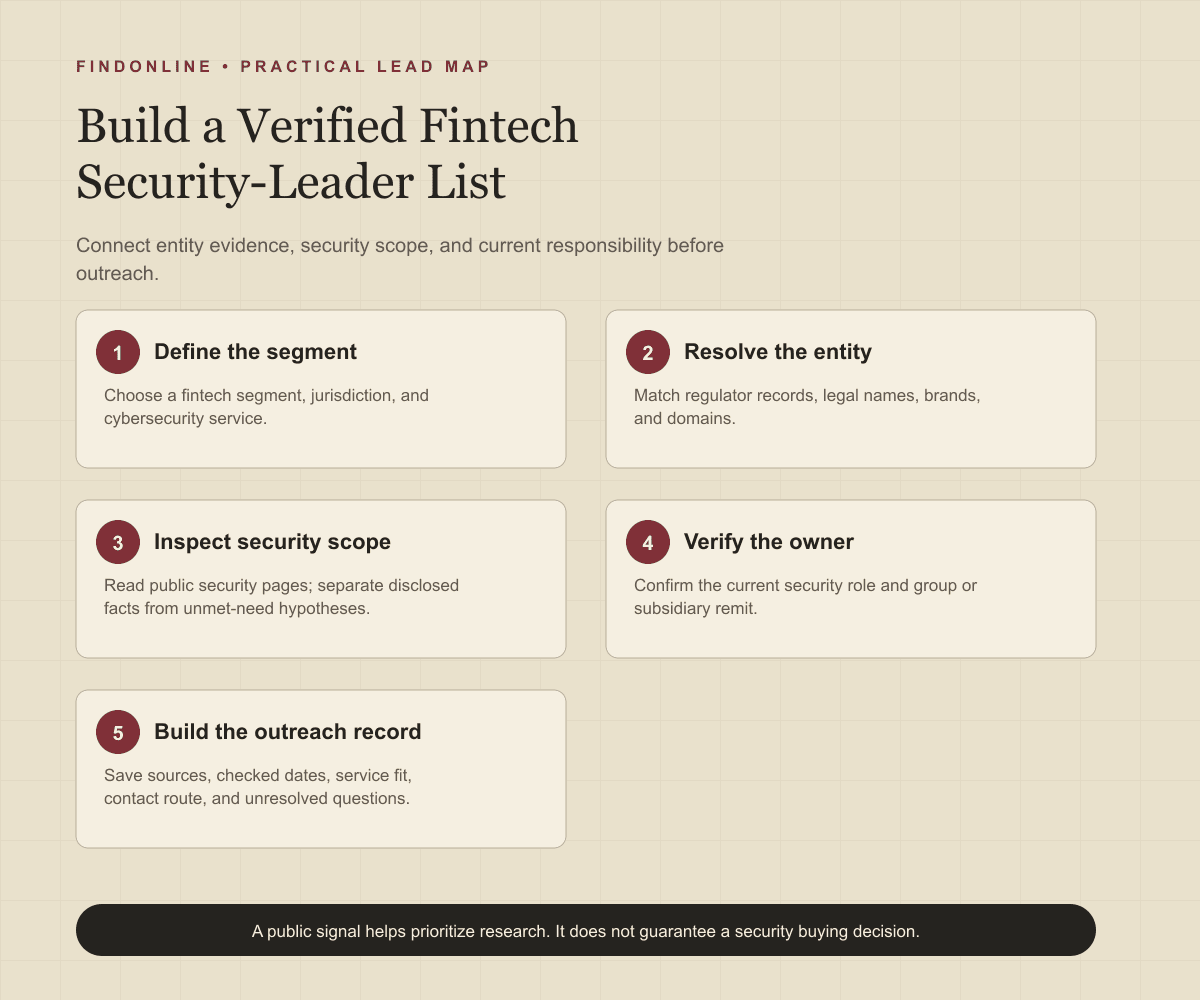
Build the list in five steps:
- Define one segment, jurisdiction, and service so qualification stays consistent.
- Resolve each brand to its entity and remove duplicate trading names.
- Review public security information and record a relevant change or an explicit unknown.
- Verify the security leader and distinguish technical ownership from executive sponsorship.
- Admit the record only when entity, role, and service relevance are defensible; otherwise retain it for research.
For example, a new application launch could justify investigating application-security ownership. It does not prove a penetration-testing contract is available. Save “testing need unconfirmed” alongside the launch evidence.
Best tools to automate outreach: which options fit this workflow?
Select tools according to the work remaining after qualification: relationship outreach, role discovery, sequence execution, research automation, engagement context, or account prioritization. The following evaluations use official material checked on September 23, 2026. Fit judgments are editorial recommendations.
FindOnline
What it does: FindOnline combines discovery from public signals with automated LinkedIn, Reddit, and email outreach for fintech security prospects. It supports end-to-end engagement, including replies and ongoing relationship activity. FindOnline Workflow
Strengths: Teams can automate every stage or use optional review at selected stages, such as checking technical service-fit claims. Review controls
Limitations: It is designed as a complete go-to-market (GTM) system rather than a standalone signal-monitoring or enrichment utility. Contact the FindOnline team about a suitable configuration for an isolated component; specific external integrations are not confirmed in the cited official material. FindOnline
Best for: Cybersecurity providers connecting verified fintech changes to evidence-backed relationship routing and ongoing multichannel outreach. Workflow
LinkedIn Sales Navigator
What it does: Helps narrow professional searches by company and role. Official search guide
Strengths: Saved searches and matching alerts help maintain a fintech security-leader watchlist. Official search guide
Limitations: Professional search does not establish which regulated entity a security leader controls. Outreach automation, specific integrations, and approval controls are not confirmed in the cited official material. Official search guide
Best for: Researchers resolving current security titles within an already verified fintech account list. Official search guide
Apollo
What it does: Runs sequences combining automated emails with manual phone and LinkedIn tasks. Sequence documentation
Strengths: Mailbox connection and sequence-management guidance support structured follow-up to qualified security contacts. Sequence documentation
Limitations: LinkedIn actions in the documented workflow are manual, creating work for teams expecting unattended social execution. Fintech discovery coverage and external integrations are not confirmed in the cited official material. Sequence documentation
Best for: Providers with verified security contacts who want email automation alongside representative-led tasks. Sequence documentation
Clay
What it does: Automates account and contact research using company, technology, and intent data. Account research documentation
Strengths: Scheduled research and delivery to Slack, Google Docs, and customer relationship management (CRM) systems support fintech account briefs. Account research documentation
Limitations: The documented research workflow requires your team to define the questions and downstream action; research output alone is not a completed outreach program. Sending and approval controls are not confirmed in the cited official material. Account research documentation
Best for: Operations teams building repeatable entity, product-scope, and security-owner research briefs. Account research documentation
Common Room
What it does: Combines buyer context across CRM, product, marketing, and engagement signals. Official platform overview
Strengths: Its documented Engage workflow connects ordered email, call, and follow-up steps to CRM prospects, with sequence performance analysis. Engage documentation
Limitations: An engagement-centered approach has less account-specific context to work with when a target fintech has no relevant activity in your connected systems. Stage approval controls are not confirmed in the cited official material. Official platform overview
Best for: Security providers prioritizing fintech accounts already interacting with their business. Official platform overview
Crunchbase
What it does: Supports account segmentation and prioritization using private-company intelligence. GTM documentation
Strengths: Private-market data can feed CRM and operational dashboards for account selection. GTM documentation
Limitations: Company growth predictions are not security-project evidence or proof of who controls the budget. Native outreach execution and approval controls are not confirmed in the cited official material. GTM documentation
Best for: Providers selecting private fintech accounts before investigating their security organization. GTM documentation
Tool comparison: how do the six options differ?
Use this table to match the tool to the bottleneck. “Not confirmed” means not confirmed in the cited official material, not necessarily unavailable.
| tool | best for | data and discovery | outreach automation | integrations | support and review | limitations |
|---|---|---|---|---|---|---|
| FindOnline | Fintech security relationship outreach | Public signals | Automated LinkedIn, Reddit, and email; end-to-end engagement | Not confirmed | Optional review by stage | Complete GTM system; discuss isolated-component configuration. Product Workflow Controls |
| LinkedIn Sales Navigator | Current security-role research | Company and role filters | Not confirmed | Not confirmed | Approval controls not confirmed | Entity-level authority remains unresolved. Guide |
| Apollo | Qualified-contact follow-up | Contacts enrolled into sequences | Automated email; manual social tasks | Connected mailbox | Sequence-management guidance | LinkedIn tasks require execution. Guide |
| Clay | Custom fintech research briefs | Account and contact research | Sending not confirmed | Slack, Google Docs, CRM delivery | Approval controls not confirmed | Research needs downstream execution. Guide |
| Common Room | Engaged fintech accounts | Connected buyer context | Engage sequences | CRM-connected workflow | Performance analysis; approvals not confirmed | Quiet accounts offer less engagement context. Platform Engage |
| Crunchbase | Private-fintech account selection | Segmentation and predictive data | Native execution not confirmed | CRM data delivery | Approval controls not confirmed | Predictions do not establish security projects. Guide |
Outreach workflow: how should you approach a verified security leader?
Lead with one verified business change and one relevant service question. Avoid claiming that public research exposed a weakness.
Choose a credible warm introduction when one exists. Otherwise, use verified professional commonality, such as a shared industry or community, without inventing familiarity. If neither route exists, send a direct message grounded in the public signal. FindOnline supports evidence-backed relationship routing and ongoing engagement within this workflow. FindOnline workflow
A hypothetical message:
Your announcement describes [new product]. We help fintech application-security teams scope independent testing around launches. Does your team own testing for this product, or is there another security owner I should contact?
Follow up with one useful scoping question, such as whether the work covers the application or its integrations. Record corrections, stop irrelevant outreach, and respect objections across channels. Do not use vulnerability-reporting inboxes for sales pitches.
Use the FindOnline discovery-to-engagement workflow to plan handoffs, and the consultancy prospecting approach to connect a specialist service to a defined buyer problem.
Industry-specific nuances: what changes qualification in fintech?
Qualify the product boundary and operating entity before proposing security work. A group-level brand, a regulated subsidiary, and an infrastructure vendor should not automatically share one buying record.
Ask which entity contracts for the service, which team operates the system, and whether the proposed assessment covers customer-facing applications, cloud infrastructure, or assurance evidence. Keep these as qualification questions until confirmed.
Do not interpret a trust portal as proof that assurance work is finished or that additional help is required. Plaid's explanation distinguishes public artifacts from confidential documents requiring access approval. Research the public material without pretending to be a customer to obtain restricted reports. Plaid portal explanation
Prioritize triggers that fit your actual service: a product launch for application assessment, a stated infrastructure migration for cloud review, or a security leadership change for an exploratory program discussion. Reject weak matches such as a fraud-operations vacancy when your offer concerns cloud configuration. These are proposed qualification rules, not verified opportunities.
Limitations: how reliable are public security buying signals?
Signals are directional rather than guaranteed truth. Use them to prioritize and personalize outreach and follow-ups, verify the underlying change, and rescan regularly because departments, roles, and company conditions change.
Missing public security details are an information gap, not evidence of inadequate controls. A title match does not guarantee authority, and a live vacancy does not prove willingness to outsource. Keep uncertain records outside active campaigns until the missing fact matters less or can be verified.
Frequently asked questions: what else should researchers check?
How do I find a fintech's CISO if no name is published?
Search current security leadership roles against the verified employer. Investigate the Head of Security or CTO as alternatives, but leave ownership unconfirmed until evidence or a direct response resolves it.
Does a regulator register include every fintech company?
Do not assume complete fintech coverage. The FCA describes its register around regulated activities and current or previous approvals; use company product information to establish whether an entity fits your segment. FCA guidance
Should I contact compliance or technical security first?
Start with the role closest to your deliverable. For an application assessment, investigate application-security ownership; for assurance evidence support, investigate GRC ownership. Confirm the sponsor separately.
Is a public security certification a buying signal?
Treat it as context for qualification, not proof of demand. Record the stated scope and ask about the relevant project rather than asserting that certification creates a need for your service.
How often should I refresh a fintech security lead list?
Recheck the role and trigger before each new outreach cycle. Rescan active accounts when new announcements or role changes appear, and retain the checked date so older assumptions remain visible.
Sources
- Financial Services Register — Financial Conduct Authority · Accessed
- Plaid Launches Security Portal To Accelerate Security Diligence — Plaid · Accessed
- Sales Navigator Advanced Search Filters — LinkedIn · Accessed
- FindOnline — FindOnline · Accessed
- About FindOnline — FindOnline · Accessed
- How FindOnline Works — FindOnline · Accessed
- Sequences Overview — Apollo · Accessed
- Automated Account Research for Sales Teams — Clay · Accessed
- Common Room Platform Overview — Common Room · Accessed
- Engage — Common Room · Accessed
- Crunchbase for GTM Teams — Crunchbase · Accessed