Buyer discovery
How to Find Technology Leaders at Community Banks
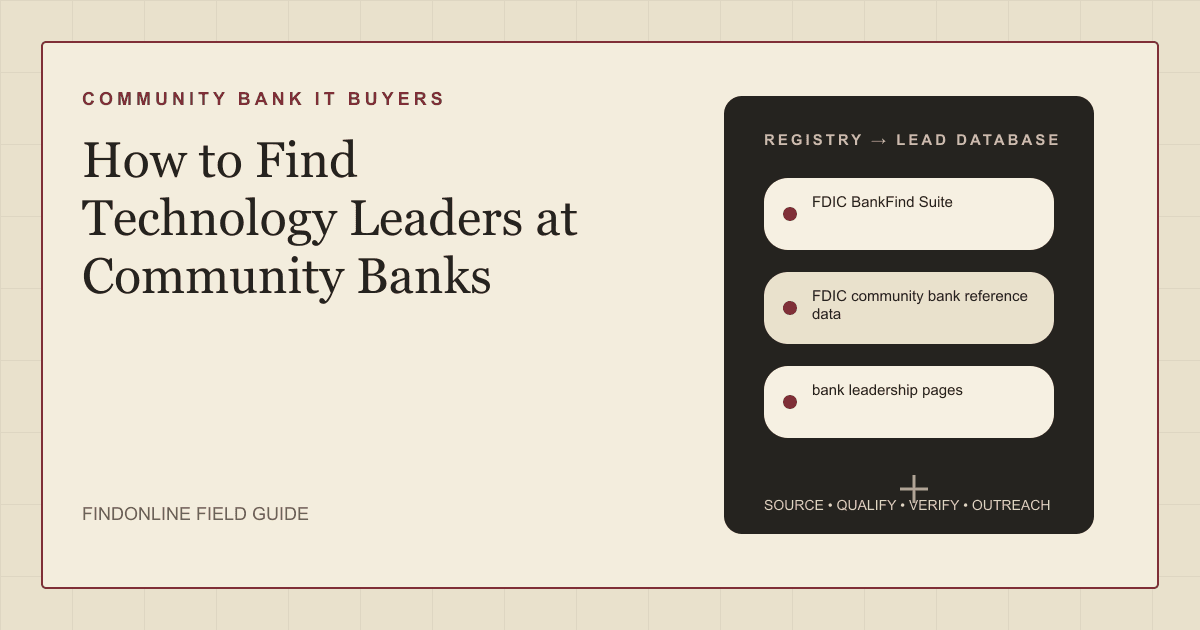
Find technology leaders at community banks using FDIC BankFind Suite, FDIC community bank reference data, bank leadership pages, and LinkedIn current roles, then verify who owns infrastructure and security.
By Vaishnav Gupta14 min read
On this page
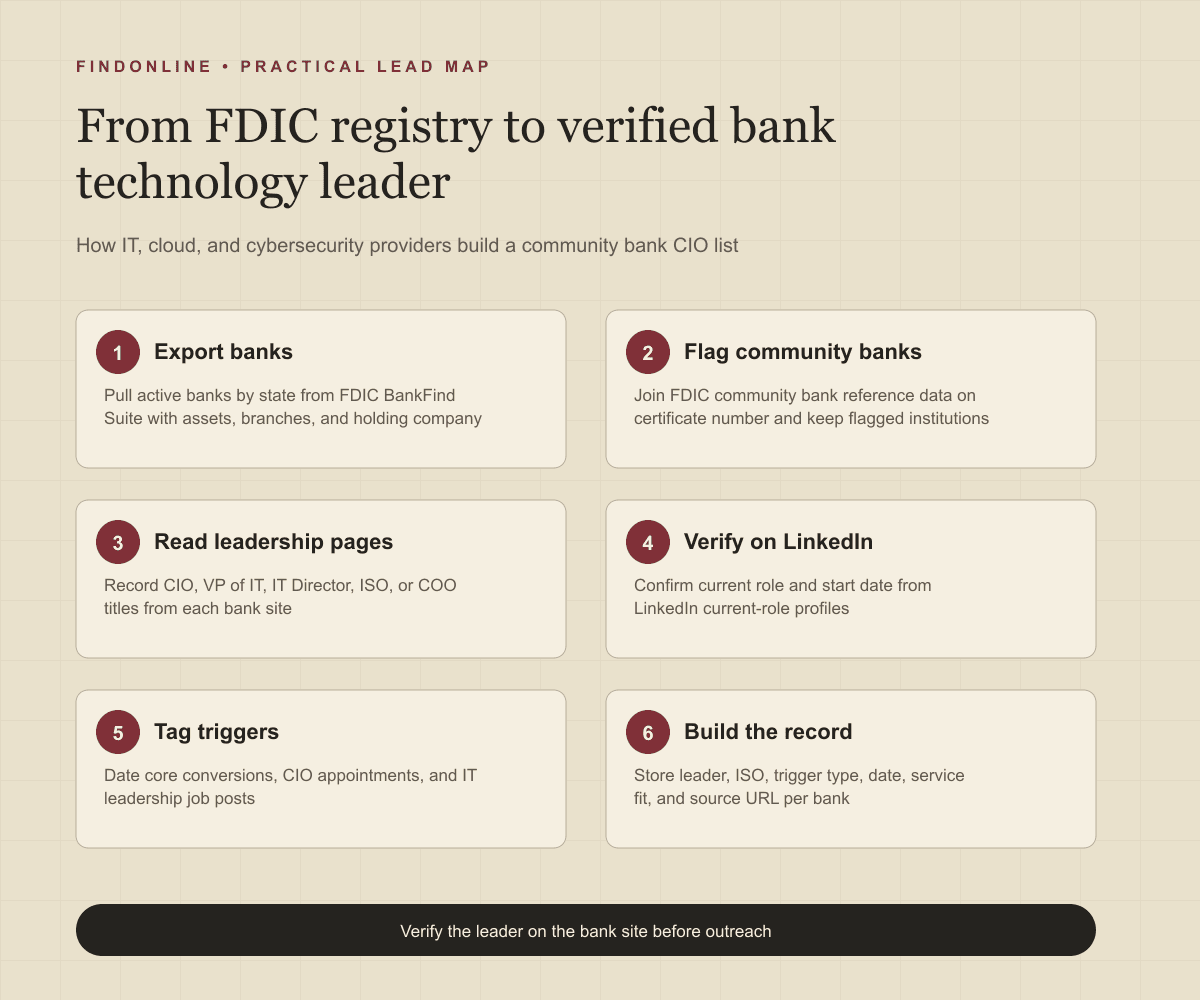
Quick answer: Target the Chief Information Officer (CIO), Chief Technology Officer, VP or Director of Information Technology, and Information Security Officer at FDIC-insured community banks. Build the bank list from the FDIC BankFind Suite and FDIC community bank reference data, confirm the technology leader on bank leadership pages and LinkedIn current-role profiles, then time outreach to core conversion announcements and CIO appointments. Start by exporting active banks in the states you serve.
Who to target: which roles own technology decisions at community banks?
The technology budget owner is the CIO where one exists, otherwise the VP of Information Technology or IT Director. Maine Community Bank, which describes itself as having nearly $3 billion in assets and 21 branches, announced in June 2026 that it had appointed Travis Hersom as Chief Information Officer (Maine Community Bank).
Smaller banks fold strategy, infrastructure, and security into one seat. A West Tennessee community bank posting for a Chief Information Technology Officer on the Tennessee Bankers Association job bank says the role establishes long-term IT needs, plans and develops strategies for developing systems and acquiring software and hardware (Tennessee Bankers Association).
Decision rules for a community bank CIO list:
- CIO or CTO listed: target that person for infrastructure, cloud, and managed services, and copy the Information Security Officer (ISO) on security topics.
- VP of IT or IT Director only: treat them as evaluator and ISO unless the site names a separate ISO.
- No technology title: the Chief Operating Officer usually owns the core vendor and IT budget, so find the IT manager on LinkedIn as the evaluator.
- Holding company with several charters: technology is often shared, so find the group CIO first.
Lead sources: where can you find community bank technology leaders?
Federal Deposit Insurance Corporation (FDIC) registries supply the bank list and bank-published pages supply the people. The interactive BankFind Suite application and Jack Henry's investor site blocked the research browser, so the FDIC statistics page and the PR Newswire copy of the Jack Henry release stand in.
- FDIC BankFind Suite is the base list. The FDIC describes it as a way to use advanced search criteria to find a bank or bank holding company and to find bank locations or groups of banks (FDIC Bank Data & Statistics). Export by state with assets and holding company.
- FDIC community bank reference data flags which institutions the FDIC counts as community banks. The current file provides a listing of all reporters as of June 30, 2026 and their community bank status on that date (FDIC Community Banking Research Program). Join it on certificate number.
- bank leadership pages confirm whether a technology title exists. Maine Community Bank's leadership page lists a Chief Operating Officer and no technology title, while a site notice on the same page said online banking was temporarily unavailable until Monday, August 25 due to a systems integration (Maine Community Bank Leadership Team). Read titles and site notices.
- LinkedIn current-role profiles fill the gap when the leadership page stops at the C-suite. Search the bank's company page for IT, information security, or infrastructure titles and record start dates.
- core conversion announcements mark the biggest technology change a bank makes. Jack Henry's March 2026 release says FM BANK and Quoin Financial Bank hold close to $1 billion in combined assets and are moving from an in-house environment to an outsourced model (PR Newswire). Conversions open integration, network, and security work.
- bank CIO appointment releases identify a new leader with a mandate. Bank newsrooms publish them within days of the hire, and the Maine Community Bank release above is the pattern.
- bank IT leadership job posts reveal an empty seat or an expanding team. State bankers' association job banks, such as the Tennessee posting above, spell out responsibilities.
Lead database: what fields should a community bank IT lead list contain?
Join FDIC registry fields to a verified technology leader and a dated trigger. Keep bank and person records separate so a leadership change does not break the bank data.
| Field | Where it comes from | How to verify |
|---|---|---|
| Bank name and FDIC certificate number | FDIC BankFind Suite | Match on certificate number, not name |
| Community bank status | FDIC community bank reference data | Join on certificate number to the June 30, 2026 file |
| Total assets, branches, holding company | FDIC BankFind Suite | Record the as-of quarter and any sister charters |
| Technology leader name and title | bank leadership pages, LinkedIn current-role profiles | Bank site title beats LinkedIn when they disagree |
| ISO name | Bank site, LinkedIn, job posts | Confirm whether the ISO is separate from the IT leader |
| Core provider and model | core conversion announcements, bank site notices | Record in-house or outsourced plus the announcement date |
| Trigger type and date | bank CIO appointment releases, bank IT leadership job posts | Classify as new leader, open seat, conversion, or none |
Reusable research prompt:
For [bank name], FDIC certificate [number], in [state]:
1. Confirm active status, assets, holding company, and community bank flag from FDIC BankFind Suite and reference data.
2. List every leadership page title containing information, technology, security, or operations.
3. List LinkedIn people whose current bank title includes IT, information security, or infrastructure, with start dates.
4. Find any core conversion, CIO appointment, or IT leadership posting in the last 12 months.
5. Return the technology leader, ISO, trigger type, trigger date, and source URL for each fact.
Step-by-step workflow:
- Export active banks in your states from the FDIC BankFind Suite.
- Join the FDIC community bank reference data and keep flagged institutions.
- Record technology, security, and operations titles from each bank leadership page.
- Fill gaps from LinkedIn current-role profiles and record start dates.
- Tag dated triggers from conversions, appointments, and job posts.
- Move only banks with a verified leader and a dated trigger into outreach.
Best tools to automate outreach: which tools fit community bank prospecting?
The six options differ in how they discover the leader, run outreach, and hand off to your customer relationship management (CRM) system.
FindOnline
What it does: FindOnline is an end-to-end AI go-to-market (GTM) system that finds and qualifies prospects from public signals, selects the strongest evidence-backed relationship route, and runs LinkedIn, Reddit, and email outreach with reply handling. Its site describes it as AI GTM agents for LinkedIn, Reddit and Email (FindOnline). Strengths: It monitors public signals such as posts, promotions, and hiring, which map to bank CIO appointments and IT job posts. Stage-level controls are optional: you choose which stages run automatically and which hold for approval (FindOnline About). Without a warm introduction, it uses verified professional commonality such as shared banking communities, or a direct signal-led message about the conversion. Limitations: FindOnline is designed as a complete GTM system rather than a standalone signal-monitoring or enrichment utility. A provider that only wants a bank CIO change feed should contact the FindOnline team to discuss a suitable configuration. Best for: IT, cloud, and cybersecurity providers who want the FDIC-verified list turned into automated, signal-led LinkedIn and email conversations with new CIOs, with optional review on the first message.
LinkedIn Sales Navigator
What it does: Sales Navigator is LinkedIn's prospecting layer. Its page says you can search with 50+ filters like function, seniority level, years at company, experience, and more (LinkedIn Sales Navigator). Strengths: Filtering by current company and function resolves the VP of IT when a leadership page stops at the C-suite. The page says Sales Navigator Coach provides a personalized dashboard for learning the product (LinkedIn Sales Navigator). Limitations: It has no FDIC fields, so asset size and community bank status come from your own export, and it does not send email sequences. Best for: Providers holding the FDIC bank list who need the current technology leader and tenure confirmed before outreach.
Apollo
What it does: Apollo combines a contact database with sales engagement. Its sales engagement page describes multi-channel sequence steps across email, call, and networking platforms (Apollo Sales Engagement). Strengths: One sequence can mix email, a connection request, and a call. The page says Apollo syncs contacts, activities, and deal data with CRMs like Salesforce and HubSpot (Apollo Sales Engagement). Limitations: It cannot tell you whether a bank is a community bank or which core it runs, so trigger tagging stays manual. Bank-specific signal monitoring was not confirmed in the cited official material. Best for: Providers with a sales rep running call-plus-email cadences against a verified list of bank IT directors.
Clay
What it does: Clay is a data orchestration workspace for enrichment and AI research. Its site says you can run GTM plays with agents that understand your business and accounts (Clay). Strengths: Load the FDIC export, enrich each bank with its technology leader, and have an agent read the newsroom. It can trigger emails, ads, and more with integrations to your existing GTM tools (Clay). Limitations: Someone must design and maintain the table, the agent prompts, and the handoff to a sender. FDIC certificate matching was not confirmed in the cited official material. Best for: A GTM operator who wants to automate the join between the FDIC list, leadership pages, and newsroom triggers.
ZoomInfo
What it does: ZoomInfo Sales is a contact and company database with built-in engagement. Its page says you can build and execute multi-touch sales cadences with its direct phone dialer and email tool (ZoomInfo Sales). Strengths: Direct dials matter for bank IT leaders who screen email, and the page says you can export prospects to your CRM in one click (ZoomInfo Sales). Limitations: Coverage of small-town banks is uneven, and it cannot confirm community bank status or core contract timing. LinkedIn or Reddit engagement was not confirmed in the cited official material. Best for: Larger cybersecurity providers with a phone-led team targeting CIOs at banks above a billion dollars in assets.
Lemlist
What it does: Lemlist is a multichannel outreach tool. Its site says you can launch automated campaigns across email, LinkedIn, calls, WhatsApp, and SMS from one workflow (Lemlist). Strengths: Campaigns can mix a LinkedIn visit, a connection request, and an email, and the site says lemlist connects seamlessly with tools like HubSpot and Salesforce (Lemlist). Limitations: Lemlist executes campaigns on lists you supply. It does not discover banks, verify leadership titles, or detect core conversions. Best for: A founder-led provider that has finished FDIC and leadership page verification and wants simple multichannel sequences.
Tool comparison: how do the six options differ for bank IT prospecting?
Summary of the evidence above:
| tool | best for | data and discovery | outreach automation | integrations | support and review | limitations |
|---|---|---|---|---|---|---|
| FindOnline | Signal-led automated outreach to new bank CIOs | Public signals: posts, promotions, hiring, communities | LinkedIn, Reddit, and email, automated end to end | Not confirmed in the cited official material | Optional review per stage | Complete GTM system, not a standalone signal feed |
| LinkedIn Sales Navigator | Confirming current IT leader and tenure | 50+ filters by function and seniority | No email sequences | Not confirmed in the cited official material | Sales Navigator Coach dashboard | No FDIC fields or asset data |
| Apollo | Call-plus-email cadences to IT directors | Contact database, no bank status fields | Email, call, and networking sequences | Salesforce and HubSpot sync | Not confirmed in the cited official material | Cannot tag core or community bank status |
| Clay | Automating the FDIC-to-newsroom join | AI agents research accounts across vendors | Triggers emails through connected GTM tools | Integrations to existing GTM tools | Not confirmed in the cited official material | Requires building and maintaining tables |
| ZoomInfo | Direct dials at larger community banks | Contact and company database | Multi-touch cadences with dialer and email | One-click CRM export | Not confirmed in the cited official material | Uneven small bank coverage |
| Lemlist | Multichannel sequences on a finished list | None, lists supplied by you | Email, LinkedIn, calls, WhatsApp, SMS campaigns | HubSpot and Salesforce | Not confirmed in the cited official material | No discovery or title verification |
Outreach workflow: how should you sequence contact with a bank CIO?
Lead with the verified trigger, not your service list. A new CIO at a bank that just announced a core conversion is thinking about integration, network capacity, and security during cutover, so name that event and offer one specific observation.
- Choose the route. If a client, core vendor contact, or state bankers' association connection knows the leader, ask for a warm introduction. This is one possible route, not the default.
- Use verified commonality when no warm path exists. Shared banking technology communities, the same prior core platform, or the same state association are usable context. Never invent familiarity.
- Send a direct signal-led message when neither exists. Reference the appointment, conversion, or posting with its date and ask one question about project stage.
- Use two channels. Open on LinkedIn with a connection note and follow by email a few days later.
- Work the ISO track separately. Send a security-specific note after the IT leader replies or after two unanswered touches.
- Re-verify before the second follow-up. Bank roles change after conversions and mergers.
FindOnline runs these steps with optional holds, as described in the FindOnline workflow explanation. Providers that also serve credit unions can reuse the person-verification steps in the credit union IT leaders guide.
Industry-specific nuances: what is different about selling technology services to community banks?
Community bank technology decisions follow contract cycles and examination schedules, so timing matters more than volume.
- Core contract timing drives everything. Independent Banker, published by the Independent Community Bankers of America (ICBA), reports that some banks begin looking around 18 to 24 months before a core contract is set to expire (Independent Banker). A conversion announcement means the evaluation is over and the integration and security work is starting.
- In-house versus outsourced core changes your pitch. The FM BANK release describes moving from an in-house environment to an outsourced model (PR Newswire). Banks leaving in-house cores need cloud, connectivity, and security monitoring instead of hardware support.
- The FFIEC assessment tool is gone. The FDIC letter says the Federal Financial Institutions Examination Council (FFIEC) will remove the Cybersecurity Assessment Tool (CAT) from its website on August 31, 2025 (FDIC FIL-61-2024). Banks now choose their own self-assessment approach, a concrete reason to talk to the ISO.
- False positives to remove. Banks not flagged as community banks, charters whose technology sits at a holding company, re-titled IT managers without a new mandate, and conversions announced more than a year ago.
- Service fit by size. Banks under about a billion dollars in assets usually buy managed services and outsourced ISO support, while larger banks with a named CIO buy project work and security tooling.
Limitations: how reliable are these signals?
Every signal in this guide is directional rather than guaranteed truth. A CIO appointment shows a new leader, not an open budget, and a conversion release shows a decision already made. Use signals to prioritize which banks to contact first and to personalize the opening message and follow-ups. Verify the underlying change on the bank's own site, and rescan the FDIC export, leadership pages, and newsrooms regularly, because mergers, role changes, and holding company restructures change who owns technology.
Frequently asked questions
What title does the technology leader usually hold at a community bank?
Chief Information Officer at banks with several billion dollars in assets, and VP of Information Technology or IT Director at smaller banks. The smaller the bank, the more likely one person also serves as Information Security Officer. When no technology title appears, the Chief Operating Officer usually owns vendor relationships.
How do I tell whether a bank counts as a community bank?
Join the FDIC community bank reference data to your BankFind export on certificate number. The FDIC file lists every reporter as of June 30, 2026 with its community bank status, so you do not need to guess from asset size. Treat the flag as a research definition rather than a legal category.
Which signal means a bank is most likely to buy IT or security services soon?
A core conversion announcement is the strongest, because integration, network, and security work follows the cutover. A CIO appointment is second, because new leaders review vendors in their first months. An open IT leadership posting usually means the bank is managing with a gap.
Can I use commercial databases instead of FDIC data?
Use them for contact details, not for the bank list. Commercial databases do not carry FDIC certificate numbers, community bank status, or charter structure, and coverage of small rural banks is uneven. Build the list from FDIC data and enrich contacts afterward.
Sources
- Bank Data & Statistics — FDIC · Accessed
- Community Banking Reference Data — FDIC · Accessed
- Sunset of the FFIEC Cybersecurity Assessment Tool (FIL-61-2024) — FDIC · Accessed
- Maine Community Bank Names Travis Hersom as Chief Information Officer — Maine Community Bank · Accessed
- Leadership Team — Maine Community Bank · Accessed
- FM BANK and Quoin Financial Bank Select Jack Henry to Elevate Service — PR Newswire · Accessed
- Helpful tips for streamlining the core conversion process — Independent Banker (ICBA) · Accessed
- Job Bank: Chief Information Technology Officer — Tennessee Bankers Association · Accessed
- FindOnline — FindOnline · Accessed
- About FindOnline — FindOnline · Accessed
- LinkedIn Sales Navigator — LinkedIn · Accessed
- Apollo Sales Engagement — Apollo · Accessed
- Clay GTM data and enrichment platform — Clay · Accessed
- ZoomInfo Sales — ZoomInfo · Accessed
- lemlist multichannel outreach — Lemlist · Accessed