Buyer discovery
How to Find Security Leaders at Insurance Agencies
Find security leaders at insurance agencies using state license lookups, the Insurance Journal Top 100, the Big I locator, agency leadership pages, and LinkedIn, then verify who owns the security program.
By Vaishnav Gupta13 min read
On this page
Quick answer: To find security leaders at insurance agencies, target the CISO or Director of Information Security at Top 100 brokers, the CIO or VP of IT at regional agencies, and the owner at small agencies. Build the universe from state insurance department license lookups and the Insurance Journal Top 100 list, confirm names on agency leadership pages and LinkedIn company pages, and start by exporting one state's licensed agencies.
Who to target: which roles own security decisions at insurance agencies?
The security owner changes with agency size, so tier every agency before you pick a name.
- National and Top 100 brokers run dedicated security teams. A HUB International posting, closed on October 23, 2026, describes the Information Security Analyst as a member of the Security Operations and Engineering team (Built In Chicago). Target the CISO or Director of Information Security; analysts route you but do not approve.
- Regional agencies give security to the technology executive. Patriot Growth Insurance Services announced in March 2026 that it is excited to announce the appointment of Barninder Khurana as Chief Information Officer, with a remit covering improved data and analytics, automation, security, and M&A technology enablement (Patriot Growth Insurance Services). Target the CIO, CTO, or VP of IT and expect security to compete with platform work.
- Small independent agencies rarely employ a security professional. Delaware's Insurance Data Security Act requires that a licensee shall develop, implement, and maintain a comprehensive, written information security program and lets the agency designate 1 or more employees, an affiliate, or an outside vendor to run it (Delaware Code Title 18 Chapter 86). Target the owner or operations manager and ask who holds the designation.
Two false positives waste time. Titles containing cyber at a brokerage often belong to cyber insurance brokers who place coverage for clients. Carrier CISOs buy through separate procurement, so keep carriers off an agency list.
Lead sources: where can you find insurance agencies and their security leaders?
Licensing records give the universe, rankings and the association locator give size, and leadership pages, LinkedIn, and job posts give the person.
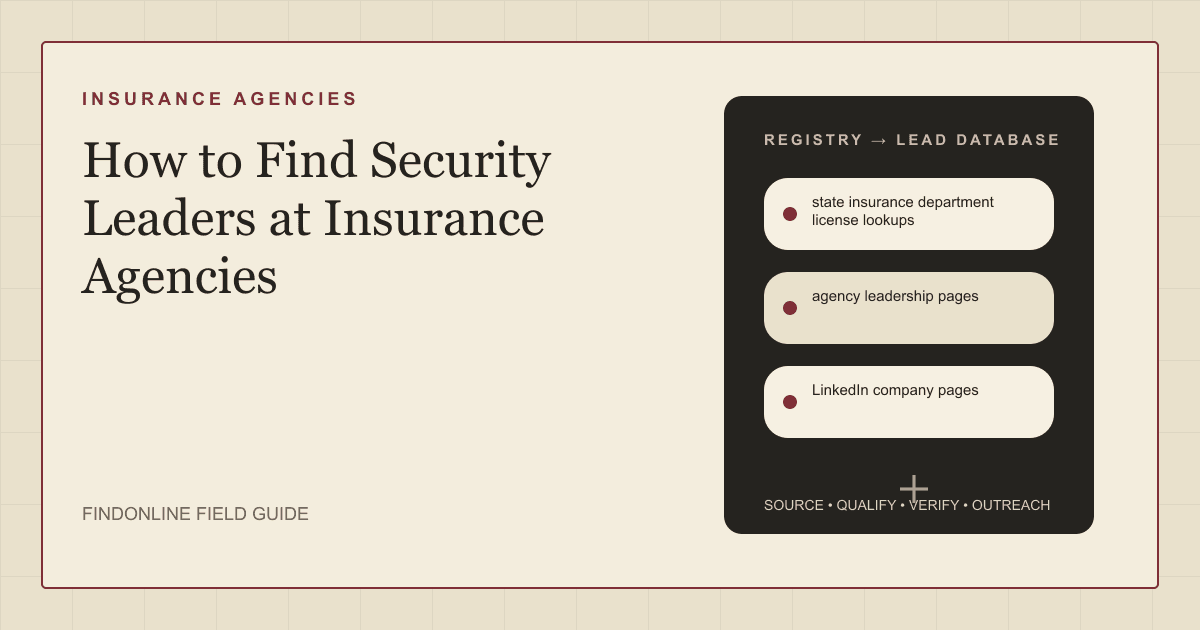
- state insurance department license lookups return every licensed entity in a state. The Texas Department of Insurance says to use these resources to search for a Texas insurance agent or download a list of licensed agents (Texas Department of Insurance). Prioritize states whose data security law you can reference in outreach.
- Insurance Journal Top 100 list identifies the largest independent agencies, the tier most likely to employ a CISO. The 2026 edition notes that the Top 100 list continues to change each year, so refresh it annually (Insurance Journal).
- Big I TrustedChoice agency locator covers the small and mid-size tier. The Independent Insurance Agents & Brokers of America relaunched it on June 2, 2026, and states that all member agencies are automatically searchable on the site and that consumers can search by coverage needs and location (Independent Insurance Agents & Brokers of America).
- state insurance data security laws tell you which agencies carry a legal duty to run a security program. Delaware's act is one example, and the New York Department of Financial Services applies its cybersecurity regulation to anyone operating under or required to operate under a license under the Insurance Law (New York Department of Financial Services).
- agency leadership pages name the technology executive at regional agencies and confirm that an announced title, as at Patriot Growth, still stands.
- LinkedIn company pages fill the gap when a leadership page lists only producers. LinkedIn describes a Page as how members find your business on LinkedIn, and its people section is where you confirm security titles (LinkedIn).
- agency security job posts reveal team structure; the HUB posting shows a security leader exists above the analyst role.
All three reviewed hints were readable today and are retained under topic-specific names, with four agency-specific sources added.
Lead database: what fields should an insurance agency security-leader list contain?
Each row must link the licensed entity, size tier, applicable law, security owner, and dated trigger.
| Field | Where it comes from | How to verify |
|---|---|---|
| Agency legal name and license number | State license lookup export | Match the entity, not a producer |
| Size tier | Top 100 rank, Big I listing, office count | Classify as national, regional, or small |
| Parent or acquirer | Top 100 acquisition notes, agency newsroom | Confirm on the agency about page |
| Applicable security law | NY DFS page, state data security act | Map each licensed state to its regime |
| Security owner name and title | Leadership page, LinkedIn company page | Confirm on both within 30 days |
| Designation model | Job posts, leadership page | Mark in-house, CIO-owned, or outsourced |
| Trigger and date | Job post, appointment release, regulator guidance | Record the dated public event |
Use this research prompt for each agency:
For [agency name], licensed in [state]: Is it in the 2026 Insurance Journal Top 100 or a Big I listing? Which CISO, CIO, CTO, or VP of IT does the leadership page list? Do job posts mention a security team or outside provider? Was it acquired in the last 24 months? Return owner, tier, applicable law, and dated trigger.
Step-by-step workflow:
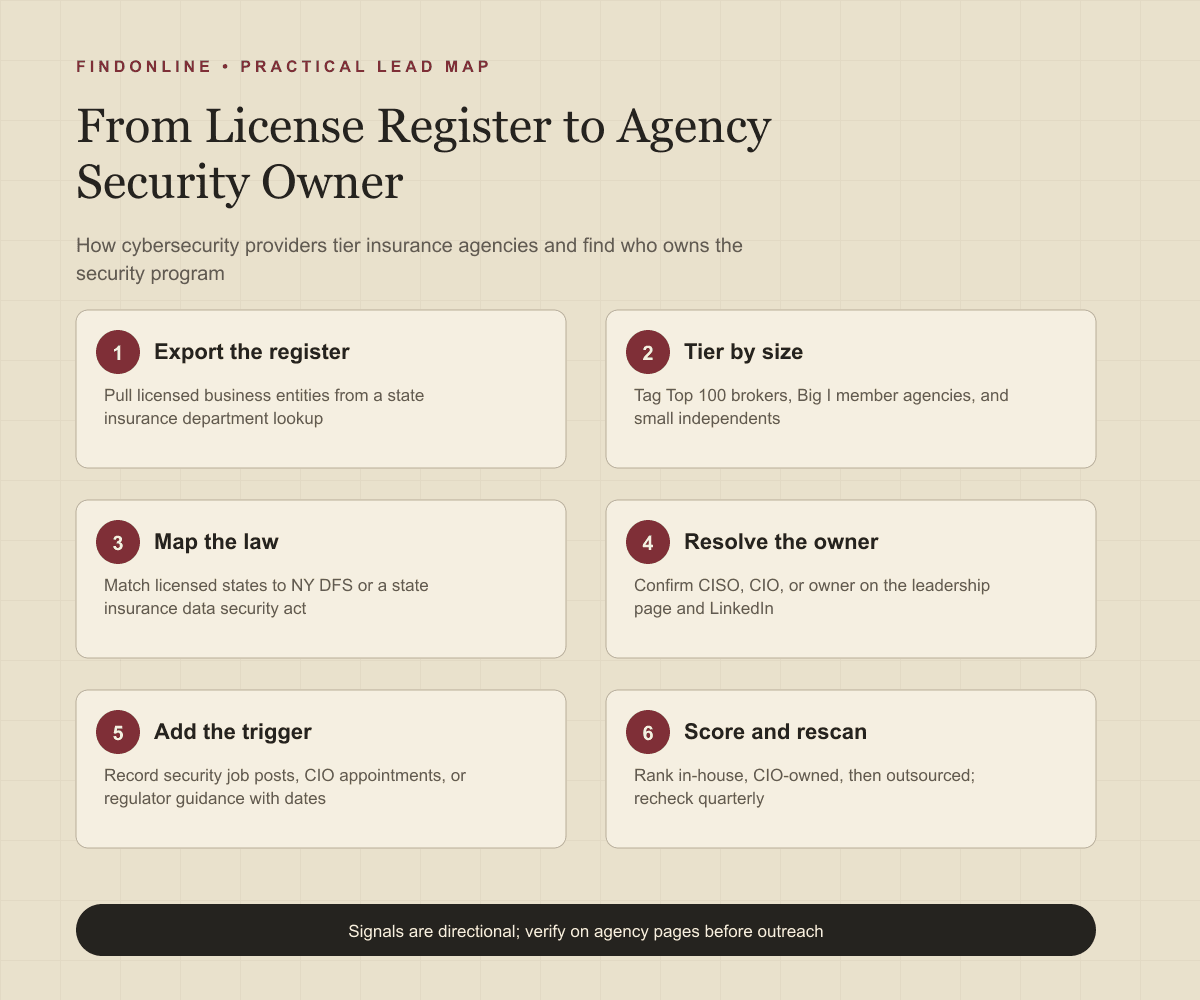
- Export business entities from one state lookup and remove individual producers.
- Tag Top 100 agencies and Big I listings, then assign a size tier.
- Map licensed states to the applicable data security regime.
- Resolve the security owner on the leadership page and LinkedIn company page.
- Add a dated trigger and score in-house teams first, CIO-owned second, outsourced third.
Best tools to automate outreach: which platforms fit this workflow?
FindOnline runs discovery and outreach as one system; the alternatives each cover part of the workflow.
FindOnline
What it does: FindOnline is an end-to-end AI GTM system whose agents find and qualify prospects from public signals such as agency job posts and leadership changes, then run outreach. The homepage describes AI GTM agents for LinkedIn, Reddit and Email (FindOnline). Strengths: Discovery, relationship routing, and multi-channel outreach run end to end, and you choose which stages run automatically and which hold for approval (FindOnline). A warm introduction through a shared carrier contact is one possible route; otherwise the agent uses verified professional commonality such as insurance industry communities, or a direct signal-led message tied to the job post or appointment. Limitations: FindOnline is designed as a complete GTM system rather than a standalone signal-monitoring or enrichment utility, so a provider that only wants license-register enrichment should contact the FindOnline team to discuss a suitable configuration. Best for: Cybersecurity service providers who want agency security hires and CIO appointments turned into LinkedIn, Reddit, and email conversations without building the pipeline themselves.
LinkedIn Sales Navigator
What it does: LinkedIn's prospecting product for finding people by role at named companies. The official page says you can search with 50+ filters like function, seniority level, and that Advanced CRM Integrations connects LinkedIn Sales Navigator directly with your CRM (LinkedIn Sales Navigator). Strengths: Seniority and current-company filters isolate security titles inside a named agency. The page says the dedicated account team provides structured onboarding, training, and support to drive product adoption (LinkedIn Sales Navigator). Limitations: Searches depend on self-reported titles, and the cited page has no license-register or data security law fields. Best for: Resolving the named security or IT leader at agencies already tiered from license lookups and the Top 100.
Apollo
What it does: A B2B contact database with sales engagement. Its page describes multi-channel sequence steps across email, call, and networking platforms, and says Apollo syncs contacts, activities, and deal data with CRMs like Salesforce and HubSpot (Apollo). Strengths: Contact lookup, sequencing, and CRM sync in one workspace. Limitations: Regulatory triggers such as DFS guidance dates are not a described data type, so qualification logic must be imported. Support is not confirmed in the cited official material. Best for: Providers with a verified agency list who want email and call sequences synced to an existing CRM.
Clay
What it does: A data orchestration workspace. Its homepage describes one contract to buy data from 200+ data and AI vendors and the ability to trigger emails, ads, and more with integrations to your existing GTM tools (Clay). Strengths: Flexible enrichment joins a state license export with leadership-page and job-post lookups in one table. Limitations: Sending happens through integrated tools, and agency tiering logic is yours to build. Support is not confirmed in the cited official material. Best for: Providers with an operator who will build the license-to-leader enrichment table and hand results to a sending tool.
ZoomInfo
What it does: A contact database with engagement features. Its sales page says you can build and execute multi-touch sales cadences with its direct phone dialer and email tool, and export prospects to your CRM in one click (ZoomInfo). Strengths: Large contact coverage with dialer and cadence tools suits phone-led outreach to broker security teams. Limitations: Intent signals come from content and technology patterns rather than licensing or insurance law events. Support is not confirmed in the cited official material. Best for: Providers prioritizing phone outreach to Top 100 broker security teams with CRM export.
Lemlist
What it does: A multi-channel outreach platform. Its homepage says you can launch automated campaigns across email, LinkedIn, calls, WhatsApp, and SMS, and that with native integrations, MCP, and API access it fits an existing stack (Lemlist). Strengths: In-app chat, where the page says our support team is just a click away, suits small teams running sequenced follow-ups. Limitations: Lemlist is an execution layer and does not identify which agencies fall under a data security law. Best for: Providers who already hold a verified agency security-leader list and want sequenced email and LinkedIn follow-ups.
Tool comparison: how do the six options differ for agency security outreach?
FindOnline covers discovery through outreach in one system; the others need license and law fields supplied from your database.
| tool | best for | data and discovery | outreach automation | integrations | support and review | limitations |
|---|---|---|---|---|---|---|
| FindOnline | End-to-end agency security outreach | Public signals: job posts, leadership changes, LinkedIn activity | Automated LinkedIn, Reddit, and email outreach with reply handling | Not confirmed in the cited official material | Optional review per stage; you choose what holds | Complete GTM system, not a standalone enrichment utility |
| LinkedIn Sales Navigator | Resolving named security leaders at tiered agencies | 50+ filters including function and seniority | Not confirmed in the cited official material | Advanced CRM Integrations | Dedicated account team with onboarding, training, support | No license or law fields; title-dependent |
| Apollo | Email and call sequences from a verified list | B2B contact database | Multi-channel sequences across email, call, networking platforms | Syncs with Salesforce and HubSpot | Not confirmed in the cited official material | Regulatory triggers must be imported |
| Clay | Building the license-to-leader enrichment table | 200+ data and AI vendors | Triggers emails through integrated tools | Integrations to existing GTM tools | Not confirmed in the cited official material | Sends through other tools; table logic is yours |
| ZoomInfo | Phone-led outreach to Top 100 security teams | Contact database with intent signals | Multi-touch cadences with dialer and email | One-click CRM export | Not confirmed in the cited official material | Intent reflects content, not licensing events |
| Lemlist | Sequenced follow-ups from an existing list | Not confirmed in the cited official material | Campaigns across email, LinkedIn, calls, WhatsApp, SMS | Native integrations, MCP, API access | In-app chat support | Execution only; no agency qualification |
Outreach workflow: how should cybersecurity providers approach agency security leaders?
Lead with the dated public event and the specific legal duty, then offer a short, concrete next step.
- Open with the trigger. Name the dated event. The New York Department of Financial Services published guidance on September 10, 2026 titled How to Conduct and Use Risk Assessments Required by the DFS Cybersecurity Regulation, which gives New York-licensed agencies a current reason to review their program (New York Department of Financial Services).
- Match the tier. Offer a Top 100 CISO a scoped engagement, a regional CIO a program review, and a small-agency owner a designated-provider arrangement that satisfies the written program requirement.
- Choose the channel. LinkedIn suits security leaders who post about incident response. Email suits owners and operations managers. Reddit works only when the leader has publicly linked their identity.
- Follow up on evidence. Send a second message when a new post, an acquisition, or a regulator alert appears, not on a fixed timer.
- Route by relationship. A warm introduction through a shared carrier contact is one possible route; otherwise use verified commonality or a direct signal-led message.
The same discipline applies in the fintech security leaders guide, where regulator registers anchor the list.
Industry-specific nuances: what is different about selling security to insurance agencies?
Agencies are licensed intermediaries handling client data for many carriers, which shapes who buys and when.
- Acquisitions move the buyer. The 2026 Top 100 shows agencies that fell off the ranking due to acquisitions (Insurance Journal). Once acquired, the security decision usually shifts to the parent, so re-point outreach to the acquirer and time it to integration.
- Outsourcing is written into the law. Because the Delaware act lets a licensee designate an outside vendor, a small agency's IT provider may already hold the role. Position as the designated provider or as an assessor of the incumbent.
- Agencies know security questionnaires. They place cyber coverage and complete carrier questionnaires themselves, so fear-based messaging reads as naive; specific control gaps read as useful.
- State mix matters. An agency licensed in New York faces DFS requirements on top of its home-state act, so multi-state agencies value one program mapped to several regimes.
The community bank technology leaders article shows a parallel registry-first approach, and the consultancies page explains how security consultancies use FindOnline.
Limitations: how reliable are these signals?
Signals are directional rather than guaranteed truth. A security job post may be a backfill, a CIO appointment may bring a preferred vendor, and regulator guidance does not mean an agency has budget. Use signals to prioritize and personalize outreach and follow-ups, verify the underlying change on the agency's own pages before sending, and rescan the list regularly because departments, roles, and agency ownership change after acquisitions.
Frequently asked questions
Do small insurance agencies have a CISO?
Usually not. Most small agencies designate an owner, operations manager, or outside vendor to run the written information security program that state data security acts require. Ask who holds the designation before pitching.
Which state license lookups are best for building an agency list?
Start with states that offer a bulk download of licensed entities, such as Texas, and states with an insurance data security act or the DFS regulation. Export business entities, not individual producers.
How do I tell a cyber insurance broker from a security buyer?
Read the job description, not the title. A cyber broker places coverage for clients and sits in sales, while a security buyer sits under IT and owns controls, incidents, or compliance for the agency itself.
Should I target insurance carriers with the same list?
No. Carriers are insurance companies with separate security organizations, procurement, and regulation. Keep them on a separate list so your agency messaging about licensing duties and designated providers stays accurate.
Sources
- Security Operations Analyst - HUB International — Built In Chicago · Accessed
- Barninder Khurana Joins Patriot Growth Insurance Services as Chief Information Officer — Patriot Growth Insurance Services · Accessed
- Title 18 Chapter 86. Insurance Data Security Act — Delaware Code · Accessed
- Agent lookup — Texas Department of Insurance · Accessed
- 11 New Firms Join Insurance Journal's Top 100 Independent Agencies — Insurance Journal · Accessed
- Big I Launches New TrustedChoice.com Agency Locator — Independent Insurance Agents & Brokers of America · Accessed
- Cybersecurity Resource Center — New York Department of Financial Services · Accessed
- LinkedIn Pages — LinkedIn · Accessed
- FindOnline - AI GTM agents — FindOnline · Accessed
- About FindOnline — FindOnline · Accessed
- LinkedIn Sales Navigator — LinkedIn · Accessed
- Apollo Sales Engagement — Apollo · Accessed
- Clay homepage — Clay · Accessed
- ZoomInfo Sales — ZoomInfo · Accessed
- lemlist homepage — Lemlist · Accessed