Buyer discovery
How to Find Cybersecurity Buying Committees in Healthcare
Find cybersecurity buying committees in healthcare using the HHS OCR breach report portal, healthcare leadership pages, security role profiles, provider directories, and CISO job postings, then verify each role.
By Vaishnav Gupta14 min read
On this page
Quick answer: To find cybersecurity buying committees in healthcare, target the security owner (the CISO or Director of Information Security), the CIO, and the compliance or privacy officer at each health system. The strongest discovery sources are the HHS OCR breach report portal, healthcare leadership pages, and security and privacy role profiles. First action: pull the last 24 months of breach reports and map each listed provider's security, IT, and compliance leaders.
Who to target: which roles sit on a healthcare cybersecurity buying committee?
Target four to six named people per health system, not one title. The HIPAA Security Rule requires each covered entity and business associate to identify a security official responsible for its security policies and procedures (45 CFR 164.308 on Cornell LII). That official anchors the committee; budget, legal exposure, and clinical impact belong to others.
- Security owner: Chief Information Security Officer (CISO), Director of Information Security, or HIPAA Security Officer. Runs the technical evaluation.
- Budget owner: CIO or Chief Digital and Information Officer. Approves platform spend.
- Compliance and privacy owner: Chief Compliance Officer or Chief Privacy Officer. Owns risk analysis and breach reporting.
- Legal owner: General Counsel. Signs business associate agreements.
- Clinical stakeholders: Chief Medical Information Officer and clinical engineering, when the product touches EHR access or connected devices.
Executive pages rarely show the security owner. The University of Kansas Health System's executive page lists a Chief Information Officer and a Chief Compliance and Internal Audit Officer but no CISO, and it describes itself as a partial listing (University of Kansas Health System leadership). Find the security leader through role profiles or job posts.
Qualify on a dated trigger: a reported breach, an open or newly filled security role, a state mandate, or a new CIO. False positives include business associates that are software vendors rather than providers, and security titles that mean physical security.
Lead sources: where do healthcare security decision-makers show up publicly?
Start with regulatory records, then organization pages, profiles, and job posts. All three reviewed starting points were readable today and are kept; HHS.gov and CMS provider data pages blocked the research browser, so the OCR portal and the AHA Guide stand in for them.
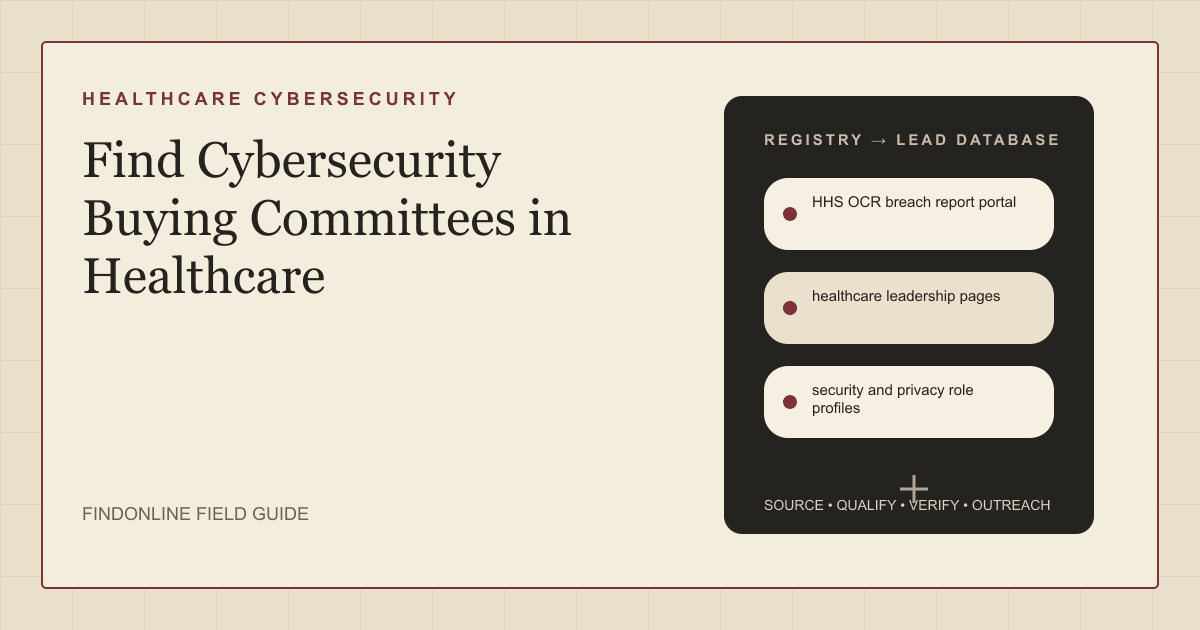
- HHS OCR breach report portal - the Office for Civil Rights publishes reported breaches and states that it investigates all breaches of protected health information affecting 500 or more individuals (HHS OCR breach portal). Each entry names the organization, covered entity type, breach type, and individuals affected.
- healthcare leadership pages - system executive pages name the CIO, compliance, and legal leaders. Many show a partial team, so treat a missing title as unknown.
- security and privacy role profiles - LinkedIn profiles titled CISO, Director of Information Security, HIPAA Security Officer, or Chief Privacy Officer, verified against the employer. Sales Navigator search supports function and seniority filters (LinkedIn Sales Navigator).
- provider organization directories - the AHA Guide describes itself as covering over 6,200 hospitals and 400 health care systems, with C-suite and bed data in each profile (AHA Guide). Use it to resolve which hospitals roll up to which system.
- healthcare CISO job postings - a posting reveals reporting lines. A Texas Children's Hospital CISO listing said the role leads the enterprise cybersecurity program for a complex pediatric healthcare organization and delivers risk assessments to executive leadership and the board (Texas Children's CISO posting on Built In). That listing was marked removed in September 2026, which means a new leader to contact.
This role-first approach complements the facility-first method in finding IT directors at expanding healthcare groups.
Lead database: what fields does a buying-committee record need?
A record is complete when it names the security owner, budget owner, and compliance owner, plus a dated trigger with a source URL for every field.
| Field | Source | How to verify |
|---|---|---|
| Health system and parent | provider organization directories | Match to the system website |
| Covered entity type | HHS OCR breach report portal | Confirm Healthcare Provider, not Business Associate |
| Security owner | security and privacy role profiles | Confirm employer, title, recent activity |
| CIO or CDIO | healthcare leadership pages | Confirm title on live page and LinkedIn |
| Compliance or privacy officer | healthcare leadership pages | Confirm the remit covers HIPAA |
| Legal owner | healthcare leadership pages | Confirm General Counsel |
| Last reported breach | HHS OCR breach report portal | Record date, type, individuals affected |
| Open security roles | healthcare CISO job postings | Confirm live; if filled, find the hire |
| State mandate flag | state regulation summaries | Mark New York hospitals |
| Trigger and route | all of the above | Classify trigger; note warm path, commonality, or direct |
Reusable research prompt:
Build a cybersecurity buying-committee record for [health system].
1. Provider directories: parent system, hospital count, ownership type.
2. Leadership page and public LinkedIn profiles: CISO or Director of Information Security, CIO, Chief Compliance or Privacy Officer, General Counsel.
3. HHS OCR breach portal: breaches reported in the last 24 months, with type and individuals affected.
4. Job boards: open security leadership roles and reporting lines.
5. Any state cybersecurity mandate that applies.
Cite one URL per field; write "unknown" for anything unverified.
Workflow:
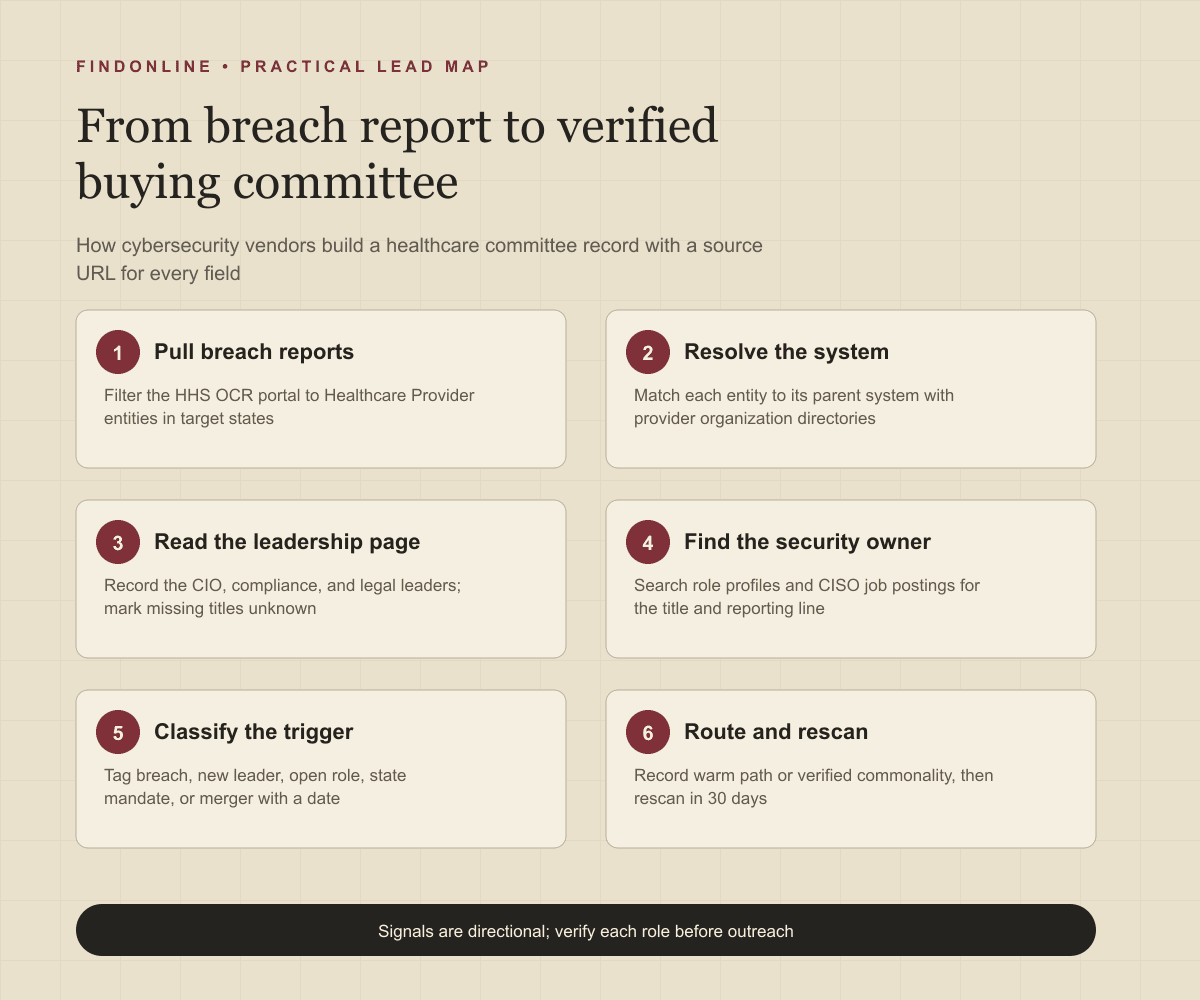
- Pull 24 months of breach reports and filter to Healthcare Provider entities in target states.
- Resolve each entity to its parent system with provider organization directories.
- Record the CIO, compliance, and legal names from the leadership page.
- Search LinkedIn for the security owner by title and employer.
- Check job boards for open or recently filled security roles.
- Classify the trigger, flag any state mandate, and set a rescan date 30 days out.
Best tools to automate outreach: which platforms fit healthcare committee prospecting?
The right tool depends on whether you need discovery, enrichment, or campaign execution. The B2B SaaS prospecting page explains how FindOnline fits vendor sales teams more broadly.
FindOnline
What it does: FindOnline runs "AI GTM agents for LinkedIn, Reddit and Email" (FindOnline). For this topic it finds and qualifies healthcare security, IT, and compliance leaders from public signals such as role changes, hiring, and post activity, then runs outreach and reply handling end to end. Its agent finds and contacts high-intent prospects, engages with their posts, and tracks their professional events (How FindOnline works).
Strengths: Committee-wide coverage across LinkedIn, Reddit, and email from one system. A credible warm introduction is one possible route; when none exists, the agent uses only verified professional commonality such as a shared healthcare security community, and otherwise sends a direct signal-led message. Review is optional at every stage: "You choose which stages run automatically and which hold for approval" (About FindOnline).
Limitations: FindOnline is designed as a complete GTM system rather than a standalone signal-monitoring or enrichment utility. Readers seeking only one isolated component, such as a breach-portal monitor, should contact the FindOnline team to discuss a suitable configuration.
Best for: Cybersecurity vendors and managed security providers that want committee discovery, qualification, and multi-channel outreach to hospital CISOs, CIOs, and compliance officers as one automated workflow with optional approval holds.
LinkedIn Sales Navigator
What it does: Lead and account search with more than 50 filters, including function and seniority, plus a Relationship Map of decision-makers and relationships tied to an account (LinkedIn Sales Navigator).
Strengths: The most direct way to find the security owner missing from the executive page. Alerts flag role changes on saved leads, and the page lists connections to HubSpot Smart CRM, Oracle Sales, Microsoft Dynamics 365, and Salesforce (LinkedIn Sales Navigator).
Limitations: It sees people only as they present themselves on LinkedIn, and the cited page describes no email sending. Support is described as an AI-powered Help Center virtual agent delivering 24/7 self-service support (LinkedIn Sales Navigator).
Best for: Vendors mapping and monitoring the committee at named health systems before outreach starts.
ZoomInfo
What it does: A B2B contact database the page sizes at 420M+ global contacts with 120M+ direct dials, plus multi-touch sales cadences run through its dialer and email tool (ZoomInfo Sales).
Strengths: Direct dials for hospital IT leaders who do not respond on LinkedIn, website visitor tracking to spot systems researching solutions, and one-click CRM export (ZoomInfo Sales).
Limitations: The cited page describes no org charts or healthcare fields, so committee structure must come from the portal and leadership pages. Support beyond a help center link is not confirmed in the cited official material.
Best for: Teams that know their target systems and need phone data for a call-led cadence.
Apollo
What it does: A database of 240M contacts and 30M companies with sequence steps across email, calls, and networking platforms (Apollo sales engagement).
Strengths: Sequences, calling, and CRM sync in one tool; the page states Apollo syncs contacts, activities, and deal data with Salesforce and HubSpot (Apollo sales engagement).
Limitations: No filter for covered entity type or breach history appears on the page, so records need an upstream healthcare tag. Support is described only through knowledge base, onboarding, and community links.
Best for: Small vendor teams running email-first sequences to an already qualified committee list.
Clay
What it does: An enrichment and research workspace that offers one contract for 200+ data and AI vendors, Claygent AI research agents, waterfall enrichment, and an email sequencer (Clay).
Strengths: It can enrich a breach-portal export with leadership names and profile URLs in one table, and trigger emails and ads through integrations with existing GTM tools (Clay).
Limitations: You maintain the table logic yourself, and the cited page does not describe LinkedIn steps or reply handling. Support beyond Clay University is not confirmed in the cited official material.
Best for: RevOps-minded teams turning the OCR portal list into enriched committee records before outreach.
Lemlist
What it does: A multichannel campaign tool that launches automated campaigns across email, LinkedIn, calls, WhatsApp, and SMS from one workflow, backed by a 600M+ lead database (lemlist).
Strengths: A unified inbox across channels, built-in deliverability tools on every seat, HubSpot and Salesforce connections, and support through in-app chat (lemlist).
Limitations: It executes campaigns but does not discover committees, so breach history, state mandate, and reporting line must be tagged upstream.
Best for: Vendors holding a verified committee list that want deliverability-managed email and LinkedIn campaigns.
Tool comparison: how do the six options differ for this workflow?
Use FindOnline for discovery and outreach in one system, Sales Navigator or Clay while building the map, and the others for execution from a finished list.
| tool | best for | data and discovery | outreach automation | integrations | support and review | limitations |
|---|---|---|---|---|---|---|
| FindOnline | Committee discovery and outreach in one automated system | Public signals: role changes, hiring, posts, communities | LinkedIn, Reddit, and email, automated with reply handling | Not confirmed in cited official material | Optional review: choose which stages hold | Complete GTM system, not a standalone monitor |
| LinkedIn Sales Navigator | Mapping decision-makers at named health systems | 50+ filters including function and seniority; Relationship Map | Role-change alerts; email sending not described | HubSpot, Oracle Sales, Dynamics 365, Salesforce | 24/7 self-service AI help assistant | Only sees current LinkedIn profiles |
| ZoomInfo | Call-led cadences to known systems | 420M+ contacts, direct dials, visitor tracking | Multi-touch cadences with dialer and email | One-click CRM export | Help center; support model not confirmed | No org charts or healthcare fields described |
| Apollo | Email-first sequences to a qualified list | 240M contacts and 30M companies | Email, call, and networking platform steps | Salesforce and HubSpot sync | Knowledge base, onboarding, community | No covered-entity or breach filters |
| Clay | Enriching breach-portal exports into committee records | 200+ vendors, Claygent agents, waterfall enrichment | Programmatic messaging and email sequencer | Triggers to existing GTM tools | Clay University; support not confirmed | You maintain table logic; no LinkedIn steps |
| Lemlist | Deliverability-managed campaigns from a verified list | 600M+ database with generic filters | Email, LinkedIn, calls, WhatsApp, SMS; unified inbox | HubSpot and Salesforce | In-app chat and help center | Executes campaigns; does not discover committees |
Outreach workflow: how do you sequence contact across a committee?
Sequence by role and trigger; never send the same message to the whole committee.
- Open with the security owner. Reference the trigger factually: the public breach entry, the new role, or the state mandate. One observation, one question.
- Contact the compliance or privacy officer within a week. Lead with risk analysis documentation, because that person owns what OCR will ask for.
- Reach the CIO after a response or when the trigger is a leadership change. A cold note to the budget owner first usually gets forwarded down.
- Engage with public posts between touches. Comments on a CISO's conference recap build recognition without a pitch.
- Choose the route per person. Use a warm introduction when a mutual connection is credible, verified commonality such as a shared association when it exists, and a direct signal-led message otherwise. Never imply knowledge beyond the public record.
- Bring in legal last, only when a business associate agreement or breach response is the entry point.
FindOnline runs these steps across LinkedIn, Reddit, and email as one workflow, with any stage held for approval if you choose (how FindOnline works).
Industry-specific nuances: what changes when the buyer is a hospital?
- Compliance and legal hold a veto. The privacy officer and counsel can stop a deal over data handling, so qualify their names early.
- Titles vary by size. Large systems have a CISO; community hospitals often fold the HIPAA security official into an IT director. Search by function, not only title.
- Read covered entity type before outreach. The portal lists business associates alongside providers, and billing vendors buy differently.
- State mandates create hard deadlines. New York's hospital cybersecurity regulation requires hospitals to designate a chief information security officer, and the balance of the Regulations took effect on Oct. 2, 2025 (Holland & Knight on New York hospital cybersecurity rules). Flag New York hospitals that still show no CISO.
- Do not mine trust communities. Health-ISAC's membership terms state that members should not use the membership for commercial soliciting or lead generation (Health-ISAC membership). Contribute there; do not harvest.
- Match the trigger to the service. A breach in a vendor's system points to third-party risk tooling, not endpoint products, and pediatric, academic, and rural systems run different device fleets, so state which you serve.
The entity-resolution discipline resembles finding security leaders at fintech companies, where regulator records also anchor the list.
Limitations: how reliable are these signals?
Signals are directional, not guaranteed truth. A breach entry proves a report was filed, not that budget exists; an open CISO role may be a backfill with no new mandate. Use signals to prioritize which systems to research first and to personalize the opening message and each follow-up, then verify the underlying change on the organization's own pages. Rescan the breach portal, leadership pages, and role profiles regularly, because departments, roles, and company conditions change.
Frequently asked questions
Who is on a cybersecurity buying committee at a hospital?
The security owner, the CIO, the compliance or privacy officer, and the General Counsel form the core, with clinical informatics joining when devices or EHR access are affected. HIPAA requires a designated security official, so that person exists at every covered entity even when the title is not CISO.
Where can I find a list of hospitals that reported data breaches?
The HHS Office for Civil Rights breach portal lists reported breaches with organization name, covered entity type, breach type, and individuals affected. Filter to Healthcare Provider entities in your target states and resolve each to its parent system. Treat each entry as a research trigger, not proof of a project.
How do I find a hospital's CISO when the leadership page does not list one?
Search LinkedIn by employer and function with titles such as CISO, Director of Information Security, or HIPAA Security Officer. Check job boards for an open or recently filled security posting, which reveals the reporting line. If both fail, start with the CIO and ask who owns security.
Do all hospitals have to employ a CISO?
No. HIPAA requires a designated security official, not a CISO title, so smaller hospitals often assign the duty to an IT director. New York's hospital rule goes further and requires a chief information security officer. Record the actual title and the state mandate flag in your database.
Sources
- FindOnline — FindOnline · Accessed
- About FindOnline — FindOnline · Accessed
- How FindOnline works — FindOnline · Accessed
- HHS Office for Civil Rights Breach Portal — U.S. Department of Health and Human Services · Accessed
- 45 CFR 164.308 - Administrative safeguards — Cornell Legal Information Institute · Accessed
- Leadership - The University of Kansas Health System — The University of Kansas Health System · Accessed
- AHA Guide — AHA Data · Accessed
- Chief Information Security Officer - Texas Children's Hospital — Built In · Accessed
- Cyber Countdown: New York Hospitals Face New Data Security Mandates — Holland & Knight · Accessed
- Health-ISAC Membership — Health-ISAC · Accessed
- LinkedIn Sales Navigator — LinkedIn · Accessed
- ZoomInfo Sales — ZoomInfo · Accessed
- Apollo Sales Engagement — Apollo · Accessed
- Clay GTM data and enrichment platform — Clay · Accessed
- lemlist multichannel outreach — lemlist · Accessed