Buyer discovery
How to Find Founders of WordPress Plugin Companies
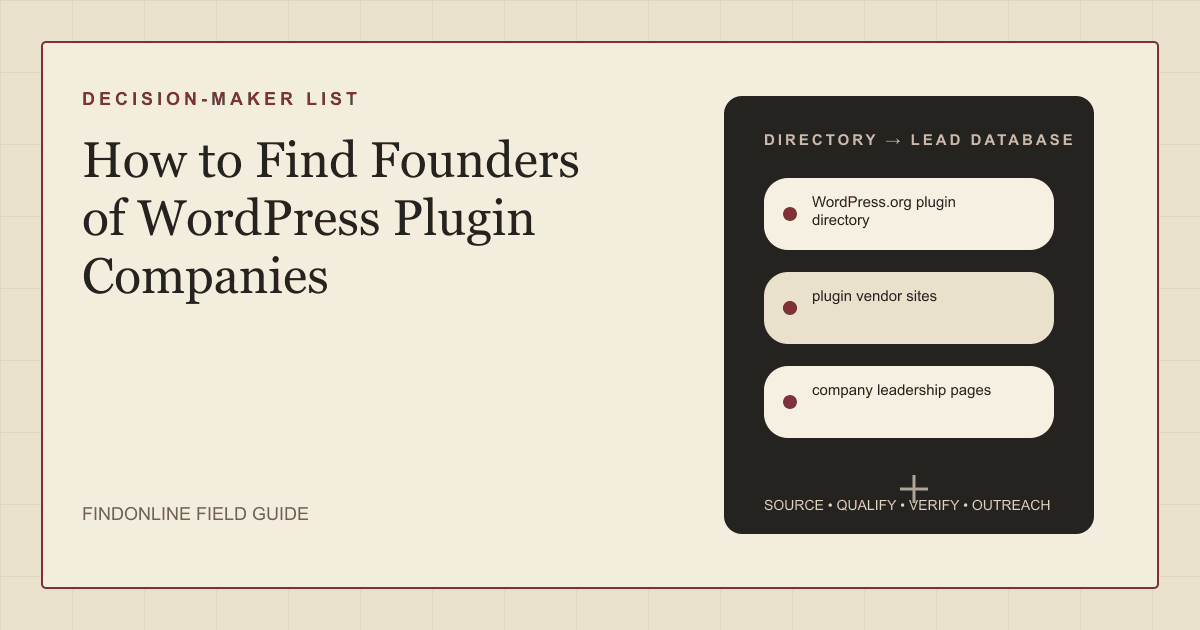
Find founders of WordPress plugin companies using the WordPress.org plugin directory, vendor sites, leadership pages, WordCamp sponsor lists, and acquisition coverage, then verify the founder still runs the vendor.
By Vaishnav Gupta15 min read
On this page
Quick answer: To find founders of WordPress plugin companies, target the founder, co-founder, or CEO named on a plugin's WordPress.org author line and confirmed on the vendor's leadership page. The strongest discovery sources are the WordPress.org plugin directory, plugin vendor sites, company leadership pages, WordCamp sponsor lists, and plugin acquisition coverage. Start by filtering the directory for commercial plugins with large install bases, then confirm who still owns each vendor.
Who to target: which roles own the decision at a plugin company?
Target the founder or co-founder who still runs the vendor, because at most plugin companies that person approves tools, agencies, and partnerships. Larger vendors add a second layer of owners, so confirm team size before choosing a title.
Plugin companies come in three shapes, and the buyer changes with each:
- Founder-run vendors. The founder is usually the plugin author, the CEO, and the buyer. Awesome Motive's about page says "In 2009, our founder & CEO, Syed Balkhi, started a free blog called WPBeginner" and that "over 30 million websites use the software we manage" (Awesome Motive about page). Even at that scale the founder remains the CEO.
- Multi-founder product companies. Elementor's about page presents Yoni Luksenberg and Ariel Klikstein, each titled Co-Founder & CEO, and states "In 2016, they created Elementor to make professional web creation accessible to all." (Elementor about page). Where two founders split product and engineering, pitch the one whose remit matches your service.
- Founded companies with a new leadership layer. Yoast's page says "Yoast was founded in 2010 by Joost de Valk." and "Our team consists of about 110 people." but names no current executives (Yoast about page). A named founder does not mean a founder-run company, so verify the current operator before outreach.
Secondary decision-makers worth recording: a Head of Growth or Marketing at vendors with more than roughly 30 staff, a Head of Partnerships at vendors with integration programs, and a lead developer who influences technical purchases. The same role logic applies when you prospect founders of Shopify app companies.
Lead sources: where do WordPress plugin founders show up publicly?
Five sources cover the three reviewed starting points plus two ecosystem-specific sources that add timing signals. All five were readable today.
- WordPress.org plugin directory is the base list. The directory describes itself as "the largest directory of free and open source WordPress plugins," and each listing shows an author line, an active installation count, and a last-update date (WordPress.org plugin directory). The author line often names a person: WPForms Lite shows "By Syed Balkhi," reports 5+ million active installations, and states "This plugin is the Lite version of WPForms Pro" (WPForms Lite listing). A Lite-to-Pro model is the clearest sign of a company rather than a hobby project.
- plugin vendor sites turn a plugin slug into a company. The directory's guidelines state that "Developers are responsible for the contents and actions of their plugins" and that developers must "ensure their contact information on WordPress.org is up to date and accurate" (WordPress plugin guidelines). Follow the listing's website link to the vendor site, then read the about page for the operating company, founder, and brand portfolio, as the Awesome Motive page does for WPBeginner, OptinMonster, and MonsterInsights.
- company leadership pages confirm who runs the vendor today. Use them to record founder titles, as on Elementor's page, and to flag vendors like Yoast whose page gives team size without naming leaders. Those gaps go to LinkedIn verification in the workflow below.
- WordCamp sponsor lists reveal vendors spending on community marketing. The WordCamp US 2026 sponsor thank-you post, dated July 22, 2026, names "Our Admin Level sponsors, Bluehost, Elementor, Jetpack, and Woo," and lists Yoast among Editor Level sponsors (WordCamp US 2026 sponsors). Separate plugin vendors from hosts and platforms, which dominate these lists.
- plugin acquisition coverage tells you when a founder stops being the buyer. WP Tavern reported on March 1, 2024 that "Katie Keith, CEO of Barn2, announced that Kestrel has acquired seven plugins from her company" (WP Tavern acquisition report). Use this coverage to remove sold plugins from a founder list and to add acquirers, which are often new ventures with fresh budgets.
Lead database: which fields make a plugin founder list usable?
A usable list links each plugin to a legal vendor, a verified operator, and a timing signal. Build one row per vendor, not per plugin, because large vendors publish many plugins under one author.
| Field | Where it comes from | How to verify |
|---|---|---|
| Plugin slugs owned | WordPress.org plugin directory author page | Open each listing and confirm the author line matches |
| Active installations | Directory listing | Record the banded figure and the capture date |
| Commercial model | Listing text such as Lite version of a Pro plugin | Confirm a paid tier on the vendor site |
| Last updated | Directory listing | Treat updates older than a year as inactive |
| Operating company | plugin vendor sites | Match brand to legal entity on about or terms pages |
| Founder or CEO | company leadership pages | Confirm current title on the LinkedIn profile |
| Founder still operating | plugin acquisition coverage | Search vendor and plugin names for sale announcements |
| Team size | Vendor about page | Cross-check the LinkedIn employee count |
| Community spend | WordCamp sponsor lists | Record event, year, and sponsor tier |
| Hiring signal | Vendor careers page | Note growth, marketing, support, or partnership roles |
| Preferred channel | LinkedIn activity, email on vendor site | Choose the channel the founder uses publicly |
Reusable research prompt for one vendor:
Vendor: [vendor name]. Plugins: [slugs]. Using the WordPress.org listings, the vendor about page, the leadership page, acquisition coverage, and LinkedIn: 1) name the operating company; 2) name the founder and current CEO with a source URL; 3) state whether any plugin was sold or acquired since [year]; 4) list active installs and commercial model per plugin; 5) list open growth, marketing, partnership, or support roles; 6) note any WordCamp sponsorship in [year]. Mark unknowns as unverified.
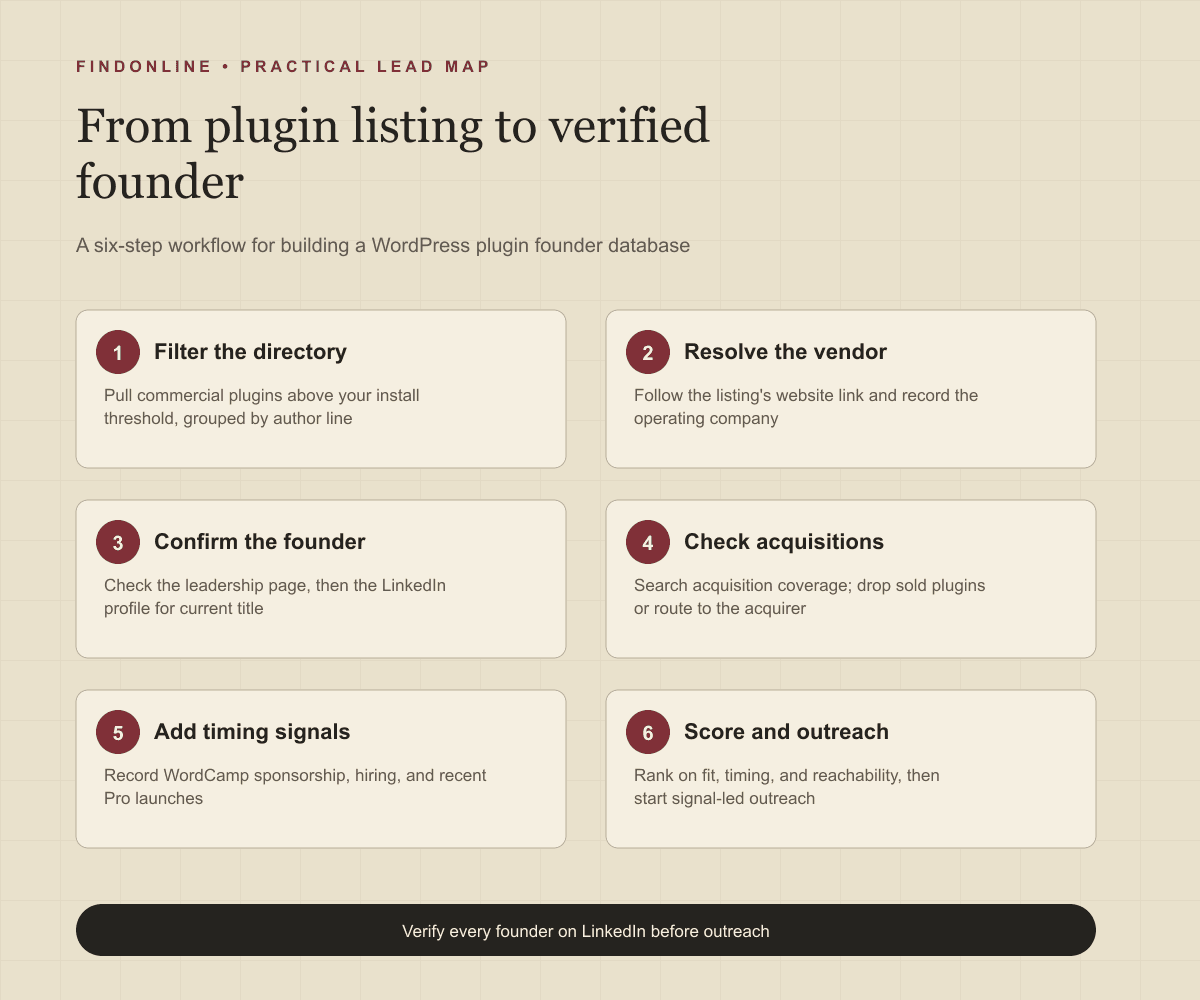
Step-by-step workflow:
- Pull commercial plugins above your install threshold from the directory, grouped by author.
- Open the listing's website link and record the operating company from the vendor site.
- Confirm the founder on the leadership page, then on LinkedIn for the current title.
- Search acquisition coverage for the vendor and each plugin; drop sold plugins or re-route to the acquirer.
- Add WordCamp sponsorship, hiring, and recent Pro launches as timing signals.
- Score each vendor on fit, timing, and reachability, then move the top tier into outreach.
Best tools to automate outreach: which platforms fit plugin founder prospecting?
Six options cover the workflow: one end-to-end system, a LinkedIn-native prospecting tool, three data and sequencing platforms, and a multichannel campaign tool. Crunchbase was shortlisted for acquisition tracking, but its official help pages blocked retrieval today, so Lemlist stands in as the fifth alternative.
FindOnline
What it does: FindOnline is an end-to-end AI GTM system that discovers plugin founders from public signals and runs outreach across channels; its homepage describes "AI GTM agents for LinkedIn, Reddit and Email." (FindOnline). The about page states "You choose which stages run automatically and which hold for approval," so review is optional and set per stage (FindOnline about). Strengths: Discovery, relationship routing, outreach, and reply handling run in one system; the homepage says the agent "spots buying signals like hiring, promotions and funding" (FindOnline), which matches vendor hiring and acquisition triggers. When no credible introduction exists, agents "use verified professional common ground or a direct business signal" (FindOnline about), so a WordCamp connection is used only when verified. Limitations: Designed as a complete GTM system rather than a standalone signal-monitoring or enrichment utility; teams seeking only one isolated component should contact the FindOnline team to discuss a suitable configuration. Best for: GTM teams and service providers who want plugin founder discovery, qualification, and LinkedIn, Reddit, and email follow-up to run end to end, with optional review on drafts.
LinkedIn Sales Navigator
What it does: LinkedIn's prospecting tool for finding and tracking people; the official page says you can "Search with 50+ filters like function, seniority level, years at company, experience, and more." (LinkedIn Sales Navigator). Strengths: Fastest way to confirm a founder's current title and tenure at the vendor and to set alerts on role changes; Success Plans "provides structured onboarding, training, and support to drive product adoption" (LinkedIn Sales Navigator). Limitations: Searches by people attributes, not plugin attributes, so install counts, commercial status, and acquisition history must come from the directory first. CRM integration is described on the page, but specific CRMs are not confirmed in the cited official material. Best for: GTM teams verifying founders and tracking title changes at vendors already identified in the directory.
Apollo
What it does: A contact database and sales engagement platform offering "Multi-channel sequence steps across email, call, and networking platforms" (Apollo sales engagement). Strengths: Sequences and CRM sync in one place; the page says Apollo "syncs contacts, activities, and deal data with CRMs like Salesforce and HubSpot" (Apollo sales engagement). Limitations: Sequencing starts from contacts you load; the cited page describes no directory or open-source signals, so plugin-specific qualification happens outside Apollo. Support details are not confirmed in the cited official material. Best for: Teams with a verified founder list who want email-led sequences with call steps synced to Salesforce or HubSpot.
Clay
What it does: A data enrichment workspace; the official page describes "One contract to buy data from 200+ data and AI vendors" (Clay). Strengths: Flexible tables for enriching directory exports with founder emails and company data, and you can "Trigger emails, ads, and more with integrations to your existing GTM tools" (Clay). Limitations: Outreach runs through connected tools rather than natively, and every table, enrichment chain, and trigger must be built and maintained by an operator. Support details are not confirmed in the cited official material. Best for: GTM operators who want to enrich a directory export of plugin vendors and push qualified founders into a sequencing tool.
ZoomInfo
What it does: A B2B data platform that can "Surface companies with high intent scores based on content consumption, technology signals, and behavioral patterns" (ZoomInfo sales). Strengths: Broad company and contact coverage with fast handoff; the page says "Export prospects to your CRM in one click" and describes automated outreach triggered by market signals (ZoomInfo sales). Limitations: Intent scoring is built around content consumption and technology signals, which do not capture directory events such as a Pro launch or a plugin sale. Support is not confirmed in the cited official material. Best for: Sales teams at larger vendors that need company-level coverage and CRM export for a plugin-company segment.
Lemlist
What it does: A campaign tool that lets teams run "automated campaigns across email, LinkedIn, calls, WhatsApp, and SMS" from one workflow, with a built-in lead database and filters (Lemlist). Strengths: Multichannel steps in one place; the page says it "connects seamlessly with tools like HubSpot and Salesforce" and that "our support team is just a click away" through in-app chat (Lemlist). Limitations: No WordPress ecosystem signals, and Reddit is absent from the listed channels, so community-led discovery and founder qualification must happen before the campaign starts. Best for: Agency owners running email-plus-LinkedIn campaigns to a pre-qualified list of plugin founders.
Tool comparison: how do the six options differ for this list?
The table restates the evidence above so each option can be judged on the same dimensions.
| tool | best for | data and discovery | outreach automation | integrations | support and review | limitations |
|---|---|---|---|---|---|---|
| FindOnline | End-to-end plugin founder discovery and outreach with optional review | Public signals such as posts, hiring, promotions, and funding | LinkedIn, Reddit, and email outreach, automated end to end | Not confirmed in the cited official material | Optional review: choose which stages hold for approval | Complete GTM system, not a standalone monitoring or enrichment utility |
| LinkedIn Sales Navigator | Verifying founder titles and tracking role changes | 50+ people filters such as function and seniority | Not confirmed in the cited official material | CRM integration described; specific CRMs not confirmed | Success Plans with onboarding, training, and support | No plugin install, commercial, or acquisition attributes |
| Apollo | Email-led sequences with call steps from a verified list | Contact database loaded into sequences | Multi-channel steps across email, call, and networking platforms | Syncs with CRMs like Salesforce and HubSpot | Not confirmed in the cited official material | No directory or open-source signals for qualification |
| Clay | Enriching directory exports and pushing founders to sequencers | 200+ data and AI vendors under one contract | Triggers emails through integrations, not natively | Integrations to existing GTM tools | Not confirmed in the cited official material | Tables and triggers need operator build and upkeep |
| ZoomInfo | Company-level coverage and CRM export for larger teams | Intent scores from content, technology, and behavioral signals | Automated outreach triggered by market signals | One-click CRM export | Not confirmed in the cited official material | Intent model misses directory events like Pro launches or sales |
| Lemlist | Multichannel campaigns to pre-qualified founders | Built-in lead database with filters | Email, LinkedIn, calls, WhatsApp, and SMS campaigns | HubSpot and Salesforce | In-app chat support | No WordPress signals; Reddit is not a listed channel |
Outreach workflow: how do you contact a plugin founder without being ignored?
Lead with the plugin, choose the channel the founder already uses, and reference one verified signal. Founders identify with their plugin more than their company name, so name the plugin in the first line.
- Pick the route. A credible warm introduction, such as a mutual connection who publicly worked with the vendor, is one route when it can be verified. Otherwise use verified professional commonality: the same WordCamp, open-source contributions, or a shared community. If neither exists, send a direct signal-led message about the Pro launch, acquisition, or hire.
- Choose the channel. Use a LinkedIn connection note for founders who post there, email to the vendor's business address for those who do not, and Reddit replies only in threads where the founder asked for help.
- Write to the model. Tie your offer to Lite-to-Pro conversion, support load, licensing, or partnerships, which are the levers a plugin founder manages.
- Follow up with engagement. Two or three touches over three weeks, with comments on the founder's posts between touches.
- Handle replies and recycle. Book interested replies, log declines, and rescan the vendor in 90 days. How FindOnline sequences these stages shows the same route-to-reply flow run by agents.
Industry-specific nuances: what is different about selling to plugin founders?
Plugin founders operate in an open-source community with its own etiquette, a freemium revenue model, and an active acquisition market. Each changes how you qualify and approach them.
- Respect the directory's channels. The guidelines make developers keep accurate contact details on WordPress.org for plugin matters, so never pitch through support forums or the directory contact. Use LinkedIn, the vendor's business email, or community events instead.
- Sell to the Lite-to-Pro model. Revenue comes from paid upgrades, so founders buy what lifts conversion, reduces support tickets, protects licensing, or adds integrations. Fit services include conversion optimization, support outsourcing, localization, affiliate management, and security audits.
- Track consolidation. Acquirers such as Kestrel buy plugins from founders who keep running other products. After a sale, the directory author line may still name the seller while budget sits with the buyer, so route by current owner.
- Filter hosts and platforms. WordCamp sponsor tiers are led by hosts and platforms; keep only sponsors whose main product is a plugin, and treat plugins owned by large platforms as corporate accounts with different buyers.
- Time around releases and events. Major WordPress releases force compatibility work, and WordCamp US in August concentrates attention, so pitch in the weeks after rather than during.
- Plan for distributed teams. Awesome Motive describes a fully distributed team, and many vendors are based outside the US, so expect time-zone lag and apply consent rules for cold email where they are headquartered.
Limitations: how reliable are these signals?
Signals are directional rather than guaranteed truth. A Pro listing, a sponsorship, or a hiring post shows activity, not a decision to buy from you. Use signals to prioritize which founders to contact first and to personalize the opening line and follow-ups, then verify the underlying change on the vendor site or LinkedIn before sending. Rescan the directory, sponsor lists, and acquisition coverage regularly, because plugins change hands, founders step back, and teams restructure.
Frequently asked questions
How do I tell whether a WordPress plugin is run by a company or a hobbyist?
Look for a paid tier, a vendor website, and recent updates. Listings that describe a Lite version of a Pro plugin, link to a company site, and show updates within the last year are almost always businesses. Solo plugins with no site, no paid tier, and stale updates are usually side projects.
Is the WordPress.org author line always the founder?
No. The author line names whoever registered the plugin, which may be a founder, a brand, or a former owner after a sale. Confirm the current founder or CEO on the vendor's leadership page and LinkedIn profile before outreach.
How do I find out if a plugin company was acquired?
Search the vendor and plugin names in plugin acquisition coverage from WordPress trade publications, then check the vendor's own news page. Acquisition reports name the buyer and seller, which tells you whether the founder still controls budget.
Which channel works best for reaching plugin founders?
The channel the founder already uses publicly. Many post on LinkedIn and speak at WordCamps, so a short LinkedIn note referencing a plugin milestone works well, with business email as the fallback. Avoid the WordPress.org support forums, which exist for plugin users.
How often should I refresh a plugin founder list?
Quarterly for the full list and monthly for your top tier. Install counts, ownership, and leadership change often enough that a six-month-old list will include sold plugins and departed founders.
Sources
- WordPress Plugins | WordPress.org — WordPress.org · Accessed
- Detailed Plugin Guidelines — WordPress.org Developer Resources · Accessed
- Contact Form by WPForms - WordPress plugin listing — WordPress.org · Accessed
- About Awesome Motive — Awesome Motive · Accessed
- About Elementor — Elementor · Accessed
- About Yoast — Yoast · Accessed
- Thank You to Our WordCamp US 2026 Sponsors — WordCamp US · Accessed
- Acquisition Alert: Kestrel Acquires Seven Barn2 Plugins — WP Tavern · Accessed
- FindOnline - AI GTM agents for LinkedIn, Reddit and Email — FindOnline · Accessed
- About FindOnline — FindOnline · Accessed
- LinkedIn Sales Navigator — LinkedIn · Accessed
- Apollo Sales Engagement — Apollo · Accessed
- Clay - Go to market with unique data and the ability to act on it — Clay · Accessed
- ZoomInfo Sales — ZoomInfo · Accessed
- lemlist - Multichannel outreach platform — lemlist · Accessed