Buyer discovery
How to Find Founders of Atlassian Marketplace Companies
Identify Atlassian Marketplace vendors and the founders behind them using Marketplace listings, vendor privacy pages, and leadership pages, then verify ownership before outreach.
By Vaishnav Gupta12 min read
On this page
Quick answer: How to Find Founders of Atlassian Marketplace Companies starts with the Marketplace itself: each app listing names its vendor, the vendor's privacy and trust pages name the legal entity, and company leadership pages name the founder or chief executive. Target the founder for partnership, acquisition, or service proposals, then verify that the person still runs the company before contacting anyone. Atlassian invites teams to discover apps for your team and enhance your Atlassian experience with Marketplace apps, which makes the listings a complete starting index. Atlassian Marketplace.
Who to target: which roles decide at a Marketplace vendor?
Target the founder or chief executive for proposals that change the company's direction, then confirm who owns the specific decision. For business-to-business (B2B) go-to-market (GTM) teams and service providers, use this research shortlist:
- Small vendor with one to three apps: the founder, who usually owns partnerships, sales, and product together.
- Growing vendor with a leadership page: the CEO for strategic proposals, with technology, revenue, or finance leaders as functional counterparts.
- Vendor owned by a group or solution partner: the group executive who sponsors apps, not the app's product manager.
- Vendor that also sells services: the founder for product partnerships and the services lead for delivery collaboration.
Treat titles as hypotheses. A support contact or product manager listed on a Marketplace page is a routing step, not the decision-maker. Tempo's about page lists our leadership team: Mark Lorion, CEO; Adam Wallace, Technology; Jeffrey Bolke, Revenue; Gregg Clevenger, Finance, which shows how quickly a founder-led vendor can become a functional leadership team. Tempo leadership page.
Search within verified vendors before widening titles. Sales Navigator filters people by company, title, function, and seniority, and saved searches and matching alerts support repeated founder research. Sales Navigator filter documentation. For adjacent segments, use the B2B SaaS prospecting context and the HubSpot app partnership guide.
Lead sources: where can you identify Marketplace vendors and their founders?
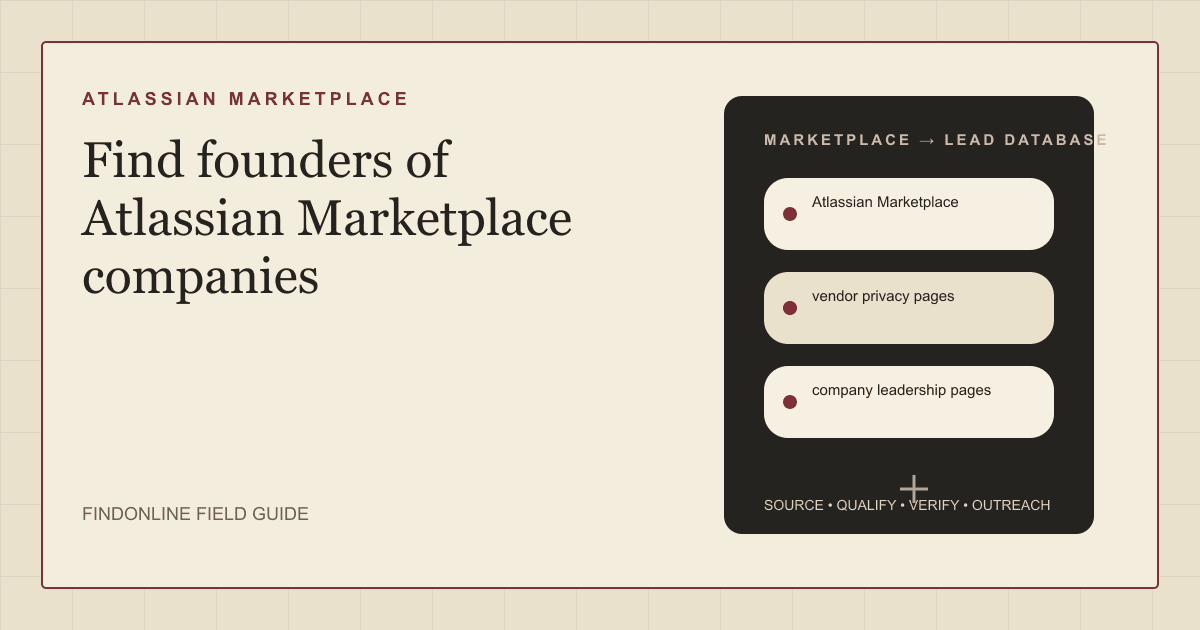
Use the Atlassian Marketplace for vendor identity, vendor privacy pages for the legal entity, and company leadership pages for the founder. Keep the three reviewed starting points:
- Atlassian Marketplace. Every listing links to a vendor profile with a description, partner tier, and contact route. Lively Apps, based in Munich, empowers 3.3 million users worldwide to achieve their best work every day, according to its vendor profile, which also links a trust center. Lively Apps vendor profile. Atlassian's partner documentation covers due diligence: business and identity verification for Marketplace partners, so listed vendors are verified businesses rather than anonymous accounts. Atlassian Marketplace partner documentation.
- Vendor privacy pages. Privacy policies and trust centers name the operating entity, its products, and its jurisdiction. Tempo's policy states that this privacy policy applies to visitors to this website and to users of this website, our cloud and on-premises software products, which ties the Marketplace apps to one company. Tempo privacy policy. On the Marketplace side, a vendor profile lets you access the partner's trust center to review their security, compliance, and privacy information. Lively Apps vendor profile.
- Company leadership pages. Founders appear on about pages, leadership pages, and company histories. Adaptavist's history records that in 2010: Adaptavist helps build and launch the Atlassian Marketplace, and that the company was founded in 2005. Adaptavist company history. Use such timelines to separate founders from later executives and acquirers.
Combine at least two sources per record. A Marketplace listing without a matching privacy entity may be resold, white-labeled, or transferred; a leadership page without a Marketplace listing may belong to a services partner rather than an app vendor.
Lead database: what should a verified founder list contain?
Build one company record per vendor, linked to one record per app and one per founder or executive. Keep evidence separate from interpretation so a teammate can audit each Atlassian Marketplace founder lead before it enters a campaign.
| Field | Where to obtain it | How to verify it |
|---|---|---|
| Vendor name and canonical domain | Marketplace vendor profile | Match the profile name to the website and privacy entity |
| Apps and hosting types | Marketplace listings | Record cloud and data center availability and the listing address |
| Partner tier and programs | Vendor profile badges | Note bug bounty, security program, or partner tier statements |
| Legal entity and jurisdiction | Vendor privacy pages and trust center | Confirm the entity name matches the vendor profile |
| Founder and current title | Company leadership pages and histories | Resolve founder versus current CEO and record the check date |
| Ownership changes | Company histories and announcements | Distinguish founder-led, acquired, and group-owned vendors |
| Decision route | Leadership page, partner page, and role wording | Separate strategic sponsor from product or support contacts |
| Trigger and evidence date | New listings, new editions, or partner tier changes | Verify the underlying change before scoring the lead |
| Contact route and next action | Published business contact details | Confirm identity; record replies and suppression requests |
Leave missing values unknown rather than guessing.
Use this reusable research prompt:
Research [vendor domain] as an Atlassian Marketplace vendor. Find its vendor profile, app listings, privacy policy or trust center entity, and leadership page. Identify the founder, the current CEO if different, and any acquisition or group ownership. Return source addresses, checked dates, exact role wording, hosting types, and unresolved questions. Do not infer decision authority or invent contact details.
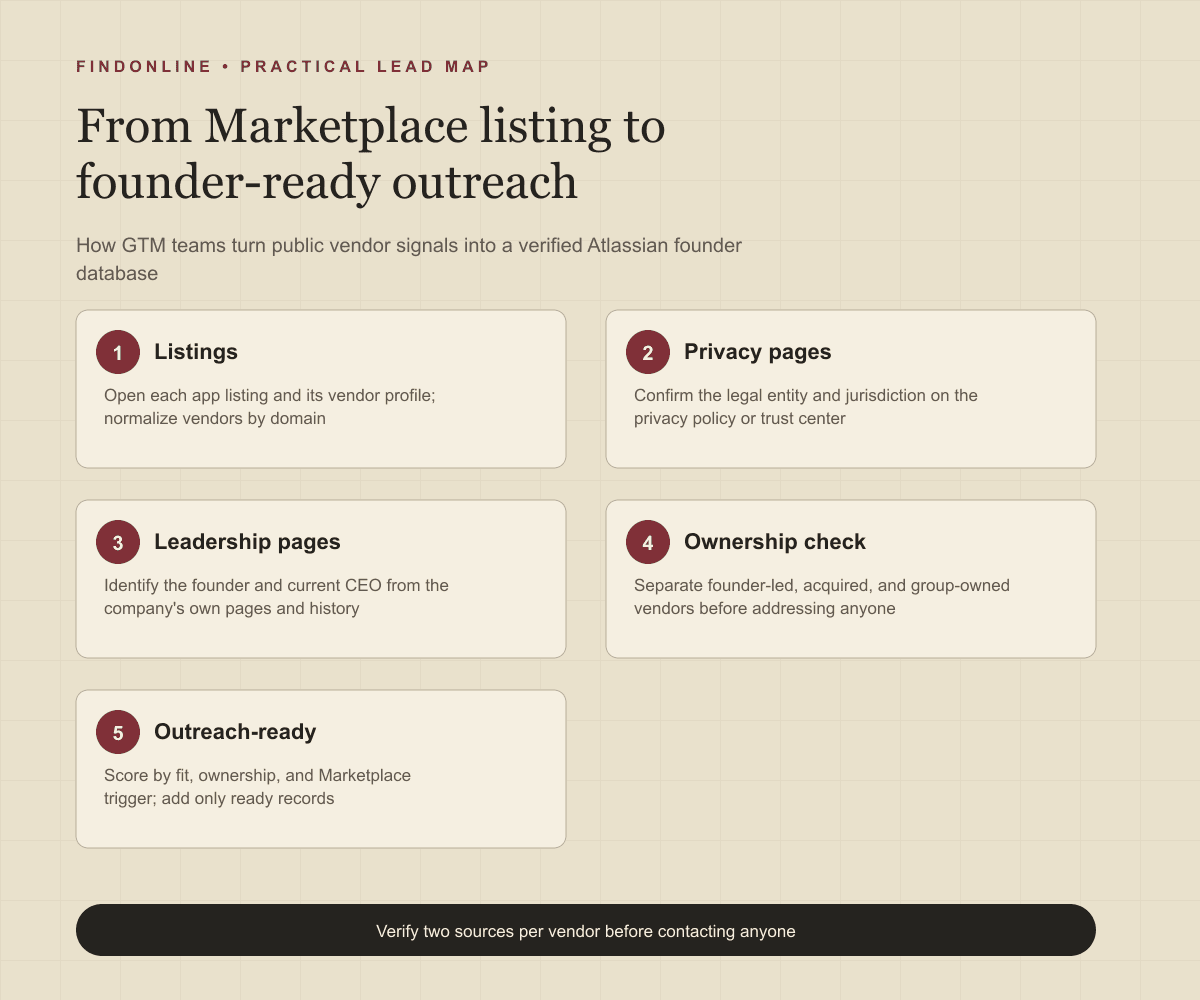
Follow this sequence:
- Choose Marketplace categories relevant to your proposal and list the vendors in them.
- Open each vendor profile and normalize vendors by website domain.
- Read the privacy page or trust center to confirm the legal entity and jurisdiction.
- Identify the founder and current leadership from the company's own pages.
- Score each record by fit, ownership model, and trigger; mark it ready, needs verification, or out of scope.
- Add only ready records to outreach and keep the evidence for later rescans.
Best tools to automate outreach: which options fit Marketplace founder research?
Choose the tool for the stage you need to operate.
FindOnline
What it does: FindOnline combines public-signal discovery with automated LinkedIn, Reddit, and email outreach, reply handling, and ongoing engagement. Apply it to verified Marketplace vendors and the founders behind them. FindOnline product and workflow.
Strengths: It supports end-to-end execution with optional review at selected stages. Use evidence-backed relationship routing, verified professional commonality, or a direct signal-led message about a specific app. FindOnline operating model.
Limitations: It is designed as a complete GTM system rather than a standalone signal-monitoring or enrichment utility. Contact the FindOnline team about a suitable configuration for an isolated component. A Marketplace listing connection is not confirmed in the cited official material. FindOnline product.
Best for: GTM teams taking vendor and founder research through multichannel conversations while choosing which stages run automatically. FindOnline workflow and review controls.
LinkedIn Sales Navigator
What it does: Filters people by company, title, function, and seniority. Sales Navigator filter documentation.
Strengths: Saved searches and matching alerts support repeated founder research across a vendor list. Sales Navigator filter documentation.
Limitations: Founder titles vary widely at small vendors, so a title filter alone misses owners who list themselves as engineers or product leads. Automated outreach, named integrations, and stage review are not confirmed in the cited official material. Sales Navigator filter documentation.
Best for: Researchers confirming the founder inside a vendor that the Marketplace has already surfaced. Sales Navigator filter documentation.
Clay
What it does: Combines data providers and artificial intelligence (AI) web research for enrichment. CRM enrichment documentation.
Strengths: Custom enrichment logic and customer relationship management (CRM) synchronization suit vendor-to-entity-to-founder matching fields. CRM enrichment documentation.
Limitations: Your team must design the logic that links a Marketplace vendor name to a legal entity and a founder. Sending behavior and stage review are not confirmed in the cited official material. CRM enrichment documentation.
Best for: Operators building repeatable vendor-to-founder research before contact activation. CRM enrichment documentation.
Crunchbase
What it does: Crunchbase Pro provides private company data and aims to identify high-potential companies the moment signals emerge. Crunchbase Pro overview.
Strengths: Funding and growth context helps rank which vendors are likely to entertain partnership or acquisition conversations. Crunchbase Pro overview.
Limitations: Many Marketplace vendors are bootstrapped and thinly covered, so absence from the data does not mean the company is small. Outreach sending and stage review are not confirmed in the cited official material. Crunchbase Pro overview.
Best for: Teams prioritizing funded vendors within a verified Marketplace list. Crunchbase Pro overview.
Common Room
What it does: Connects business sources of contacts, organizations, and signals. Business integrations.
Strengths: Engagement context from connected business sources can raise the priority of a vendor already interacting with your team or community. Business integrations.
Limitations: Its documented integrations cover business sources, not the Atlassian Marketplace, so vendor signals must be imported from your own research. Stage review is not confirmed in the cited official material. Business integrations.
Best for: Teams connecting existing engagement context to a vendor pipeline they already maintain. Business integrations.
HeyReach
What it does: HeyReach runs LinkedIn outreach with multichannel outreach through native Instantly and Smartlead integrations. HeyReach product overview.
Strengths: Founders of small vendors are often most reachable on LinkedIn, where HeyReach concentrates its automation. HeyReach product overview.
Limitations: Email steps depend on the connected Instantly or Smartlead account rather than a native sender. Stage review is not confirmed in the cited official material. HeyReach product overview.
Best for: Teams running LinkedIn-first sequences to verified founders after research is complete. HeyReach product overview.
Tool comparison: how do the six options differ?
Match the tool to your unresolved workflow stage. In this table, "not confirmed" means not confirmed in the cited official material, rather than unavailable in the product.
| tool | best for | data and discovery | outreach automation | integrations | support and review | limitations |
|---|---|---|---|---|---|---|
| FindOnline | Vendor-to-founder conversation workflow | Public signals | Automated LinkedIn, Reddit, and email; end-to-end engagement | Marketplace connection not confirmed | Optional review by stage | Complete GTM system; discuss isolated components with the team. Product, workflow, controls |
| LinkedIn Sales Navigator | Confirming the founder | Company and role filters | Not confirmed | Named connections not confirmed | Stage review not confirmed | Founder titles vary at small vendors. Evidence |
| Clay | Custom vendor-to-founder enrichment | Providers and AI research | Sending not confirmed | CRM synchronization | Stage review not confirmed | Requires entity-matching logic design. Evidence |
| Crunchbase | Ranking funded vendors | Private company data and signals | Sending not confirmed | Not confirmed | Stage review not confirmed | Bootstrapped vendors are thinly covered. Evidence |
| Common Room | Activating engagement context | Connected business signals | Not confirmed | Business source integrations | Stage review not confirmed | No Marketplace source. Evidence |
| HeyReach | LinkedIn-first founder sequences | Not confirmed | LinkedIn outreach; email via Instantly or Smartlead | Instantly and Smartlead | Stage review not confirmed | Email depends on connected accounts. Evidence |
Outreach workflow: how should you approach a Marketplace founder?
Lead with the specific app and a concrete proposal, not a general introduction. Use the FindOnline discovery-to-outreach workflow to connect vendor research with campaign execution, and set stage-level review controls if you want to approve the first message to each founder.
Confirm the vendor, the app, the legal entity, and the founder's current role. Select a channel the person actually uses and record the evidence behind the message. A credible warm introduction, such as a shared solution partner, investor, or customer, is one possible route. Without one, use only verified professional commonality, such as a documented Atlassian community contribution or a public conference talk. Never invent familiarity.
If there is no meaningful commonality, send a direct signal-led message:
Your [app] listing shows [hosting type] availability and [partner tier]. We [proposal] for teams that use [app] with [adjacent workflow]. Would a [specific joint step] fit your plans for [app], or does someone else own partnerships?
Time the sequence to a Marketplace change, such as a new cloud edition, a partner tier upgrade, or a trust center update. Founders answer faster when the message references something they just shipped.
Industry-specific nuances: what changes qualification in the Atlassian ecosystem?
Qualify the vendor's ownership and hosting position, not the presence of a listing.
Separate founder-led vendors from acquired ones. Adaptavist's timeline shows acquisitions such as ScriptRunner in 2014 and later group formation, so the founder of an acquired app may no longer decide anything about it. Check the vendor profile name, the privacy entity, and the history page together before addressing a founder.
Read hosting and trust signals as intent. A vendor investing in cloud editions, security programs, or a public trust center is planning to stay in the ecosystem, which favors partnership proposals. A vendor with only data center listings and no trust content may be winding down or selling.
Watch for false positives: solution partners that list apps built for clients, group-owned brands that share one privacy policy, and listings whose vendor name is a product brand rather than a company. Prioritize vendors with several active listings, a named founder or CEO, and a recent Marketplace change.
Limitations: how reliable are Marketplace signals?
Signals are directional rather than guaranteed truth. Use them to prioritize and personalize outreach and follow-ups, verify the underlying change, and rescan regularly because departments, roles, and company conditions change.
A listing does not prove revenue, active development, or a founder who wants partners. Treat those as unanswered qualification questions and recheck the record before each campaign step.
Frequently asked questions: what do teams ask about Marketplace founders?
How do I find the company behind an Atlassian Marketplace app?
Open the app listing and follow it to the vendor profile, then confirm the legal entity on the vendor's privacy policy or trust center. The profile gives the operating name; the privacy page gives the entity behind it.
Is the vendor's support contact a useful route to the founder?
Only for routing. Support addresses reach service staff, so ask who owns partnerships and record the answer. Use the leadership page and professional profiles to identify the founder directly.
What if the founder no longer runs the company?
Record the founder as historical and target the current CEO or group executive. Company histories and acquisition announcements usually explain the change, and the privacy entity often changes with it.
How often should I rescan the Marketplace?
Monthly for your target categories and immediately after a partner program or hosting change. New listings, new editions, and tier changes are the triggers most likely to make a founder receptive.
Sources
- Atlassian Marketplace — Atlassian · Accessed
- Atlassian Marketplace developer documentation — Atlassian · Accessed
- Lively Apps vendor profile — Atlassian Marketplace · Accessed
- Tempo privacy policy — Tempo · Accessed
- About Tempo — Tempo · Accessed
- About Adaptavist — Adaptavist · Accessed
- FindOnline GTM agents — FindOnline · Accessed
- About FindOnline — FindOnline · Accessed
- How FindOnline works — FindOnline · Accessed
- Sales Navigator Advanced Search Filters — LinkedIn · Accessed
- CRM Enrichment — Clay · Accessed
- Crunchbase Pro — Crunchbase · Accessed
- Business Integrations — Common Room · Accessed
- HeyReach — HeyReach · Accessed