Buyer discovery
How to Find AI Startup Founders Preparing to Launch
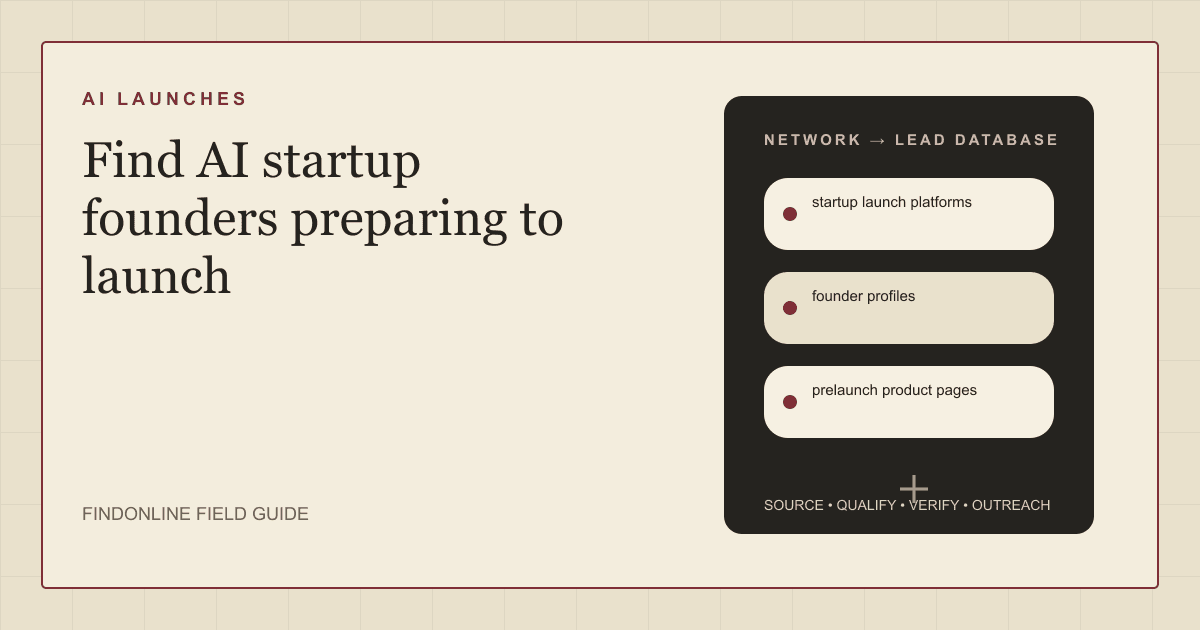
Find AI startup founders preparing to launch using startup launch platforms, founder profiles, and prelaunch product pages, then verify the launch is still ahead before outreach.
By Vaishnav Gupta13 min read
On this page
Quick answer: How to Find AI Startup Founders Preparing to Launch starts with three public signals: startup launch platforms where founders schedule or tease a launch, founder profiles that confirm who is building the product and what stage they are at, and prelaunch product pages such as waitlists and coming-soon pages that show the launch has not happened yet. Target the founder in the weeks before launch day, when positioning, audience, and launch marketing are still being decided. Product Hunt shows how compressed that moment is: for its top products launching today, for the first 4 hours of the day, it is hiding upvotes so every product gets a fair start. Product Hunt.
Who to target: which founders are worth approaching before a launch?
Target the founder who owns launch marketing, then confirm the launch is genuinely ahead rather than behind. For marketing agencies and growth service providers, use this research shortlist:
- Solo or two-person AI startup with a waitlist page: the founder, who is doing everything and usually decides on outside help within days.
- Accelerator-backed team approaching demo day: the CEO, who has a fixed launch date and a budget expectation set by the program.
- Team with a growth or marketing hire already: that person for execution, with the founder as the approver.
Treat profiles as hypotheses. A founder listed on a company page may have moved on, and a launch platform profile may belong to a marketer rather than the founder. Team pages resolve that: Linear's page names Karri Saarinen, Co-founder, CEO; Jori Lallo, Co-founder, CPO; Tuomas Artman, Co-founder, CTO, which is the level of role clarity you need before treating a person as the decision-maker. Linear team page.
Search within verified companies before widening titles. Sales Navigator filters people by company, title, function, and seniority, and saved searches and matching alerts support repeated founder research. Sales Navigator filter documentation. For segment context, use the B2B SaaS prospecting context.
Lead sources: where do upcoming AI launches surface first?
Use startup launch platforms for timing, founder profiles for identity and stage, and prelaunch product pages to confirm the launch is still ahead. Keep the three reviewed starting points:
- Startup launch platforms. Launch sites publish upcoming and just-launched products with the maker attached. Product Hunt offers a launch guide with checklists and pro tips for launching, and its front page ranks the day's launches. Product Hunt. Launching Next publishes the newest trending tech startups and projects. Launching Next. Peerlist's Launchpad invites makers to become the first project to launch this week, noting that it is only accepting a limited number of projects, so don't delay your launch, which means its weekly list is a forward calendar. Peerlist Launchpad. Hacker News asks makers to read the Show HN rules and tips before posting, and lets you browse the newest Show HNs. Show HN.
- Founder profiles. Accelerator directories and team pages confirm the founder, the company, and the stage. Y Combinator's AI industry page lists funded companies with batch, status, and size, for example Scale AI, S2016, active, 500 employees, San Francisco, and notes that we also have a startup directory where you can search through over 5,000 companies. Y Combinator AI startups.
- Prelaunch product pages. Waitlist pages, coming-soon pages, and new-entry listings in AI directories show products that have not launched or have only just appeared. Futurepedia invites readers to join 350,000 AI adopters and to explore top AI tools and learn how to use them effectively, and its recently added section lists products entering the market. Futurepedia. A product page with a waitlist form and no pricing or sign-in is the prelaunch profile you want.
Combine at least two sources per record. A launch platform entry without a prelaunch page usually means the launch already happened; a waitlist page without any platform presence may be a side project with no launch date.
Lead database: what should a verified prelaunch founder list contain?
Build one company record per startup, linked to one record per founder and one per launch signal. Keep evidence separate from interpretation so a teammate can audit each AI startup launch lead before it enters a campaign.
| Field | Where to obtain it | How to verify it |
|---|---|---|
| Startup name and canonical domain | Launch platforms and prelaunch product pages | Match the listing to the product's own domain |
| Founder and current title | Founder profiles and team pages | Resolve conflicting companies, dates, and duplicate names |
| Stage and backing | Accelerator directories and founder profiles | Record batch, founding year, and any announced funding |
| Launch status | Startup launch platforms | Classify as scheduled, teased, launched, or unknown, with the date |
| Prelaunch page type | Prelaunch product pages | Note waitlist, coming soon, beta access, or early pricing |
| Product category | Product page and directory listing | Record the AI category and the buyer the product serves |
| Trigger and evidence date | Platform entry, page change, or profile update | Verify the underlying change before scoring the lead |
| Contact route and next action | Published business contact details | Confirm identity; record replies and suppression requests |
Leave missing values unknown rather than guessing.
Use this reusable research prompt:
Research [startup] for evidence that it is preparing to launch an AI product. Find its entries on launch platforms with dates, the founder's profile and team page, and any waitlist or coming-soon page. Classify the launch as scheduled, teased, launched, or unknown, and note the category, stage, and any named marketing help. Return source addresses, checked dates, exact role wording, and unresolved questions. Do not infer budget or invent contact details.
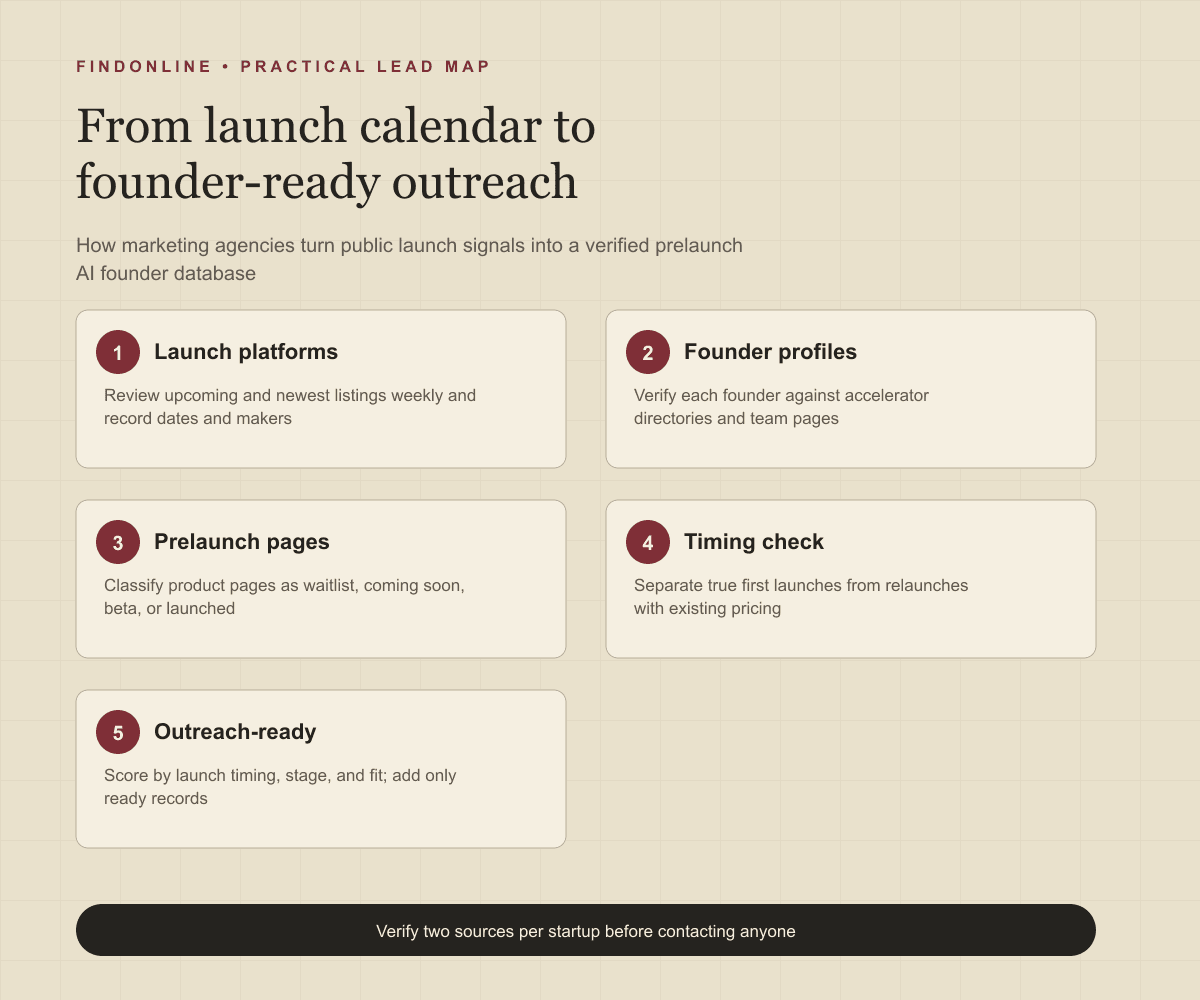
Follow this sequence:
- Choose AI categories and stages you serve, then list the launch platforms and directories that cover them.
- Review upcoming and newest listings weekly and normalize startups by domain.
- Verify each founder against accelerator directories and team pages.
- Open the product page and classify it as prelaunch, launched, or unclear.
- Score each record by launch timing, stage, and fit; mark it ready, needs verification, or out of scope.
- Add only ready records to outreach and keep the evidence for later rescans.
Best tools to automate outreach: which options fit an agency's prelaunch pipeline?
Choose the tool for the stage you need to operate.
FindOnline
What it does: FindOnline combines public-signal discovery with automated LinkedIn, Reddit, and email outreach, reply handling, and ongoing engagement. Apply it to verified AI startups and the founders behind each upcoming launch. FindOnline product and workflow.
Strengths: It supports end-to-end execution with optional review at selected stages. Use evidence-backed relationship routing, verified professional commonality, or a direct signal-led message about the specific launch. FindOnline operating model.
Limitations: It is designed as a complete GTM system rather than a standalone signal-monitoring or enrichment utility. Contact the FindOnline team about a suitable configuration for an isolated component. Launch platform connections are not confirmed in the cited official material. FindOnline product.
Best for: Agency owners taking launch platform and profile research through multichannel conversations with founders while choosing which stages run automatically. FindOnline workflow and review controls.
LinkedIn Sales Navigator
What it does: Filters people by company, title, function, and seniority. Sales Navigator filter documentation.
Strengths: Saved searches and matching alerts support repeated founder research across a startup list. Sales Navigator filter documentation.
Limitations: Filters cannot show launch timing or a waitlist page, so launch platforms and product pages must supply that evidence. Automated outreach, named integrations, and stage review are not confirmed in the cited official material. Sales Navigator filter documentation.
Best for: Researchers confirming the founder inside a startup that launch platforms have already surfaced. Sales Navigator filter documentation.
Crunchbase
What it does: Crunchbase Pro provides private company data and aims to identify high-potential companies the moment signals emerge. Crunchbase Pro overview.
Strengths: Funding and founding-date context ranks which prelaunch startups can pay for launch marketing. Crunchbase Pro overview.
Limitations: Many prelaunch AI startups have no funding record yet, so absence from the data does not mean the company is not real. Outreach sending and stage review are not confirmed in the cited official material. Crunchbase Pro overview.
Best for: Agencies prioritizing funded startups within a verified prelaunch list. Crunchbase Pro overview.
Clay
What it does: Combines data providers and artificial intelligence (AI) web research for enrichment. CRM enrichment documentation.
Strengths: Custom enrichment logic and customer relationship management (CRM) synchronization suit platform-to-founder-to-page matching fields. CRM enrichment documentation.
Limitations: Your team must design the logic that classifies a product page as prelaunch or launched. Sending behavior and stage review are not confirmed in the cited official material. CRM enrichment documentation.
Best for: Operators building repeatable launch-signal research before contact activation. CRM enrichment documentation.
Common Room
What it does: Connects business sources of contacts, organizations, and signals. Business integrations.
Strengths: Engagement context from connected business sources can raise the priority of a founder already interacting with your community. Business integrations.
Limitations: Its documented integrations cover business sources, not launch platforms or waitlist pages, so launch signals must be imported from your own research. Stage review is not confirmed in the cited official material. Business integrations.
Best for: Agencies connecting existing community context to a prelaunch pipeline they already maintain. Business integrations.
Amplemarket
What it does: Amplemarket offers social prospecting to engage leads directly from social media, alongside lead generation and engagement features. Amplemarket product overview.
Strengths: Founders preparing a launch are active on social channels, and social prospecting keeps the conversation there. Amplemarket product overview.
Limitations: Social prospecting starts from leads you identify, so launch platform review still has to happen first. Stage review is not confirmed in the cited official material. Amplemarket product overview.
Best for: Agencies running social-first follow-up with founders already verified. Amplemarket product overview.
Tool comparison: how do the six options differ?
Match the tool to your unresolved workflow stage. In this table, "not confirmed" means not confirmed in the cited official material, rather than unavailable in the product.
| tool | best for | data and discovery | outreach automation | integrations | support and review | limitations |
|---|---|---|---|---|---|---|
| FindOnline | Launch-signal-to-conversation workflow | Public signals | Automated LinkedIn, Reddit, and email; end-to-end engagement | Launch platform connections not confirmed | Optional review by stage | Complete GTM system; discuss isolated components with the team. Product, workflow, controls |
| LinkedIn Sales Navigator | Confirming the founder | Company and role filters | Not confirmed | Named connections not confirmed | Stage review not confirmed | Cannot show launch timing. Evidence |
| Crunchbase | Ranking funded prelaunch startups | Private company data and signals | Sending not confirmed | Not confirmed | Stage review not confirmed | Prelaunch startups often have no record. Evidence |
| Clay | Custom launch-signal enrichment | Providers and AI research | Sending not confirmed | CRM synchronization | Stage review not confirmed | Requires prelaunch classification logic. Evidence |
| Common Room | Activating community context | Connected business signals | Not confirmed | Business source integrations | Stage review not confirmed | No launch platform sources. Evidence |
| Amplemarket | Social-first follow-up | Lead data and social prospecting | Multichannel engagement | Not confirmed | Stage review not confirmed | Starts from leads you identify. Evidence |
Outreach workflow: how should an agency approach a founder before launch day?
Lead with the launch and a concrete first deliverable, not a general agency introduction. Use the FindOnline discovery-to-outreach workflow to connect launch research with campaign execution, and set stage-level review controls if you want to approve the first message to each founder.
Confirm the startup, the founder, the launch status, and the product category. Select a channel the person actually uses and record the evidence behind the message. A credible warm introduction, such as a shared accelerator, investor, or community, is one possible route. Without one, use only verified professional commonality, such as a public build-in-public thread or a documented community. Never invent familiarity.
If there is no meaningful commonality, send a direct signal-led message:
Your [product] is listed for launch on [platform] on [date], and your site is still on a waitlist. We ran launch positioning and audience work for [number] AI products in [category] this year. Would a short launch-week plan review help, or is launch marketing already covered?
Time the sequence to the launch calendar. Positioning and audience decisions are made two to four weeks before launch day, so start as soon as the launch appears on a platform calendar and offer something usable immediately, such as a launch-day checklist tailored to the platform.
Industry-specific nuances: what changes qualification for AI startup launches?
Qualify the launch timing and the founder's capacity, not the presence of an AI label.
Separate genuine prelaunch from relaunch. Many AI products relaunch on platforms after adding a feature, and their founders already have a marketing routine. A waitlist page plus a first platform listing signals a true first launch; a product with an existing pricing page signals a relaunch.
Read the product page for the buyer. An AI tool aimed at developers launches through Show HN and technical communities and needs different marketing than a consumer or business tool launching through Product Hunt and newsletters. Match your proposal to the channels the founder is already using.
Watch for false positives: agencies and studios listing client products under their own profiles, AI directories that list products submitted by marketers rather than founders, and launch calendars padded with placeholder entries. Prioritize startups with a founder-owned profile, a scheduled launch date, and a prelaunch page that names the buyer.
Limitations: how reliable are launch signals?
Signals are directional rather than guaranteed truth. Use them to prioritize and personalize outreach and follow-ups, verify the underlying change, and rescan regularly because departments, roles, and company conditions change.
A scheduled launch does not prove a marketing budget, an open agency search, or a founder who wants help.
Frequently asked questions: what do agencies ask about prelaunch AI founders?
Which launch platforms are most useful for finding upcoming AI products?
Platforms with a forward calendar, such as weekly launch lists and coming-soon sections, are most useful because they show launches before they happen.
How do I confirm a founder is really prelaunch?
Check the product page for a waitlist or coming-soon state and the absence of pricing or sign-in, then confirm the platform listing has a future or very recent date. A launched product with an active pricing page is past this stage.
Should I contact the founder or the growth hire?
Contact the founder when no marketing hire is visible, and the growth hire when one is, referencing the founder's launch.
How often should I rescan launch platforms and prelaunch pages?
Weekly for launch calendars and directories, and every few days in the two weeks before a scheduled launch, because founders finalize plans in that window.
Sources
- Product Hunt — Product Hunt · Accessed
- Launching Next — Launching Next · Accessed
- Show HN — Hacker News · Accessed
- Peerlist Launchpad — Peerlist · Accessed
- AI Startups funded by Y Combinator — Y Combinator · Accessed
- Futurepedia — Futurepedia · Accessed
- About Linear — Linear · Accessed
- FindOnline GTM agents — FindOnline · Accessed
- About FindOnline — FindOnline · Accessed
- How FindOnline works — FindOnline · Accessed
- Sales Navigator Advanced Search Filters — LinkedIn · Accessed
- Crunchbase Pro — Crunchbase · Accessed
- CRM Enrichment — Clay · Accessed
- Business Integrations — Common Room · Accessed
- Amplemarket — Amplemarket · Accessed