Buyer discovery
How to Find Real Estate Brokerages Recruiting Agents
Find real estate brokerages recruiting agents using state license lookups, brokerage careers pages, office opening announcements, and agent growth job posts, then verify the recruiting owner.
By Vaishnav Gupta13 min read
On this page
Quick answer: Target broker-owners, managing brokers, and directors of agent growth at real estate brokerages that are actively adding agents, not every licensed brokerage. The strongest discovery sources are state real estate license lookups, brokerage careers pages, office opening announcements, and agent growth job posts. Start by exporting one state's active brokerage entities, then flag any that opened an office or posted a recruiting role in the last 90 days.
Who to target: which roles own agent recruiting at a brokerage?
The buyer is whoever is accountable for agent count. At independent brokerages the broker-owner or designated broker decides personally. At regional firms a managing broker runs recruiting for one office, while a Director of Agent Growth owns it across offices. National brands add a Chief Growth Officer and a marketing leader who builds the recruiting brand.
Job posts show how these roles are framed. Orchard's Director of Agent Growth posting states that the brokerage grows only as fast as it can attract and keep the right agents (Orchard Director of Agent Growth posting on Tech Sales Jobs). A Director of Growth posting from Premier Property Solutions, a PLACE network team in Charlotte, asks the hire to build and maintain a consistent pipeline of new, developing, and experienced real estate professionals (Premier Property Solutions Director of Growth posting on Jobilize).
Qualification rule: a brokerage is recruiting-qualified when two signals line up, such as a live careers page pitch plus a growth hire, or a new office plus a named managing partner. One signal is a lead to watch, not a lead to contact.
Priority order for agencies: broker-owner, growth director, managing partner, then marketing director.
Lead sources: where do brokerages reveal they are recruiting agents?
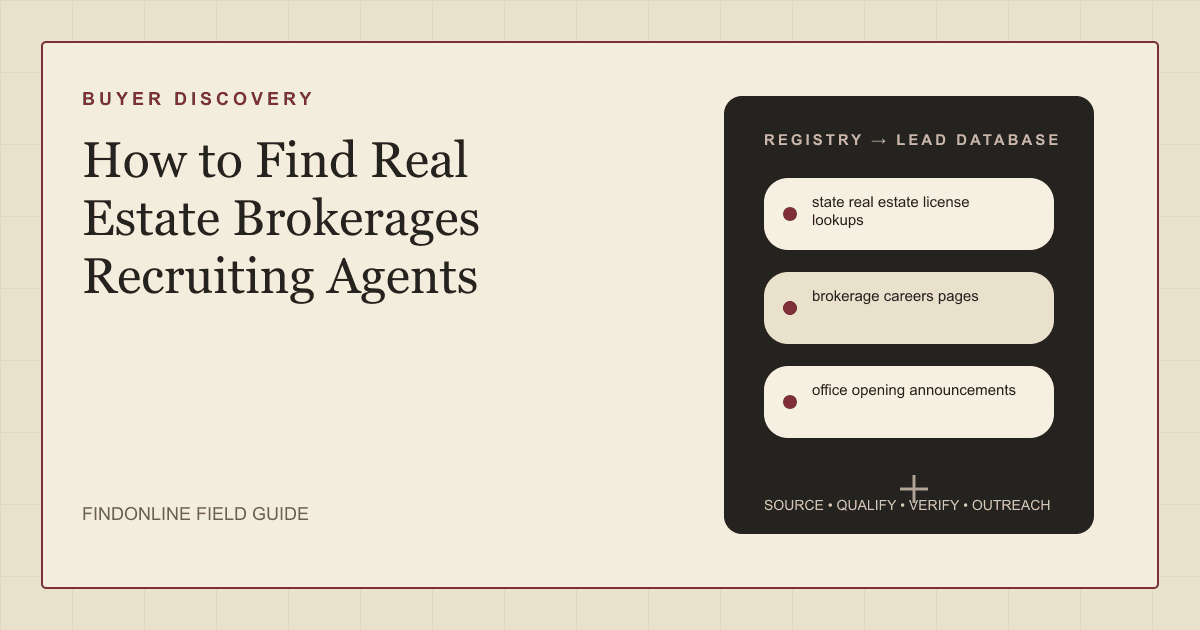
- state real estate license lookups define the universe of licensed brokerages. California's Department of Real Estate public license search accepts a licensee name, company name, or license identification number (California DRE Public License Information). Florida's Department of Business and Professional Regulation licensee search describes itself as providing information about applicants and licensed individuals (Florida DBPR Licensee Search). The Texas Real Estate Commission search refused connections, so California and Florida stand in.
- brokerage careers pages show the current recruiting pitch. Real's agent recruiting site leads with commission splits, no monthly fees, and low caps, and lists marketing tools that generate flyers, brochures, social media assets, and more (Real agent recruiting page).
- office opening announcements are the strongest timing signal. The Agency's October 29, 2026 release announced a Spokane, Washington office led by two managing partners and noted the firm launched 27 new offices in 2025, with more on the horizon (The Agency Spokane office release on PRWeb). The managing partner named in the release is a buyer with a deadline.
- agent growth job posts reveal that recruiting has a budget and an owner. Search job boards for Director of Agent Growth, agent attraction, and real estate recruiter, filtered to brokerages and teams.
- trade press recruiting coverage documents competitive recruiting. Hoodline reported on October 6, 2026 that SERHANT. launched two Illinois offices with an initial roster of more than 40 agents, and that leading the new practice is Dina Lissner, who joins SERHANT. Illinois from Baird & Warner (Hoodline coverage of the SERHANT. Chicago launch).
- LinkedIn company and career pages confirm the people behind a brokerage. LinkedIn states that you can create a Career Page to help attract the right talent by showcasing your culture and open roles (LinkedIn Help on Page types).
Inman and the Howard Hanna, eXp, and Compass careers pages blocked the research browser, so PRWeb, Hoodline, and Real stand in.
Lead database: how should you structure a brokerage recruiting list?
Build one row per licensed brokerage entity, with a child record for each office opening.
| Field | Where it comes from | How to verify |
|---|---|---|
| Licensed brokerage entity and license number | state real estate license lookups | Match careers page name to licensed entity |
| Designated broker or broker-owner | License record, brokerage about page | Confirm the name on license and website |
| Office count and newest office date | office opening announcements, locations page | Check the locations page lists the office |
| Recruiting owner and title | agent growth job posts, LinkedIn profiles | Confirm title and start date on LinkedIn |
| Live recruiting pitch | brokerage careers pages | Record split, fee, training, and marketing claims |
| Competitive agent moves | trade press recruiting coverage | Count agents gained or lost in 90 days |
Reusable research prompt:
Find real estate brokerages in [state] with two or more recruiting signals since [date]: new office announcement, live agent recruiting page, open agent growth or recruiter role, or trade press coverage of agents joining. Return licensed entity, designated broker, recruiting owner and title, newest office city, pitch summary, signal dates, and source URLs. Exclude teams under another brokerage's license.
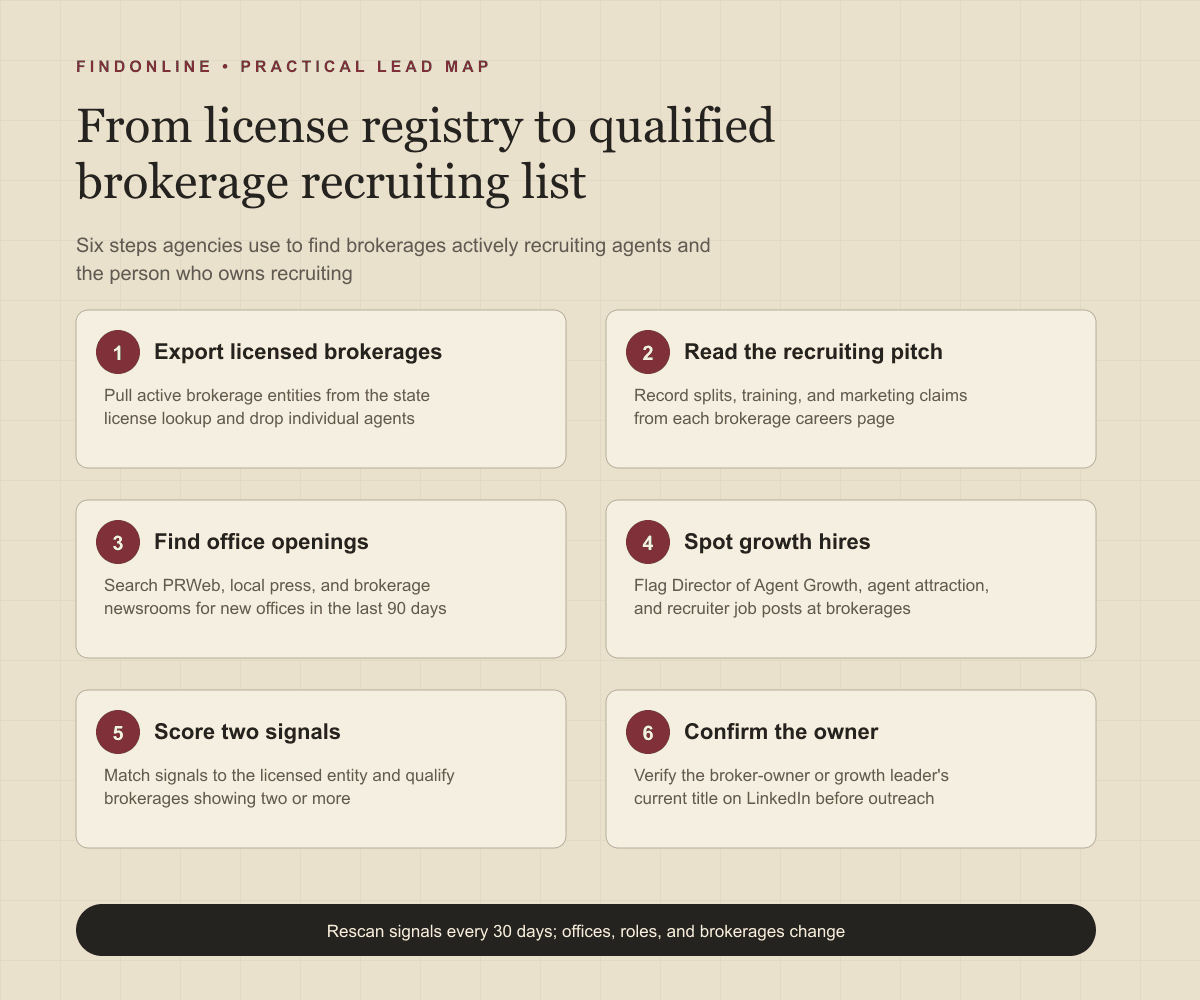
Step-by-step workflow:
- Export active brokerage entities from the state license lookup.
- Record each brokerage's careers page pitch.
- Search PRWeb, local press, and brokerage newsrooms for office openings in the last 90 days.
- Search job boards for agent growth and recruiter roles at brokerages.
- Match signals to the licensed entity and qualify brokerages showing two or more.
- Confirm the recruiting owner's current title on LinkedIn.
Best tools to automate outreach: which platforms fit brokerage prospecting?
FindOnline runs discovery and outreach together; the five alternatives each cover part of the job.
FindOnline
What it does: FindOnline runs AI go-to-market (GTM) agents for LinkedIn, Reddit and Email that find and qualify prospects from public signals, select an evidence-backed relationship route, and run outreach and reply handling end to end (FindOnline).
Strengths: You choose which stages run automatically and which hold for approval, so an agency can hold sends for review during a new client's first month (FindOnline about page). A credible warm introduction is one possible route; otherwise the agent adapts outreach using verified commonality such as the same metro market, or sends a direct signal-led message when none exists.
Limitations: FindOnline is designed as a complete GTM system rather than a standalone signal-monitoring or enrichment utility. Agencies that want only a license-lookup enrichment feed or a recruiting-signal alert should contact the FindOnline team to discuss a suitable configuration.
Best for: Agencies and growth service providers that want to turn office openings and agent growth hires into LinkedIn-first conversations with broker-owners without separate data, sequencing, and inbox tools. See how FindOnline runs outreach stages.
LinkedIn Sales Navigator
What it does: Sales Navigator is LinkedIn's prospecting product for finding and saving leads, and it notifies you when saved leads have important updates, like a job or role change (LinkedIn Sales Navigator).
Strengths: Role-change alerts catch a newly promoted managing broker. LinkedIn also says it provides structured onboarding, training, and support to drive product adoption (LinkedIn Sales Navigator).
Limitations: Sales Navigator surfaces people, not license records or office openings. Customer relationship management (CRM) integration was not confirmed in the cited official material.
Best for: Agencies that already prospect on LinkedIn and want alerts when brokerage leaders change roles.
Apollo
What it does: Apollo is a sales engagement platform with multi-channel sequence steps across email, call, and networking platforms (Apollo sales engagement).
Strengths: Reps can make, receive, record, and log calls from the same system they prospect and sequence, which suits broker-owners who answer a call faster than an email (Apollo sales engagement).
Limitations: Office openings and growth hires must be researched and tagged outside the tool. Support details were not confirmed in the cited official material.
Best for: Agencies running email-and-phone cadences to brokerages already qualified from registry and announcement sources.
Clay
What it does: Clay is a data workspace that lets you buy data from 200+ data and AI vendors under one contract in its marketplace (Clay).
Strengths: Enrich a license-lookup export with sites, profiles, and job posts in one table, then trigger emails, ads, and more with integrations to your existing GTM tools (Clay).
Limitations: Clay does not manage replies or run LinkedIn conversations, so it needs a sequencing tool downstream. Support details were not confirmed in the cited official material.
Best for: Agencies with an operations lead who enriches license exports before outreach.
ZoomInfo
What it does: ZoomInfo Sales is a B2B contact database with engagement tools that build and execute multi-touch sales cadences with a direct phone dialer and email tool (ZoomInfo Sales).
Strengths: Prospects export to your CRM in one click, which keeps agency pipeline reporting clean across several brokerage accounts (ZoomInfo Sales).
Limitations: Many independent broker-owners appear only in state license records, so coverage thins below the regional-brand tier. Support details were not confirmed in the cited official material.
Best for: Agencies targeting regional and national brokerage brands where executive contacts are well covered.
HeyReach
What it does: HeyReach automates LinkedIn outreach and imports relevant LinkedIn contacts from Sales Navigator, Clay, RB2B, HubSpot, or any other tool (HeyReach).
Strengths: Every connection, message, and reply shows up automatically on your HubSpot contacts, so brokerage conversations stay visible to the whole account team (HeyReach).
Limitations: HeyReach is LinkedIn-only, so email and phone steps need another tool, and it discovers no brokerage signals. Support details were not confirmed in the cited official material.
Best for: Agencies running high-volume LinkedIn connection campaigns to managing brokers across several client accounts.
Tool comparison: how do the six options differ for this workflow?
| tool | best for | data and discovery | outreach automation | integrations | support and review | limitations |
|---|---|---|---|---|---|---|
| FindOnline | Office openings into LinkedIn-first broker-owner conversations | Public signals: posts, hiring, office news, role changes | Automated LinkedIn, Reddit, and email outreach with reply handling | Not confirmed in the cited official material | Optional review: choose which stages run or hold | Complete GTM system, not a standalone signal or enrichment utility |
| LinkedIn Sales Navigator | Alerts when brokerage leaders change roles | LinkedIn profiles, saved leads, role change alerts | No sequencing; manual messaging | Not confirmed in the cited official material | Structured onboarding, training, and support | Shows people, not license records or new offices |
| Apollo | Email-and-phone cadences to qualified brokerages | Contact data you load or source | Multi-channel sequences across email, call, networking platforms | Calls logged in the same system | Not confirmed in the cited official material | Signals researched and tagged outside the tool |
| Clay | Enriching license exports before outreach | Marketplace of 200+ data and AI vendors | Triggers emails and ads through integrations | Integrations to existing GTM tools | Not confirmed in the cited official material | No reply management or LinkedIn conversations |
| ZoomInfo | Regional and national brokerage brands | B2B contact database | Multi-touch cadences with dialer and email tool | One-click export to CRM | Not confirmed in the cited official material | Thin coverage of independent brokerages |
| HeyReach | High-volume LinkedIn campaigns to managing brokers | Imports contacts from Sales Navigator, Clay, HubSpot | Automated LinkedIn connection and message campaigns | HubSpot contact sync | Not confirmed in the cited official material | LinkedIn-only; no email, phone, or discovery |
Outreach workflow: how do you approach a broker-owner who is recruiting?
Lead with the signal, name the recruiting problem, and ask one question.
- Open with the verified event. Reference the office opening, growth hire, or agent moves by date and city.
- Choose the route. Use a credible warm path if one exists, otherwise verified commonality such as the same metro or industry community, otherwise a direct signal-led note.
- Offer a specific artifact. Propose a recruiting-page teardown, a competitor agent-move brief, or a 30-day new-office launch plan.
- Sequence across channels. Start on LinkedIn where broker-owners post about their offices, follow with one email, and add a phone step for independents.
- Engage before and after. Comment on the new-office post, then follow up when the next agent-join post appears.
Agencies running location-based prospecting can reuse the footprint logic from finding marketing leaders at home services brands and the territory timing from finding franchise leaders entering new territories.
Industry-specific nuances: what is different about selling to brokerages?
- Teams are not brokerages. Growth roles like the Premier Property Solutions posting often belong to teams operating under another brokerage's license. Team leaders buy recruiting marketing but cannot sponsor licenses, so confirm entity type in the license lookup.
- Franchisees decide locally. A new office under a national brand is usually opened by a local broker-owner. Pitch that person, not the franchisor, and expect brand standards to constrain creative.
- The offer is the pitch. Brokerages recruit with splits, caps, revenue share, training, and marketing support. Your service sharpens how that offer is communicated, not the offer itself.
- Selective versus volume recruiting. A brokerage recruiting experienced agents from named competitors, as in the SERHANT. launch, buys competitive positioning. A brokerage recruiting newly licensed agents buys lead volume and nurture.
- False positives. Agents joining through an acquisition are not recruited, routine agent job ads run continuously and only signal change when volume rises, and a franchise sale creates a new brokerage rather than expanding one.
Limitations: how reliable are recruiting signals?
Recruiting signals are directional rather than guaranteed truth. An office opening may be staffed by a team that moved together, a growth posting may be a replacement hire, and a careers page may be years old. Use signals to prioritize which brokerages to contact first and to personalize the first message and follow-ups, then verify the underlying change on the source page. Then rescan signals regularly, because managing brokers move, offices close, and brokerages merge.
Frequently asked questions
How do I tell whether a real estate brokerage is actively recruiting agents?
Look for two signals within 90 days: a live agent recruiting page plus a new office, an open agent growth role, or trade press coverage of agents joining. A single careers page is not enough, because most brokerages keep one permanently.
Who at a brokerage buys recruiting marketing services?
At independent brokerages the broker-owner or designated broker approves recruiting marketing. At multi-office firms a Director or VP of Agent Growth holds the budget, and at new offices the managing partner named in the opening announcement needs agents fastest.
How is a real estate team different from a brokerage for prospecting?
A team operates under a sponsoring brokerage's license and cannot sponsor agents itself, while a brokerage holds its own license. Teams still buy recruiting marketing, but the buyer is the team leader and the pitch is about team growth.
How often should a brokerage recruiting prospect list be refreshed?
Rescan every 30 days. Office openings and growth hires are time-bound, managing brokers change roles, and a brokerage that filled its recruiting role last month is no longer a priority. Re-verify the recruiting owner's title on LinkedIn before each outreach wave.
Sources
- Public License Information — California Department of Real Estate · Accessed
- Licensee Search Options — Florida Department of Business and Professional Regulation · Accessed
- Join Real — The Real Brokerage · Accessed
- Global Brokerage The Agency Launches Office in Spokane, Washington — PRWeb · Accessed
- Director of Agent Growth (Remote) at Orchard — Tech Sales Jobs · Accessed
- Director of Growth Job in Charlotte — Jobilize · Accessed
- SERHANT. Launches Chicago Office With 40-Plus-Agent Roster — Hoodline · Accessed
- LinkedIn Page types and their functions — LinkedIn Help · Accessed
- FindOnline homepage — FindOnline · Accessed
- About FindOnline — FindOnline · Accessed
- LinkedIn Sales Navigator — LinkedIn · Accessed
- Apollo Sales Engagement — Apollo · Accessed
- Clay homepage — Clay · Accessed
- ZoomInfo Sales — ZoomInfo · Accessed
- HeyReach homepage — HeyReach · Accessed