Buyer discovery
How to Find Restaurant Owners Opening New Locations
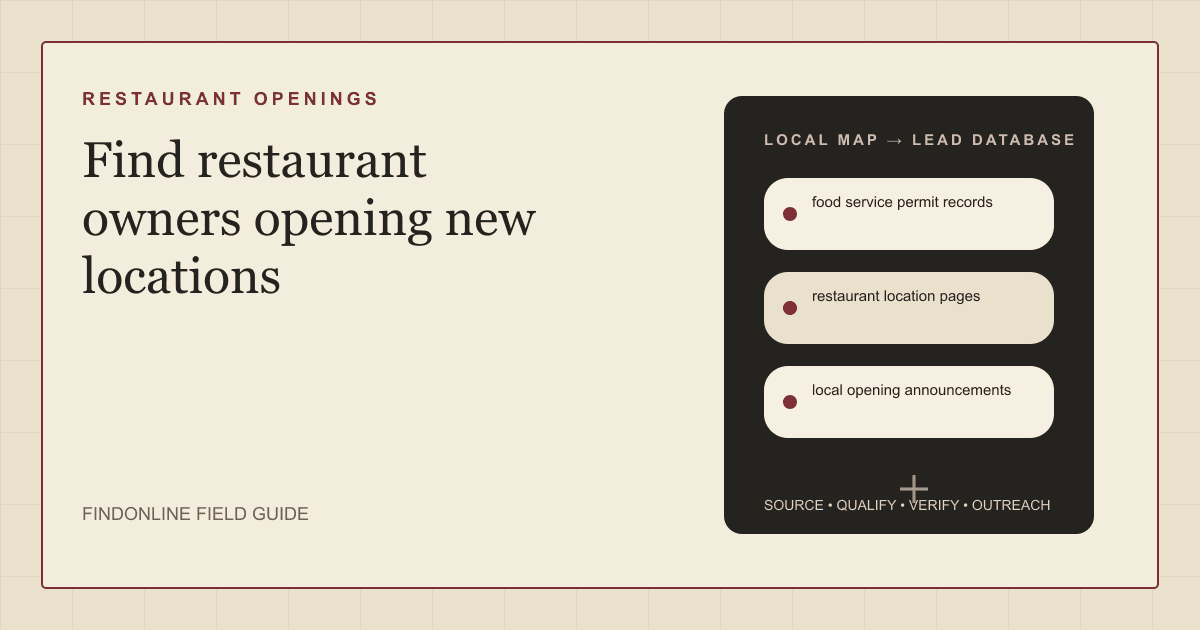
Find restaurant owners opening new locations using food service permit records, restaurant location pages, and local opening announcements, then verify who owns launch marketing.
By Vaishnav Gupta12 min read
On this page
Quick answer: How to Find Restaurant Owners Opening New Locations starts with three public signals: a new food service permit application, a new entry on a brand's restaurant location pages, and a local opening announcement. Target the owner or operating partner who approved the expansion, then confirm the opening window before contacting anyone. New York City's inspection dataset includes records for each restaurant that has applied for a permit but has not yet been inspected, which makes permit data an early signal. NYC restaurant inspection dataset.
Who to target: which roles decide on marketing for a new location?
Target the person who approved the expansion budget, then confirm who owns marketing for the new site. For marketing agencies and growth service providers, use this research shortlist:
- Independent group of one to five restaurants: the owner or operating partner, who usually approves agency spend personally.
- Regional multi-unit group: the director of operations or a marketing lead, with the owner as final approver.
- Franchisee opening a new unit: the multi-unit franchise owner, who buys local marketing within franchisor guidelines.
- Franchisor opening company-owned units: the vice president of marketing or a field marketing manager, not the local general manager.
Treat titles as hypotheses. A general manager announced for a new site usually influences local promotions rather than owning the budget.
Search within verified companies before widening titles. Sales Navigator filters people by company, title, function, and seniority, and saved searches and matching alerts support repeated owner research. Sales Navigator filter documentation.
Lead sources: where do new restaurant openings surface first?
Use permit records for the earliest signal, restaurant location pages for confirmation, and local opening announcements for timing and ownership context. Keep the three reviewed starting points:
- Food service permit records. Cities license food businesses before they open, so applications precede public marketing. Philadelphia requires a food preparation and serving license to operate a business where you prepare or serve food for public consumption. Philadelphia food license requirements. New York City publishes inspection records covering restaurants that have applied for a permit but have not yet been inspected, and the same dataset notes that thousands of restaurants start business and go out of business every year. NYC restaurant inspection dataset.
- Restaurant location pages. Brands maintain their own location lists, which reveal new markets before local press covers them. sweetgreen's locations page lists all sweetgreen locations in the US by state, with an address and hours for each restaurant. sweetgreen locations page.
- Local opening announcements. Trade coverage and company newsrooms confirm timing and name the people behind an expansion. Restaurant Business reported that Shark Club just opened its second location in Texas, and its emerging brands section tracks new brands and soon-to-open concepts worth watching. Restaurant Business emerging brands coverage. Larger brands publish their own releases: Chipotle's newsroom announced its first restaurant in Seoul as a milestone in its global expansion. Chipotle newsroom.
Combine at least two sources per record. A permit application without a location page entry may be a relocation, an ownership change, or a concept that never opens.
Lead database: what should a verified opening list contain?
Build one company record per restaurant group, linked to one record per planned location. Keep evidence separate from interpretation so a teammate can audit each restaurant opening lead before it enters a campaign.
| Field | Where to obtain it | How to verify it |
|---|---|---|
| Group name and canonical domain | Restaurant location pages and permit applicant name | Match the licensed entity to the brand that markets the location |
| Planned address and market | Permit records and location pages | Confirm the address in two sources, or one source plus a lease or hiring signal |
| Opening window | Local opening announcements and coming-soon entries | Record the stated date or quarter and the date you checked it |
| Ownership model | Franchise pages, announcements, and permit applicant | Distinguish independent, franchisee, and company-owned units |
| Decision-maker and current title | Company leadership pages and professional profiles | Resolve conflicting employers, dates, and duplicate names |
| Marketing owner | Announcements, job posts, and leadership pages | Separate the budget approver from the local promotions contact |
| Trigger and evidence date | Permit filing, page change, or announcement | Verify the underlying change before scoring the lead |
| Contact route and next action | Published business contact details | Confirm identity; record replies and suppression requests |
Leave missing values unknown rather than guessing.
Use this reusable research prompt:
Research [restaurant group] for a planned opening at [address or market]. Find the permit or license record, the brand's location page entry, and any announcement naming the opening date, the owner or operating partner, and the marketing contact. Classify the unit as independent, franchisee, or company-owned. Return source addresses, checked dates, exact role wording, and unresolved questions. Do not infer budget authority or invent contact details.
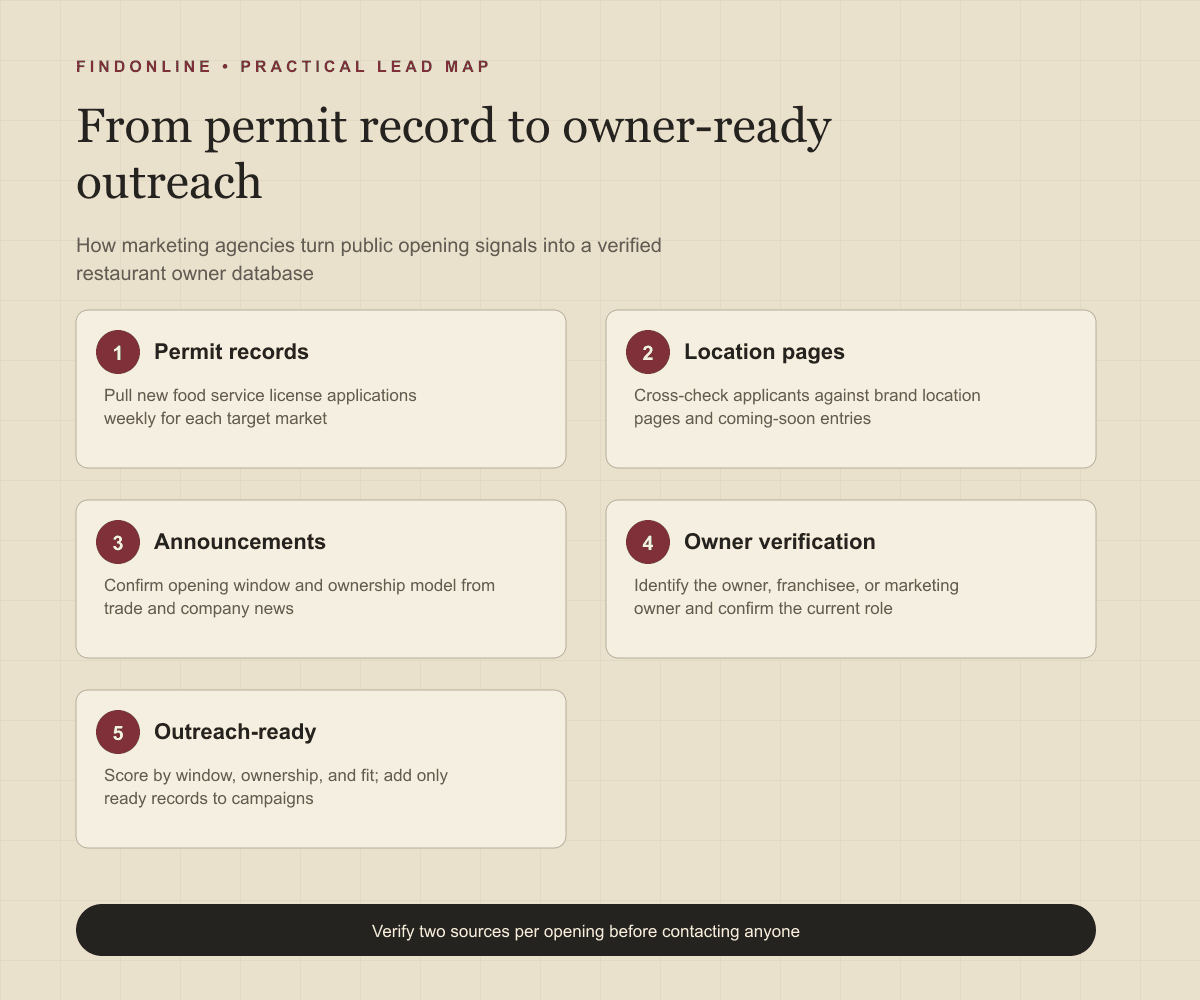
Follow this sequence:
- Choose target markets and list the permit or license portals that cover them.
- Pull new applications weekly and normalize applicants by operating entity and domain.
- Cross-check each applicant against restaurant location pages and opening coverage.
- Identify the owner, operating partner, or marketing owner and confirm the current role.
- Score each record by opening window, ownership model, and service fit; mark it ready, needs verification, or out of scope.
- Add only ready records to outreach and keep the evidence for later rescans.
Best tools to automate outreach: which options fit an agency's opening pipeline?
Choose the tool for the stage you need to operate. These six options cover complete outreach, owner discovery, enrichment, engagement context, and multichannel sequencing.
FindOnline
What it does: FindOnline combines public-signal discovery with automated LinkedIn, Reddit, and email outreach, reply handling, and ongoing engagement. Apply it to verified restaurant groups and the owners behind each planned opening. FindOnline product and workflow.
Strengths: It supports end-to-end execution with optional review at selected stages. Use evidence-backed relationship routing, verified professional commonality, or a direct signal-led message about the specific opening. FindOnline operating model.
Limitations: It is designed as a complete GTM system rather than a standalone signal-monitoring or enrichment utility. Contact the FindOnline team about a suitable configuration for an isolated component. Permit-portal connections are not confirmed in the cited official material. FindOnline product.
Best for: Agency owners taking permit and announcement research through multichannel conversations with restaurant owners while choosing which stages run automatically. FindOnline workflow and review controls.
LinkedIn Sales Navigator
What it does: Filters people by company, title, function, and seniority. Sales Navigator filter documentation.
Strengths: Saved searches and matching alerts support repeated owner research. Sales Navigator filter documentation.
Limitations: Many independent restaurant owners keep sparse profiles, so a missing result does not mean there is no decision-maker. Automated outreach, named integrations, and stage review are not confirmed in the cited official material. Sales Navigator filter documentation.
Best for: Researchers confirming the owner or marketing lead inside a group that permit data has already surfaced. Sales Navigator filter documentation.
Apollo
What it does: Runs sequences combining automated email and manual tasks. Sequences overview documentation.
Strengths: Email and LinkedIn tasks can share one planned opening campaign. Sequences overview documentation.
Limitations: Manual email, phone call, and LinkedIn steps create tasks that someone must complete before contacts advance, which slows time-sensitive pre-opening outreach. Discovery coverage, named integrations, and support commitments are not confirmed in the cited official material. Sequences overview documentation.
Best for: Agencies with verified owner contacts that want email sequences with deliberate phone and social steps. Sequences overview documentation.
Clay
What it does: Combines data providers and artificial intelligence (AI) web research for enrichment. CRM enrichment documentation.
Strengths: Custom enrichment logic and customer relationship management (CRM) synchronization suit permit-to-owner matching fields. CRM enrichment documentation.
Limitations: Your team must design the logic that links a licensed entity to a brand and an owner. Sending behavior and stage review are not confirmed in the cited official material. CRM enrichment documentation.
Best for: GTM operators building repeatable permit-to-owner research before contact activation. CRM enrichment documentation.
Common Room
What it does: Connects business sources of contacts, organizations, and signals. Business integrations.
Strengths: Engagement context from connected business sources can raise the priority of a group already interacting with your team. Business integrations.
Limitations: Its documented integrations cover business sources, not permit portals or location pages, so opening signals must be imported from your own research. Stage review is not confirmed in the cited official material. Business integrations.
Best for: Agencies connecting existing engagement context to an opening pipeline they already maintain. Business integrations.
lemlist
What it does: lemlist runs multichannel sequences that reach leads via email, LinkedIn, calls, WhatsApp, and SMS from one workflow. lemlist product overview.
Strengths: Phone and text channels suit restaurant owners who spend little time in email during a build-out. lemlist product overview.
Limitations: Sequences depend on contact data you supply, and calling a restaurant's published line often reaches staff rather than the owner. Stage review is not confirmed in the cited official material. lemlist product overview.
Best for: Agencies running phone-inclusive follow-up after an owner has been identified and verified. lemlist product overview.
Tool comparison: how do the six options differ?
Match the tool to your unresolved workflow stage. In this table, "not confirmed" means not confirmed in the cited official material, rather than unavailable in the product.
| tool | best for | data and discovery | outreach automation | integrations | support and review | limitations |
|---|---|---|---|---|---|---|
| FindOnline | Opening-signal-to-conversation workflow | Public signals | Automated LinkedIn, Reddit, and email; end-to-end engagement | Permit-portal connections not confirmed | Optional review by stage | Complete GTM system; discuss isolated components with the team. Product, workflow, controls |
| LinkedIn Sales Navigator | Confirming owners and marketing leads | Company and role filters | Not confirmed | Named connections not confirmed | Stage review not confirmed | Sparse owner profiles limit coverage. Evidence |
| Apollo | Email-led opening campaigns | Coverage not confirmed | Automated email; manual call and social tasks | Not confirmed | Manual steps; support not confirmed | Task steps slow pre-opening timing. Evidence |
| Clay | Custom permit-to-owner enrichment | Providers and AI research | Sending not confirmed | CRM synchronization | Stage review not confirmed | Requires entity-matching logic design. Evidence |
| Common Room | Activating engagement context | Connected business signals | Not confirmed | Business source integrations | Stage review not confirmed | No permit or location page sources. Evidence |
| lemlist | Phone-inclusive follow-up | Not confirmed | Email, LinkedIn, calls, WhatsApp, SMS | Not confirmed | Stage review not confirmed | Published lines reach staff, not owners. Evidence |
Outreach workflow: how should an agency approach an owner before opening day?
Lead with the specific opening and a concrete first deliverable, not a general agency introduction. Use the FindOnline discovery-to-outreach workflow to connect permit research with campaign execution, and set stage-level review controls if you want to approve the first message to each owner.
Confirm the group, the planned address, the opening window, and the owner or marketing owner. Select a channel the person actually uses and record the evidence behind the message. A credible warm introduction, such as a shared landlord, supplier, or franchise peer, is one possible route. Without one, use only verified professional commonality, such as a documented industry association or a public community. Never invent familiarity.
If there is no meaningful commonality, send a direct signal-led message:
Your [market] location appears in [source] with an opening planned for [window]. We help restaurant groups fill the first sixty days with local search, reviews, and launch promotions. Would a pre-opening plan for [address] fit your remit, or does someone else own launch marketing?
Owners are busiest in the two weeks before opening, so start sixty to ninety days out and offer something usable immediately, such as a local listing audit for the new address. Record referrals, objections, and requests to stop; remove unsupported personalization before later messages.
Industry-specific nuances: what changes qualification for restaurant openings?
Qualify the ownership model and the opening stage, not the presence of a permit.
Separate franchise openings from independent ones. A franchisee often must use approved vendors or co-op funds for launch marketing, so confirm what the franchise agreement allows before proposing services. Company-owned units of a large brand usually buy through a central marketing team, which makes the local general manager a weak target.
Read permit records for stage, not just existence. An application signals intent, a plan review signals a build-out, and a passed inspection signals an imminent opening.
Watch for false positives: ghost kitchens and virtual brands that add a permit without a dine-in location, seasonal or pop-up permits, relocations that close one address as another opens, and holding companies whose licensed name does not match the brand. Prioritize groups whose second or third opening sits within twelve months of the first; they have a repeatable playbook and a budget habit.
Limitations: how reliable are opening signals?
Signals are directional rather than guaranteed truth. Use them to prioritize and personalize outreach and follow-ups, verify the underlying change, and rescan regularly because departments, roles, and company conditions change.
A permit application does not prove financing, a signed lease, or an owner who wants outside marketing help. Opening dates slip, concepts change names, and some licensed locations never open.
Frequently asked questions: what do agencies ask about restaurant opening leads?
How early can a permit record show a planned restaurant?
A permit or license application usually appears weeks to months before opening, because cities require the license before food service begins. Treat the application date as the start of your outreach window and confirm the stage with a location page entry or announcement.
Should I contact the general manager listed for a new location?
Only as a routing step. The general manager rarely approves agency spend, so ask who owns launch marketing and whether that decision sits with the owner, a franchisee, or a central brand team.
How do I tell a franchise opening from an independent one?
Check the brand's franchising page, the permit applicant's legal name, and the announcement wording. Franchisees typically operate under their own company name while marketing the brand; independents license and market under the same entity.
How often should I rescan permit records and location pages?
Weekly for permit portals in your target markets and at least monthly for brand location pages. Shorten the interval when a group has announced a growth plan.
Sources
- DOHMH New York City Restaurant Inspection Results — Data.gov · Accessed
- Get a Food Preparation and Serving License — City of Philadelphia · Accessed
- sweetgreen locations — sweetgreen · Accessed
- Emerging Brands — Restaurant Business · Accessed
- Chipotle Newsroom — Chipotle Mexican Grill · Accessed
- FindOnline GTM agents — FindOnline · Accessed
- About FindOnline — FindOnline · Accessed
- How FindOnline works — FindOnline · Accessed
- Sales Navigator Advanced Search Filters — LinkedIn · Accessed
- Sequences Overview — Apollo · Accessed
- CRM Enrichment — Clay · Accessed
- Business Integrations — Common Room · Accessed
- lemlist multichannel outreach — lemlist · Accessed