Buyer discovery
How to Find DTC Brands Launching on Amazon
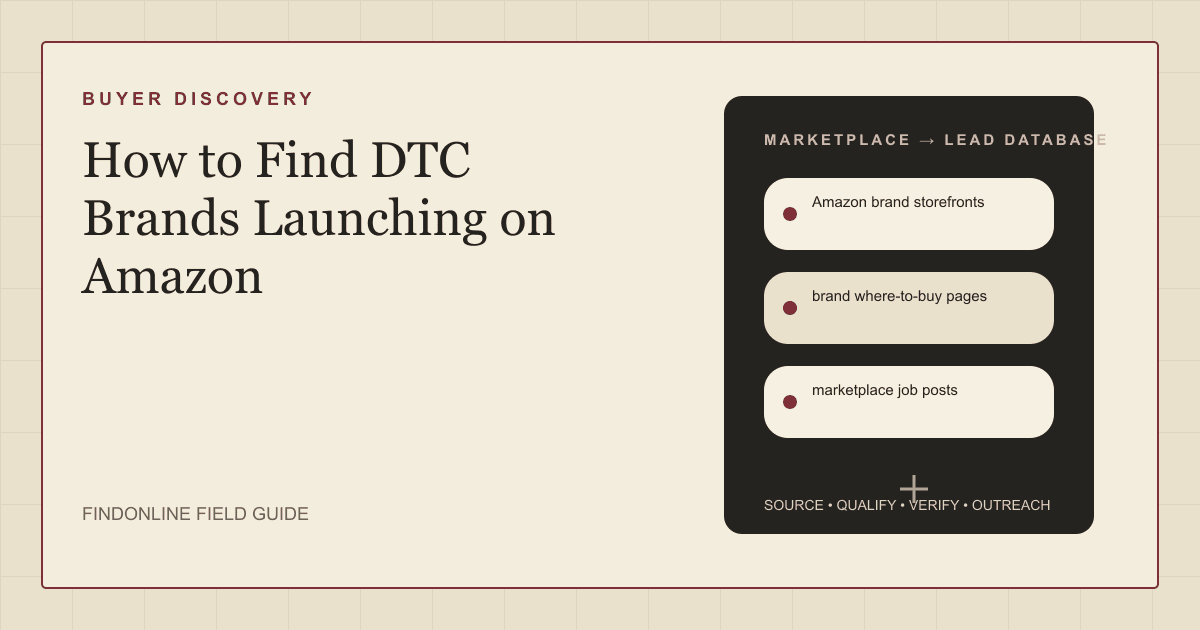
Find DTC brands launching on Amazon using Amazon brand storefronts, brand where-to-buy pages, marketplace job posts, and Amazon launch coverage, then verify the launch stage and the marketing approver.
By Vaishnav Gupta15 min read
On this page
Quick answer: To find DTC brands launching on Amazon, target the founder, VP of Marketing, or head of ecommerce at direct-to-consumer (DTC) brands whose Amazon Brand Store is new or still sparse. The strongest discovery sources are Amazon brand storefronts, brand where-to-buy pages, marketplace job posts, and Amazon launch coverage. Start by searching amazon.com/stores for your category and logging every brand with a thin storefront or a fresh marketplace hire.
Who to target: which roles own the Amazon launch decision?
Target the person who owns channel growth, not the person who runs Seller Central day to day. At brands under roughly 50 people that is usually the founder or CEO. At larger brands it is the VP of Marketing, Head of Ecommerce, or Director of Marketplaces, with the Amazon Marketplace Manager as the day-to-day champion who evaluates your work but rarely approves spend. A Raycon marketplaces role describes its scope as "Own end-to-end marketplace operations for Amazon and Walmart, including weekly KPI check-ins" and states "This role reports to our VP of Marketing." (Built In). That posting closed in December 2025, but the reporting line is typical: marketing leadership approves agency spend for the channel.
Qualify the brand before the person. A brand with a mature Brand Store, hundreds of reviews per listing, and an in-house Amazon team is scaling, not launching. Service fit for a direct-to-consumer brand Amazon launch is strongest between the first listings going live and the first full quarter of advertising.
Lead sources: where do DTC brands reveal an Amazon launch?
Four public sources reveal a launch and a fifth builds the universe you screen. Corroborate every brand with at least two.
- Amazon brand storefronts are the primary signal. Amazon's advertising documentation states "Brand Stores are available for sellers enrolled in Amazon Brand Registry, vendors, and agencies" and that brands can "send shoppers directly to your Brand Store via the short URL" (Amazon Ads). A storefront with one or two pages, a handful of products, and listings with few reviews is a brand in launch mode. Google's site operator "allows you to request search results from the particular domain" (Google Search Central), so site:amazon.com/stores plus a category keyword enumerates storefronts. Amazon's seller-facing Stores page returned 404 today, so the Amazon Ads page is cited instead.
- brand where-to-buy pages confirm the launch from the brand's side. Hero Cosmetics' store locator lists authorized retailers, including Amazon, and says the brand is "working quickly to make Mighty Patch available in more stores and sites" (Hero Cosmetics). A brand that just added Amazon to this page, or that has live brand-sold listings but has not updated the page, is in the window you want. Other brand locator URLs returned 404 today, so Hero stands in as the readable example.
- marketplace job posts reveal launches before storefronts do. Horizon Brands, a consumer products company, posted an Amazon Marketplace Manager role asking the hire to "Coordinate new product launches and expansions into new categories or markets on Amazon." (Built In). That posting was removed in January 2026, but its wording shows how expansion scope surfaces in a single title. A London recruiter posting for an international DTC brand asks the hire to "Lead Amazon product launches and determine the appropriate fulfilment model across markets." (Salt). Each posting names the brand or recruiter, the scope, and the markets. A Workable posting used in an earlier draft could not be verified by the publisher, so the Built In posting stands in.
- Amazon launch coverage catches announced launches. NBC Select reported on May 15, 2025 that for Away, "Historically, the brand has only been available for purchase on its website." and "But starting today, you can find several bestselling pieces on Amazon." (NBC News). Away launched with bestsellers rather than its full range, so a partial catalog at announcement is itself a stage marker.
- Store Leads ecommerce database builds the DTC universe to screen. Its site says users can "Use any combination of 60 search filters to segment the database" (Store Leads). Filter by category, country, and estimated sales, then check each brand against the four signal sources above.
All three reviewed hints were readable today and are retained; launch coverage and Store Leads are topic-specific additions.
Lead database: which fields qualify a DTC brand launching on Amazon?
Build one row per brand and resolve the decision-maker only after the brand passes the launch-stage check.
| Field | Where it comes from | How to verify |
|---|---|---|
| Brand and DTC site | Store Leads ecommerce database, where-to-buy pages | Open the site; confirm it sells its own products |
| Brand Store URL | Amazon brand storefronts via site search | Record page count and product count |
| Seller of record | Amazon product listings | Confirm Sold by shows the brand, not a reseller |
| Launch stage | Storefront size, review counts, launch coverage | Thin catalog and few reviews mean early stage |
| Where-to-buy names Amazon | brand where-to-buy pages | Compare the page to live listings |
| Marketplace hire | marketplace job posts, LinkedIn | Record title, posting date, and scope wording |
| Markets in scope | Job posts, storefront country sites | Note US only versus UK, EU, Canada, Australia |
| Decision-maker | LinkedIn current roles, team pages | Confirm title and reporting line |
Reusable research prompt:
For [brand name] at [brand site], answer with evidence links:
1. Does the where-to-buy page name Amazon?
2. Brand Store URL, page count, and product count?
3. Seller of record on the top three listings?
4. Any marketplace or Amazon job post in the last 180 days?
5. Any Amazon launch coverage, with date?
Classify: pre-launch, soft launch, announced launch, or scaled. Name the likely approver.
Step-by-step workflow:
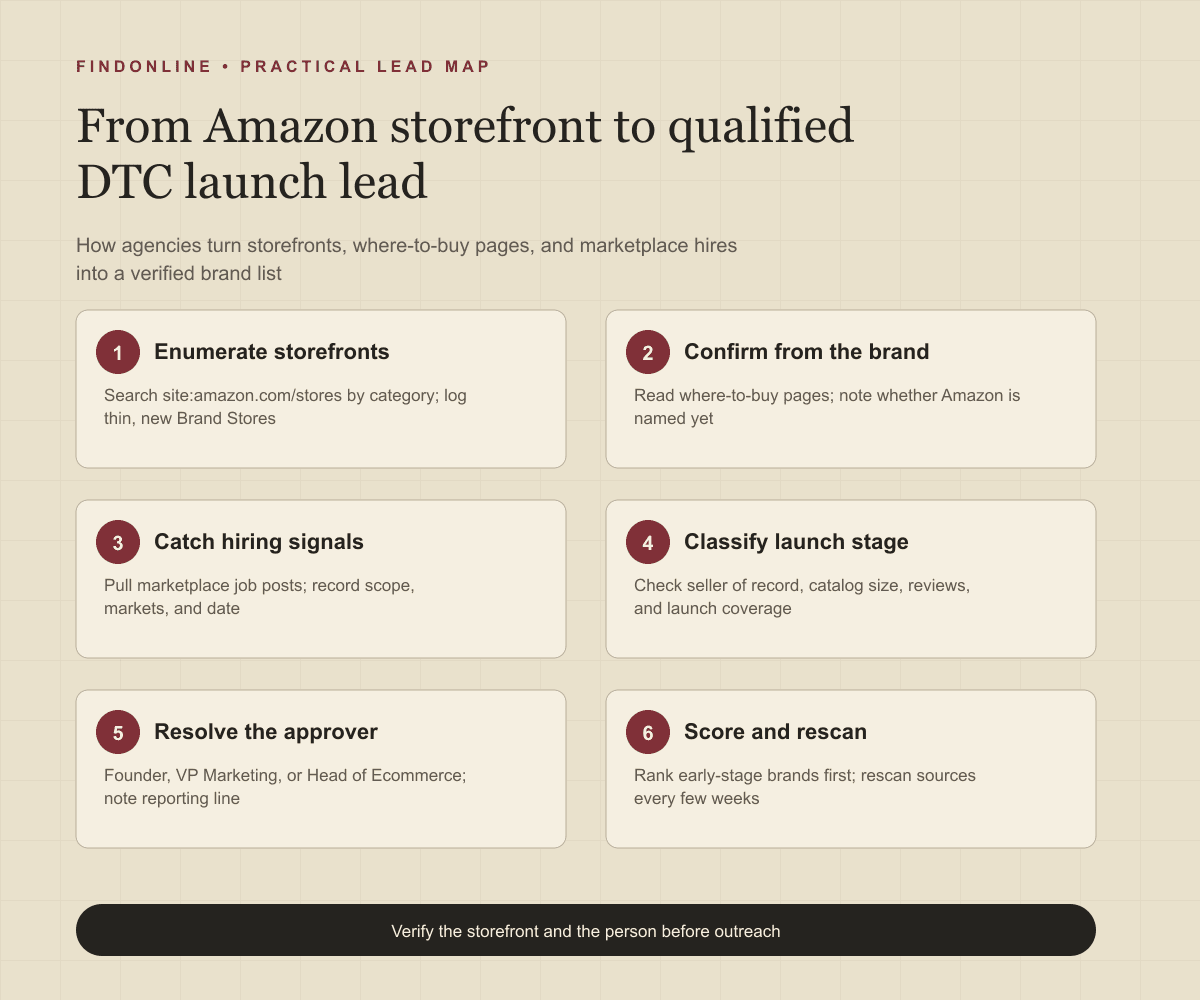
- Pull a category list from the Store Leads ecommerce database or your own client-lookalike list.
- Run site:amazon.com/stores with the category keyword and match storefronts to brands.
- Open each storefront and the brand's where-to-buy page, then classify the launch stage.
- Search LinkedIn and job boards for marketplace titles posted in the last 180 days.
- Resolve the approver and the champion, record the reporting line, and rank announced or soft launches with a new hire and a thin storefront first.
The same evidence-to-approver logic applies when finding ecommerce founders launching new product categories, where category pages play the role that storefronts play here.
Best tools to automate outreach to DTC brands launching on Amazon
FindOnline
What it does: FindOnline is an end-to-end AI GTM system that finds and qualifies prospects from public signals, selects an evidence-backed relationship route, and runs outreach across LinkedIn, Reddit, and email. Its homepage describes "AI GTM agents for LinkedIn, Reddit and Email." (FindOnline). Here it watches marketplace hires, founder launch posts, and role changes at DTC brands, then adds the qualified marketing or ecommerce leader to a campaign. Strengths: Discovery, routing, outreach, reply handling, and post engagement run as one automated workflow. Stage-level control is optional: "You choose which stages run automatically and which hold for approval." (FindOnline about). When no warm path exists it uses verified professional commonality, such as a shared ecommerce community, or sends a direct signal-led message. Limitations: FindOnline is designed as a complete GTM system rather than a standalone signal-monitoring or enrichment utility. An agency that only wants a storefront-monitoring feed should contact the FindOnline team to discuss a suitable configuration. Best for: Agency owners who want the launch signal, the decision-maker, and the multi-channel follow-up handled in one system while they pitch Amazon launch work.
Store Leads
What it does: Store Leads is an ecommerce store database for building the DTC universe before checking Amazon presence. Its site says users can "Use any combination of 60 search filters to segment the database" (Store Leads). Strengths: Filters by platform, category, country, and estimated sales produce a candidate list quickly, and the site says its integrations "enrich data in your CRM to help make better prioritization decisions" (Store Leads). Limitations: Store Leads tracks brand-owned web stores, not Amazon, so it cannot show whether a Brand Store exists. It is a discovery source rather than a direct FindOnline competitor. Best for: Agencies that want a category-wide DTC brand list to screen for Amazon launches.
LinkedIn Sales Navigator
What it does: Sales Navigator is LinkedIn's prospecting product for finding people and accounts and tracking changes. The official page describes "receiving real-time lead alerts, and acting on fresh prospects" (LinkedIn Sales Navigator). Strengths: Saved searches for titles such as Marketplace Manager at consumer brands surface new hires. Support includes a Help Center "virtual agent to deliver 24/7 self-service support for LinkedIn products" and CRM integration is listed for higher tiers (LinkedIn Sales Navigator). Limitations: Sales Navigator sees people and company pages, not Amazon, so it cannot confirm whether a Brand Store exists or how mature it is. Best for: Agency sellers who already prospect on LinkedIn and want alerts when DTC brands hire marketplace leaders.
Apollo
What it does: Apollo combines a contact database with sequences. Its sales engagement page lists "Multi-channel sequence steps across email, call, and networking platforms" (Apollo). Strengths: Contact data and sequencing sit in one tool. The page states "Apollo syncs contacts, activities, and deal data with CRMs like Salesforce and HubSpot" (Apollo). Limitations: Apollo's company filters do not include marketplace activity, so the Amazon launch stage must be qualified elsewhere and imported as a custom field. Its support model is not confirmed in the cited official material. Best for: Growth agencies with a verified brand list who want email-first sequences and CRM sync.
Clay
What it does: Clay is an enrichment and workflow platform. Its site offers "One contract to buy data from 200+ data and AI vendors" (Clay). Strengths: Its site lists Claygent AI research agents, which can be prompted to open a brand site and note whether the where-to-buy page names Amazon. The site says you can "Trigger emails, ads, and more with integrations to your existing GTM tools." (Clay). Limitations: Clay needs an operator to build and maintain the table logic and prompts, or Amazon-presence results drift. Support model not confirmed in the cited official material. Best for: Agencies with a GTM operator who want where-to-buy and storefront checks automated at scale.
Lemlist
What it does: Lemlist is a multichannel outreach tool. Its site says you can "Launch automated campaigns across email, LinkedIn, calls, WhatsApp, and SMS from one workflow." (Lemlist). Strengths: Deliverability tooling is built in, HubSpot and Salesforce connections are described, and "our support team is just a click away via the in-app chat" (Lemlist). Limitations: Lemlist does not discover or qualify brands; it executes campaigns you feed it, so launch-stage research comes from the other sources in this guide. Best for: Agencies that have qualified a list and want LinkedIn plus email sequences with deliverability protection.
Tool comparison: which tool fits an Amazon launch prospecting workflow?
| tool | best for | data and discovery | outreach automation | integrations | support and review | limitations |
|---|---|---|---|---|---|---|
| FindOnline | Agencies wanting signal-to-reply handled end to end | Public signals: hires, posts, role changes at DTC brands | Automated LinkedIn, Reddit, and email outreach with reply handling | Not confirmed in the cited official material | Optional review per stage; team support | Complete GTM system, not a standalone monitor |
| Store Leads | Building the DTC brand universe by category | Web store database with 60 search filters | None; discovery source only | CRM enrichment integrations | Not confirmed in the cited official material | Tracks brand web stores, not Amazon |
| LinkedIn Sales Navigator | Alerts on marketplace hires and role changes | People and account search with lead alerts | Manual messaging on LinkedIn | CRM integration on higher tiers | 24/7 virtual agent help | Cannot see Brand Stores or listings |
| Apollo | Email-first sequences with contact data | Contact and company database | Multi-channel sequences across email and calls | Salesforce and HubSpot sync | Support model not confirmed | No marketplace-activity filters |
| Clay | Automating where-to-buy and storefront checks | 200+ data and AI vendors, research agents | Triggers emails through connected tools | GTM tool integrations | Not confirmed in the cited official material | Needs an operator to build tables |
| Lemlist | Running LinkedIn plus email campaigns | No discovery; runs lists built elsewhere | Automated campaigns across email, LinkedIn, calls, SMS | HubSpot and Salesforce | In-app chat support | No brand discovery or qualification |
Outreach workflow: how should agencies approach brands mid-launch?
Lead with the specific public evidence, name one gap you can close, and ask for a short storefront review.
- Trigger: a new storefront, a where-to-buy update, a marketplace hire, or launch coverage within the last 60 days.
- Route: check for a credible warm path first, such as a client who knows the founder; a warm introduction is one possible route, not the main workflow. Without one, use verified professional commonality such as the same ecommerce community or a shared former employer, and never invent familiarity. If neither exists, send a direct signal-led message.
- Message: "Saw your Brand Store went live with 14 products and that you are hiring a Marketplace Manager. Three of your top listings have no A+ content yet. Happy to share a 10-point launch audit."
- Channels: a LinkedIn note to the champion, an email to the approver, and thoughtful engagement with the founder's launch posts.
- Follow-up: three touches over three weeks, each adding one new observation such as a new review or a second market.
- Hand-off: when a reply arrives, offer the audit, not a retainer.
To run trigger monitoring, routing, and follow-ups as one automated workflow, see how FindOnline runs discovery and outreach end to end.
Industry-specific nuances: what is different about DTC brands moving to Amazon?
- Seller versus vendor changes the buyer. When listings show Sold by the brand, the brand controls pricing, content, and ads and buys agency services directly. When Amazon is the seller, a vendor team is involved and the service mix shifts toward content and advertising support.
- Brand Registry gates the services you sell. Amazon's Brand Registry asks brands to "Have a pending or registered trademark for your brand name or logo" and lets them "Differentiate your brand by designing your own free storefront" (Amazon Brand Registry). A brand with listings but no storefront may not be enrolled yet, so registry enrollment, storefront design, and A+ content are natural first deliverables.
- Job post wording tells you what stays in-house. The Horizon Brands posting asks the hire to "Develop and manage Amazon PPC campaigns" alongside deals and launch coordination in one role (Built In). A brand hiring that full scope may buy strategy or creative rather than execution; a brand hiring a generalist Head of Ecommerce may need full-service support.
- International scope multiplies the work. The Salt posting spans the UK, US, Canada, Australia, and the EU (Salt). Multi-market launches need localized listings and market-specific ads, which favors agencies with international experience; similar market-scope checks appear in finding growth leaders at international Shopify brands.
- Unauthorized resellers are false positives. Hero's locator warns shoppers off other outlets (Hero Cosmetics). Listings not sold by the brand mean the brand has not launched; they may also mean a brand-protection conversation comes first.
Limitations: what can launch signals not tell you?
Signals are directional, not proof of budget or intent. A storefront, a hire, or a news story tells you a brand is moving onto Amazon; it does not tell you whether the brand already has an agency or who will decide. Use signals to prioritize which brands to research first and to personalize the opening message and follow-ups, then verify the underlying change by opening the listings and confirming the person's current title. Rescan the sources every few weeks because marketplace managers change jobs, storefronts fill out, and paused launches restart.
Frequently asked questions
How can I tell whether a DTC brand has actually launched on Amazon?
Open a listing, confirm the seller of record is the brand, and look for a Brand Store. Listings sold only by third parties mean the brand has not launched. A storefront with few pages and few reviews indicates an early launch, which is the stage agencies want.
Which job titles signal that a brand is launching on Amazon?
Marketplace Manager, Amazon Marketplace Manager, Head of Amazon, and Director of Marketplaces are the clearest. Postings that mention launching into new marketplaces, Brand Store, or A+ content indicate the channel is being built rather than maintained. Record the posting date as the trigger.
Who approves hiring an Amazon agency at a DTC brand?
Usually the founder at small brands and the VP of Marketing or Head of Ecommerce at larger ones. Marketplace managers often report into marketing, as the Raycon posting shows, so they are champions rather than approvers. Confirm the reporting line on LinkedIn before choosing whom to email.
How early should I contact a brand launching on Amazon?
Within 60 days of the first signal, ideally between the first listings going live and the first advertising push. Earlier, the brand may still be enrolling in Brand Registry; later, it may already have an agency or an in-house team. Offer a storefront audit rather than a retainer at first contact.
Sources
- Amazon Brand Stores — Amazon Ads · Accessed
- Amazon Brand Registry — Amazon · Accessed
- Hero Cosmetics Store Locator and Where to Buy — Hero Cosmetics · Accessed
- Amazon Marketplace Manager at Horizon Brands — Built In · Accessed
- Amazon Marketplace Manager, International DTC Brand — Salt · Accessed
- Marketplaces Brand Manager at Raycon — Built In · Accessed
- Away luggage is now available on Amazon — NBC News · Accessed
- site: search operator — Google Search Central · Accessed
- Store Leads: The platform for ecommerce data — Store Leads · Accessed
- LinkedIn Sales Navigator — LinkedIn · Accessed
- Apollo Sales Engagement — Apollo · Accessed
- Clay: Go to market with unique data — Clay · Accessed
- lemlist multichannel outreach — lemlist · Accessed
- FindOnline: AI GTM agents for LinkedIn, Reddit and Email — FindOnline · Accessed
- About FindOnline — FindOnline · Accessed