Buyer discovery
How to Find Growth Leaders at International Shopify Brands
Find growth leaders at international Shopify brands using storefront market evidence, shipping pages, and LinkedIn company pages. Verify markets, roles, and service fit before outreach.
By Vaishnav Gupta12 min read
On this page
Quick answer: To find growth leaders at international Shopify brands, target the Head of Growth, VP of Ecommerce, or international marketing lead, and the founder at smaller brands. The strongest discovery sources are Shopify storefronts, international shipping pages, and LinkedIn company pages. Start by recording which countries, currencies, and languages each storefront actually serves, then confirm who currently owns growth before outreach.
Who to target: which roles own growth at an international Shopify brand?
Target the person who owns revenue in the markets your service affects, not the most senior marketing title.
| Brand situation | Likely growth owner | Confirm before outreach |
|---|---|---|
| Founder-led, one store shipping abroad | Founder or co-founder | Whether a marketing hire runs paid media |
| Scaling brand with localized markets | Head of Growth or VP of Ecommerce | Whether international sits in their remit |
| Brand with regional teams | Head of International or regional marketing lead | Which region and budget they control |
Record retention or SEO (search engine optimization) specialists as influencers, with one accountable decision-maker per brand.
Lead sources: where do international Shopify brands reveal their markets and teams?
Use four sources in sequence: Shopify storefronts for market evidence, international shipping pages for delivery scope, Shopify App Store localization app listings for candidate merchants, and LinkedIn company pages for people.
Shopify storefronts. A storefront shows whether a brand localizes or merely ships abroad. Shopify's developer guide says Shopify Markets lets merchants configure multiple languages, international pricing, and market-specific domains and subfolders (Shopify Markets guide). Its theme documentation says customers can browse and check out in their preferred currency or language (Shopify theme documentation).
International shipping pages. These pages state where a brand delivers and who pays duties. Shopify's shipping guide says an international shipping policy explains how duties and taxes are collected (Shopify shipping guide). Read the country list itself: the brand HEX lists only the United States and Canada in its international shipping policy (HEX shipping policy).
Shopify App Store localization app listings. Shopify's Translate & Adapt listing describes adapting content to reflect spelling and messaging variations between markets, and its public reviews show the reviewing store's name and country (Shopify App Store). Treat reviewers as candidates only: a review shows past app use, not current expansion.
LinkedIn company pages. LinkedIn says the top of a Page displays information such as industry, office locations, and number of employees, and that the People tab offers insight into employees' job titles (LinkedIn Help). Offices outside the home country suggest regional teams.
Lead database: what fields make an international Shopify prospect record usable?
A usable record joins market evidence, one verified person, and a service-fit note, each with a source URL and a check date.
| Field | Where it comes from | How to verify |
|---|---|---|
| Storefront domain | Shopify storefronts | Match the brand name to its LinkedIn Page |
| Markets, currencies, and languages | Storefront country and language selectors | Switch markets and check that prices and product copy change |
| Delivery countries and duties | International shipping pages | Read the country list and duties terms |
| Localization tooling | Shopify App Store localization app listings | Match the reviewer's store name to the domain |
| Growth owner | LinkedIn company pages (People tab) or team page | Confirm the role is current and covers the market |
| Service gap and check date | Your storefront review | Save the URL showing the gap |
Use this reusable research prompt for each brand:
For [brand domain], list every country, currency, and language in the storefront selector, plus delivery countries and duties handling from the shipping policy. Identify who currently owns growth or ecommerce in [region], with a source URL for each fact. Mark anything unconfirmed.
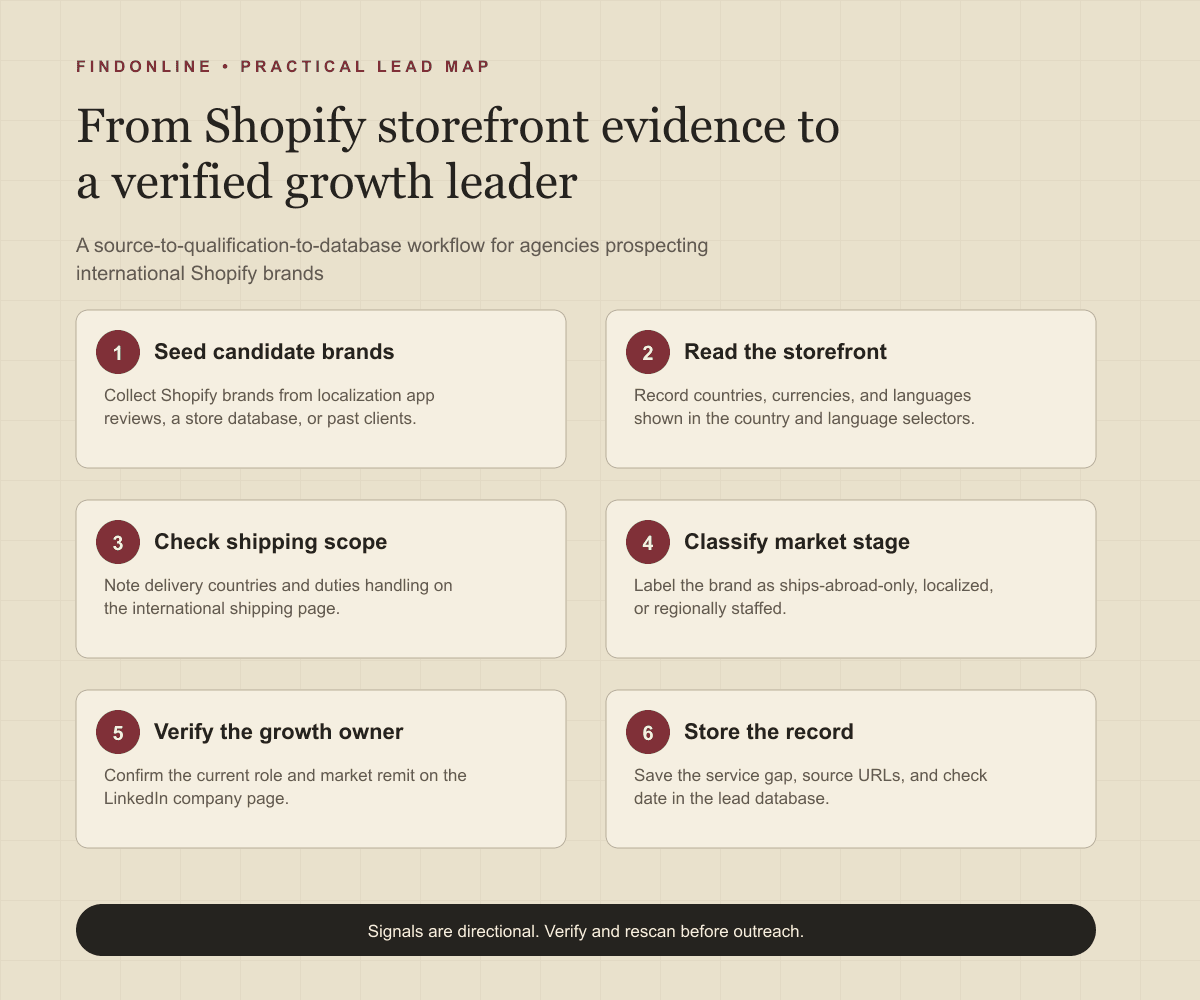
Then follow this workflow:
- Seed Shopify brands in your category from app reviews, a store database, or past clients.
- Record markets, currencies, and languages from each storefront.
- Record delivery countries and duties handling from the shipping page.
- Classify the brand as ships-abroad-only, localized, or regionally staffed.
- Confirm the current growth owner on the LinkedIn Page.
- Store one evidence-based service-gap sentence with its check date.
The same evidence-first method applies when finding ecommerce founders launching new product categories.
Best tools to automate outreach: which options fit an agency prospecting international Shopify brands?
Six options cover different parts of this workflow, from a complete GTM (go-to-market) system to single-purpose discovery and sequencing tools.
FindOnline
What it does: FindOnline describes its product as AI GTM agents for LinkedIn, Reddit and Email (FindOnline). Its agent finds and contacts high-intent prospects, engages with their posts, and tracks their professional events (how FindOnline works). Here, it qualifies growth leaders from public signals such as market-launch posts and regional marketing hiring, then runs outreach end to end.
Strengths: Discovery, relationship routing, and outreach run in one system, and teams choose which stages run automatically and which hold for approval (about FindOnline). It uses a credible warm introduction where one exists, otherwise verified professional commonality such as industry or role, and a direct signal-led message when neither applies.
Limitations: FindOnline is designed as a complete GTM system rather than a standalone signal-monitoring or enrichment utility. Agencies needing only one isolated component, such as a storefront market checker, should contact the FindOnline team to discuss a suitable configuration.
Best for: Agencies and growth service providers that want public-signal discovery of international Shopify growth leaders and automated LinkedIn, Reddit, and email outreach in one workflow, with optional stage-level review.
Shopify App Store (discovery source)
What it does: The Shopify App Store is a first-party discovery source, not an outreach tool or a FindOnline competitor. Reviews on localization listings such as Translate & Adapt show the reviewing store's name and country (Shopify App Store).
Strengths: Reviewers have used a market-localization app, a closer sign of international activity than a generic store list (Shopify App Store).
Limitations: It names stores, not people or roles, and only merchants who left a review appear. It sends no outreach.
Best for: Agencies seeding a small list of merchants already working on localization, to qualify by hand.
Store Leads
What it does: Store Leads is an ecommerce store database. It says users can see and search on the list of countries that most Shopify stores support for delivery (Store Leads), and its HubSpot integration can create HubSpot companies from Store Leads domains (Store Leads HubSpot integration).
Strengths: Delivery-country search turns the manual shipping-page check into a filter for sizing a segment (Store Leads).
Limitations: Records are store-level. The HubSpot integration documentation describes contacts created from non-personal email addresses, so the named growth leader must be found elsewhere (Store Leads HubSpot integration).
Best for: Agencies building a first account list of Shopify brands by delivery country before person-level research.
LinkedIn Sales Navigator
What it does: Sales Navigator is LinkedIn's lead and account search product. Its filter definitions include current job title, seniority level, geography, and leads who changed jobs in the last 90 days (Sales Navigator Help).
Strengths: Title and seniority filters narrow employees to likely growth owners, and the changed-jobs filter surfaces new appointees (Sales Navigator Help).
Limitations: The cited filters describe professional and company attributes. Markets served and delivery countries were not confirmed there, so the account list must come from storefront research.
Best for: Agencies that already hold a verified list of international Shopify brands and need the current growth owner at each.
Apollo
What it does: Apollo's sales engagement page describes giving reps a repeatable way to engage prospects and says Apollo syncs contact, activity, and deal data with CRMs (customer relationship management systems) such as Salesforce and HubSpot (Apollo sales engagement).
Strengths: Sequencing and CRM sync in one place suit an agency sales team working a stable, verified list (Apollo sales engagement).
Limitations: The cited page does not confirm region- or language-specific sequence handling, which matters when a regional lead works in another language. Reddit outreach was also not confirmed.
Best for: Agency sales teams that have finished storefront qualification and need structured follow-up sequences on verified contacts.
Clay
What it does: Clay's Claygent is an AI research agent. Clay says Claygent can be pointed at manual GTM tasks like company research, lead qualification, and signal detection, returning structured data (Clay Claygent).
Strengths: This guide's storefront and shipping-page checks are repeatable research tasks that can be written as prompts (Clay Claygent).
Limitations: The team must write, test, and maintain a prompt for each evidence type, and results depend on that prompt design.
Best for: GTM operators at agencies who want to structure market-evidence checks across a few hundred storefronts.
Tool comparison: how do the six options differ for this workflow?
The six options differ mainly in whether they find stores, find people, or send outreach.
| tool | best for | data and discovery | outreach automation | integrations | support and review | limitations |
|---|---|---|---|---|---|---|
| FindOnline | Discovery plus outreach to international Shopify growth leaders | Qualifies prospects from public signals such as posts, hiring, and role changes | Automated LinkedIn, Reddit, and email outreach, end to end | Not confirmed | Optional review at chosen stages | Complete GTM system, not a standalone utility |
| Shopify App Store (source) | Seeding merchants that use localization apps | Reviews showing store name and country | Not applicable | Not applicable | Public reviews only | No people or roles; reviewers only |
| Store Leads | Shopify account lists by delivery country | Search on countries stores deliver to | Not confirmed | HubSpot companies from store domains | Help documentation | Store-level records, non-personal emails |
| LinkedIn Sales Navigator | Finding the current growth owner at verified brands | Filters for job title, seniority, geography, and job changes | Not confirmed | Not confirmed | Help documentation | No storefront market attributes confirmed |
| Apollo | Sequenced follow-up on verified contacts | Storefront market data not confirmed | Repeatable rep-run sequences | CRMs such as Salesforce and HubSpot | Not confirmed | Regional or language-specific sequencing not confirmed |
| Clay | Structuring storefront checks across many brands | Claygent research returning structured data | Not confirmed | Not confirmed | Not confirmed | Prompts need writing, testing, and upkeep |
Table sources: FindOnline, about FindOnline, Shopify App Store, Store Leads, Sales Navigator Help, Apollo sales engagement, and Clay Claygent.
Outreach workflow: how should an agency approach an international growth leader?
Lead with the verified market fact, name the gap, and make one small ask.
- Segment by market stage. Pitch market entry to ships-abroad-only brands, optimization to localized brands, and regional programs to regionally staffed brands.
- Choose the route. Use a credible warm introduction if one exists. If not, reference only verified professional commonality, such as a shared industry community. With neither, send a direct signal-led message.
- Write the first message. Example: "[Brand] sells in [country] in local currency, but product pages there are still in English. We localize product content for [category] brands. Want two examples?" Follow up only on new evidence, such as a new market or a regional marketing hire.
- Respect email rules. For US recipients, the Federal Trade Commission (FTC) CAN-SPAM guide says the law makes no exception for business-to-business email (FTC CAN-SPAM guide). Include an opt-out and check local rules for leaders based elsewhere.
Teams automating these stages can review how FindOnline's agents run discovery, outreach, and follow-up. Shopify app vendors selling to these brands can start from the FindOnline page for Shopify app companies.
Industry-specific nuances: what is different about selling to international Shopify brands?
Qualify on how the brand operates abroad, not on whether it ships abroad.
- Shipping is not localization. A single-currency English store delivering to many countries is a market-entry prospect. One with local currencies and translated product pages is an optimization prospect for paid media, conversion, or retention work.
- Managed cross-border setups change the pitch. Shopify's developer guide names Managed Markets and Global-E's native integration alongside Shopify Markets (Shopify Markets guide). Where a partner handles duties and compliance, pitch demand generation, not operations.
- Regional stores can mean regional teams. Brands running distinct country domains may give each region its own marketing lead and agency, so qualify per region.
- Common false positives. Country pages that list stockists instead of a checkout, auto-translated menus over untranslated product pages, and international policies covering only neighboring countries rarely signal a direct-to-consumer growth budget.
Limitations: how reliable are these international growth signals?
Signals are directional, not guaranteed truth. A country selector, shipping page, or app review shows what a brand has configured, not that it is buying growth services now. Use signals to prioritize accounts and to personalize outreach and follow-ups, and verify the underlying change on the live storefront before writing. Rescan signals regularly, because departments, roles, and company conditions change.
Frequently asked questions
How can I tell whether a Shopify brand really sells internationally?
Open its storefront country selector and shipping page. A brand that changes currency, language, or domain by market operates internationally, while one that only lists delivery countries ships abroad from a domestic store.
Which job title should an agency contact first at an international Shopify brand?
Contact the person who owns revenue in the market your service affects. That is often the founder at founder-led brands, the Head of Growth or VP of Ecommerce at scaling brands, and the regional marketing lead where regional teams exist.
Can I build an international Shopify brand list without a database tool?
Yes, for a few dozen accounts. Start from public reviews on Shopify App Store localization app listings, check each storefront and shipping page by hand, then find the growth owner on the LinkedIn Page.
How often should an international Shopify prospect list be refreshed?
Recheck each record before any outreach and rescan the full list on a regular schedule. Markets, languages, and team structures change, so keep the check date on every record to make stale entries visible.
Sources
- Shopify Markets developer guide — Shopify · Accessed
- Support multiple currencies and languages — Shopify · Accessed
- International Shipping for Shopify guide — Shopify · Accessed
- International Shipping Policy — HEX · Accessed
- Shopify Translate & Adapt app listing — Shopify App Store · Accessed
- Use LinkedIn Pages as a member — LinkedIn Help · Accessed
- Sales Navigator lead and account filter definitions — LinkedIn Sales Navigator Help · Accessed
- Country Delivery for Shopify Stores — Store Leads · Accessed
- HubSpot Integration — Store Leads · Accessed
- Apollo sales engagement platform — Apollo · Accessed
- Claygent AI research agent — Clay · Accessed
- CAN-SPAM Act: A Compliance Guide for Business — Federal Trade Commission · Accessed
- FindOnline home page — FindOnline · Accessed
- About FindOnline — FindOnline · Accessed
- How FindOnline works — FindOnline · Accessed