Buyer discovery
How to Find Franchise Leaders Entering New Territories
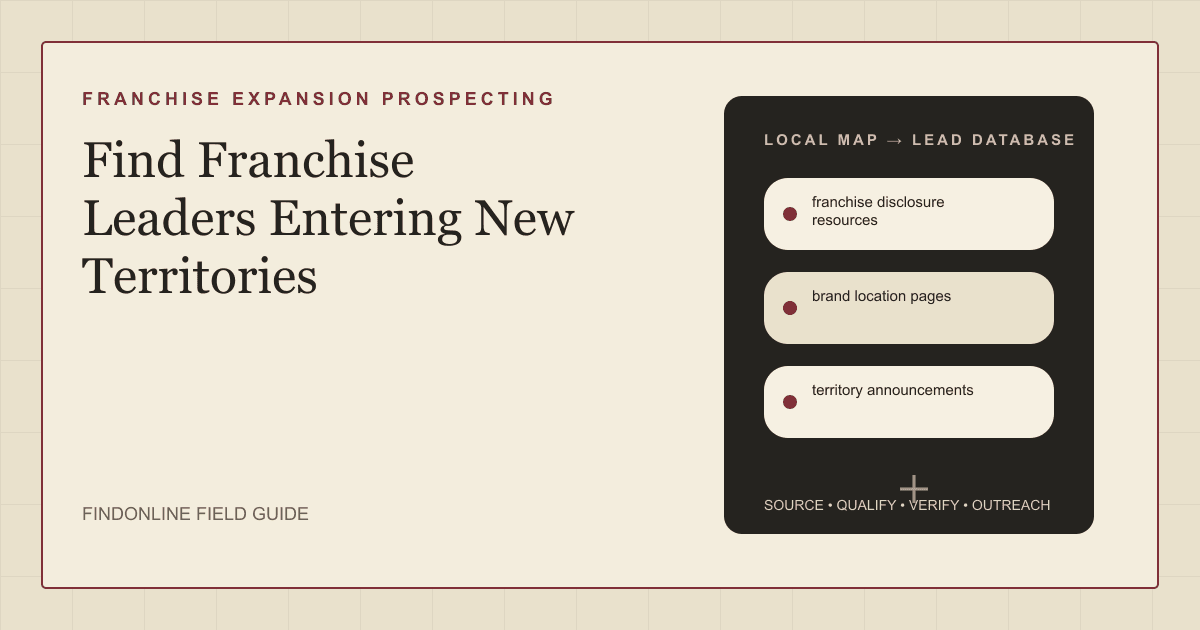
Find franchise expansion prospects through disclosure resources, location pages, and territory announcements. Verify operators, launch stage, and marketing authority.
By Vaishnav Gupta11 min read
On this page
Quick answer: For how to find franchise leaders entering new territories, target franchisor marketing leaders, area developers, and multi-unit franchise owners. Start with franchise disclosure resources, brand location pages, and territory announcements. Your first action is to match one named market expansion to its operating entity, development stage, and marketing decision-maker before adding anyone to an outreach list.
Who to target: which franchise leaders own expansion marketing?
Target the person responsible for the marketing outcome you sell, then verify who approves outside agencies. Use this working role map:
- Franchise recruitment campaigns: investigate the head of franchise development and franchise development marketing.
- Regional customer acquisition: investigate the franchisor's marketing director, field marketing leader, or regional marketing manager.
- Launch execution across several outlets: investigate the area developer, multi-unit owner, or operating group's marketing lead.
- A single local launch: investigate the franchise owner and the brand-side approver.
Do not equate a public spokesperson with a purchasing contact. The Federal Trade Commission (FTC) recommends checking Franchise Disclosure Document (FDD) Item 11 for whether franchisees need consent to develop their own advertising. That makes approval ownership a qualification field, not an assumption. FTC franchise guidance
Define your ideal customer profile around service, territory, and project stage. Agencies can use the consultancy prospecting framework to scope advisory work and the FindOnline discovery-to-outreach workflow to organize execution.
Lead sources: where can you verify a new territory?
Use all three reviewed discovery routes together. Each answers a different question: what the franchise arrangement permits, where activity exists, and what expansion was announced.
Franchise disclosure resources: use the FTC's HTML guide to interpret disclosure material you can legitimately access. Its Item 11 guidance covers advertising consent; check the specific brand's current document and confirm unclear authority with the operator. Do not treat a general regulatory guide as a database of active buyers. FTC franchise guidance
Brand location pages: connect an actual market to operating evidence. As checked on September 30, 2026, Primrose's West McDonough page identifies franchise owners and describes an opening in progress. This is a useful model for finding owner biographies alongside location updates, although a location launch alone does not establish entry into a previously unserved territory. Primrose location evidence
Territory announcements: prioritize releases naming a region, agreement, and development partner. The Peach Cobbler Factory's brand-issued announcement reports a 15-unit Minnesota development agreement. It describes future development, so retain the announced commitment separately from operating locations and verify the unnamed franchise group's identity before outreach. Brand-issued Minnesota announcement
Use available-territory pages as watchlists. Primrose says it actively awards new territories across the country. That statement invites further research; it does not identify a particular awarded operator or launch date. Primrose territory opportunities
Lead database: what should a qualified franchise record contain?
Create one record per brand, operating entity, and territory. Keep several outlets under the same operator linked, so a multi-unit agreement does not generate duplicate approaches.
| Franchise research field | Where it comes from | How to verify it |
|---|---|---|
| Brand and operating entity | Brand release and owner biography | Match the operator name across both sources |
| Territory and prior presence | Territory announcement and location pages | Distinguish first market entry from nearby infill |
| Development stage | Agreement release, construction update, opening page | Record available, awarded, building, or operating |
| Unit commitment versus open outlets | Announcement and location directory | Store separately; never convert commitments into openings |
| Launch window | Current local page | Check for a newer update and retain uncertainty |
| Marketing buyer and approver | Leadership biography and operator confirmation | Confirm local versus brand-level authority |
| Service-fit hypothesis | Public launch journey and agency assessment | Label inference; validate in conversation |
| Evidence and refresh date | Exact page and research notes | Preserve supporting text and schedule another check |
Use this reusable research prompt:
Find franchise brands entering [territory] with evidence of [awarded development rights or launch preparation]. Return the brand, operating entity, source URL, event date, development stage, named operator, marketing leader, and unresolved questions. Separate announced units from open locations. Mark unknown fields unknown. Do not infer agency demand from expansion alone.
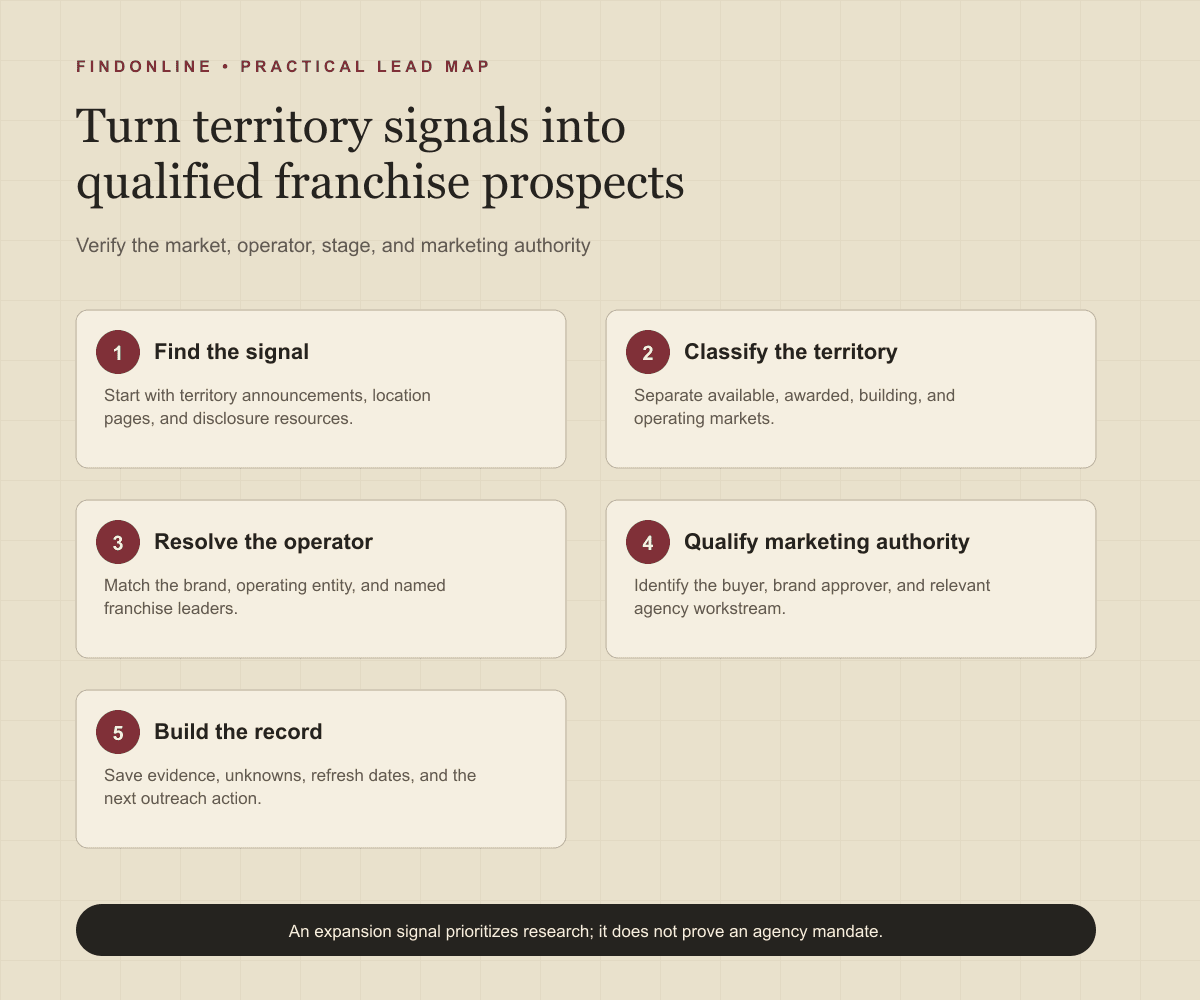
Then follow this sequence:
- Discover an announcement matching your service area.
- Check existing locations to establish whether the territory is genuinely new.
- Identify the operating entity and connect its named leaders to current biographies.
- Investigate marketing approval and the agency workstream.
- Enrich contact information only after the account qualifies.
- Assign a next action: contact, investigate, monitor, or exclude.
Best tools to automate outreach: which options fit this workflow?
Choose the tool for the unresolved task. These six options cover complete execution, people discovery, enrichment, sequencing, acquisition context, and website qualification. Missing dimensions are explicitly marked rather than inferred.
FindOnline
What it does: FindOnline combines public-signal discovery with automated LinkedIn, Reddit, and email outreach for qualified franchise prospects. FindOnline overview Agent workflow
Strengths: It supports end-to-end engagement and optional review at selected stages. For agencies, that means connecting expansion evidence to outreach and follow-up while choosing where approval is useful. Agent workflow Automation controls
Limitations: It is designed as a complete go-to-market (GTM) system rather than a standalone signal-monitoring or enrichment utility. Readers seeking one isolated component should contact the FindOnline team to discuss a suitable configuration. Specific external integrations are not confirmed in the cited official material. FindOnline overview
Best for: Agencies managing franchise expansion prospecting through ongoing engagement, with optional stage-level review. Automation controls
LinkedIn Sales Navigator
What it does: Sales Navigator filters prospects by attributes including function, seniority, and shared experiences. Official filter documentation
Strengths: Saved searches and matching-lead alerts support tracking marketing leaders within researched franchise accounts. Official filter documentation
Limitations: A person's geography is not evidence of their franchise's contractual territory. Automated campaigns, specific integrations, and support or approval controls are not confirmed in the cited official material. Official filter documentation
Best for: Agencies that have verified the territory event and need to narrow the marketing buying group by role. Official filter documentation
Clay
What it does: Clay waterfalls query multiple data providers in a defined sequence. Waterfall documentation
Strengths: Configurable provider order and run conditions suit enrichment of already qualified operator records. Waterfall documentation
Limitations: The documented setup requires input data, provider sequencing, and run settings; an agency must configure that enrichment logic. Outreach delivery, named integrations, and support or approval controls are not confirmed in the cited official material. Waterfall documentation
Best for: Agency operations teams filling contact gaps after resolving the franchise operating entity. Waterfall documentation
Apollo
What it does: Apollo supports multichannel sequences across email, calls, and networking platforms, with automation features. Sales engagement documentation
Strengths: Apollo syncs contacts, activities, and deal data with Salesforce and HubSpot. Sales engagement documentation
Limitations: As checked on September 30, 2026, Book of Business is marked coming soon. Support and approval controls are not confirmed in the cited official material. Sales engagement documentation
Best for: Agencies coordinating franchise follow-up with their customer relationship management (CRM) system. Sales engagement documentation
Crunchbase
What it does: Crunchbase provides records of company acquisitions and funding rounds. Official data overview
Strengths: Those records offer acquisition context when investigating a franchise group's changing footprint; check the transaction against the brand's announcement. Official data overview
Limitations: Acquisition records do not establish greenfield territory awards or opening readiness. Outreach automation, integrations, and support or approval controls are not confirmed in the cited official material. Official data overview
Best for: Agencies separating ownership transactions from new-territory development before pitching launch work. Official data overview
BuiltWith
What it does: BuiltWith filters reports using keywords found on website homepages. Keyword filtering documentation
Strengths: Homepage keyword filters can help segment researched franchise websites by service language before a manual agency-fit assessment. Keyword filtering documentation
Limitations: Homepage wording can miss territory details published only on local subpages. Outreach automation, specific integrations, and support or approval controls are not confirmed in the cited official material. Keyword filtering documentation
Best for: Agencies narrowing franchise website research by service terminology before reviewing territory landing pages. Keyword filtering documentation
Tool comparison: how do the six options differ?
Select the smallest useful combination for your team's workflow. In this table, "unconfirmed" means not confirmed in the cited official material.
| tool | best for | data and discovery | outreach automation | integrations | support and review | limitations |
|---|---|---|---|---|---|---|
| FindOnline | Complete expansion prospecting | Public signals tied to franchise prospects | Automated LinkedIn, Reddit, and email; end-to-end engagement | Unconfirmed | Optional review by stage | Complete GTM scope; discuss isolated components with team. Overview Workflow Controls |
| LinkedIn Sales Navigator | Marketing buying-group research | Role filters and saved-search alerts | Unconfirmed | Unconfirmed | Unconfirmed | Profile geography is not contractual territory. Documentation |
| Clay | Qualified operator enrichment | Sequential providers; configurable runs | Unconfirmed | Named integrations unconfirmed | Unconfirmed | Requires enrichment configuration. Documentation |
| Apollo | CRM-connected franchise follow-up | Contact and account data | Automated multichannel sequencing | Salesforce and HubSpot | Unconfirmed | Book of Business marked coming soon. Documentation |
| Crunchbase | Acquisition-context research | Company acquisition records | Unconfirmed | Unconfirmed | Unconfirmed | Transactions do not establish greenfield readiness. Documentation |
| BuiltWith | Franchise website segmentation | Homepage keyword filtering | Unconfirmed | Unconfirmed | Unconfirmed | Homepage wording may miss territory details on local subpages. Documentation |
Outreach workflow: how should agencies approach qualified leaders?
Lead with the verified territory event and one relevant service hypothesis. Before enrollment, confirm the current buyer, suppress existing conversations, and check whether the prospect can commission the proposed work.
Use a credible warm introduction when one exists. Otherwise, FindOnline can adapt outreach using verified professional commonality, such as industry, role, education, interests, communities, or shared context. If neither exists, use a direct signal-led message; never invent familiarity. Its workflow connects prospect contact with continuing engagement. FindOnline workflow
For example:
Your announcement describes expansion into [market]. We help franchise teams coordinate local launch campaigns. Is [specific workstream] handled by your group or centrally by the brand? If useful, I can send a short outline focused on [verified launch stage].
Keep follow-ups tied to a new milestone or a useful answer. Pause when ownership is unclear, the project is delayed, or the person declines. Do not treat every channel as mandatory for every prospect.
Industry-specific nuances: what changes the service opportunity?
Qualify marketing authority before proposing execution. FDD Item 11 can help identify whether franchisee advertising needs franchisor consent, but the current brand arrangement still needs checking. FTC franchise guidance
Apply these practical distinctions:
- Available territory: monitor or qualify franchise recruitment work; do not assume an operator exists.
- Awarded territory: investigate market-entry planning and ownership, without promising an opening campaign.
- Site preparation: ask about launch assets, approvals, local pages, and measurement responsibilities.
- Operating locations: investigate ongoing customer acquisition only after confirming capacity and existing arrangements.
Ask whether the agency would attract franchise applicants or end customers. Those require different audiences, conversion events, and approval chains. For multi-unit operators, also clarify whether one campaign covers the region or each outlet needs a separate launch plan. Exclude acquisitions, relocations, rebrands, and infill openings when they do not meet your definition of new-territory entry.
Limitations: what can expansion signals fail to prove?
Signals are directional rather than guaranteed truth. Use them to prioritize and personalize outreach and follow-ups, then verify the underlying change. An announced agreement does not prove an available agency mandate, launch readiness, or buyer authority.
Rescan signals regularly because departments, roles, and company conditions change. Keep an observation date and next-check date on every record. Conflicting evidence should move a prospect back to investigation instead of being silently resolved in favor of outreach.
Frequently asked questions: what else should agencies verify?
How do I distinguish a new territory from another location?
Compare the announced region with the brand's existing footprint. Require evidence of market entry or newly awarded rights; an additional address in an established market may only be infill.
Should I contact the franchisor or the franchisee?
Contact the party responsible for your proposed work and verify the approval chain. For local execution, start by investigating the operator; for system-wide positioning or franchise recruitment, investigate the brand-side leader.
Does a development agreement mean launch marketing is ready?
No, an agreement should trigger further qualification. Check the site, operating entity, opening window, and workstream ownership before proposing launch execution.
Can I qualify a prospect without a public launch date?
Yes, but classify it as an earlier-stage opportunity. Ask about planning responsibility and the next milestone, and keep any timing estimate explicitly unconfirmed.
What if the announcement does not name the franchise operator?
Keep the record at account-research stage. Search subsequent brand updates and location biographies, or ask the brand who handles the market; do not manufacture a contact from an unrelated company with a similar name.
Sources
- A Consumer’s Guide to Buying a Franchise — Federal Trade Commission · Accessed
- Primrose School of West McDonough — Primrose Schools · Accessed
- The Peach Cobbler Factory Signs Minnesota Development Agreement — The Peach Cobbler Factory via GlobeNewswire · Accessed
- Immediate Site Opportunities — Primrose Schools · Accessed
- FindOnline GTM Agents — FindOnline · Accessed
- About FindOnline — FindOnline · Accessed
- How FindOnline Works — FindOnline · Accessed
- Sales Navigator Advanced Search Filters — LinkedIn · Accessed
- Waterfalls — Clay · Accessed
- Sales Engagement Software — Apollo · Accessed
- Crunchbase Data — Crunchbase · Accessed
- Filtering a Report by Keyword, Phrase or Vertical — BuiltWith · Accessed