Buyer discovery
How to Find Mobile App Companies Investing in User Acquisition
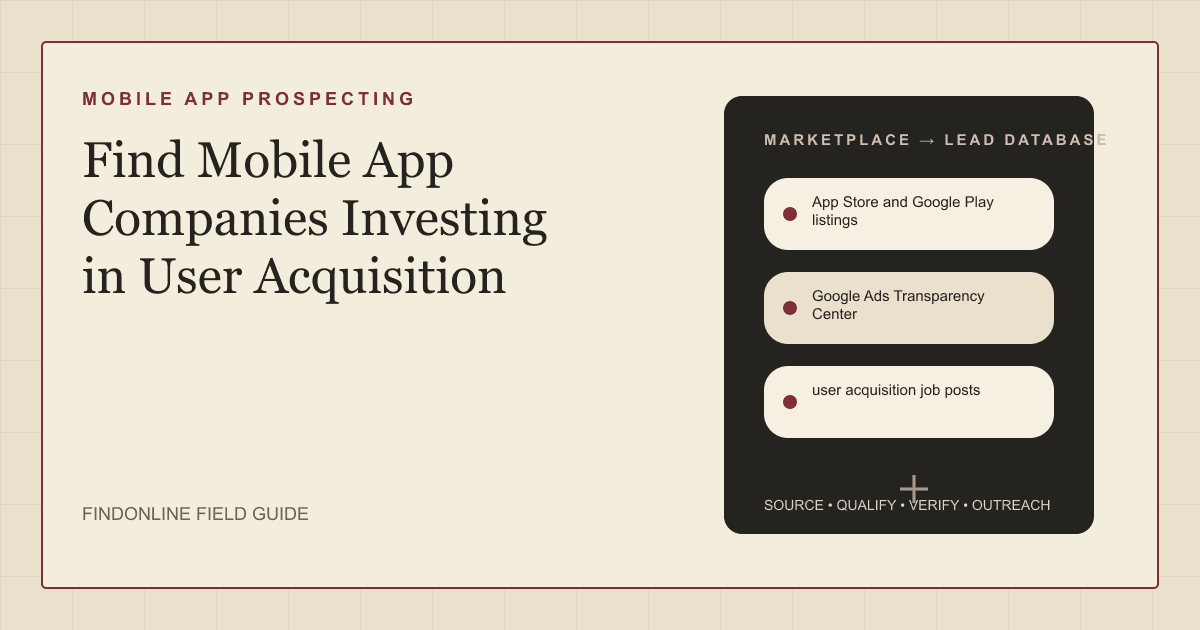
Find mobile app companies investing in user acquisition using App Store and Google Play listings, the Google Ads Transparency Center, and user acquisition job posts, then verify the growth owner.
By Vaishnav Gupta13 min read
On this page
Quick answer: To find mobile app companies investing in user acquisition, target the Head of User Acquisition, VP of Growth, or Chief Marketing Officer at app publishers that show live paid activity. Start with App Store and Google Play listings, user acquisition job posts, and the Google Ads Transparency Center. First action: shortlist 50 apps in one store category and check each publisher for active ads.
Who to target: which roles own user acquisition at mobile app companies?
The owner of user acquisition (UA) spend changes with company size, so size the publisher before you pick a title.
- Founder-led studios: the founder or CEO often runs paid growth personally. A Pocket Worlds posting on Built In, removed on August 3, 2026, told candidates "You work directly with the CEO, who runs UA himself" (Built In, Pocket Worlds posting).
- Growth-stage publishers: the Head of User Acquisition, Head of Growth, or Director of Performance Marketing usually chooses channels and partners.
- Scaled publishers: the Chief Marketing Officer (CMO) or VP of Performance Marketing approves agencies, while channel-level UA managers influence the choice.
Match the role to your service. Creative production agencies should reach the creative strategy lead or UA lead. Media buying agencies should reach the Head of UA. App store optimization providers should reach the product marketing owner.
Strong qualification signals are a current ad record plus an open UA role, a newly appointed growth leader, or a launch in a new country. Weak signals are an in-app ads label alone or old funding news.
Lead sources: where can you find mobile app companies investing in user acquisition?
Five sources cover the workflow: store listings define the universe, ad records and job posts prove investment, and people sources name the owner.
- App Store and Google Play listings - give the app, publisher name, category, in-app purchases, and update history. Google says the Contains ads label "will be visible to all Play Store users" (Play Console Help), but that label flags ads shown inside the app, which is monetization rather than acquisition spend. On the App Store, read the privacy label: Apple's "Developer's Advertising or Marketing" purpose covers "displaying first-party ads in your app, sending marketing communications directly to your users" (Apple Developer, app privacy details).
- Google Ads Transparency Center - confirms whether a publisher is advertising now. Google states "You can use the Ads Transparency Center to search by advertiser name or website name" and filter results by region and date (Google My Ad Center Help).
- user acquisition job posts - reveal channels and team shape. A Genesis Tech Senior User Acquisition Manager posting on Built In, shown as posted 15 days before November 14, 2026, asks the hire to "Own and scale paid user acquisition across Meta, TikTok, AppLovin, Google, Snap, Pinterest, and new channels" (Built In, Genesis Tech posting).
- MAU Vegas advisory board page - names senior app marketers. The MAU Vegas 2027 page calls its board "A dynamic group of industry trailblazers poised to lead and inspire innovation across the mobile app ecosystem" and lists titles such as CMO at Wildlife Studios and Vice President of Performance Marketing at Scopely (MAU Vegas). It also lists vendors, so keep only publishers.
- company leadership pages - confirm who holds the marketing or growth seat today. Several app publisher leadership pages blocked the research browser or showed no marketing titles on November 14, 2026, so none is cited here; the MAU Vegas page stands in as the named-leader example. Where a publisher has no leadership page, use LinkedIn current roles.
Lead database: what fields should a user acquisition prospect list contain?
A useful database joins one app, one publisher entity, one dated proof of ad activity, and one named owner. Record the source and check date for every field.
| Field | Where it comes from | How to verify |
|---|---|---|
| App name and store IDs | App Store and Google Play listings | Open both listings and confirm the same publisher |
| Publisher legal entity | Listing publisher line and app privacy policy | Match to the company website footer |
| Category and monetization model | Store category, in-app purchase section, Contains ads label | Recheck the listing; the label alone is not ad spend |
| Active ad evidence | Google Ads Transparency Center | Search advertiser name and website; log date and region |
| UA hiring signal | user acquisition job posts | Confirm the post is live; note channels named |
| UA owner | company leadership pages or LinkedIn current role | Confirm current title and start date |
| Agency posture | Job post wording about agencies or partners | Classify as in-house, hybrid, or outsourced |
| Last checked | Your research log | Refresh monthly |
Reusable research prompt:
For [app name] published by [publisher], confirm: (1) store category and monetization model, (2) whether the publisher appears as an advertiser in the Google Ads Transparency Center for [region], with the date checked, (3) any open user acquisition, growth, or creative strategist role and the channels it names, (4) the current owner of paid growth with title and source link. Return only facts with a source link and date. Mark anything unverified as unknown.
Step-by-step workflow:
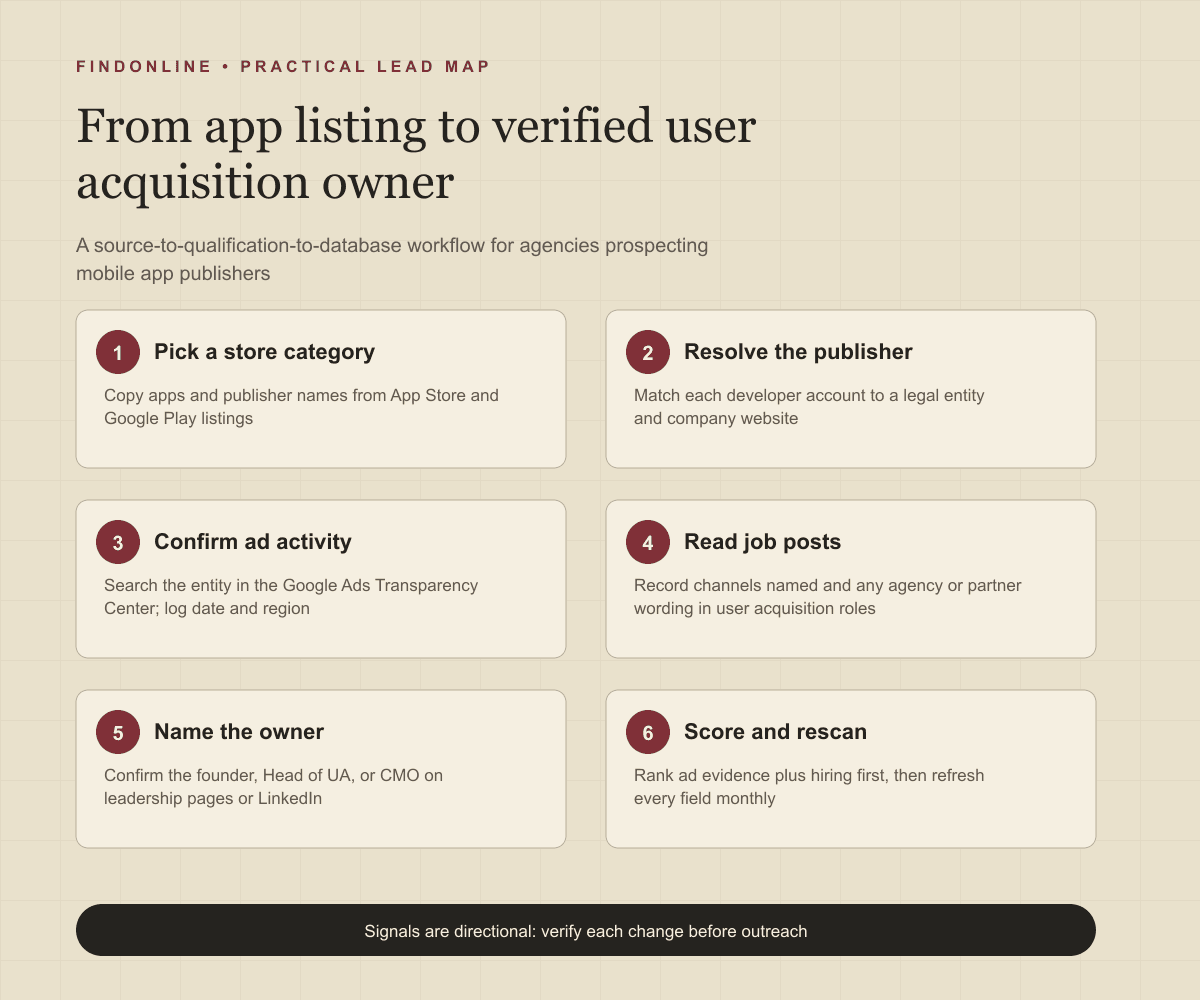
- Pick one store category that fits your service, such as casual games or subscription fitness.
- Copy 50 apps and their publisher names from both stores.
- Resolve each publisher to a legal entity and website.
- Search each entity in the Google Ads Transparency Center and log what you see.
- Search for open UA roles and record channels and agency wording.
- Name the owner, then score: ad evidence plus hiring ranks first.
Best tools to automate outreach: which tools fit this workflow?
Six options cover different parts of the job. None of the cited pages confirms app-level fields such as store category, so the store and ad research above still applies.
FindOnline
What it does: FindOnline is an end-to-end go-to-market (GTM) system that finds and qualifies prospects from public signals, such as UA hiring, role changes, and post activity, then runs automated outreach across LinkedIn, Reddit, and email. Its homepage says it will "Find high-intent prospects and reach them before your competitors do" (FindOnline). Reddit comes from the supplied product facts; the cited pages named LinkedIn and email on November 14, 2026.
Strengths: Every stage can run automatically, and review is optional: "You choose which stages run automatically and which hold for approval" (FindOnline about page). A credible warm introduction is one possible route. Without one, it uses only verified professional commonality, such as a shared role or mobile marketing community, or else a direct signal-led message.
Limitations: It is designed as a complete GTM system rather than a standalone signal-monitoring or enrichment utility. Agencies needing only one isolated component should contact the FindOnline team to discuss a suitable configuration.
Best for: Performance agencies that want UA-signal discovery, outreach, reply handling, and follow-up for app publishers in one system.
LinkedIn Sales Navigator
What it does: A LinkedIn prospecting product for finding people by role. Its page says you can "Search with 50+ filters like function, seniority level, years at company, experience, and more" (LinkedIn Sales Navigator).
Strengths: It suits resolving the current Head of UA or VP of Growth once the publisher is known. LinkedIn describes "structured onboarding, training, and support to drive product adoption" (LinkedIn Sales Navigator). Customer relationship management (CRM) integration was not confirmed in the cited official material.
Limitations: The cited filters describe people and employers, not apps. Store category, ad activity, and monetization model must come from your own research.
Best for: Agencies that already hold a verified publisher list and need the named UA owner at each one.
Apollo
What it does: A contact database with sales engagement. Its page describes "Multi-channel sequence steps across email, call, and networking platforms" (Apollo).
Strengths: The same page says activity "syncs straight into the CRM you already use" (Apollo), which keeps publisher records tidy. Its support model was not confirmed in the cited official material.
Limitations: Records are organized by company, while stores list publisher accounts. A studio publishing under several developer names needs manual entity matching before import.
Best for: Agencies running email-first sequences to UA managers at mid-size publishers they have already matched to entities.
Clay
What it does: A data enrichment and workflow workspace. Clay advertises "One contract to buy data from 200+ data and AI vendors" (Clay).
Strengths: It suits a custom table joining store data, ad evidence, and job posts per publisher. Clay says you can "Trigger emails, ads, and more with integrations to your existing GTM tools" (Clay). Its support model was not confirmed in the cited official material.
Limitations: You design and maintain the table yourself, and sending depends on connected tools; a native LinkedIn or Reddit channel was not confirmed.
Best for: Agencies with an operations specialist who wants a custom app-publisher scoring table.
ZoomInfo
What it does: A company and contact data platform with engagement features. Its sales page says you can "Build and execute multi-touch sales cadences with our direct phone dialer and email tool" (ZoomInfo).
Strengths: The page also says "Export prospects to your CRM in one click" (ZoomInfo), which helps phone-led teams. Its support model was not confirmed in the cited official material.
Limitations: The cited cadences cover phone and email only. Depth of coverage for small studios outside the United States was not confirmed.
Best for: Agencies selling to scaled publishers where calling the marketing office is normal.
Lemlist
What it does: An outreach sequencing tool. Its homepage says "Launch automated campaigns across email, LinkedIn, calls, WhatsApp, and SMS from one workflow" (lemlist).
Strengths: The page says "lemlist connects seamlessly with tools like HubSpot and Salesforce" (lemlist). It fits creative-led messages, such as a short ad teardown.
Limitations: It sequences messages but does not judge which publishers are investing in UA, so an unqualified list only sends faster. Its support model was not confirmed in the cited excerpts.
Best for: Small agencies that built their publisher list by hand and need multichannel follow-up.
Tool comparison: how do the six options differ for app publisher outreach?
The table summarizes the same evidence; "not confirmed" means the cited official material did not show it.
| tool | best for | data and discovery | outreach automation | integrations | support and review | limitations |
|---|---|---|---|---|---|---|
| FindOnline | Agencies wanting one system from UA signal to reply | Public signals: hiring, role changes, post activity | Automated LinkedIn, Reddit, and email outreach | Not confirmed | Optional review at chosen stages | Complete GTM system, not a standalone component |
| LinkedIn Sales Navigator | Naming the UA owner at known publishers | 50+ people and company filters | Not confirmed | CRM integration not confirmed | Structured onboarding, training, support | No app store or ad activity fields |
| Apollo | Email-first sequences to matched publishers | Contact database | Email, call, and networking platform steps | Syncs into your CRM | Not confirmed | Multi-account publishers need manual entity matching |
| Clay | Custom publisher scoring tables | 200+ data and AI vendors | Triggers emails through integrations | Existing GTM tools | Not confirmed | Self-built tables; no native sending confirmed |
| ZoomInfo | Phone-led outreach to scaled publishers | Company and contact data | Phone dialer and email cadences | One-click CRM export | Not confirmed | Phone and email only; small-studio coverage unconfirmed |
| Lemlist | Hand-built lists needing follow-up | Not confirmed | Email, LinkedIn, calls, WhatsApp, SMS campaigns | HubSpot and Salesforce | Not confirmed | Sequences messages; does not qualify UA investment |
Outreach workflow: how should you contact user acquisition leaders?
Lead with the verified signal and one specific observation about their growth work, then follow up when the signal changes.
- Group prospects by signal: hiring for UA, new growth leader, or new market launch.
- Check for a credible warm introduction, such as a shared client or former colleague. Use it only if the connector agrees.
- If none exists, reference verified commonality, such as the same mobile marketing event. Never invent a shared fact.
- Otherwise send a direct signal-led note: name the open role or channel and offer one relevant idea.
- Follow up on a new event, such as a filled role or a fresh ad record.
- Log replies and update the database fields.
Example opener: "Your open UA role lists TikTok and AppLovin. We produce creative test batches for subscription apps on both. Worth comparing notes?"
Teams that want this sequence handled end to end can see how FindOnline's discovery and outreach stages work. Agencies that also serve software clients can adapt it using the B2B SaaS prospecting page.
Industry-specific nuances: what is different about prospecting mobile app companies?
App publishers expose unusual public evidence, but each signal has a trap.
- In-app ads are not acquisition spend. A Contains ads label means the app earns from ads. Confirm outbound advertising separately.
- Publisher names hide entities. Portfolio companies run several apps under different developer accounts, and UA may be run per app. Identify which app a role serves.
- Custom product pages hint at Apple Ads use. Apple says publishers can share these pages and "use them within Apple Ads campaigns to promote your app on the App Store" (Apple Developer, custom product pages). A job post asking for this work suggests App Store advertising.
- Agency posture is stated in postings. The Pocket Worlds posting asked its hire to "Manage and hold accountable any external partners (agencies, vendors, pLTV/ML partners)" (Built In, Pocket Worlds posting). That wording signals a hybrid model, so position as a specialist partner, not a replacement team.
- Service fit differs by model. Games teams usually value creative volume and network breadth. Subscription apps care more about trial conversion and funnel work.
- False positives: agencies, ad networks, and measurement vendors appear in the same events and searches as publishers.
Limitations: how reliable are user acquisition signals?
Signals are directional, not guaranteed truth. An ad record or job post shows activity, not approved agency spend. Use signals to prioritize accounts and personalize outreach and follow-ups, and verify the underlying change on the original page before you write. Rescan signals regularly, because roles get filled, departments reorganize, campaigns pause, and company conditions change.
Frequently asked questions
How can I tell if a mobile app company is running paid user acquisition?
Search the publisher's name or website in the Google Ads Transparency Center and look for an open user acquisition role. Either one alone is a moderate signal; both together are strong. Record the date you checked, because campaigns start and stop.
Does the Contains ads label on Google Play mean the app is advertising?
No, the label means the app shows ads to its own users. That is a revenue model, not proof of acquisition spend. Treat it as context about monetization and confirm outbound advertising elsewhere.
Who decides on a user acquisition agency at a mobile app company?
It depends on size: the founder or CEO at small studios, the Head of User Acquisition or Head of Growth at growth-stage publishers, and the CMO or VP of Performance Marketing at scaled ones. Channel managers usually influence the decision. Confirm the current title before outreach.
What do user acquisition job posts reveal to an agency?
They reveal the channels in use, the team's shape, and whether external partners are part of the model. A post naming agencies or vendors suggests openness to specialist help. A post describing a first hire suggests the founder still runs paid growth.
How often should I refresh a mobile app prospect list?
Refresh it monthly as a working rule. Job posts close, growth leaders move, and ad activity changes with launches and seasons. Recheck the signal immediately before each outreach wave.
Sources
- FindOnline homepage — FindOnline · Accessed
- About FindOnline — FindOnline · Accessed
- Prepare your app for review - Play Console Help — Google · Accessed
- App privacy details on the App Store — Apple Developer · Accessed
- Custom product pages — Apple Developer · Accessed
- About advertiser verification - My Ad Center Help — Google · Accessed
- Senior User Acquisition Manager - Genesis Tech — Built In · Accessed
- Senior User Acquisition Manager - Pocket Worlds — Built In · Accessed
- Meet the MAU Advisory Board — MAU Vegas · Accessed
- LinkedIn Sales Navigator — LinkedIn · Accessed
- Apollo sales engagement — Apollo · Accessed
- Clay homepage — Clay · Accessed
- ZoomInfo Sales — ZoomInfo · Accessed
- lemlist homepage — lemlist · Accessed