Buyer discovery
How to Find Companies Expanding Into New States
Find companies expanding into new states using Secretary of State foreign registration filings, state economic development announcements, new office releases, and state-filtered job posts, then verify the owner or CFO.
By Vaishnav Gupta13 min read
On this page
Quick answer: To find companies expanding into new states, target owners, CFOs, and controllers at companies that just filed a foreign registration, announced a new office or facility, or started hiring in a state where they had no staff. The strongest sources are Secretary of State foreign registration filings and state economic development announcements. Start by pulling last month's new foreign registrations in your home state and checking each company's headquarters state.
Who to target: which roles own the multistate decision?
Target the person who signs the state registration and approves the first out-of-state payroll. At owner-led companies that is the founder or owner. Where a finance team exists it is the CFO, VP of Finance, or controller, plus the head of people when the trigger is remote hires. Public companies route multistate tax to a tax director, so they suit only specialist state and local tax practices.
Qualification signals that matter:
- The state is genuinely new. A release calling a site the sixteenth office says nothing about the state. Check the headquarters state and locations page first.
- Payroll follows the office. The SBA notes that the need for a state tax ID number ties directly to whether a business must pay state taxes (SBA, Get federal and state tax ID numbers). That registration is the first conversation.
- Nexus arrives before registration. The Texas Secretary of State states that the threshold level of activity required for a tax nexus is generally lower than the registration threshold (Texas Secretary of State, Foreign or Out-of-State Entities). Companies owe tax before they think to register.
False positives include companies with existing remote staff in the state, headquarters relocations that close the old state, and agent-service registrations for entities with no operations yet.
Lead sources: where does evidence of a new-state expansion appear first?
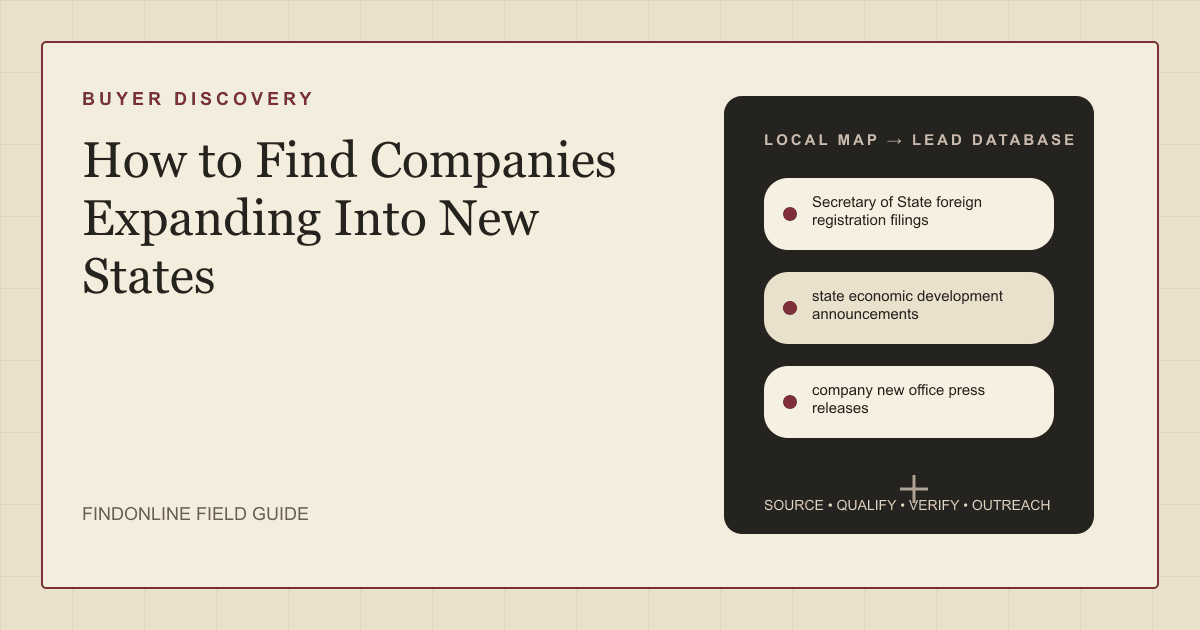
- Secretary of State foreign registration filings are the earliest formal evidence. The SBA explains that foreign qualification notifies the state that a foreign business is active there, and that to foreign qualify a company files a Certificate of Authority with the state (SBA, Register your business). Texas lists late filing fees owed by an entity registering more than 90 days after first transacting business (Texas Secretary of State, Foreign or Out-of-State Entities). Search your state's entity register for companies formed elsewhere with filing dates in the last 60 days.
- state economic development announcements name the company, headquarters, investment, and job count. The Tennessee Department of Economic and Community Development reported on October 19, 2026 that ITT Goulds Pumps, headquartered in Seneca Falls, New York, is establishing its first Tennessee location in Shelby County, and that ITT Goulds Pumps plans to invest $31 million and create 57 new jobs in Memphis (TNECD, ITT Goulds Pumps announcement). Every state agency publishes a comparable feed.
- company new office press releases often precede the agency release. Starbucks announced on April 21, 2026 that its Southeast corporate office in Nashville will employ up to 2,000 people over the next several years (Starbucks Investor Relations, Southeast corporate office release). Search the phrase first office in [state] to surface smaller firms that no agency covers.
- state-filtered LinkedIn job posts corroborate the other sources. LinkedIn Help explains that you narrow job results by entering a location such as a city or state in the location field, and can show only jobs posted within the last 24 hours, the past week, or the past month (LinkedIn Help, Filter and sort job search results). A posting tied to one city in a state where the company had no office supports the expansion. A posting open in ten states supports nothing.
The reviewed hint about state foreign entity registrations appears here as Secretary of State foreign registration filings. Florida's Division of Corporations search and the Texas Comptroller nexus page blocked the research browser, so SBA and Texas Secretary of State guidance stand in.
Lead database: which fields turn expansion evidence into a working list?
Build one row per company and new state. Each field, its source, and its check:
| Field | Source | Verification |
|---|---|---|
| Company and home state | Announcement, about page | Match the legal name on the home-state register |
| New state | Agency or company release | Confirm no prior location on the locations page |
| Expansion type | Release wording | Office, plant, distribution center, HQ move, or remote hires |
| Foreign registration date | New-state Secretary of State search | Record filing date and registered agent |
| Planned jobs and investment | State agency release | Copy figures and release date exactly |
| In-state hiring evidence | LinkedIn jobs filtered by state | Save the posting URL and posted date |
| Finance owner | Leadership page, LinkedIn profile | Confirm current title and tenure |
Reusable research prompt:
For [company], confirm the headquarters state and existing US locations, and state whether [new state] is new. Record the announcement date, planned jobs, investment, and opening timing. Identify the owner, CFO, or controller and any job post located in [new state]. Mark anything unverified.
Step-by-step workflow:
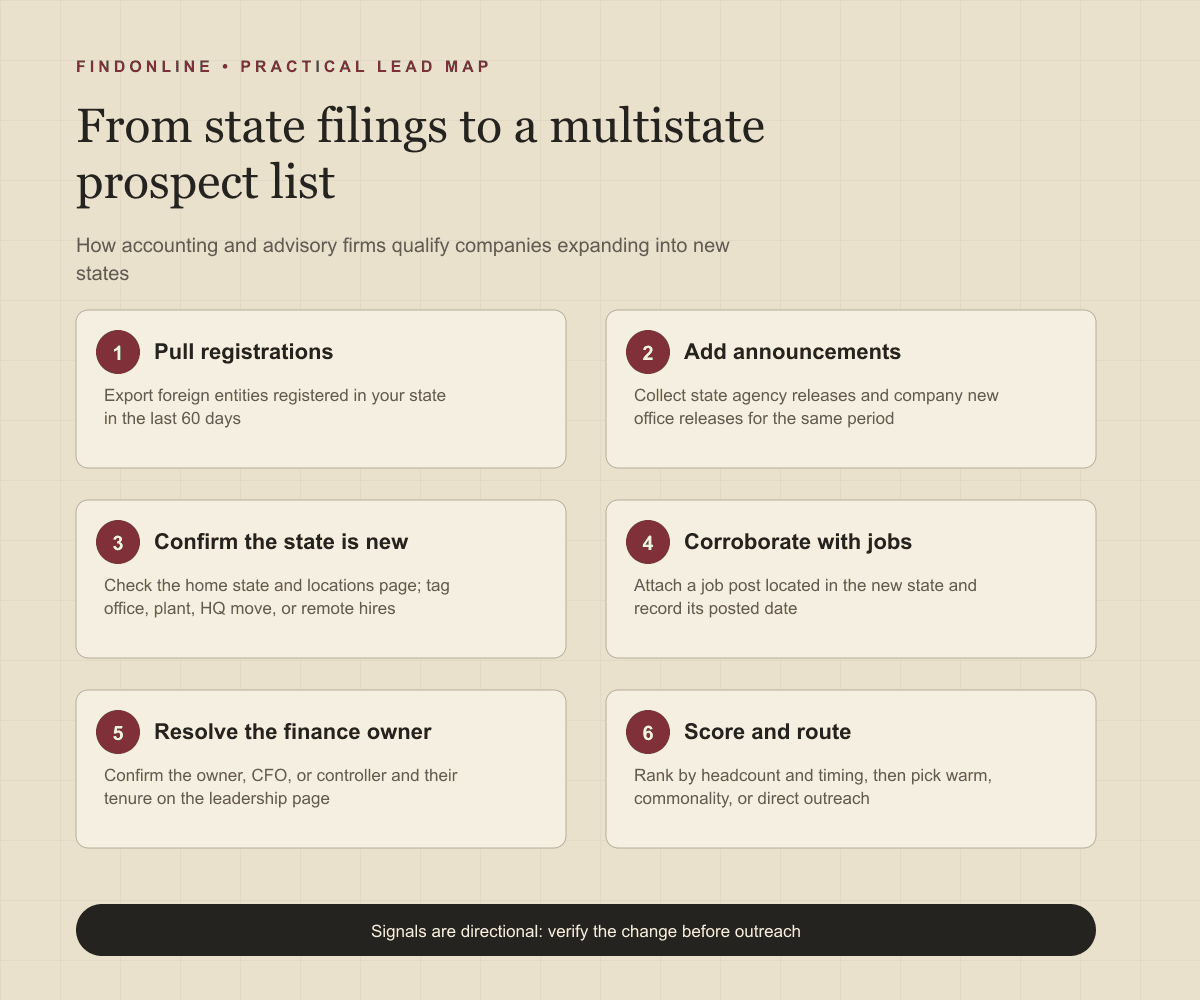
- Export foreign registrations filed in your target state in the last 60 days and drop entities with no website or staff.
- Add companies from the state agency feed and company releases for the same period.
- Resolve each company's home state and existing locations, then tag the expansion type.
- Attach a state-filtered job post with its posted date where one exists.
- Resolve the finance owner and score rows by planned headcount, opening timing, and whether a finance seat exists.
The same register-first approach for overseas headquarters is covered in how to find international companies opening US offices, and accounting-firm positioning sits on the FindOnline page for accounting firms.
Best tools to automate outreach: which platforms fit a new-state expansion list?
FindOnline
What it does: FindOnline's homepage describes AI GTM agents for LinkedIn, Reddit and Email, and says the agent spots buying signals like hiring, promotions and funding (FindOnline). Its about page says the agent finds and contacts high-intent prospects and that you choose which stages run automatically and which hold for approval (FindOnline, About).
Strengths: It watches public hiring signals, runs discovery through replies automated across LinkedIn, Reddit, and email, and holds any stage for optional review. A credible warm introduction is one route, verified commonality another, and a direct signal-led message the fallback.
Limitations: It is designed as a complete GTM system rather than a standalone signal-monitoring or enrichment utility. Firms wanting only a registration alert feed or one-off enrichment should contact the FindOnline team to discuss a suitable configuration.
Best for: Accounting and advisory firm owners who want expansion signals, finance-owner identification, and LinkedIn and email follow-up in one system, with approval holds where they want them.
LinkedIn Sales Navigator
What it does: Sales Navigator's official page says you can search with 50+ filters like function, seniority level, years at company, experience, and more (LinkedIn Sales Navigator).
Strengths: It resolves the CFO or controller and surfaces new hires located in the new state. Support runs through an AI-powered Help Center virtual agent that delivers 24/7 self-service support (LinkedIn Sales Navigator).
Limitations: It holds no registration or incentive data, and member location is self-declared, so it cannot confirm a state is new. Email sequencing and CRM integration are not confirmed in the cited official material.
Best for: Firm owners resolving the finance seat after the expansion is confirmed elsewhere.
Apollo
What it does: Apollo's search page says you can search by region to see total available accounts and contacts, that signals trigger sequences, dialing tasks, and workflows automatically, and that a bi-directional sync with Salesforce, HubSpot, and Pipedrive keeps data aligned (Apollo, Search).
Strengths: Region sizing, contact records, and sequences sit in one tool.
Limitations: Its region search sizes a market by current location and its triggers are company-level signals, not state registrations, so build the new-state logic first. Support model not confirmed in the cited official material.
Best for: Firms that keep a signal spreadsheet and want contacts and sequences attached to it.
Clay
What it does: Clay's homepage says you can enrich, score, and route every lead to the right rep in minutes, and trigger emails, ads, and more with integrations to your existing GTM tools (Clay).
Strengths: A table seeded from registrations can be enriched with the finance owner and scored by timing.
Limitations: It sends through other tools rather than running conversations itself, and every table needs someone to build and maintain it. Support model not confirmed in the cited official material.
Best for: Firms with an operations person who will own the table and the downstream sending tools.
ZoomInfo
What it does: ZoomInfo's sales page says you can build and execute multi-touch sales cadences with its direct phone dialer and email tool, and export prospects to your CRM in one click (ZoomInfo, Sales).
Strengths: Direct dials and cadences help reach finance leaders at mid-market expanders.
Limitations: Its cadences and dialer suit a phone-led sales team, and the cited material confirms no state expansion or registration signal. Support model not confirmed in the cited official material.
Best for: Larger firms with a sales team calling finance leaders at companies announcing plants or regional offices.
Lemlist
What it does: Lemlist's homepage says you can launch automated campaigns across email, LinkedIn, calls, WhatsApp, and SMS, and that its support team is just a click away via the in-app chat (lemlist).
Strengths: Email and LinkedIn steps run from one sequence.
Limitations: It has no expansion or registration signal of its own, so it treats a headquarters relocation like a first-state office unless you segment. CRM integrations not confirmed in the cited official material.
Best for: Firm owners who hold a verified list and want automated email-plus-LinkedIn follow-ups.
Tool comparison: how do the six options differ for this list?
| tool | best for | data and discovery | outreach automation | integrations | support and review | limitations |
|---|---|---|---|---|---|---|
| FindOnline | Firm owners wanting signals, routing, and outreach together | Public signals such as hiring, promotions, and funding | LinkedIn, Reddit, and email, automated end to end | Not confirmed in the cited official material | Optional review at stages you choose | Complete GTM system, not a standalone utility |
| LinkedIn Sales Navigator | Resolving the finance seat and in-state hires | 50+ filters on LinkedIn member data | Not confirmed in the cited official material | Not confirmed in the cited official material | AI Help Center virtual agent, 24/7 self-service | No registration data; location self-declared |
| Apollo | Contacts and sequences for a signal list | Region search for accounts and contacts | Signal-triggered sequences and dialing tasks | Bi-directional Salesforce, HubSpot, Pipedrive sync | Not confirmed in the cited official material | Company-level triggers, no registration logic |
| Clay | Teams with an operator to own a table | Enrich, score, and route leads | Triggers emails through integrated tools | Integrations with existing GTM tools | Not confirmed in the cited official material | Sends through other tools; tables need upkeep |
| ZoomInfo | Sales teams calling mid-market finance leaders | Contact and company database | Multi-touch cadences, dialer, email | One-click CRM export | Not confirmed in the cited official material | Dialer-led; expansion signals not confirmed |
| Lemlist | Multichannel follow-ups on a verified list | Not confirmed in the cited official material | Email, LinkedIn, calls, WhatsApp, SMS campaigns | Not confirmed in the cited official material | In-app chat support | No expansion signal; relies on your segmentation |
Outreach workflow: what should the first message to an expanding company say?
Lead with the public fact and one question. A first message to the controller at a company opening a Memphis facility names the announcement and planned headcount, then asks whether Tennessee withholding and unemployment registrations are set up ahead of the first hires. Keep it under 80 words and never assert knowledge of their tax position.
Choose the route before writing:
- Warm introduction when a current client, banker, or attorney genuinely knows the owner. One option, not the default.
- Verified commonality when you share an industry, association, or community you can prove. Context only.
- Direct signal-led message when neither exists. The announcement is reason enough.
Time follow-ups to the event: a registration checklist two weeks later, then a note near the opening date. On reply, offer a new-state nexus review, not a full-firm proposal. Running this sequence with stage-level approval is described on the FindOnline how it works page.
Industry-specific nuances: what changes the pitch for a multistate expansion?
- Expansion type sets the service. An office with payroll creates withholding and unemployment registrations. A plant or distribution center adds sales and use tax, property tax, and often incentive compliance. Remote hires create payroll obligations without an address, which owners notice last.
- Incentive deals create reporting work. Announcements citing investment and job figures, like the ITT Goulds Pumps release, usually rest on performance commitments the company must report against. Offer to own that calendar.
- The 90-day window is the outreach window. Texas adds late filing fees once an entity registers more than 90 days after starting business, so the first quarter after an announcement is when registration help sells.
- Owner-led companies buy the package; CFO-led companies buy a workstream. Pitch registration, payroll setup, and the first state return together to an owner. Pitch a single new-state nexus review to a CFO who already has a home-state firm, positioning yourself as the in-state specialist rather than a replacement.
Limitations: how reliable are expansion signals?
Expansion signals are directional, not guaranteed truth. A foreign registration can precede a project that stalls, and a release can describe a state the company already served remotely. Use signals to prioritize which companies to research first and to personalize the opening message and follow-ups, then verify the change on the register, the locations page, and the job post. Then rescan the sources monthly, because finance owners change, openings slip, and conditions shift before the first annual report.
Frequently asked questions
How do I find companies that recently registered to do business in my state?
Search your Secretary of State business entity register for foreign entities with recent filing dates. The record shows the home state and registered agent. Export the last 30 to 60 days and remove entities with no website or staff.
Is a new office announcement enough to qualify a company as expanding into a new state?
No. Check the locations page and the state register to confirm there was no prior location. Many releases count offices without saying whether the state is new, and relocations are a different buying situation.
Who should an accounting firm contact at a company opening a facility in a new state?
The owner or CEO at owner-led companies, and the CFO or controller where a finance team exists. Add the head of people for remote hiring. Public companies usually route the work to a tax director.
When is the best time to reach out after an expansion announcement?
Within the first 90 days after the announcement or registration, before the first in-state payroll requires withholding registration. After the opening date, shift the offer to the first state return and incentive reporting.
Sources
- Register your business — U.S. Small Business Administration · Accessed
- Get federal and state tax ID numbers — U.S. Small Business Administration · Accessed
- Foreign or Out-of-State Entities — Texas Secretary of State · Accessed
- ITT Goulds Pumps Announces Establishment of Tennessee Manufacturing, Distribution Presence in Shelby County — Tennessee Department of Economic and Community Development · Accessed
- Starbucks Selects Tennessee for Southeast Corporate Office — Starbucks Investor Relations · Accessed
- Filter and sort job search results — LinkedIn Help · Accessed
- FindOnline homepage — FindOnline · Accessed
- About FindOnline — FindOnline · Accessed
- LinkedIn Sales Navigator — LinkedIn · Accessed
- Apollo Search — Apollo · Accessed
- Clay homepage — Clay · Accessed
- ZoomInfo Sales — ZoomInfo · Accessed
- lemlist homepage — lemlist · Accessed