Buyer discovery
How to Find International Companies Opening US Offices
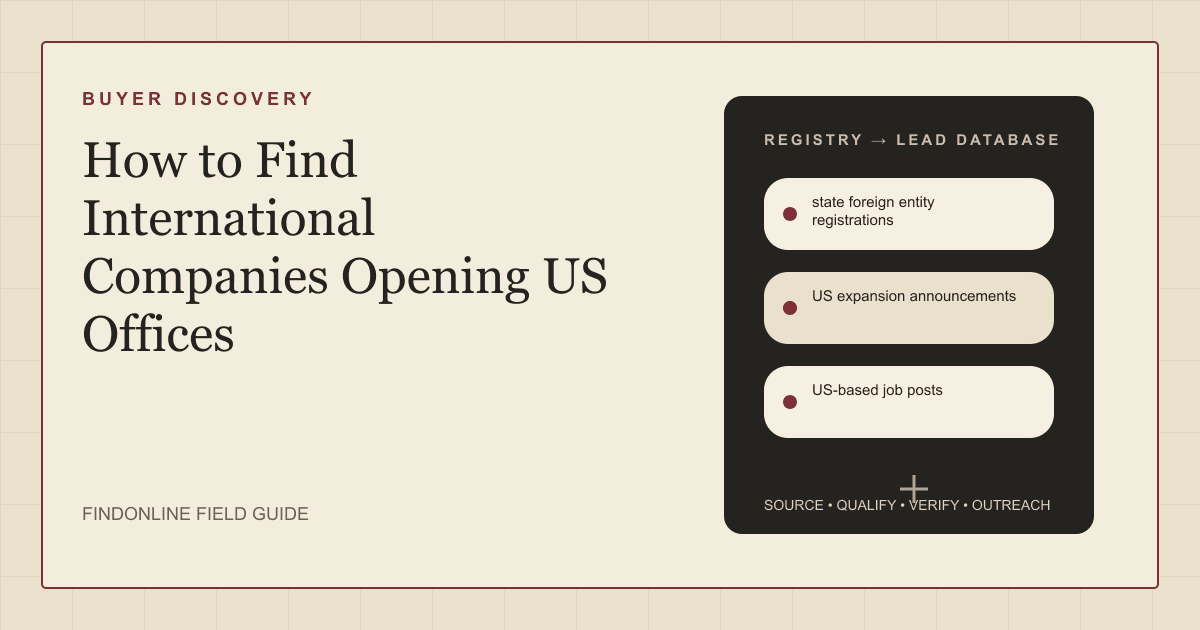
Find international companies opening US offices using state foreign entity registrations, US expansion announcements, and US-based job posts, then verify the HQ sponsor and the first US leader before outreach.
By Vaishnav Gupta15 min read
On this page
Quick answer: To find international companies opening US offices, target the headquarters executive sponsoring the entry and the first US leader they appoint. The strongest discovery sources are state foreign entity registrations, US expansion announcements from governors and commerce agencies, and US-based job posts from foreign-headquartered companies. Start by pulling last month's new foreign qualifications in your target states and matching each filing to its overseas parent.
Who to target: which roles own the US entry decision?
Target two people per company: the headquarters (HQ) sponsor and the first US leader. Before any US hire exists, the CEO, CFO, or head of international expansion at HQ controls the budget. Once a US country manager or general manager for North America is in seat, that person selects local recruiters, advisers, and vendors.
- Recruiters and staffing firms: the HQ head of talent plus the US country manager. The trigger is the first US leadership or sales posting, which usually precedes a wave of local hires.
- Market entry consultants: the HQ CEO, CFO, or expansion lead, reached at registration or announcement stage while the plan is still open.
- Immigration counsel, employer of record (EOR), payroll, tax, and office providers: the HQ CFO or general counsel at registration stage, then the US lead once appointed.
Treat these as false positives: companies with an existing US subsidiary adding a second site, foreign owners that bought a US business rather than opening one, remote US postings that an EOR can fill without an entity, and out-of-state US companies, which every state also calls "foreign".
Staffing and search firms can see how this list feeds a placement pipeline on the recruitment and staffing workflow, and advisory firms can use the consultancy prospecting page.
Lead sources: where do international companies opening US offices show up first?
Foreign companies expanding to the US surface in state filings first, then in state announcements, then in job posts. Work the sources in that order to reach the HQ sponsor before competitors who only watch hiring.
- state foreign entity registrations are the earliest public footprint. New York's Department of State explains that "A foreign business corporation may apply for authority to do business in NYS by filing an Application for Authority." (New York Department of State). California's Secretary of State states that "Before transacting intrastate business in California, the business must first qualify/register" (California Secretary of State). Run a foreign entity registration search in each state's business database and keep only entities formed outside the US. Delaware's foreign qualification page was not readable today, so New York and California stand in as worked examples.
- US expansion announcements from governors and commerce departments name the parent, site, job count, and often the US leader. Illinois reported on October 8, 2026 that "Aermec chose to locate its first U.S. manufacturing site right here in DeKalb" (Office of the Governor of Illinois). North Carolina announced on June 30, 2026 that Goldhofer Inc. will create 80 jobs in Catawba County and noted that "Companies receive no money upfront and must meet job creation and capital investment targets to qualify for payment." (Office of the Governor of North Carolina). Performance-based grants make announced hiring contractual.
- US-based job posts confirm the entry is funded. On LinkedIn, "You can filter your job search by a specific company or multiple companies." (LinkedIn Help). Search titles such as Country Manager US or General Manager North America, set the location to the United States, and keep companies headquartered abroad.
- international company careers pages show first US hire signals before aggregators copy them. Hypatos, a German software company, posted a remote Country Manager US role that will "Build and manage a high-performing US sales and business development team." (Hypatos careers). Wording like this signals a first US leader rather than a replacement.
- BEA new foreign direct investment data tells you which countries, industries, and states to prioritize. The Bureau of Economic Analysis (BEA) reported on June 10, 2026 that "Expenditures by foreign direct investors to acquire, establish, or expand U.S. businesses totaled $232.2 billion in 2025" (Bureau of Economic Analysis), with Japan, Germany, and Canada the largest sources. The same release shows acquisitions dwarf new establishments, so deal news mostly surfaces companies that already have US staff.
All three reviewed starting points were readable today and are retained; the two added sources narrow and prioritize the same list.
Lead database: how should you structure the list?
Build one row per parent company, not per filing, because a single entry can produce a Delaware formation, a New York qualification, and a Texas registration within weeks.
| Field | Where it comes from | How to verify |
|---|---|---|
| Parent name and HQ country | Jurisdiction of formation on the filing | Match to the parent's own website |
| US entity and state | Secretary of State business search | Confirm the filing date is in your window |
| Entry type | Announcement wording | Classify as new site, expansion, or acquisition |
| Announced jobs and investment | Governor or commerce release | Check against the company's own release |
| Entry stage | Filing date, job posts, named US lead | Rescan every 30 days |
| HQ sponsor and US lead | Release quotes, leadership page, job post | Confirm current title on LinkedIn |
| Open US roles | LinkedIn jobs, careers page | Count by function |
| Service trigger and last verified | Stage plus roles; research log | One trigger sentence; date of latest check |
Reusable research query:
Find companies headquartered outside the United States that registered a new US entity in [state] or announced a first US office or site in [state] since [date]. Return parent name, HQ country, US entity, filing or announcement date, announced jobs, entry stage (registered, announced, hiring, leader appointed), HQ sponsor, US leader, and source URL.
Workflow:
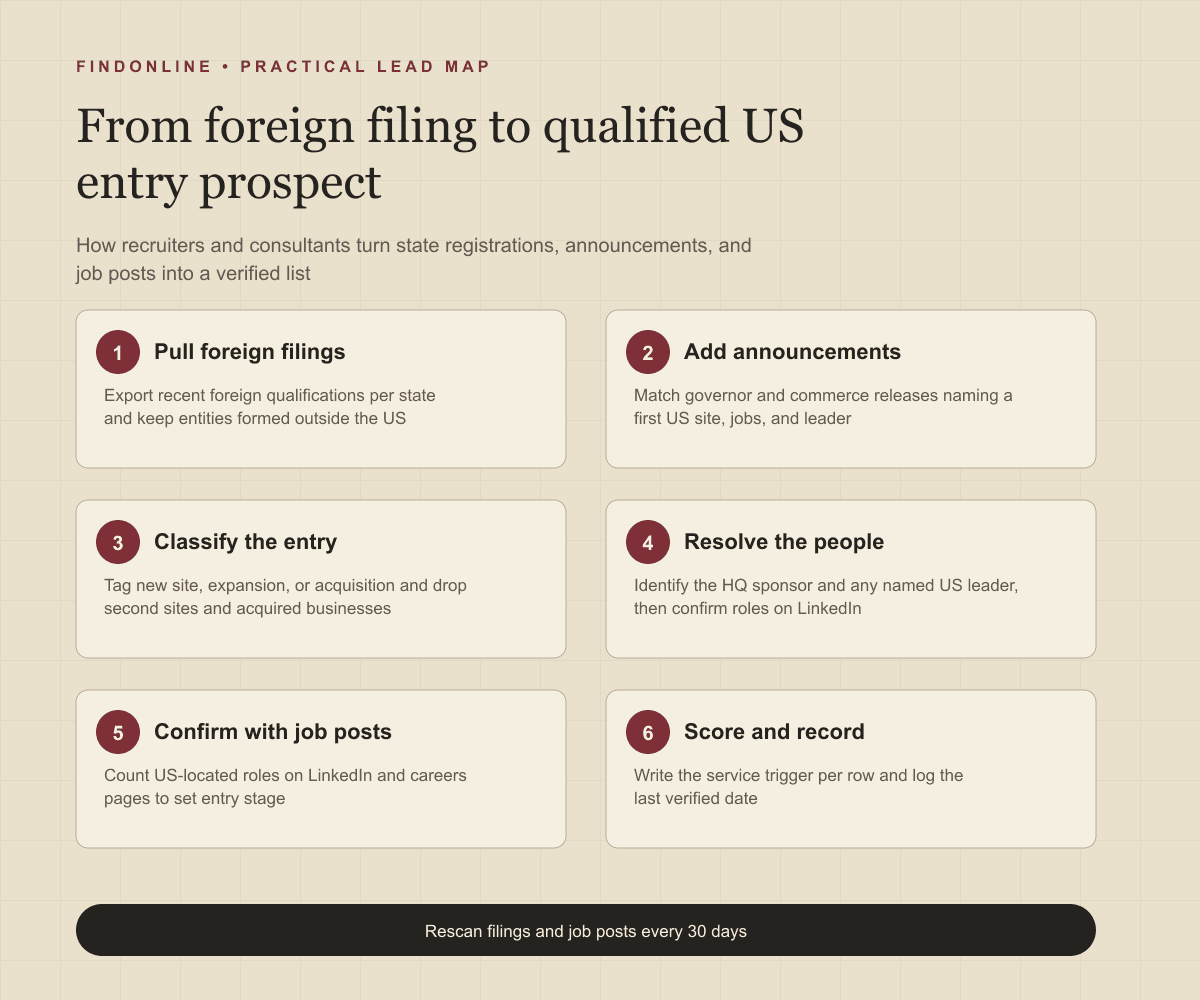
- Export the last 30 days of foreign qualifications per target state and remove US-formed entities.
- Add parents named in governor and commerce releases for the same period.
- Classify entry type and stage, then drop acquisitions and second sites.
- Resolve the HQ sponsor and any US leader, and count open US roles.
- Write the trigger sentence your service answers and log the verification date.
Best tools to automate outreach
The six options below cover signal discovery, contact data, and multi-channel sequencing. None exports a foreign-filing feed, so the state registration step stays manual or scripted in every stack.
FindOnline
What it does: FindOnline is an end-to-end AI GTM system whose agents find and qualify prospects from public signals such as role changes, hiring, and posts, then contact them on the three channels its homepage names: "AI GTM agents for LinkedIn, Reddit and Email." (FindOnline). Reply handling and ongoing post engagement run inside the same workflow rather than in a separate tool. Strengths: It can watch for a newly appointed US country manager or first US job posts and add those people to campaigns automatically, while teams decide what runs unattended: "You choose which stages run automatically and which hold for approval." (FindOnline about). A credible warm introduction is one possible route; otherwise it adapts the message using verified professional commonality such as industry, role, or communities, or sends a direct signal-led message. Limitations: It is designed as a complete GTM system rather than a standalone signal-monitoring or enrichment utility, so a team that only wants a filings feed should contact the FindOnline team to discuss a suitable configuration. Best for: Recruiters and consultants who want US entry signals turned into LinkedIn, Reddit, and email conversations with HQ sponsors and new US leaders without stitching together separate monitoring, enrichment, and sequencing tools.
LinkedIn Sales Navigator
What it does: Sales Navigator is LinkedIn's prospecting layer. Its official page says you can "Search with 50+ filters like function, seniority level, years at company" and bring LinkedIn data "into CRMs like HubSpot Smart CRM, Oracle Sales, Microsoft Dynamics 365, and Salesforce" (LinkedIn Sales Navigator). Strengths: Alerts on saved leads flag role changes, which is how you catch a new US country manager, and the page describes an AI help assistant for self-service support (LinkedIn Sales Navigator). Limitations: No filter identifies a foreign parent or a brand-new US entity, so the account list must come from filings and announcements first, and the page ties CRM features to its top plan. Best for: Recruiters who already hold a parent-company list and want role-change alerts on the HQ sponsor and incoming US leader.
Apollo
What it does: Apollo combines a contact database with sales engagement. Its sales engagement page describes "Multi-channel sequence steps across email, call, and networking platforms" and states that "Apollo syncs contacts, activities, and deal data with CRMs like Salesforce and HubSpot" (Apollo sales engagement). Strengths: Sequences, dialer, and tasks run in one workflow, so a consultant can call the HQ sponsor and email the US lead from the same record (Apollo sales engagement). Limitations: The database does not flag state registration or entry stage, so sequences only run well on rows you qualified elsewhere; support options were not confirmed in the cited official material. Best for: Consultancies with an SDR who will load a pre-qualified entry list and run email-plus-call sequences to HQ finance and expansion leaders.
Clay
What it does: Clay is a data orchestration workspace. Its homepage says you can "Create intent signals from anything on the internet." and "Keep CRM records accurate, complete, and continuously refreshed with live data." (Clay). Strengths: A table can watch announcement and careers pages for the phrases in this guide and enrich each parent with HQ country and leaders (Clay). Limitations: Every signal and the filings-to-leader logic must be designed and maintained by your team; support was not confirmed in the cited official material. Best for: Agency operators who build their own enrichment tables and want entry stage scored before rows reach outreach.
ZoomInfo
What it does: ZoomInfo is a B2B database with intent data. Its sales page claims you can "Access 420M+ global contacts including 120M+ direct dials and 145M+ companies" and "Export prospects to your CRM in one click." (ZoomInfo Sales). Strengths: Global coverage helps resolve HQ executives at the overseas parent, and intent scores based on content consumption can show when a parent researches US services (ZoomInfo Sales). Limitations: A US entity formed last month may not yet appear in the database, and content-based intent cannot see a foreign qualification filing; support was not confirmed in the cited official material. Best for: Specialist providers prospecting HQ finance and legal leaders at larger overseas parents where direct dials matter.
Lemlist
What it does: Lemlist is a campaign tool. Its homepage says you can "Launch automated campaigns across email, LinkedIn, calls, WhatsApp, and SMS from one workflow." and that the "support team is just a click away via the in-app chat" (Lemlist). Strengths: Multi-channel steps suit a two-person target, with LinkedIn touches for the US lead and email for the HQ sponsor, and the page lists HubSpot and Salesforce connections (Lemlist). Limitations: Its lead database is generic and carries no US entry signal, so campaigns stay only as good as the imported list. Best for: Small recruiting firms that qualify entries by hand and want one simple multi-channel campaign per parent company.
Tool comparison: which option fits your US entry workflow?
Entry-stage qualification stays with you in every option, so judge each tool on what it adds after that step.
| tool | best for | data and discovery | outreach automation | integrations | support and review | limitations |
|---|---|---|---|---|---|---|
| FindOnline | Recruiters and consultants turning signals into conversations | Public signals such as role changes, hiring, and posts | Automated LinkedIn, Reddit, and email outreach with reply handling | Not confirmed in the cited official material | Optional review holds on chosen stages | Complete GTM system, not a standalone filings feed |
| LinkedIn Sales Navigator | Recruiters tracking HQ sponsors and incoming US leaders | 50+ filters and role-change alerts on saved leads | Not confirmed in the cited official material | HubSpot, Oracle, Dynamics 365, Salesforce on top plan | AI help assistant | Cannot filter for foreign parent or new US entity |
| Apollo | Consultancies running email and call sequences | Contact database without entry-stage flags | Multi-channel sequences, dialer, and tasks | Salesforce and HubSpot sync | Not confirmed in the cited official material | Only as good as the qualified list you load |
| Clay | Operators building their own scoring tables | Custom signals from announcement and careers pages | Triggers actions through connected tools | CRM refresh and GTM tool triggers | Not confirmed in the cited official material | Signal logic must be built and maintained yourself |
| ZoomInfo | Providers targeting HQ finance and legal leaders | Large global contact data and content-based intent | Connects to sales engagement tools | One-click CRM export | Not confirmed in the cited official material | New US entities may be missing; intent misses filings |
| Lemlist | Small firms running simple multi-channel campaigns | Generic lead database without entry signals | Email, LinkedIn, calls, WhatsApp, and SMS campaigns | HubSpot and Salesforce | In-app chat support | No US entry signal in its own data |
Outreach workflow: how do you sequence contact across HQ and the US?
Open with the HQ sponsor on the filing or announcement, then add the US leader as soon as one is named. Keep both threads consistent so neither person hears a different pitch.
- Lead with the trigger. Name the state, the date, and the stage you observed, such as the 80-job Catawba County commitment or a fresh New York Application for Authority.
- Route by relationship evidence. Use a warm introduction only when a shared investor, adviser, or former colleague genuinely exists. Otherwise rely on verified professional commonality, such as the same industry or community, and never invent familiarity.
- Match the channel to the person. HQ sponsors tend to answer email in their working hours; new US leaders are often active on LinkedIn in their first weeks.
- Follow up on stage changes. A new job post, a named US leader, or a second state registration is the reason for the next message.
- Hand off cleanly. Once the US leader is in seat, move the conversation to them and tell the HQ sponsor you have done so.
FindOnline runs this sequence across LinkedIn, Reddit, and email with optional holds on any stage; the how FindOnline works page shows how signal detection, routing, and reply handling connect.
Industry-specific nuances: what changes when the buyer sits overseas?
- Time the service to the stage. Immigration counsel, EOR services, and registered agents sell before the first hire; recruiters sell once the US leader is named; office and insurance providers sell when a site is announced.
- Read the grant terms. Performance-based state grants pay only after job targets are met, so announced headcount is a commitment rather than an aspiration.
- Separate greenfield from acquisition. BEA data shows acquisitions dominate foreign investment, and an acquired US business already has payroll, counsel, and recruiters in place.
- Expect a remote first leader. The Hypatos posting is remote, so qualify the US lead by authority over US hiring rather than by city.
- Work across time zones. Schedule sends for the HQ morning in Germany, Japan, or Canada and check the parent's holidays before judging silence.
Limitations: what these signals cannot tell you
Signals are directional rather than guaranteed truth. A foreign qualification shows intent to operate, not a budget for your service, and an announced opening can slip by quarters. Use signals to prioritize and personalize outreach and follow-ups, verify the underlying change on the filing or release itself, and rescan the sources regularly because departments, roles, and company conditions change.
Frequently asked questions
How do I tell a foreign-country company from an out-of-state US company in state filings?
Check the jurisdiction of formation on the filing, because states label both as foreign. Keep only entities formed outside the United States, then confirm the parent on its own website. If the filing lists only a US registered agent, look for the parent address elsewhere in the record.
Who is the first person to contact at an international company opening a US office?
Contact the HQ executive sponsoring the entry, usually the CEO, CFO, or head of international expansion, until a US leader is named. Once a country manager or general manager for North America is appointed, that person owns local vendor and recruiting decisions. Keep both informed so the thread survives the handoff.
Can job posts alone find international companies hiring in the US for a first office?
No, because job posts miss companies that have registered but not yet hired, and remote US roles may be filled through an employer of record without a US entity. Combine job posts with state registrations and announcements, then use the posts to confirm funding and stage. The job post is the best trigger for recruiters and the latest trigger for market entry consultants.
How often should I rescan the sources for US market entry prospects?
Rescan state filings and job posts every 30 days and announcement pages weekly. A company that was a consulting prospect one month becomes a recruiting prospect the next once a US leader is appointed. Log the last verified date on every row so stale rows are easy to spot.
Sources
- Foreign Business Corporations — New York Department of State · Accessed
- Business Entities Frequently Asked Questions — California Secretary of State · Accessed
- Gov. Pritzker Announces Aermec to Establish First U.S. Manufacturing Site in DeKalb — Office of the Governor of Illinois · Accessed
- Goldhofer Inc. Selects Hickory for Its U.S. Headquarters and First North American Production Facility — Office of the Governor of North Carolina · Accessed
- Filter and sort job search results — LinkedIn Help · Accessed
- Country Manager US — Hypatos · Accessed
- New Foreign Direct Investment in the United States, 2025 — Bureau of Economic Analysis · Accessed
- FindOnline AI GTM agents — FindOnline · Accessed
- About FindOnline — FindOnline · Accessed
- LinkedIn Sales Navigator — LinkedIn · Accessed
- Apollo Sales Engagement — Apollo · Accessed
- Clay GTM data and enrichment platform — Clay · Accessed
- ZoomInfo Sales — ZoomInfo · Accessed
- lemlist multichannel outreach — Lemlist · Accessed