Buyer discovery
How to Find Finance Leaders at Growing Manufacturers
Find finance leaders at growing manufacturers using manufacturer directories, state expansion press releases, and leadership pages, then verify ownership type and incentive obligations before accounting outreach.
By Vaishnav Gupta12 min read
On this page
Quick answer: Target the CFO, VP of finance, or controller at manufacturers that have announced a facility expansion, and the owner where the company is too small to employ one. The strongest discovery sources are the IndustrySelect manufacturer database, state economic development press releases, and Area Development expansion news. Start by listing announced expansions in your service states, then confirm the finance owner on each company's leadership page.
Who to target: which finance roles own the accounting decision at a growing manufacturer?
The buyer is whoever approves outside accounting, tax, and advisory spend, and that depends on company size and ownership.
- Owner-led manufacturers under roughly 50 employees. The owner or president decides, with a controller or office manager running the books. Area Development reports that for Virginia Steel and Fabrication "The $3.6 million project is expected to create 52 jobs in Bland County," which suggests a small finance function about to grow (Area Development).
- Mid-market private manufacturers. A CFO or VP of finance decides, often with a broad remit. The Marena Group's leadership page says its CFO "has led Finance, Accounting, Information Technology, Legal and Human Resources," which is typical of a mid-market CFO who buys several advisory services at once (The Marena Group).
- PE-backed, public, or foreign-owned manufacturers. A private equity-backed CFO still decides, with the sponsor as an influence. Public and foreign-owned plants keep finance at headquarters with existing audit relationships, so qualify them out unless you serve that segment.
Plant controllers help with cost accounting projects but rarely sign engagement letters.
Lead sources: where do growing manufacturers and their finance leaders show up?
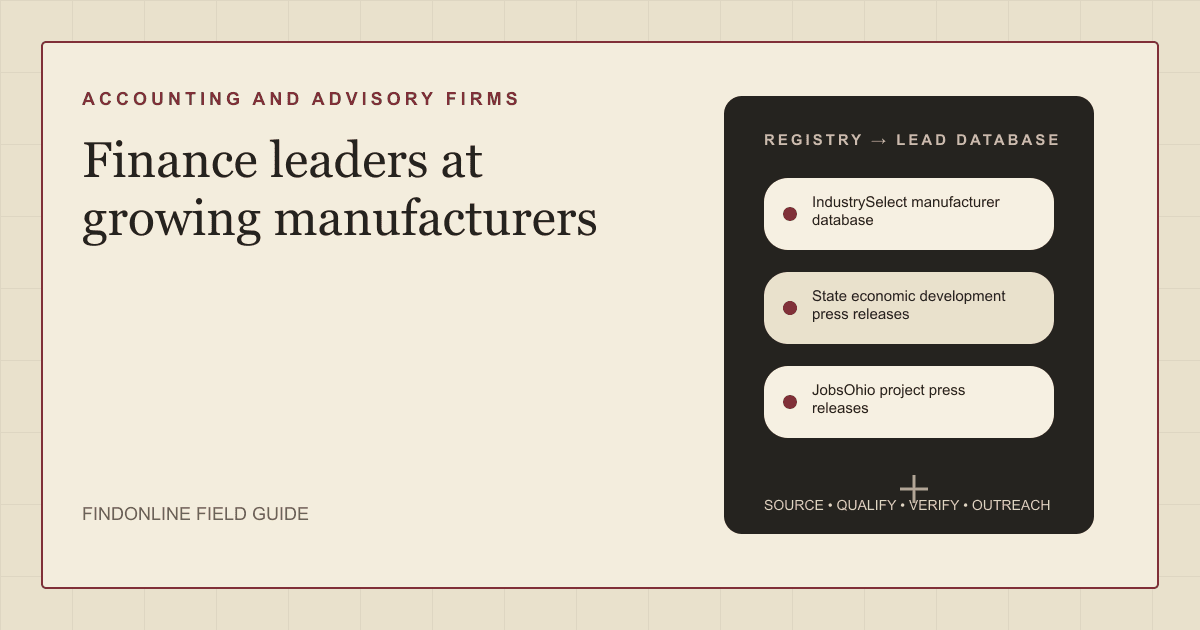
Use a manufacturer directory to size the universe, expansion announcements to find timing, and leadership pages to name the finance owner. Thomasnet blocked retrieval during research, so the IndustrySelect manufacturer database replaces it as the directory source.
IndustrySelect manufacturer database. The platform behind Manufacturers' News profiles nearly 350,000 U.S. manufacturers and 850,000 executive contacts. It says you can "Identify your best prospects by company location, industry, and size" and "Target decision-makers by name, title, and job function to build contact lists" (IndustrySelect).
State economic development press releases. Agencies publish a release for each supported project, naming investment, job types, and incentives. JobsOhio project press releases are a good example: the Vertiv release states that "New roles at the facility are expected to include mechanical, electrical, assembly, quality, production maintenance, and supervisory positions" (JobsOhio). Repeat the scan for every agency in your service states.
Area Development expansion news. This dated feed covers individual projects nationally. Its Virginia Steel item says the investment will include "fully automated manufacturing equipment and infrastructure upgrades," which signals capital spending that needs fixed-asset and depreciation work (Area Development).
Company leadership pages. Once you have a company, its leadership page confirms the finance owner's name and remit, as the Marena bio above shows. Where no finance title appears, record the owner or president.
Lead database: what fields should a manufacturing finance-leader list contain?
Build one row per company that pairs the expansion event, ownership type, and verified finance owner.
| Field | Source | Verification |
|---|---|---|
| Company name and website | IndustrySelect record | Match the release name to the directory record |
| Expansion event: investment, jobs, operational date | State agency release, Area Development | Re-read the release; recheck every 90 days |
| Ownership type: owner-led, PE-backed, public, subsidiary | Leadership page, release wording | Look for sponsor names, tickers, or a foreign parent |
| Finance leader name, title, and remit | Company leadership page | Confirm the current role on LinkedIn within 30 days |
| Incentive obligations and service trigger | State agency release | Record grants, tax credits, and job commitments; assign the first service |
| Relationship route | Your network, shared associations | Record only a credible introducer or verified commonality |
Reusable research prompt. "For [company name] in [state], find the latest expansion announcement with investment, jobs, and operational date; ownership type and any sponsor or parent; the current finance leader's name, title, and remit; any state grant or tax credit named; and any publicly named accounting firm. Cite each URL."
Step-by-step workflow:
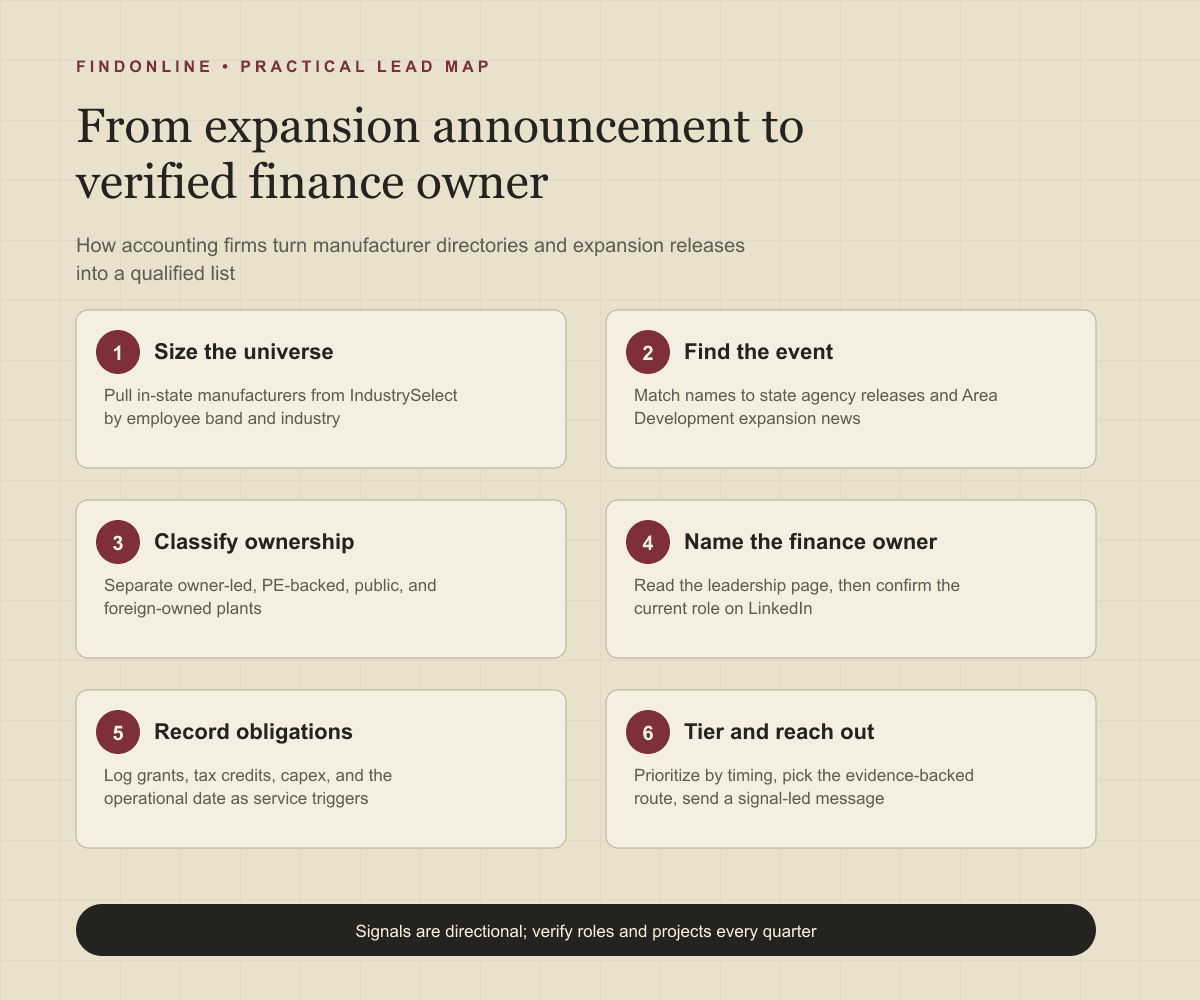
- Pull manufacturers in your service states from IndustrySelect, filtered to your target employee band.
- Scan six months of state agency releases and Area Development news for matching names, and add new names that fit.
- Classify ownership, then record the finance owner from the leadership page.
- Verify the current role on LinkedIn, then assign a service trigger and a priority tier.
Best tools to automate outreach: which platforms fit this workflow?
FindOnline
What it does: FindOnline finds and qualifies prospects from public signals, selects an evidence-backed relationship route, and runs outreach end to end. Its site describes "AI GTM agents for LinkedIn, Reddit and Email" (FindOnline), and its product page says "Your AI agent finds and contacts high-intent prospects, engages with their posts, tracks their professional events" (FindOnline how it works).
Strengths: Discovery, routing, outreach, and reply handling run as one automated system, and "You choose which stages run automatically and which hold for approval" (FindOnline about). That optional review lets a partner approve the first message to a CFO while follow-ups run automatically. See the accounting-firm prospecting overview.
Limitations: FindOnline is designed as a complete GTM system rather than a standalone signal-monitoring or enrichment utility, so a firm that wants only an expansion-alert feed or contact enrichment should contact the FindOnline team to discuss a suitable configuration. CRM integrations are not confirmed in the cited official material.
Best for: Accounting and advisory firm owners who want expansion-driven manufacturer prospecting, finance-leader outreach, and follow-up handled end to end, with chosen stages held for partner approval.
LinkedIn Sales Navigator
What it does: Sales Navigator is LinkedIn's prospecting layer. Its page says you can "Search with 50+ filters like function, seniority level, years at company, experience, and more" (LinkedIn Sales Navigator).
Strengths: The page describes alerts when saved leads change job or role and says you can "Add leads instantly, saving time and cutting down manual entry" to a CRM (LinkedIn Sales Navigator).
Limitations: Automated sequences and email sending are not confirmed in the cited official material, so every message is written and sent by a person.
Best for: Partners who verify roles themselves and send a few hand-written messages to manufacturing CFOs each week.
ZoomInfo
What it does: ZoomInfo Sales pairs a contact database with engagement tools. Its page says you can "Access 420M+ global contacts including 120M+ direct dials and 145M+ companies to define and filter your target market" (ZoomInfo).
Strengths: Direct dials reach plant finance leaders who avoid LinkedIn. The page says prospects export to a CRM in one click and teams can "Build and execute multi-touch sales cadences with our direct phone dialer and email tool" (ZoomInfo).
Limitations: Its intent data is built to "Track website visitors and identify accounts researching solutions like yours" (ZoomInfo), a weak trigger for accounting services because a controller at a 60-person fabricator rarely researches audit firms online.
Best for: Firms with a dedicated business development caller who wants direct dials for manufacturing finance contacts.
Apollo
What it does: Apollo's sales engagement page lists "Multi-channel sequence steps across email, call, and networking platforms" and "Context-aware email drafting from real-time contact and account data" (Apollo).
Strengths: The page says Apollo "syncs contacts, activities, and deal data with CRMs like Salesforce and HubSpot" (Apollo), so follow-up activity lands in the firm's CRM.
Limitations: Apollo's drafting draws on its own contact and account data, not state releases, so incentive and capex context must be added as custom fields before it can be used.
Best for: Firms that already keep a verified manufacturer list and want sequenced email and call follow-up logged to Salesforce or HubSpot.
Clay
What it does: Clay enriches lists and triggers actions from signals. Its signals page says you can "Trigger automations when people change jobs or get promoted, or when companies make new hires" (Clay).
Strengths: The page says you can "pair it with the right automated or manual actions on your CRM, email, Slack, or other platforms" (Clay), so a new-CFO alert can route to a partner for review.
Limitations: Clay is a build-it-yourself layer: someone at the firm must design and maintain the tables and signal rules, and sending depends on connected tools.
Best for: Firms with an operations-minded marketer who will own a custom table joining directory records, expansion events, and role changes.
Lemlist
What it does: Lemlist runs multichannel campaigns. Its site says you can "Launch automated campaigns across email, LinkedIn, calls, WhatsApp, and SMS from one workflow" (Lemlist).
Strengths: Replies land in one unified inbox, and "With native integrations, MCP, and API access, it fits right into your team's existing workflow" (Lemlist).
Limitations: Lemlist has no discovery layer. It expects you to "Upload leads from your CRM or CSV and enrich them" (Lemlist), so it cannot surface a newly announced expansion on its own.
Best for: Firms that have finished qualification and want a combined email and LinkedIn campaign to a short list of finance leaders.
Tool comparison: how do the six options differ?
| tool | best for | data and discovery | outreach automation | integrations | support and review | limitations |
|---|---|---|---|---|---|---|
| FindOnline | Firm owners automating expansion-driven manufacturer outreach end to end | Public signals: post activity, hiring, role changes, professional events | Automated LinkedIn, Reddit, and email outreach with reply handling | Not confirmed in cited official material | Optional review of chosen stages | Complete GTM system, not a standalone signal feed or enrichment utility |
| LinkedIn Sales Navigator | Partners sending hand-written messages after verifying roles | 50+ filters; job and role change alerts | Automated sequences not confirmed | Add leads to a CRM instantly | Manual tool; support not confirmed | Email sending not confirmed |
| ZoomInfo | Firms with a business development caller | 420M+ contacts, 120M+ direct dials; visitor intent | Multi-touch cadences with dialer and email | One-click CRM export | Rep-run cadences; support not confirmed | Intent reflects online vendor research, weak for accounting services |
| Apollo | Firms with a verified list wanting sequenced email and calls | Contact and account data; no expansion discovery | Multi-channel steps across email, call, and networking platforms | Salesforce and HubSpot sync | Rep-run sequences; support not confirmed | Incentive and capex context must be added as custom fields |
| Clay | Marketer building a custom signal table | Job change, promotion, and new-hire signals | Automated or manual actions from signals | CRM, email, Slack, other platforms | Actions per signal; support not confirmed | Tables and rules must be built and maintained |
| Lemlist | Firms with a finished list running email and LinkedIn campaigns | Upload from CRM or CSV, then enrich | Automated campaigns across email, LinkedIn, calls, WhatsApp, and SMS | Native integrations, MCP, and API access | Unified inbox; support not confirmed | No discovery layer; cannot surface new expansions |
Outreach workflow: how should an accounting firm contact these finance leaders?
Lead with the expansion and one finance consequence.
- Tier by timing and ownership. Owner-led and PE-backed manufacturers with an operational date inside 18 months go first.
- Pick the route. A credible warm introduction is one possible route, not the default. Without one, use only verified professional commonality such as membership in the same state manufacturers association. If neither exists, send a direct signal-led message and never invent familiarity.
- Write around the release. Example for a controller: "Saw the [state] release on your [city] expansion and the [grant name] award. Firms at this stage usually need help capitalizing new equipment and filing the first incentive compliance report."
- Run four touches over four weeks. LinkedIn connection note, email with a checklist, a second email tied to a project milestone, and a final LinkedIn message, with replies handed to a partner within one business day.
FindOnline runs steps two through four automatically and can hold the first message for partner approval, as the how FindOnline works walkthrough describes.
Industry-specific nuances: what makes manufacturing finance outreach different?
- Incentive compliance is the sharpest trigger. Grants and job creation tax credits carry job and investment commitments that must be reported, so a firm offering incentive compliance has a reason to call the week the release appears.
- Automation capex changes the books. Releases describing automated equipment, as the Virginia Steel item does, mean fixed-asset capitalization, depreciation method choices, and sales and use tax questions on equipment.
- New production lines need cost accounting. A plant adding capacity for a new product, as the Vertiv release describes for thermal management systems, needs standard costs, overhead allocation, and inventory valuation updates.
- Crossing a state line creates nexus work. A first out-of-state plant brings payroll registration, apportionment, and franchise tax questions. Lead with multi-state tax.
- False positives. Screen out headquarters or engineering expansions at public companies, re-announcements of earlier projects, and plants whose parent sits abroad.
Staffing-focused readers can use the same announcements through the manufacturer HR leader workflow for new facilities.
Limitations: what can these signals not tell you?
Expansion announcements, directory records, and leadership pages are directional signals, not proof that a finance leader is ready to change advisors. Use them to prioritize and personalize outreach and follow-ups, then verify the underlying change: the project is still proceeding, the person still holds the role, and no firm was just appointed. Rescan every quarter, because operational dates slip, controllers get promoted, CFOs leave after sponsor exits, and company conditions change.
Frequently asked questions
What title should an accounting firm contact at a growing manufacturer?
Contact the CFO or VP of finance at mid-market manufacturers and the owner or president at companies under roughly 50 employees. Controllers help with cost accounting projects but usually do not sign engagement letters.
Where can I find manufacturing facility expansion announcements for free?
State economic development agency newsrooms and Area Development's news feed publish expansion announcements without a subscription. State releases are the most detailed because they name incentives, job types, and sometimes operational dates.
What accounting services do expanding manufacturers need first?
Incentive compliance reporting, fixed-asset accounting for new equipment, and cost accounting for new lines come first. Multi-state tax follows when the expansion crosses a state line.
How soon after an expansion announcement should I reach out?
Reach out within a few weeks of the release and before the operational date, while the finance leader is planning the project's accounting. Avoid the weeks around year-end close.
Sources
- IndustrySelect manufacturer database — IndustrySelect (Manufacturers' News) · Accessed
- Vertiv Announces Expansion of Two Ohio Facilities — JobsOhio · Accessed
- Virginia Steel and Fabrication Expands in Bastian, Virginia — Area Development · Accessed
- Our Leadership Team: Brandon Brown — The Marena Group · Accessed
- FindOnline — FindOnline · Accessed
- How FindOnline Works — FindOnline · Accessed
- About FindOnline — FindOnline · Accessed
- LinkedIn Sales Navigator — LinkedIn · Accessed
- ZoomInfo Sales — ZoomInfo · Accessed
- Apollo Sales Engagement — Apollo · Accessed
- Clay Signals — Clay · Accessed
- lemlist — lemlist · Accessed