Buyer discovery
How to Find CIOs at Mid-Market Manufacturing Companies
Build a verified manufacturing CIO list using Thomasnet, current-role profiles, and technology job posts, then qualify plant-system needs before outreach.
By Vaishnav Gupta11 min read
On this page
Quick answer: To find CIOs at mid-market manufacturing companies, target the chief information officer and verify who owns enterprise systems versus plant technology. Start with Thomasnet manufacturer records, LinkedIn current-role profiles, and manufacturers’ technology job posts. First define your size band and manufacturing segment, then connect each company to a current technology leader and a documented operational need.
Who to target: which manufacturing leaders own the decision?
Build the list around responsibility, with the CIO as the starting contact. For this workflow, define mid-market using your own documented employee or revenue range; do not assume every directory uses the same definition. Record whether that range applies to the operating company or its parent.
Search chief information officer, VP of IT, IT director, and head of information technology. LinkedIn supports filters for function, seniority, content keywords, memberships, and shared experiences. Apply them within verified manufacturing accounts, then corroborate employment on a company biography or recent announcement. LinkedIn filter documentation
Map an additional technical owner to the service you sell:
- Cloud services: ask who owns infrastructure, identity, and application hosting.
- Cybersecurity: establish the security sponsor and the plant-system stakeholder.
- Enterprise applications: identify the enterprise resource planning, or ERP, owner.
- Factory integration: identify the manufacturing execution system, or MES, owner and plant engineering counterpart.
Treat this as a research checklist, not an assumed organization chart. Keep plant managers as potential stakeholders rather than automatically labeling them enterprise technology buyers.
Lead sources: where can you find manufacturers and current IT ownership?
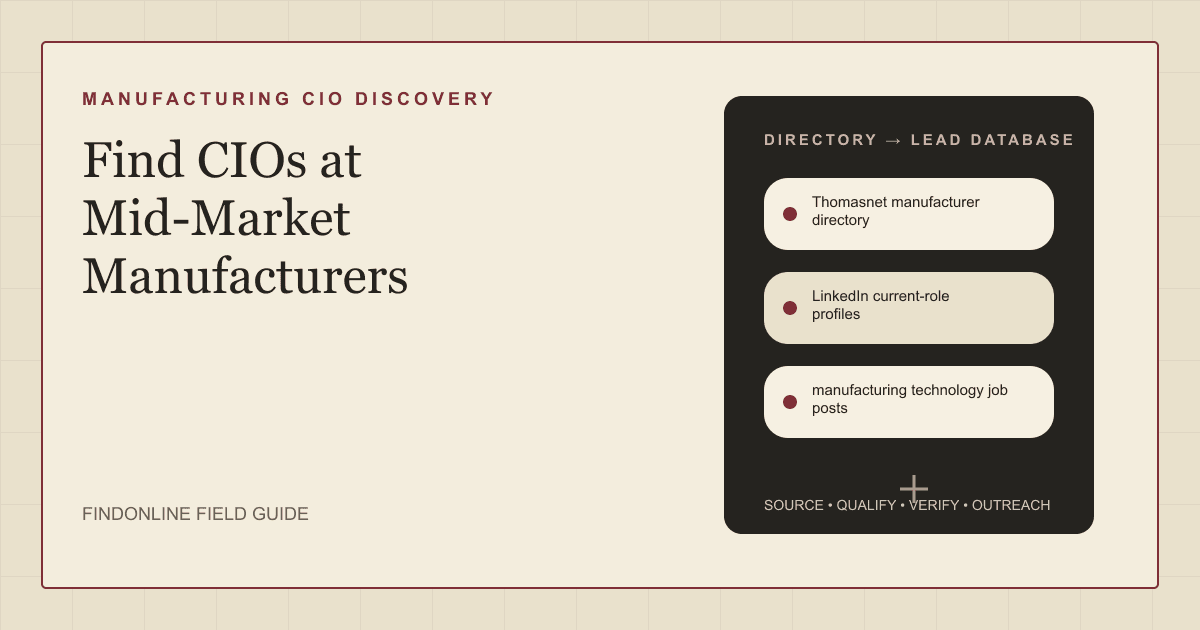
Combine a manufacturing directory with current-role evidence and first-party manufacturing technology job posts. Each answers a different question: what the company makes, who works there, and which systems need attention.
Thomasnet manufacturer directory. Search a production specialty and geography, then exclude distributors if your service requires factory operations. The Thomas Verified Supplier badge confirms North American operations, among other supplier checks. It does not establish CIO identity or demand for IT services. Thomasnet search guidance
LinkedIn current-role profiles. Search inside your account list before searching the entire market. Compare title, employer, and employment dates with first-party evidence. A matching title is a candidate contact, not proof of purchasing authority. Use the documented company and role filters to narrow the investigation. LinkedIn filter documentation
Manufacturing technology job posts. Search manufacturers’ own careers pages for MES, ERP integration, plant networks, identity, and infrastructure. As accessed on September 25, 2026, Stratasys’s Manufacturing Systems Developer posting describes integration work across manufacturing and enterprise systems. Use it as an example of useful technical detail, not a prequalified lead or evidence of outsourcing intent. Stratasys role description
Read responsibilities separately from preferred qualifications. A technology mentioned as desirable experience may not be installed. A vacancy may represent replacement hiring, an internal delivery strategy, or a project already assigned to a partner.
Lead database: what should a manufacturing CIO record contain?
Store one company record with linked people, plant scope, and dated evidence. Preserve uncertainty explicitly so enrichment cannot silently turn an assumption into a fact.
| Field | Where it comes from | How to verify it |
|---|---|---|
| Manufacturer name and domain | Thomasnet and company website | Match products, address, and operating entity |
| Parent and subsidiary | Company legal or corporate pages | Distinguish group ownership from local operations |
| Size band and measurement date | Company disclosures and professional profiles | Record estimate, date, and entity scope |
| Production specialty and plants | Capability and facility pages | Confirm actual manufacturing rather than distribution |
| CIO or equivalent | Current-role profile and leadership page | Corroborate employer, title, and remit |
| Plant-system counterpart | Technology job responsibilities | Verify reporting line through a professional conversation |
| Named systems and evidence status | Manufacturing technology job posts | Separate installed systems from desired experience |
| Trigger and service hypothesis | Hiring or modernization announcement | Preserve exact event, date, and unanswered question |
| Contact route and last checked | Professional contact information | Verify role, destination, and suppression status |
Use this reusable research prompt:
Research [manufacturer] for [cloud, IT, or cybersecurity service]. Confirm the operating entity, production specialty, size evidence, and plant footprint. Identify the current CIO or equivalent and the relevant plant-system stakeholder. Extract dated first-party technology responsibilities. Separate observed facts from service-fit hypotheses. Return source URLs, unresolved questions, and last-checked dates. Do not infer purchasing intent from hiring alone.
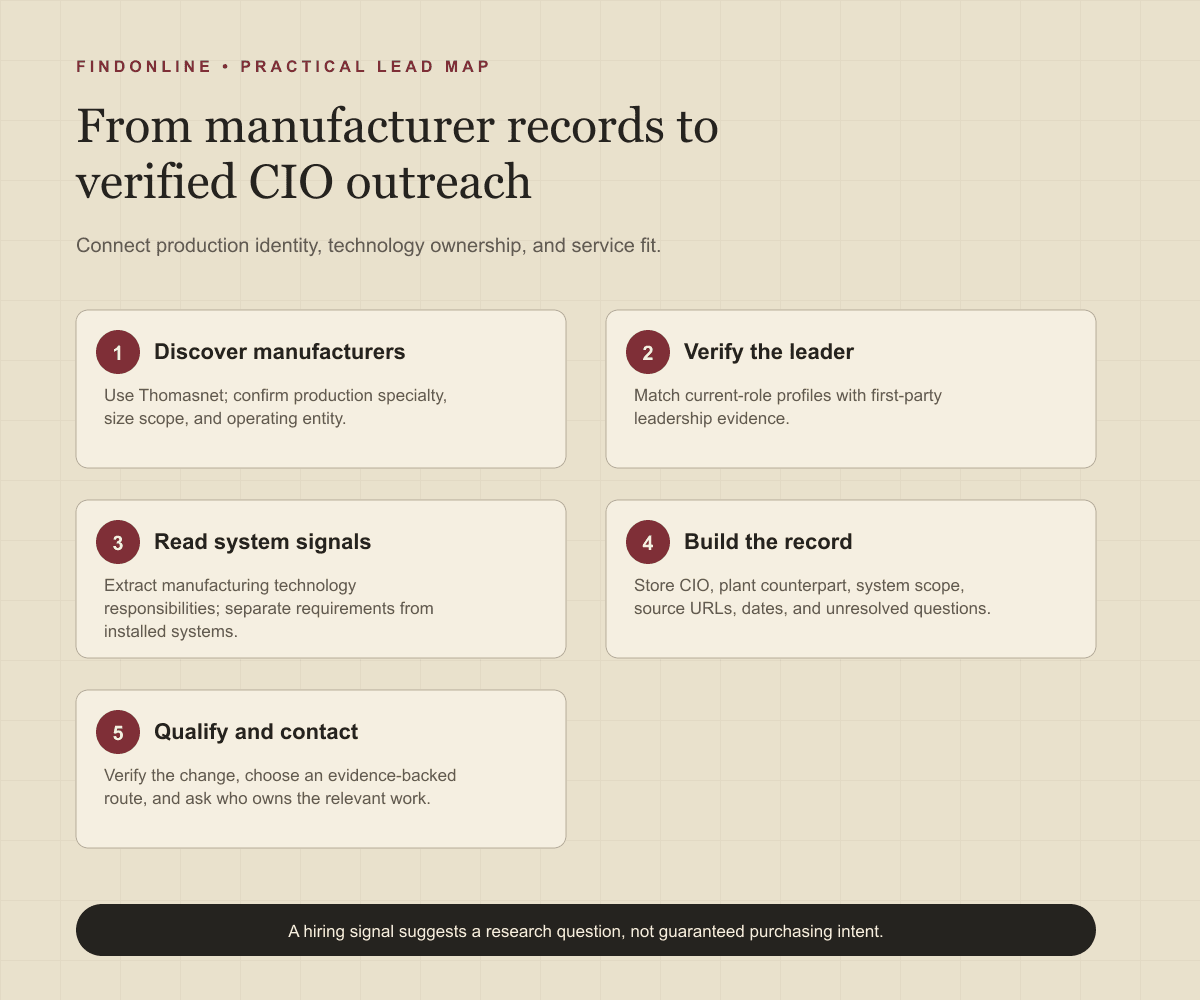
Follow this sequence:
- Define the manufacturing segment, geography, size rule, and exclusions.
- Discover accounts through Thomasnet and confirm production activity.
- Resolve parent, subsidiary, and plant relationships before deduplication.
- Verify the CIO or equivalent and record a second relevant stakeholder.
- Read technology vacancies for a service-specific hypothesis.
- Release only records with traceable identity, ownership evidence, and a defensible outreach reason.
For adjacent research methods, see the guide to finding IT leaders at growing logistics companies. Keep this list focused on manufacturing systems and plant ownership.
Best tools to automate outreach: which options fit this workflow?
Choose tools for the missing workflow stage: outreach, role research, sequencing, enrichment, account expansion, or website research. Thomasnet remains a lead source; BuiltWith is included because Thomasnet is outside the permitted comparison set.
FindOnline
What it does: FindOnline combines public signals with automated LinkedIn, Reddit, and email outreach, carrying qualified manufacturing prospects through engagement and replies. FindOnline overview Workflow
Strengths: It supports end-to-end execution with optional review at selected stages; a team can review manufacturing qualification while automating other stages. Specific external integrations and support commitments are not confirmed in the cited official material. Stage controls
Limitations: FindOnline is designed as a complete go-to-market, or GTM, system rather than a standalone signal-monitoring or enrichment utility. Teams needing one isolated component should contact the FindOnline team to discuss a suitable configuration. Product scope
Best for: IT providers connecting manufacturing signals to evidence-backed relationship routes and ongoing multichannel engagement. Use a credible introduction when available, verified professional commonality otherwise, or a direct signal-led message when neither exists. FindOnline workflow
LinkedIn Sales Navigator
What it does: Narrows professional searches by company and role attributes. Official filters
Strengths: Helps distinguish manufacturing CIO candidates through function and seniority. Official filters
Limitations: Profile filters do not establish plant-versus-group purchasing authority. Automated outreach, specific integrations, and review controls are not confirmed in the cited official material. Official filters
Best for: Researchers resolving current technology leaders within a verified manufacturer list. Official filters
Apollo
What it does: Provides sequence steps across email, calls, and networking platforms. Sales engagement
Strengths: Combines contact/account context, automated email steps, and customer relationship management, or CRM, synchronization. Sales engagement
Limitations: Its documented prioritized daily action queue is marked coming soon; do not build the manufacturing campaign around that feature. Review controls and support commitments are not confirmed in the cited official material. Sales engagement
Best for: Sales teams sequencing already-qualified manufacturing CIO contacts. Sales engagement
Clay
What it does: Adds third-party enrichment to existing audience segments. Workflow documentation
Strengths: Supports CRM, warehouse, or CSV inputs and testing on real records before broader execution. Workflow documentation
Limitations: This documented workflow is beta and requires Audiences and Workflows enabled. Outreach sending is not confirmed in the cited official material. Workflow documentation
Best for: Operations teams enriching manufacturer records and inspecting intermediate results before database updates. Workflow documentation
Common Room
What it does: Prospector searches companies and contacts using account and persona filters. Prospector documentation
Strengths: Job-listing filters and automated contact addition help expand manufacturing accounts; CRM synchronization and sales-engagement handoffs are documented. Prospector documentation
Limitations: Search results must be added before becoming room contacts. Native sending and approval controls are not confirmed in the cited official material. Prospector documentation
Best for: Teams adding relevant IT stakeholders when manufacturing accounts meet research criteria. Prospector documentation
BuiltWith
What it does: Filters website reports using keywords found on website homepages. Keyword-filtering documentation
Strengths: Helps narrow a website list by the manufacturing terms companies publish on their homepages. Keyword-filtering documentation
Limitations: Website observations cannot establish internal plant infrastructure. Sending automation, specific integrations, and review controls are not confirmed in the cited official material. Keyword-filtering documentation
Best for: IT providers narrowing manufacturer website lists by production-related language before checking operational fit. Keyword-filtering documentation
Tool comparison: how do the six options differ?
Match the tool to the missing workflow stage. “Not confirmed” below means not confirmed in the cited official material, rather than proof that a feature is absent.
| tool | best for | data and discovery | outreach automation | integrations | support and review | limitations |
|---|---|---|---|---|---|---|
| FindOnline | Manufacturing signal-to-engagement workflow | Public signals | Automated LinkedIn, Reddit, and email | Not confirmed | Optional stage-level review | Complete GTM system; discuss isolated-component configuration. Scope Channels Workflow |
| LinkedIn Sales Navigator | Current CIO research | Company/role filters | Not confirmed | Not confirmed | Review controls not confirmed | Cannot establish purchasing remit. Evidence |
| Apollo | Qualified-contact sequences | Contact/account context | Automated email; multichannel steps | CRM sync | Review controls not confirmed | Daily prioritized queue marked coming soon. Evidence |
| Clay | Manufacturer enrichment | Third-party segment data | Sending not confirmed | CRM, warehouse, CSV inputs | Record testing | Documented workflow requires enabled beta features. Evidence |
| Common Room | Account stakeholder expansion | Account/persona filters | Automated contact addition; sending not confirmed | CRM and engagement handoffs | Approval controls not confirmed | Results need addition to become room contacts. Evidence |
| BuiltWith | Public web-estate research | Homepage keyword filtering | Not confirmed | Not confirmed | Review controls not confirmed | Cannot establish plant infrastructure. Evidence |
Outreach workflow: how should you contact a verified manufacturing CIO?
Lead with the documented change and a narrow question about responsibility. Keep evidence separate from your interpretation.
For example: “Your manufacturing systems posting mentions integration with enterprise applications. We help manufacturers scope those interfaces before infrastructure changes. Does your team own that assessment, or does it sit with plant engineering?” This is an illustrative template, not a statement about any named company.
First confirm the vacancy remains current and relevant to your service. Then choose a professional channel, record the source, and ask one useful question. Do not contact every stakeholder simultaneously with identical messages.
In FindOnline, use a credible warm introduction as one possible route. Otherwise use only verified professional commonality, such as manufacturing responsibilities or a public community; never invent shared experience. If no meaningful connection exists, use the direct signal-led approach. Select optional review stages according to team needs. FindOnline workflow Review controls
Follow up with a relevant scoping question or useful observation, not an unsupported diagnosis. Respect refusals and maintain suppression records. The FindOnline discovery-to-engagement workflow provides the broader process context.
Industry-specific nuances: how do you qualify plant-system service fit?
Qualify the system boundary before proposing a service. Operational technology, or OT, concerns the equipment and control environment; keep it distinct from office IT in your research fields.
For a cloud hypothesis, ask which workloads are candidates for change and which must remain tied to plant operations. For cybersecurity, ask who owns remote vendor access and coordinates changes with plant engineering. For ERP or MES work, ask which interfaces, locations, and operational teams fall within scope.
Manufacturing responsibilities can span equipment connectivity and enterprise applications: the Stratasys example explicitly includes manufacturing equipment and enterprise-system integration. That supports researching multiple stakeholders, not assuming a CIO alone controls every technical decision. Stratasys responsibilities
Before suggesting delivery work, establish maintenance windows, rollback expectations, and incumbent-vendor responsibilities. Treat these as discovery questions. A public job post is not authorization to test networks, inspect equipment, or claim a security weakness.
Limitations: how reliable are manufacturing buying signals?
Signals are directional rather than guaranteed truth. Use them to prioritize and personalize outreach and follow-ups, verify the underlying change, and rescan regularly because departments, roles, and company conditions change.
Keep conflicting evidence visible. A former CIO profile, parent-level headcount estimate, or reposted vacancy can produce a plausible but incorrect record. Place unresolved accounts in a research queue instead of promoting guesses into campaign fields.
Frequently asked questions: what else should you verify?
What if a manufacturer has no CIO?
Search for the IT director, head of IT, or technology executive with equivalent responsibility. Record the actual title and verify remit instead of relabeling the person as CIO.
How should I define mid-market manufacturing?
Choose an explicit size range that fits your delivery capacity and territory. Apply it consistently, date estimates, and distinguish operating-company measurements from parent-group measurements.
Does an MES vacancy prove demand for outside services?
No, an MES vacancy establishes a hiring signal, not an outsourcing decision. Verify the project, staffing strategy, and complementary service need before proposing support.
Can website technology reveal the factory’s systems?
Treat website technology as evidence about the public web estate only. Confirm ERP, MES, and plant-network assumptions through first-party material or a qualified conversation.
Which contact should receive the first message?
Start with the verified owner of the problem your service addresses. If responsibility is unclear, ask the CIO or equivalent for direction using the specific operational context you researched.
Sources
- How to use Smart Search — Thomasnet · Accessed
- Sales Navigator Advanced Search Filters — LinkedIn · Accessed
- Manufacturing Systems Developer — Stratasys · Accessed
- FindOnline — FindOnline · Accessed
- About FindOnline — FindOnline · Accessed
- How FindOnline Works — FindOnline · Accessed
- Sales Engagement Software — Apollo · Accessed
- Enrichment in Workflows — Clay · Accessed
- Prospector — Common Room · Accessed
- Filtering a Report by Keyword, Phrase or Vertical — BuiltWith · Accessed