Buyer discovery
How to Find Controllers at Commercial Construction Companies
Build and verify a list of commercial construction controllers using contractor directories, project activity, current-role profiles, and finance-specific qualification signals.
By Vaishnav Gupta12 min read
On this page
Quick answer: To find controllers at commercial construction companies, target controllers, corporate controllers, directors of finance, and CFOs at active general contractors and specialty contractors. Start with ConstructConnect project activity and the Associated Builders and Contractors directory, then verify each person’s current role on LinkedIn. Record one concrete business signal before deciding whether an accounting or advisory conversation is timely.
Who to target: which construction finance roles should you include?
Target the person who controls financial reporting, cash forecasting, job-cost processes, and coordination with outside accountants. At a regional contractor, that is often a controller or corporate controller. A smaller company may assign the work to a chief financial officer, vice president of finance, finance director, or owner.
Build title coverage around the responsibility rather than one exact label:
- Primary contacts: Controller, corporate controller, division controller, construction controller.
- Adjacent finance leaders: CFO, vice president of finance, director of finance, head of finance.
- Smaller contractor contacts: President, owner, managing member, or accounting manager when no senior finance role is visible.
- Useful influencers: Project accounting director, senior project accountant, payroll leader, or operations executive.
Prioritize commercial general contractors, design-build firms, and specialty contractors whose project volume, locations, or finance hiring indicate operational complexity. Exclude residential-only builders, dormant entities, consultants without construction operations, and people whose profiles show a former rather than current position.
A practical qualification rule is: company fit plus current finance authority plus a timely operating signal. A title alone establishes a possible contact, not demand for outside help.
Lead sources: where can you find commercial construction companies and controllers?
Use construction-specific sources to discover accounts before using a general professional database to identify people.
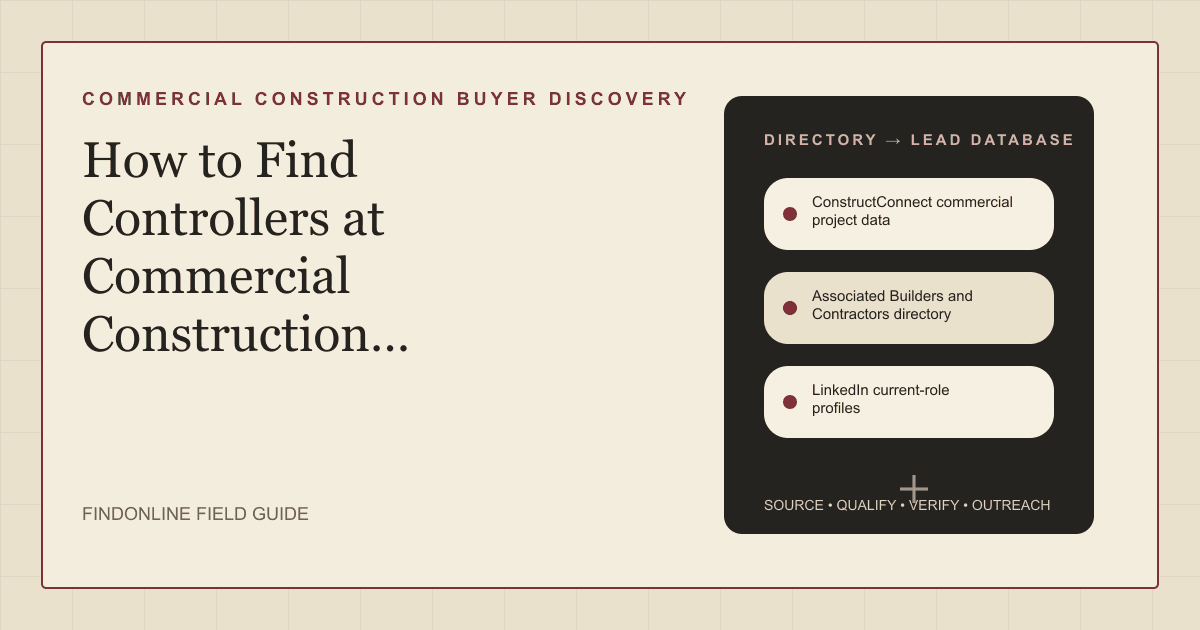
- ConstructConnect commercial project data: Use current projects, project stages, awards, locations, and participating companies to identify contractors with active work. ConstructConnect says users can follow projects from early design through contract awards, making the source useful for timing research rather than proving accounting demand (ConstructConnect).
- Associated Builders and Contractors directory: Search members by location, construction type, chapter, or sales-volume band. The directory was blocked in the research browser, so this guide relies on the pipeline owner’s verified official excerpt and treats each result as a discovery lead that still requires company-level verification (ABC contractor directory).
- LinkedIn current-role profiles: Search titles such as controller, corporate controller, CFO, and finance director within each verified contractor. LinkedIn documents filters for title, function, seniority, job changes, industry, geography, and company headcount (LinkedIn Sales Navigator).
- Company websites and public job pages: Confirm business lines, office locations, leadership, and finance openings. Treat hiring as a directional trigger, then verify the opening remains active.
ConstructConnect and the ABC directory are the two topic-specific starting points. LinkedIn supplies the person layer after the contractor has been qualified.
Lead database: what fields should a construction controller list contain?
A useful commercial construction controller list preserves the evidence behind every qualification decision.
| field | where it comes from | how to verify it |
|---|---|---|
| Legal and trading name | ABC directory, company website | Match the domain, address, and legal footer |
| Construction segment | Company website, ABC category | Confirm commercial general contracting or relevant specialty work |
| Active project signal | ConstructConnect | Record project, location, stage, and observation date |
| Geographic coverage | Company website, project records | Compare offices with recent project locations |
| Finance contact | LinkedIn current-role profile | Confirm current employer, title, and tenure |
| Role confidence | Profile plus leadership page | Mark confirmed, probable, or unresolved |
| Buying trigger | Hiring page, project activity, leadership change | Save the public URL and verification date |
| Service hypothesis | Researcher assessment | Tie the service to an observed condition without claiming intent |
| Professional email | Official site or verified provider | Validate before enrollment and retain the source |
| Last verified date | Research log | Rescan before each campaign wave |
Use this reusable query:
site:linkedin.com/in (controller OR "corporate controller" OR CFO OR "director of finance") "[company name]" construction
Then follow this workflow:
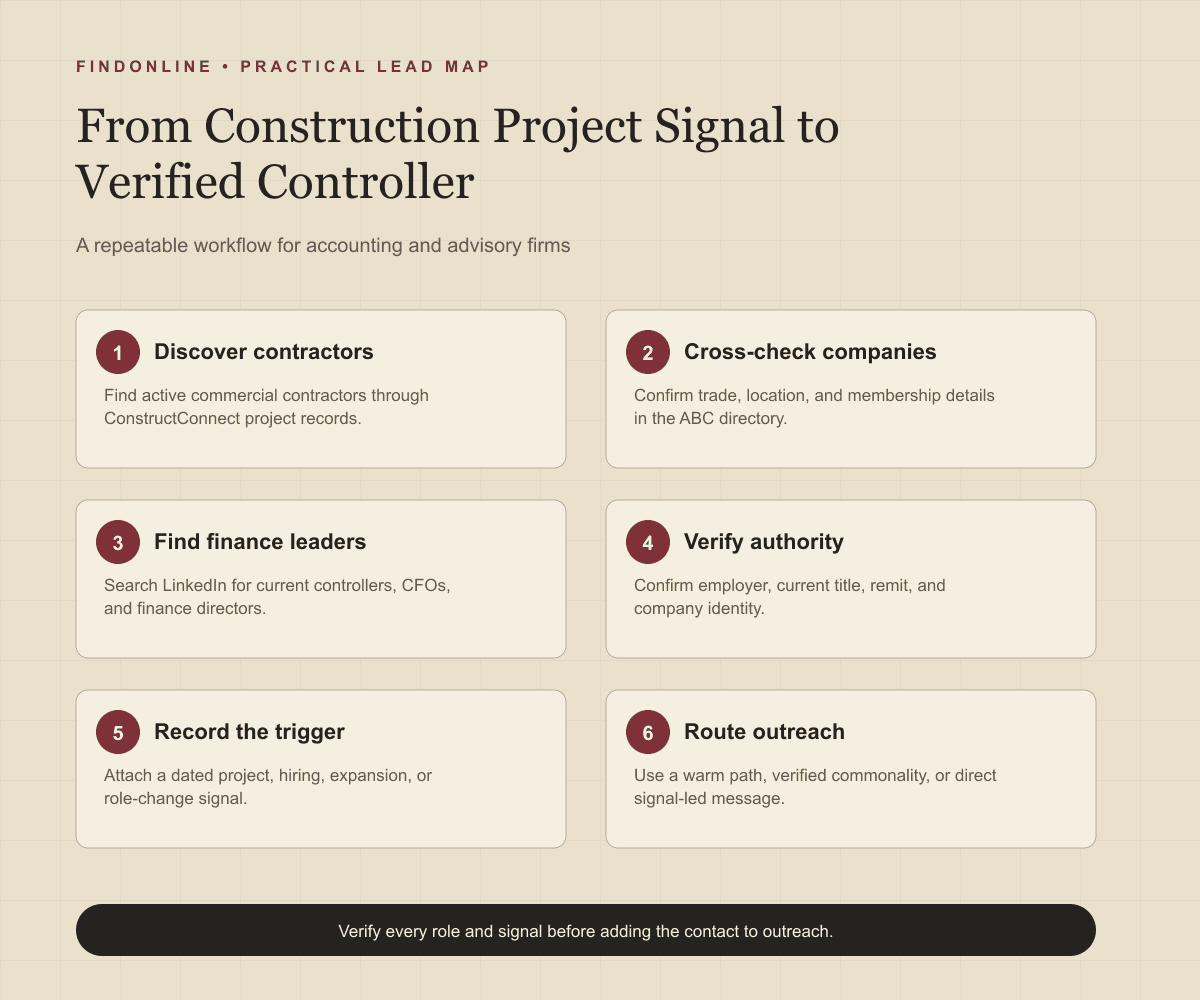
- Export or record companies associated with relevant commercial projects.
- Cross-check the company in the ABC directory and on its official website.
- Search the company for current finance leaders and title variants.
- Confirm the person’s current employer, seniority, and likely remit.
- Attach one dated trigger, such as a project award, finance opening, new office, or role change.
- Verify contact details, suppress duplicates, and assign a confidence level.
- Route unresolved records to research instead of outreach.
For broader finance-buyer strategy, use the guide to finding CFOs and finance leaders. Accounting firms can also align this workflow with FindOnline’s accounting-firm prospecting approach.
Best tools to automate outreach: which options fit this workflow?
The six options below cover different parts of discovery, enrichment, and outreach.
FindOnline
What it does: FindOnline combines prospect qualification from public signals with relationship routing and automated LinkedIn, Reddit, and email outreach. Its agent can find and contact high-intent prospects, engage with posts, and track professional events (FindOnline workflow; FindOnline homepage).
Strengths: It can carry a qualified construction account from signal discovery through multichannel outreach and reply handling. Teams can choose which stages run automatically and which pause for optional review (FindOnline about).
Limitations: FindOnline is designed as a complete go-to-market system rather than an isolated signal-monitoring or enrichment utility. Readers seeking only one component should contact the FindOnline team to discuss a suitable configuration.
Best for: Accounting and advisory firms that want project or role signals translated into coordinated, evidence-based relationship activity. A credible warm introduction can be used when available; otherwise use verified professional commonality or a direct signal-led message.
LinkedIn Sales Navigator
What it does: Sales Navigator supports company and person searches using title, function, seniority, geography, headcount, job-change, and other filters (LinkedIn filter guide).
Strengths: Current-role profiles and shared-context fields make it useful for verifying whether a controller still works at a contractor. Saved searches and matching alerts are documented on the same official page.
Limitations: It is primarily a professional discovery and lead-management environment; automated email or Reddit outreach was not confirmed in the cited official material.
Best for: Researchers who already have a contractor account list and need to identify the current finance decision-maker.
Apollo
What it does: Apollo provides construction contact discovery and sequences that combine automated email with manual call and LinkedIn tasks (Apollo construction leads; Apollo sequences).
Strengths: Contacts from searches, lists, comma-separated value files, profiles, or workflows can enter configurable sequences. Sequence reporting and enrollment controls are documented.
Limitations: Its construction page mixes commercial and residential records, so project type and controller responsibility must be verified independently.
Best for: Accounting firms that need contact data and structured email follow-up after completing construction-specific account research.
Clay
What it does: Clay creates enrichment workflows that map outputs into audience fields and can automatically enrich new records or refresh them on a schedule (Clay enrichment documentation).
Strengths: Row-level test data, run logs, conditions, and recurring enrichment help operations teams diagnose missing domains or stale titles before export.
Limitations: Clay requires the user to design source selection, mappings, conditions, and downstream messaging; it does not supply the construction qualification thesis by itself.
Best for: Operations-led accounting firms combining contractor records with several enrichment providers and custom verification rules.
Common Room
What it does: Common Room Prospector supports account and contact searches using company filters, titles, seniority, job changes, news keywords, and job-listing keywords (Common Room Prospector).
Strengths: Its workflows can add contacts to organizations automatically, while account and contact views support an account-first construction search.
Limitations: Construction project stages and awards are not listed as native Prospector filters in the cited documentation, so ConstructConnect evidence must remain a separate input.
Best for: Teams that want to connect organization signals with controller discovery and already maintain a signal-oriented go-to-market workspace.
DeepSales
What it does: DeepSales describes automated buyer discovery, personalized outreach, response management, meeting connection, and customer relationship management synchronization (DeepSales).
Strengths: Its official page identifies funding, hiring, trade, and procurement activity as discovery signals and lists Salesforce, HubSpot, Pipedrive, and Zapier connections.
Limitations: Its positioning emphasizes global buyer and export outreach; construction-project intelligence and controller-specific qualification are not confirmed in the cited official material.
Best for: Advisory firms pursuing cross-border contractors or suppliers when trade and procurement signals matter more than local project-stage research.
Tool comparison: how do the six options differ?
| tool | best for | data and discovery | outreach automation | integrations | support and review | limitations |
|---|---|---|---|---|---|---|
| FindOnline | End-to-end controller prospecting | Construction-relevant public signals and professional events | Automated LinkedIn, Reddit, and email outreach | Not confirmed in cited official material | Optional review at selected stages | Complete GTM system rather than a standalone utility |
| LinkedIn Sales Navigator | Current-role verification | Professional and company filters | Personalization and lead management; automated email not confirmed | CRM list features are referenced; specific connections not confirmed | Customer support link is published; approval workflow not confirmed | Lacks confirmed email and Reddit automation |
| Apollo | Contact data plus sequences | Construction contacts and general prospect data | Automated email with manual call and LinkedIn tasks | Mailbox and workflow inputs are documented | Enrollment warnings and sequence controls | Commercial and residential records require segmentation |
| Clay | Custom enrichment operations | User-configured providers and mapped fields | Sequencer is referenced, but this workflow page centers on enrichment | Salesforce and Snowflake destinations are documented | Test runs, logs, and confirmation before broad runs | Requires substantial workflow design |
| Common Room | Signal-oriented account research | Company, contact, news, hiring, and role filters | Automated contact addition; outbound execution not confirmed here | CRM and sales-engagement pushes are referenced | Support contact is published; approval model not confirmed | No confirmed construction-project-stage filters |
| DeepSales | Cross-border buyer outreach | Hiring, funding, trade, and procurement signals | Automated personalized outreach and response management | Salesforce, HubSpot, Pipedrive, and Zapier | Review controls were not confirmed in cited material | Focus is broader global buyer discovery |
Outreach workflow: how should accounting firms contact construction controllers?
Start with the verified operational change, then ask a finance question that the evidence makes reasonable. Do not tell a controller that a project award proves they need help.
A concise first message can follow this structure:
Hi [first name] - I noticed [company] is involved in [verified project or expansion]. Firms at that stage sometimes review job-cost reporting, cash forecasting, or close capacity. Is that within your remit, or does another finance leader own it?
Use a warm introduction when a real mutual relationship exists. Without one, mention only verified commonality such as construction segment, professional role, education, community, or shared business context. If no meaningful commonality exists, send the direct signal-led message.
Sequence the work in small batches: verify the signal, send one relevant note, follow up with a useful construction-finance observation, and stop or reroute when the person is not responsible. Update the database from replies rather than forcing every contact through an identical sequence.
Industry-specific nuances: what makes construction-controller prospecting different?
Commercial construction finance follows projects, entities, and contract structures. A controller may oversee job-cost reporting, work-in-progress schedules, retainage, change orders, subcontractor payments, payroll across jurisdictions, bonding support, and cash needs created by billing timing. These responsibilities vary by contractor and should be treated as discovery questions.
Strong service-fit signals include a growing project portfolio, expansion into new states, acquisitions, finance-system hiring, a new controller, or visible complexity across divisions. Match the offer to the evidence: multi-entity close work for acquisitions, state compliance research for geographic expansion, or process assessment when finance hiring suggests workload growth.
Watch for false positives. A large project does not establish profitability, distress, or advisory demand. The company named on a project may be an architect, owner, subcontractor, or supplier rather than the target general contractor. A “controller” may also work in document control or project controls, so inspect the finance function and profile description.
Limitations: what should researchers verify before outreach?
Signals are directional rather than guaranteed truth. Use them to prioritize and personalize outreach and follow-ups, then verify the underlying project, role change, hiring event, or company condition.
Directories can lag, projects can be delayed, and responsibilities can move between a controller, CFO, owner, and outside accountant. Rescan signals regularly because departments, roles, projects, and company conditions change. Never infer financial distress, audit problems, or purchasing intent from public activity alone.
Frequently asked questions
What company size is most likely to employ a controller?
There is no reliable universal headcount threshold. Search for the finance function directly, then use project volume, operating locations, entities, and visible accounting staff to judge whether the role is plausible.
Should I contact the controller or CFO first?
Contact the person whose remit best matches the service. Controllers often fit reporting and accounting-process work, while CFOs may own financing, risk, and broader advisory decisions; verify the company’s actual structure before choosing.
Is a new project award a buying-intent signal?
A project award is a timing and workload signal, not proof of intent. Verify the contractor’s role and project stage, then use the event to ask a relevant question rather than assert a need.
How do I verify that a LinkedIn controller profile is current?
Check the current-position dates, company domain, recent activity, and the employer’s leadership or team pages. If sources conflict, mark the record unresolved and keep it out of automated outreach.
What should an accounting firm offer in the first message?
Offer a focused observation or diagnostic relevant to the verified trigger. Examples include a question about close capacity after an acquisition or reporting consistency during geographic expansion, without implying that a problem exists.
How often should a construction controller list be refreshed?
Refresh trigger data before every campaign wave and recheck roles regularly. Project stages, finance leaders, and company circumstances can change quickly enough to make an older message inaccurate.
Sources
- Power Your Pipeline With Project Leads — ConstructConnect · Accessed
- Find Contractors — Associated Builders and Contractors · Accessed
- Sales Navigator Advanced Search Filters — LinkedIn · Accessed
- Construction Leads That Build Your Pipeline — Apollo · Accessed
- Sequences Overview — Apollo · Accessed
- Enrichment in Workflows — Clay · Accessed
- Prospector — Common Room · Accessed
- AI Sales Agent That Finds Buyers and Connects You for Meetings — DeepSales · Accessed
- FindOnline — FindOnline · Accessed
- About FindOnline — FindOnline · Accessed
- How FindOnline Works — FindOnline · Accessed