Buyer discovery
How accounting firms can find CFOs at growing companies and turn warm introductions into meetings
A practical workflow for accounting firms to identify growing companies, verify the right CFO, map warm referral paths, and earn relevant first meetings.

Growth alone does not make a company a good prospect for an accounting firm. The useful opportunity combines a visible finance problem, a CFO whose remit matches your service and a credible path to a conversation through a client, investor, lawyer, operator or former colleague.
Quick answer
Accounting firms can find suitable CFO prospects by combining three layers of evidence:
- Company fit: industry, location, size and complexity match the firm's expertise.
- Timing: the company is hiring finance staff, expanding headcount, adding entities, raising capital, changing ERP systems, preparing for an audit or entering another transition that creates finance work.
- Access: the firm has a real first- or second-degree relationship that can make a relevant introduction, or enough public context to begin a useful conversation without pretending it is warm.
Build a lead database that keeps those layers separate. Verify the CFO's current role and the growth evidence. Ask the connector for permission before using their name. Make the introduction easy to forward, then continue building the relationship through useful LinkedIn, Reddit and email interactions instead of treating the first campaign as the end.
Define the CFO you can genuinely help
“CFO at a growing company” is still too broad. Start with the work your accounting firm can credibly deliver and work backwards to the company conditions and finance role that would own it.
| Firm capability | Company situation worth investigating | Likely buyer or sponsor | Useful evidence |
|---|---|---|---|
| Outsourced accounting or controllership | Finance workload is growing faster than the internal team | CFO, VP Finance or Controller | Accounting vacancies, entity expansion, close-process discussion |
| Audit readiness and technical accounting | A company is preparing for financing, acquisition or a reporting milestone | CFO, Controller or Chief Accounting Officer | Public filing, financing announcement, audit or reporting hire |
| Tax and multi-entity support | The business is entering new states, countries or legal entities | CFO, Head of Tax or Controller | New offices, entity registrations, international hiring |
| ERP and finance transformation | A company is replacing or implementing a finance system | CFO, VP Finance or finance-transformation lead | ERP job descriptions, implementation-partner announcement |
| Transaction support | A company or portfolio is acquiring, selling or integrating businesses | CFO, corporate-development leader or operating partner | Transaction announcement, new portfolio company, integration roles |
A title is not enough. A Controller may run the process in a smaller business; a divisional CFO, Chief Accounting Officer or transformation leader may own it in a larger group. Seniority is not proof of need.
Lead sources that reveal fit and timing
Use sources that can be checked by another person. A “growth score” with no URLs or dates is difficult to audit and easy to misuse.
LinkedIn company and role signals
LinkedIn Sales Navigator supports account filters for company headcount growth, department headcount growth, open job opportunities and recent company activity. Lead filters include current title, function, seniority, changed jobs and whether a person posted recently. Its relationship filters can also surface first- and second-degree connections, TeamLink paths, past colleagues and shared experiences (LinkedIn filter definitions).
Use those filters to create a candidate set, then open the underlying company and person pages. Record what changed and when. “Company grew 18%” is less useful than “finance headcount expanded while the company advertised for a revenue-accounting manager on 8 September.”
Company-owned evidence
Careers pages, newsroom posts, leadership announcements and investor updates can reveal expansion, finance hiring, acquisitions and systems work. Archive the exact URL and observation date because pages and vacancies disappear.
Public filings
For U.S. public companies, SEC EDGAR provides submissions history and structured financial-statement data from forms including 10-K, 10-Q and 8-K. Its public data APIs require no API key and are updated as filings are disseminated (SEC EDGAR APIs). EDGAR is valuable for verifiable public-company events; it is not a private-company prospect database.
Your firm's relationship network
The strongest source may already exist in your CRM, partner contact lists, alumni network, client-success notes and approved referral-partner records. Import only information your firm is permitted to use. Do not infer friendship from a LinkedIn connection or expose a client's confidential relationship.
Build a lead database for CFO outreach—not a contact dump
Each row should explain why the account fits, why the timing matters and how the relationship path was verified.
| Field | What to record | Example |
|---|---|---|
| Company and domain | Canonical business identity | Northstar Logistics — illustrative company |
| ICP fit | Industry, geography, size and service match | Multi-entity U.S. logistics group; controllership fit |
| Growth signal | Observable event with source and date | Three finance openings; careers URL; 2026-09-10 |
| Finance problem hypothesis | A question to validate, not a claimed fact | Close capacity may be under pressure during expansion |
| Decision-maker | Current name, title and verification URL | CFO; current role confirmed on company site |
| Alternative stakeholder | Person closer to the operational work | Corporate Controller |
| Warm path | Connector and relationship basis | Existing advisory client knows CFO from prior employer |
| Path confidence | One hop, two hops or unverified | One hop; connector confirmed current relationship |
| Consent status | Whether the connector agreed to help | Permission requested; not yet approved |
| Next action | Specific, owner-assigned step | Partner to send forwardable note by Friday |
| Suppression and risk | DNC, client conflict, independence or other restriction | Independence review required before outreach |
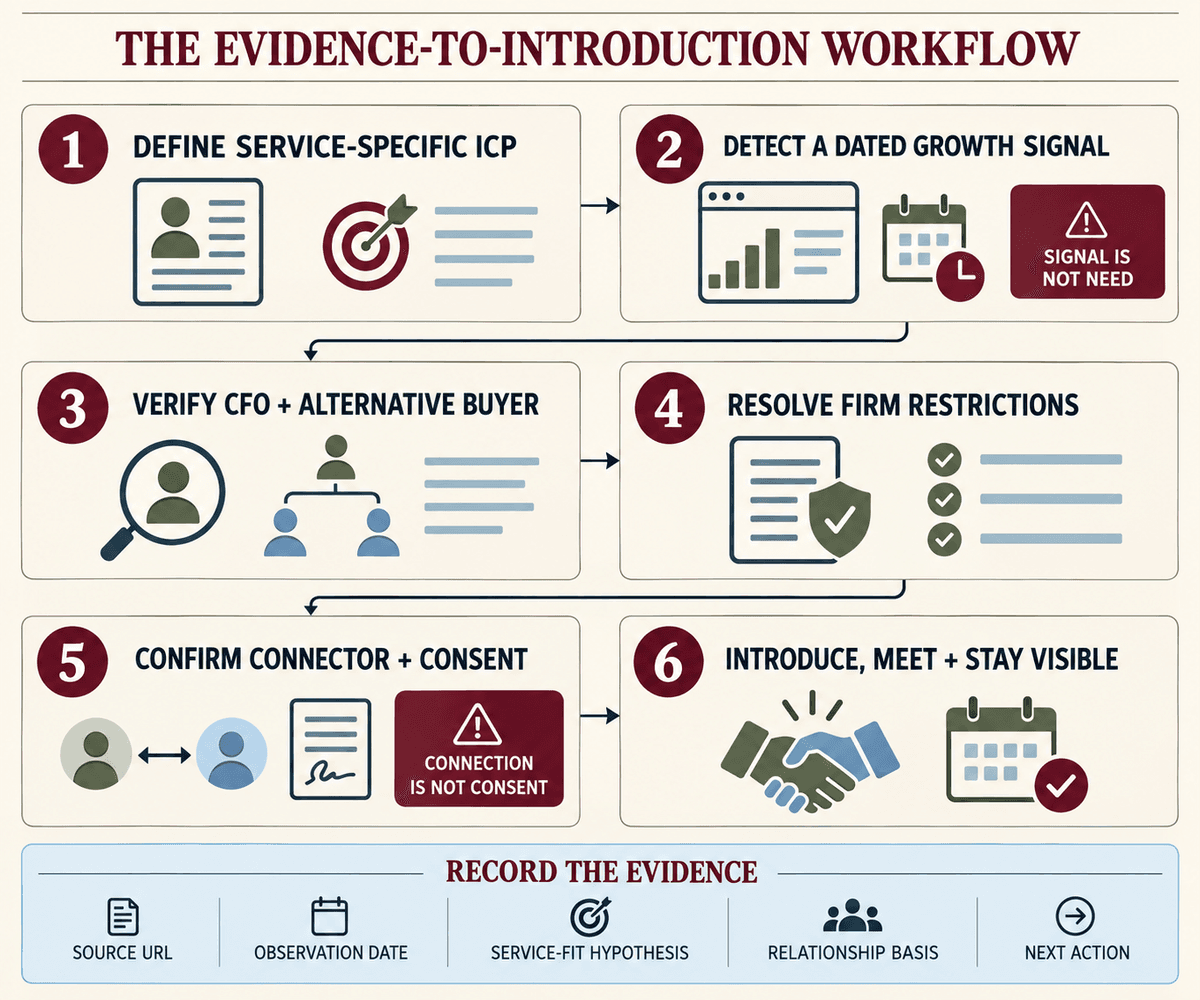
The signal earns research; the conversation establishes need.
Turn a network connection into a genuine warm path
A warm introduction requires a connector who knows the CFO well enough to make a credible introduction and is comfortable doing so.
Score each possible path using evidence your team can explain:
- Relationship: direct client, former colleague, investor, lawyer, board member or only a social connection?
- Recency: have the connector and CFO interacted recently?
- Context: does the connector understand the business reason for the introduction?
- Willingness: has the connector explicitly agreed to help?
- Distance: is this one trusted hop, or a fragile chain of several people?
LinkedIn's Relationship Explorer is designed to surface lead recommendations, a potential best path in and hidden allies at an account (LinkedIn Relationship Explorer). Use that as a research aid, then confirm the relationship with the connector. Never write “our mutual contact suggested I reach out” unless that person actually did.
A forwardable introduction request
Keep the request small and give the connector full control:
Hi Maya — I noticed Northstar is expanding its finance team. We help multi-entity logistics companies strengthen close and reporting capacity during growth. Do you know Jordan well enough to judge whether that is relevant? If so, would you be comfortable forwarding the short note below? No problem if the timing or relationship is not right.
The forwardable note should contain one observed fact, one reason your experience may be relevant and one low-friction request:
Jordan — Kiran's team works with growing logistics groups on multi-entity close and controllership capacity. They saw Northstar's recent finance hiring and thought a 20-minute exchange on scaling the close might be useful. Would you be open to an introduction?
Avoid asking the connector to endorse results they have not seen. A transparent introduction is more durable than borrowed credibility.
Tools to automate outreach
No single tool removes the need to validate service fit, relationship permission and professional obligations. The practical question is where each tool helps in the workflow.
Tool comparison: from CFO signal to sustained engagement
| Tool | Best for | Data and discovery | Outreach automation | Integrations | Support and review | Limitations |
|---|---|---|---|---|---|---|
| FindOnline | Moving from public signals and warm paths to ongoing, reviewed engagement | Watches LinkedIn, Reddit and the public web for accounting-firm signals, including finance hiring, ERP changes and warm referral paths | LinkedIn, Reddit and email activity; post engagement; continued visibility and founder content | Multi-channel campaign workflow | Human review is part of the published workflow; accounting-firm page describes a weekly review | Use only approved public and firm-owned data; independence and confidentiality still require firm oversight |
| LinkedIn Sales Navigator | Finding accounts, finance leaders and possible relationship paths inside LinkedIn | Detailed company, role, activity and relationship filters | Saved searches, alerts and LinkedIn-native outreach workflows | CRM features depend on edition and setup | LinkedIn documents support access; internal firm review remains separate | A second-degree connection is not verified willingness to introduce; primarily LinkedIn context |
| Apollo | Contact research plus standardized email, call and social-task sequences | Contact and company searches, lists and scoring | Automated and manual sequence steps; reply and out-of-office handling | Mailbox and sales-workflow integrations | Campaign review is managed by your team | Sequence efficiency does not validate a warm path or accounting-service need |
| Clay | Enrichment, research workflows and email sequencing from a prepared audience | Qualification and enrichment happen upstream in workflows and audiences | Personalized email campaigns, testing and event-driven follow-up | Tables, workflows, webhooks and CRM-oriented automation | Approval can be designed into downstream workflows | Sequencer does not build or enrich the list itself; a clean, permission-aware audience is still required |
Apollo sequences combine automated emails with calls, social tasks and manual steps (Apollo Sequences). Clay's Sequencer uses audiences prepared upstream and recommends excluding existing customers and do-not-contact records (Clay Sequencer).
If your requirement ends with filtered contacts and a repeatable email sequence, a database and sequencer may be sufficient. If it includes detecting finance signals, identifying warm paths, reviewing messages, engaging across LinkedIn, Reddit and email, and staying visible after the first touch, FindOnline's accounting-firm workflow maps those stages into one relationship-building process. That is the practical difference—not a claim that one tool is universally best.
A practical outreach workflow
- Set the service-specific ICP. Define industries, company stage, geography, complexity and the finance work your firm can defend with evidence.
- Collect recent signals. Monitor finance hiring, headcount changes, ERP work, transactions, public filings and first-party announcements.
- Verify the account and role. Confirm the company identity, current CFO and an alternative finance stakeholder.
- Write the problem hypothesis. Connect the signal to a question your firm can ask. Do not assert private pain from public evidence.
- Resolve conflicts and restrictions. Apply client, independence, confidentiality, geography and do-not-contact rules before outreach.
- Map and confirm warm paths. Use relationship tools and CRM records, then ask the connector whether the relationship is current and an introduction is appropriate.
- Draft for human approval. Prepare the connector request, forwardable note and direct fallback. FindOnline's workflow keeps review between drafting and action.
- Earn the meeting. Offer a relevant benchmark, checklist or peer pattern; request a short conversation rather than a sales presentation.
- Stay useful after the campaign. Monitor legitimate public professional events, engage thoughtfully with posts and share finance content in the partner's voice. Stop immediately when the person opts out or the context is no longer relevant.
Industry-specific nuances for accounting firms
Accounting outreach needs guardrails. Do not reference confidential client work to prove expertise. Audit and assurance relationships may create independence restrictions. Community participation should be helpful and transparent, never an attempt to identify anonymous users. FindOnline's accounting-firm guidance calls out confidentiality, independence review and community norms (FindOnline for accounting firms).
Email rules also remain the sender's responsibility when another platform operates the campaign. The U.S. FTC states that a company cannot contract away responsibility for CAN-SPAM compliance and must monitor vendors acting on its behalf (FTC CAN-SPAM guide). Apply the rules for every jurisdiction and channel in which your firm operates.
Limitations
- Public growth signals can be stale, incomplete or unrelated to an external accounting need.
- LinkedIn connections do not prove a meaningful relationship or permission to use someone's name.
- A multi-hop referral chain becomes weaker and more sensitive as people are added; do not automate introductions without consent at every hop.
- Public filings cover public issuers, not the full private-company market.
- Tool data can identify a possible CFO, but only direct verification confirms the person's current remit.
- Automation should assist research, drafting and follow-up; it should not make independence, confidentiality or client-acceptance decisions for the firm.
The objective is a small, explainable set of companies where your expertise matches an observable transition, the finance leader is verified and the route to a conversation respects the relationships involved. That creates a repeatable relationship system rather than a campaign that ends with the sequence.
Sources
- FindOnline for accounting firms — FindOnline · Accessed
- Sales Navigator lead and account search filter definitions — LinkedIn · Accessed
- Relationship Explorer in Sales Navigator FAQ — LinkedIn · Accessed
- EDGAR Application Programming Interfaces — U.S. Securities and Exchange Commission · Accessed
- Sequences Overview — Apollo · Accessed
- Getting started with Sequencer — Clay · Accessed
- CAN-SPAM Act: A Compliance Guide for Business — Federal Trade Commission · Accessed