Buyer discovery
How to find a list of founders of Google Workspace Marketplace apps
Trace Google Workspace Marketplace listings to developer companies and verified founders, then build an evidence-backed prospect database.
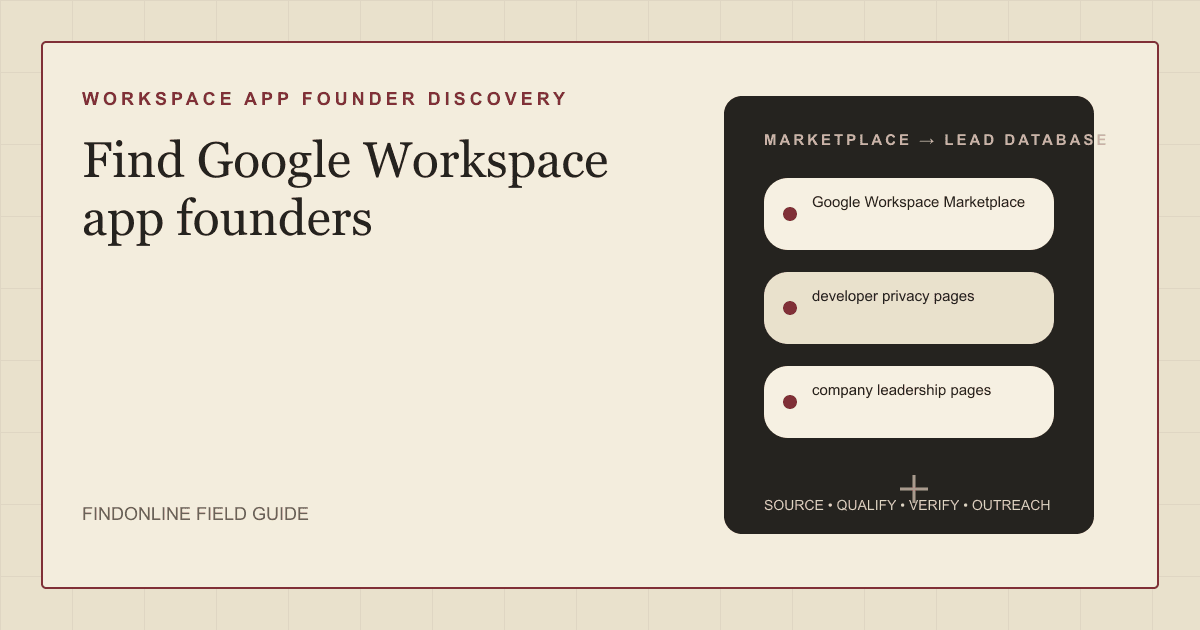
To find founders of Google Workspace Marketplace apps, start with relevant app listings, identify the developer company, and verify a named founder on company leadership evidence. Keep app identity, publisher identity, and founder identity separate until the evidence connects them. Google documents category, search, and filter options for discovering apps. Marketplace discovery guidance
Quick answer: trace the app to the company before naming a founder
Use an app-to-publisher-to-person workflow. A suitable record should include the listing URL, developer domain, founder evidence, current role, and verification date. Do not enter a support contact as a founder unless another source explicitly confirms that role.
Choose one app use case before collecting listings: for example, document workflows, spreadsheet productivity, or meeting coordination. Your research question should explain why the developer might be relevant to your service. This keeps the list focused without assuming that marketplace presence implies buying intent.
The sections below cover sources, database fields, tools, outreach, publisher nuances, and limitations. For positioning a service to these companies, use the B2B SaaS audience page as adjacent context.
Lead sources: listing, privacy page, leadership page
Google Workspace Marketplace supplies the starting app universe. Use category and search controls, then the Works with filter when your offer concerns a particular Workspace application. Record the chosen filters so another researcher can reproduce the scope. Google's app discovery instructions
Developer privacy pages are a place to investigate the business behind a listing. Google requires developer names and websites to represent the developer accurately. Its review criteria also require listing links to point to the correct information. Use these requirements as a cross-check, not as a guarantee that every identity question is resolved. Marketplace app review requirements
Company leadership pages are the next verification step. Look for explicit founder or cofounder wording and evidence of current involvement. Keep the developer's legal name, trading name, and app name in different fields. If they conflict, hold the record for review instead of selecting whichever name is easiest to enrich.
Lead database: keep app and founder evidence separate
Use one company record linked to its app records, then attach verified people. This avoids sending several nearly identical messages to a founder because their company publishes several apps.
| field | where it comes from | how to verify |
|---|---|---|
| App name and listing URL | Marketplace listing | Reopen the listing and record its exact name |
| App use case and Works with category | Listing and selected filter | Compare description with your inclusion rule |
| Developer display name and website | Listing developer information | Follow the website and compare company identity |
| Legal or operating entity | Developer privacy page | Record the wording and any mismatch with the listing |
| Founder name and founder evidence | Company leadership page | Require explicit founder or cofounder attribution |
| Current role and responsibility | Biography or current professional profile | Separate historical founder status from present involvement |
| Related apps | Additional listings | Group only when publisher identity matches |
| Business contact, evidence URLs, checked date | Public contact route and research notes | Verify contact status and reopen identity evidence |
Reusable research prompt:
Find Google Workspace Marketplace apps for the selected use case. For each app, trace the listed developer website to its privacy and leadership pages. Return app name, listing URL, developer identity, explicit founder evidence, current role, and source URLs. Group apps with the same verified publisher. Do not treat a support address as founder evidence. Mark conflicts and unknowns.
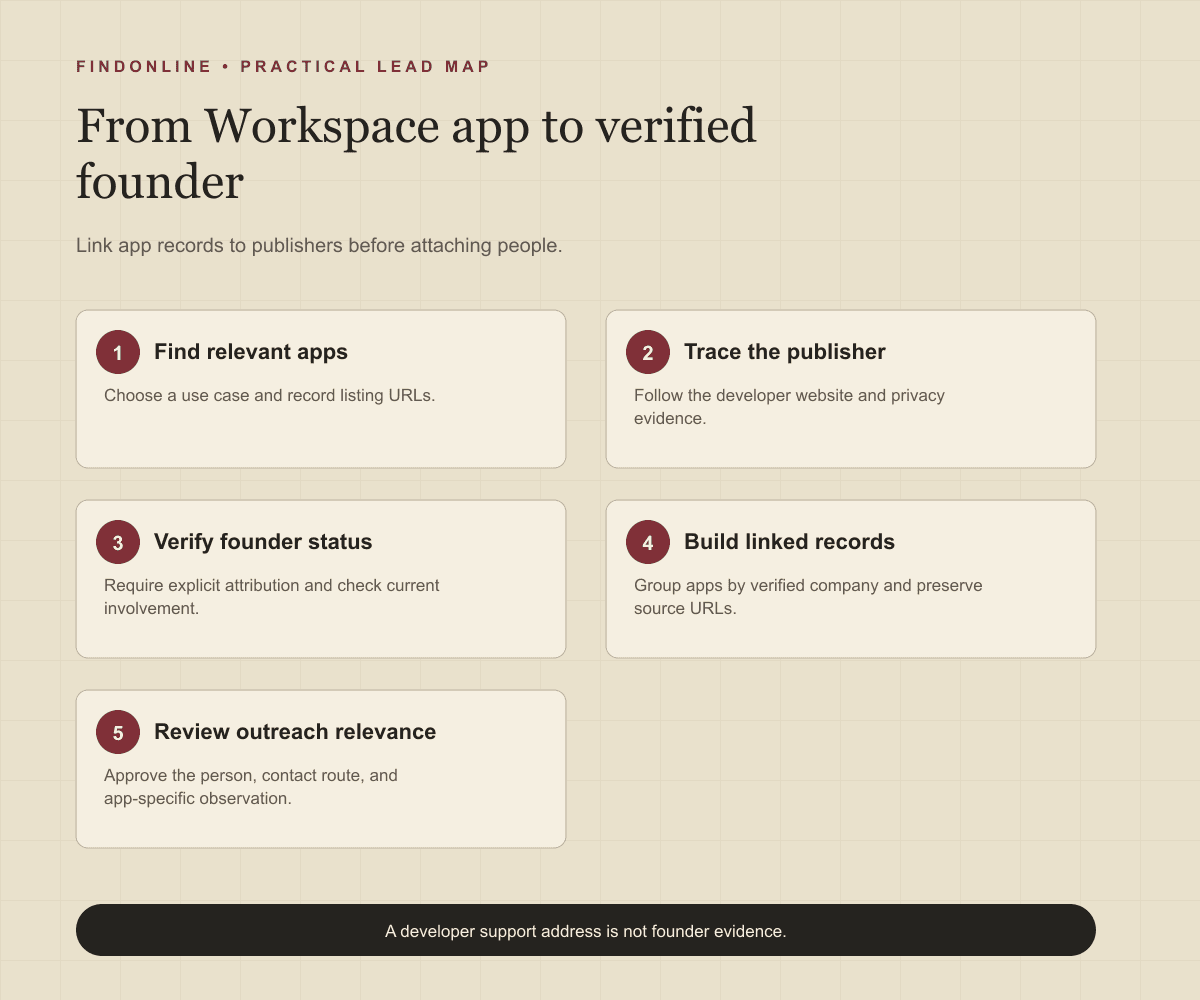
Apply the prompt through these steps:
- Define one app category and the business problem your offer addresses.
- Collect relevant listings and retain their original URLs.
- Reconcile developer names with website and privacy-page evidence.
- Verify founder attribution and current involvement.
- Deduplicate at company level while preserving linked app records.
- Review the contact route and approve a specific outreach reason.
Tools to automate outreach: separate discovery from sending
For this topic, a marketplace browser belongs in the comparison because identifying the right app companies is the first task. The other options address professional research, email checking, or reviewed engagement. Public evidence was checked on 2026-09-14; unconfirmed features are identified explicitly.
Tool comparison: app discovery to founder engagement
| tool | best for | data and discovery | outreach automation | integrations | support and review | limitations |
|---|---|---|---|---|---|---|
| FindOnline | Engagement after publisher verification | public signals; assess founder activity | LinkedIn, Reddit, and email | Marketplace import not confirmed | human review and approval | Founder identity resolution not confirmed. Channels · Approval |
| Google Workspace Marketplace | Building the app universe | Categories, search, and Works with filters | Prospect outreach not confirmed | Filters indicate app compatibility; CRM export not confirmed | Public discovery guidance; campaign approval not confirmed | Verify founders separately. Official guidance |
| LinkedIn Sales Navigator | Checking professional-role candidates | Function and seniority filters | InMail; automated sequences not confirmed | Specific connector not assessed | Approval gate and support terms not confirmed | Founder attribution needs independent evidence. Official overview |
| Hunter | Checking founder business email | Email verification | Sending automation not assessed | Google Sheets | Help Center; approval gate not confirmed | Email status cannot establish founder identity. Verification documentation |
FindOnline supports LinkedIn, Reddit, and email engagement around public signals, with human review and approval. For this workflow, use a verified founder's public activity to inform a draft. Pros: channel-aware engagement and review. Limitation: marketplace-to-founder identity resolution was not confirmed. FindOnline channels · FindOnline draft approval
Google Workspace Marketplace supports category, keyword, and Works with discovery. Pro: a relevant starting universe. Limitation: independently verify every founder; prospect outreach and CRM export were not confirmed in the guidance. Google discovery documentation
LinkedIn Sales Navigator provides professional-role filters and InMail. Pro: narrowing people after identifying the publisher. Limitation: require separate founder attribution; mandatory approval and support terms were not confirmed. Sales Navigator overview
Hunter supports email verification in Google Sheets. Pro: checking a contact beside its publisher record. Limitation: a verified address is not founder evidence. The page links to a Help Center; approval controls were not confirmed. Hunter Email Verifier
Outreach workflow: reference a verified app use case
Approve the publisher match before drafting. Then connect one observed app use case to the service you provide. An illustrative opening is: “Your listing describes a document workflow for Workspace teams. Are you the right person to ask about partner-led distribution?” Do not claim to have used the app unless you actually have.
Review the message for mistaken app names, inferred founder roles, and unsupported commercial assumptions. Choose the channel based on context. In community discussions, respond to the question without attempting to identify anonymous participants. The FindOnline discovery and outreach workflow is the closest supplied workflow reference.
For U.S. commercial email, CAN-SPAM also applies to business-to-business messages. Include accurate identification, a valid postal address, and a clear way to opt out; do not treat a published developer contact as an exemption. FTC email requirements
Industry-specific nuances: publisher identity deserves its own review
Check whether the named developer is the same organization as the leadership page. Mark possible acquisitions, renamed publishers, and former founders as unresolved until current evidence explains the relationship. These are verification categories, not assumptions about any particular app.
Do not use an installation count as a revenue estimate. Google explains that displayed user counts include both individual and administrator installations. Record any count with its stated meaning and observation date, or omit it when it adds little to qualification. Google's Marketplace count explanation
Limitations: some apps will not yield a verified founder
Exclude records with only an app name and generic support address from a founder list. Keep them in a separate unresolved company queue if they remain relevant. A founder's historical association also does not establish current authority over partnerships or GTM.
The final deliverable should distinguish verified founders, verified alternative GTM contacts, and unresolved identities. Only the first category satisfies a founder-specific inclusion rule; preserve the others without relabeling them.
Sources
- Find and install an app in the Marketplace — Google · Accessed
- App review process and requirements for the Google Workspace Marketplace — Google · Accessed
- FindOnline — FindOnline · Accessed
- About FindOnline — FindOnline · Accessed
- LinkedIn Sales Navigator — LinkedIn · Accessed
- Hunter Email Verifier — Hunter · Accessed
- CAN-SPAM Act: A Compliance Guide for Business — Federal Trade Commission · Accessed