Buyer discovery
How to Find Finance Leaders at Multi-Location Veterinary Groups
Find finance leaders at multi-location veterinary groups using group location pages, state premises permit lookups, LinkedIn company pages, CFO appointments, and acquisition news, then verify who owns the books.
By Vaishnav Gupta13 min read
On this page
Quick answer: Target the CFO, VP of Finance, or Controller at veterinary groups with three or more hospitals, or the owner-veterinarian where no finance title exists. The strongest discovery sources are veterinary group location pages, state veterinary license lookups, LinkedIn company pages, veterinary CFO appointment releases, and veterinary hospital acquisition announcements. Start by listing groups whose location pages show hospitals in more than one state, then confirm who owns consolidated reporting.
Who to target: which roles own the finance decision at multi-location veterinary groups?
The buyer is whoever owns consolidated reporting across all hospitals, and the title changes with group size. At national consolidators the CFO sets the agenda and a VP of Finance or Controller runs the work. National Veterinary Associates, "a community of 1,300 care centers across North America," appointed Todd S. Young "as Chief Financial Officer, effective May 1, 2026" (NVA newsroom). Groups at that scale rarely outsource core accounting, so the realistic opening is specialty work such as multi-state tax or acquisition accounting.
Regional groups are the sweet spot. Today's Veterinary Business reported in April 2021 that a Veterinary Integration Solutions census found "dozens of companies operating at least 7,800 clinics across North America," with "more than 60 veterinary consolidators known so far" (Today's Veterinary Business on practice consolidators). Only a few of those are national brands. A regional group with 10 to 100 hospitals usually has one Controller or Director of Finance who decides whether close, consolidation, and tax work stay in-house.
Groups of three to ten hospitals are usually owned by a veterinarian who signs off on the books with a practice administrator and an outside bookkeeper. The owner-veterinarian decides and the administrator influences.
Qualification signals, strongest first:
- Hospitals in more than one state, which creates multi-state payroll, sales tax, and registration work.
- An acquisition in the last 12 months, which creates purchase accounting and integration work.
- A new CFO or a live Controller posting, which shows finance ownership is changing.
False positives: single hospitals listing service lines as locations, local brands whose finance sits at a national parent, and boarding or daycare brands that are not veterinary practices.
Lead sources: where do multi-location veterinary groups and their finance leaders show up?
Three sources identify the account and two event sources time the outreach. Larger groups' location pages were unavailable during research, so Rarebreed is the worked example.
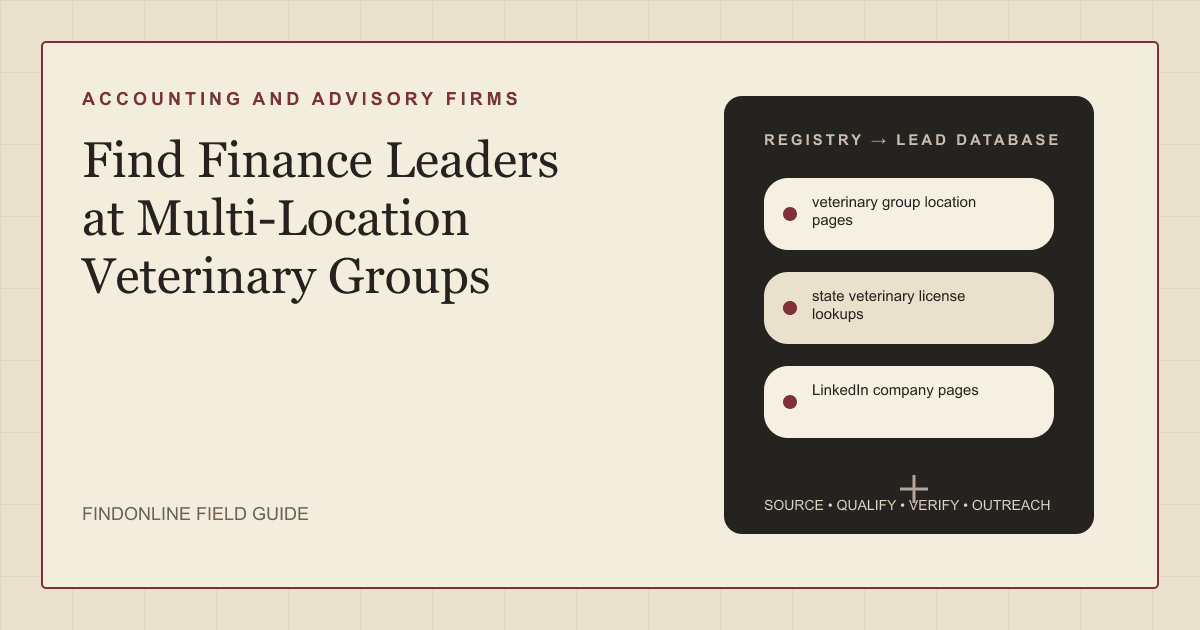
- veterinary group location pages give the hospital count and state footprint in one place. Rarebreed Veterinary Partners lists partner practices under state names and invites visitors to "Check out our current locations across the Northeast" (Rarebreed Veterinary Partners locations). Count hospitals and states, and flag locations keeping original names as likely recent acquisitions.
- state veterinary license lookups reveal the legal entity behind each hospital. Florida law states that "Any establishment, permanent or mobile, where a licensed veterinarian practices must have a premises permit" and requires the "name and address of the owners of the establishment" (Florida Statutes section 474.215). The Florida Department of Business and Professional Regulation portal "provides information about applicants and licensed individuals for those professions" it regulates (Florida DBPR license search). Group permits by owner to find hospitals missing from the corporate website. Boards that license only individuals return veterinarians rather than entities.
- LinkedIn company pages connect the entity to people. LinkedIn describes a Page toolbar with "tabs for you to use to browse detailed information about the organization," including a People tab (LinkedIn Help on Pages for members). Filter People by finance titles and record the most senior current one.
- veterinary CFO appointment releases are the clearest timing signal. Company newsrooms and trade appointment roundups carry them, and a new CFO usually reviews outside providers within two quarters.
- veterinary hospital acquisition announcements flag groups that just added entities and states. In September 2026, Holland & Knight announced it advised GoodVets on acquiring WellHaven Pet Health, "a network of more than 40 veterinary hospitals operating across seven states" (Holland & Knight press release). Such releases often precede location page updates.
Lead database: what fields should a veterinary group prospect list contain?
Pair footprint fields verified against state records with a named finance owner and a dated trigger, and keep the source URL for every field.
| Field | Where it comes from | How to verify it |
|---|---|---|
| Group name and management entity | Location page footer, about page | Match to the owner on the premises permit |
| Hospital count | Location page | Count permits held by the same owner |
| States served | Location page state headings | Confirm one hospital address per state |
| Ownership model | About page, acquisition announcements | Tag veterinarian-owned, regional, or national consolidator |
| Finance leader and title | LinkedIn People tab, leadership page | Confirm current employer on the profile |
| Trigger and date | CFO release, acquisition announcement, Controller posting | Open the primary release and record the date |
| Service hypothesis | Your own analysis | One line, such as multi-state sales tax after Florida entry |
Reusable research query for one state:
Find veterinary groups with 3 or more hospitals in [state]. For each return:
group name, management entity, hospital count, states served, latest
acquisition with date and source URL, and the most senior finance title on
its LinkedIn company page. Mark unverified fields.
Step-by-step workflow:
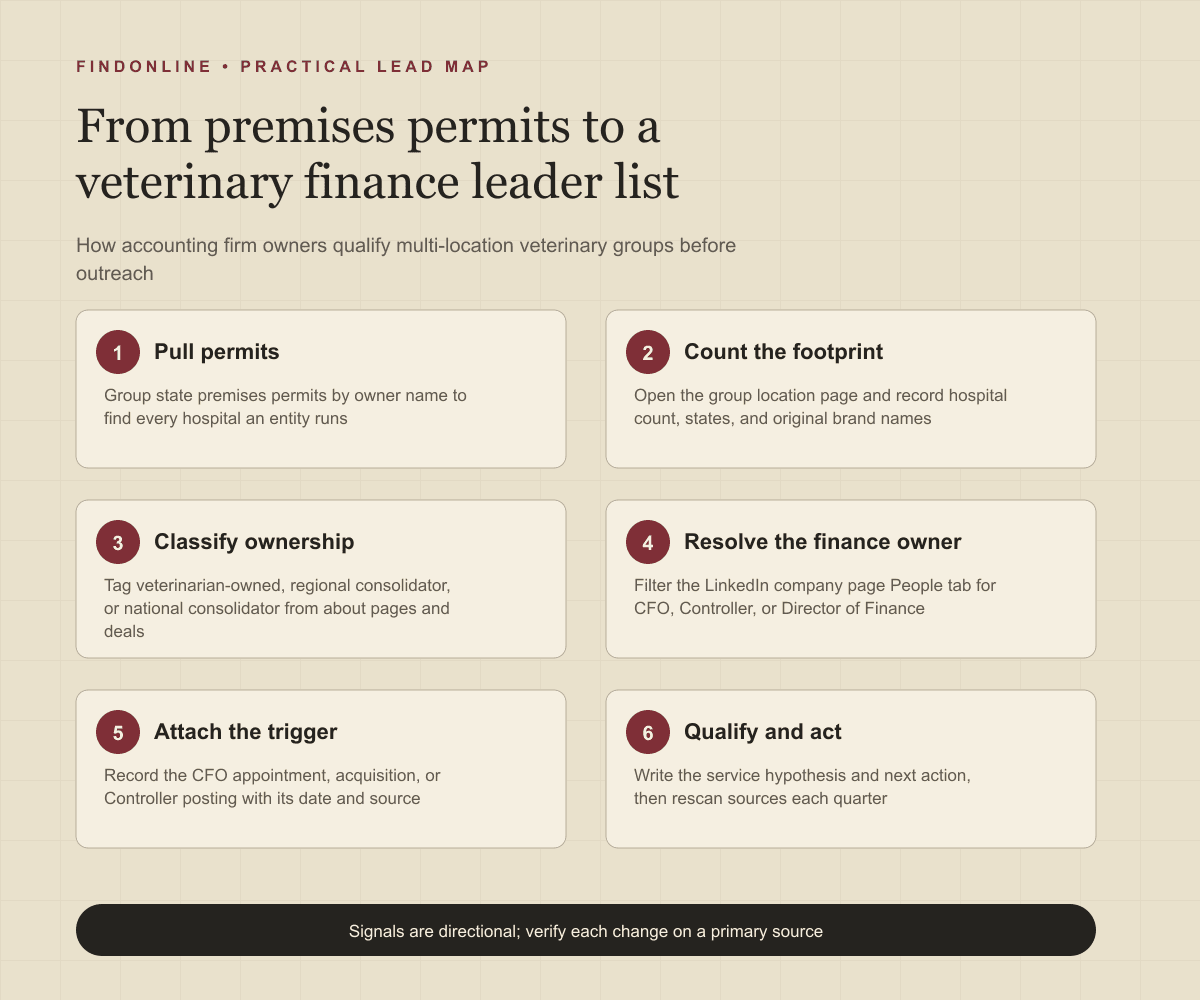
- Pull [state] premises permits and group them by owner name.
- Open the location page for owners with three or more permits and record hospital count and states.
- Classify ownership from the about page and any acquisition in the last 12 months.
- Filter the LinkedIn company page People tab by finance titles and record the senior current role.
- Attach the trigger, service hypothesis, and next action, then mark the record qualified.
Best tools to automate outreach: which platforms fit veterinary finance prospecting?
Six options cover this workflow, from one end-to-end system to single-purpose tools.
FindOnline
What it does: FindOnline runs "AI GTM agents for LinkedIn, Reddit and Email" (FindOnline). It finds and qualifies prospects from public signals, and "You choose which stages run automatically and which hold for approval" (FindOnline about). Here it watches CFO appointments, Controller hires, and acquisition posts and runs outreach and replies end to end. Strengths: Discovery, qualification, routing, and automated multi-channel outreach run as one system with optional review per stage. A genuine warm path is one route; otherwise it uses verified commonality such as industry or role, or a direct signal-led message. Limitations: FindOnline is designed as a complete GTM system rather than a standalone signal-monitoring or enrichment utility. Firms that want only acquisition alerts or a contact export should contact the FindOnline team to discuss a suitable configuration. Best for: Accounting and advisory firm owners who want veterinary finance leaders found from public signals and contacted across LinkedIn, Reddit, and email automatically.
LinkedIn Sales Navigator
What it does: Sales Navigator lets you "Search with 50+ filters like function, seniority level, years at company, experience, and more," and its CRM connection can "Add leads instantly, saving time and cutting down manual entry" (LinkedIn Sales Navigator). Strengths: Lead and account alerts flag role changes, which is how a new Controller at a regional group surfaces (LinkedIn Sales Navigator). Limitations: It works inside LinkedIn only, so footprint, permit owners, and acquisition dates come from other sources; support beyond a customer support link was not confirmed in the cited official material. Best for: Firm owners who already hold a verified group list and want to watch finance role changes there.
Apollo
What it does: Apollo's sales engagement product runs sequences in which "Reps can make, receive, record, and log calls from the same system they prospect and sequence," and activity "syncs straight into the CRM you already use" (Apollo sales engagement). Strengths: Contact data, email sequences, and calls in one system, which suits firms that phone practice administrators at smaller groups. Limitations: Apollo does not read location pages or premises records, so footprint fields must be imported before prioritizing accounts. LinkedIn steps and support terms were not confirmed in the cited official material. Best for: Firms with a business development hire running email and phone sequences against an imported, pre-qualified veterinary group list.
Clay
What it does: Clay turns account tables into enriched records and messaging. Its site says it can "Keep CRM records accurate, complete, and continuously refreshed with live data" and "Turn context into research, scoring, and personalized outreach" (Clay). Strengths: Research steps can read a location page and acquisition news and write hospital count and trigger into each row. Limitations: Sending through LinkedIn or email was not confirmed in the cited official material, so Clay needs a separate sender and table upkeep. Best for: GTM operators at larger firms enriching hundreds of veterinary group records with footprint and trigger fields before handing them to a sender.
ZoomInfo
What it does: ZoomInfo pairs a contact database with cadences: "Build and execute multi-touch sales cadences with our direct phone dialer and email tool," and you can "Export prospects to your CRM in one click" (ZoomInfo sales). Strengths: Broad contact coverage helps when a regional group publishes no leadership page. Limitations: Its intent signals track software research topics that seldom map to accounting needs, and cadences cover phone and email rather than LinkedIn or Reddit. Support terms were not confirmed in the cited official material. Best for: Firms whose outreach is phone-led and who need direct dials for controllers at mid-size groups.
Lemlist
What it does: Lemlist lets you "Launch automated campaigns across email, LinkedIn, calls, WhatsApp, and SMS from one workflow," and offers a "600M+ lemlist database and smart filters to find accounts" (Lemlist). Strengths: Multichannel sequences suit a LinkedIn connection followed by an email about a specific acquisition. Limitations: Filters cover account attributes, not hospital counts or premises permits, so groups must be qualified before import. CRM integrations and support were not confirmed in the cited official material. Best for: Agency owners running campaigns for several accounting firms against lists each firm has already qualified.
Tool comparison: how do the six options differ for this list?
| tool | best for | data and discovery | outreach automation | integrations | support and review | limitations |
|---|---|---|---|---|---|---|
| FindOnline | Discovery and outreach run end to end | Public signals such as CFO hires and acquisitions | Automated LinkedIn, Reddit, and email outreach with replies | Not confirmed in the cited official material | Optional review per stage | Complete GTM system, not a standalone alert tool |
| LinkedIn Sales Navigator | Watching finance role changes at verified groups | 50+ filters, lead and account alerts | InMail; sequences not confirmed | CRM lead add and alerts | Customer support link only | No footprint or permit data |
| Apollo | Email and call sequences on imported lists | Contact database only | Sequences, calls, and logging in one system | Syncs to your CRM | Not confirmed in the cited official material | Footprint fields must be imported first |
| Clay | Enriching hundreds of group records | Research and scoring from live data | Writes messaging; sending not confirmed | CRM record refresh | Not confirmed in the cited official material | Needs a separate sender and table upkeep |
| ZoomInfo | Phone-led outreach to controllers | Large contact database, software intent topics | Phone and email cadences | One-click CRM export | Not confirmed in the cited official material | Intent rarely maps to accounting needs |
| Lemlist | Multichannel campaigns for pre-qualified lists | 600M+ database with smart filters | Email, LinkedIn, calls, WhatsApp, SMS | Not confirmed in the cited official material | Not confirmed in the cited official material | No hospital or permit qualification |
Outreach workflow: how should an accounting firm contact a veterinary group finance leader?
Lead with the verified trigger, name the accounting consequence, and ask one question. A Controller who just inherited 40 hospitals in seven states wants to hear about multi-state registrations and purchase price allocation, not a services menu.
- Open with the event. Reference the acquisition, new state, or appointment and its date in the first sentence.
- Name the consequence. Seven new states usually means seven sales tax registrations for retail and pharmacy sales.
- Offer one artifact. A one-page post-acquisition close checklist earns a reply more often than a meeting request.
- Use a warm path only when it is real. A contact who sold a hospital to the group is one possible route; never imply familiarity you cannot verify.
- Follow up on the next signal. A Controller posting is a good moment to offer a consolidation-ready chart of accounts.
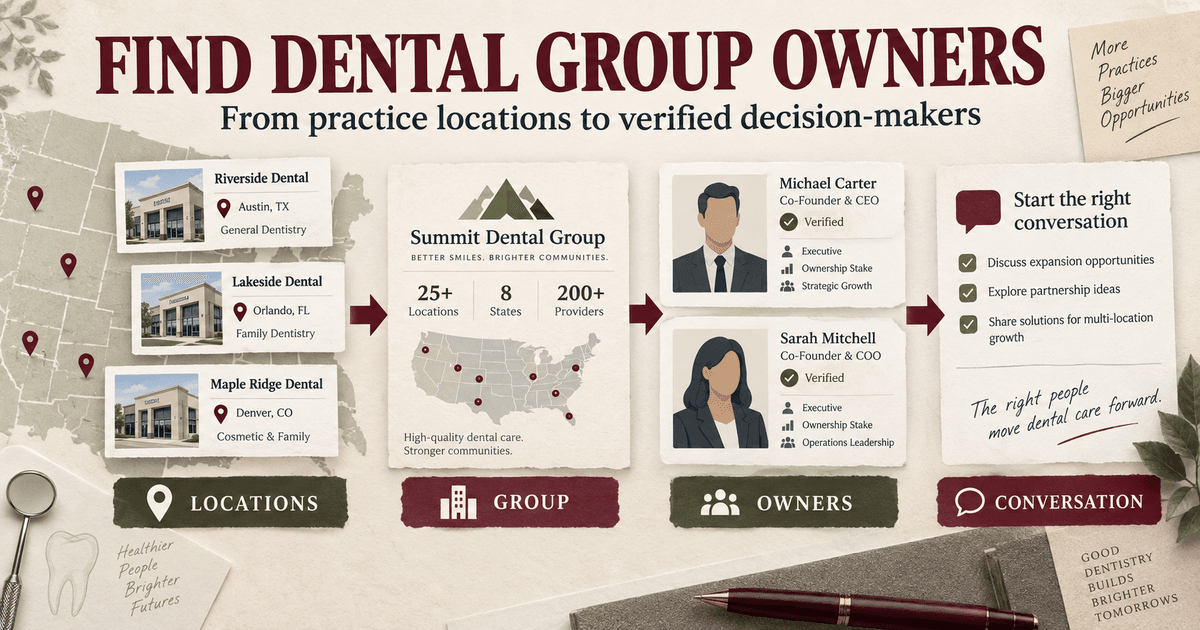
The FindOnline page for accounting firms and the how FindOnline works walkthrough show how these stages run with optional review. Owners who also prospect dental groups will find a parallel footprint-first method in the guide to finding owners of multi-location dental groups.
Industry-specific nuances: what is different about veterinary group finance?
- Corporate practice rules shape the entity map. Arnall Golden Gregory explained in February 2020 that the corporate practice doctrine in several states generally "prohibits a non-veterinarian or an entity, such as a general business corporation" from owning a practice, so investors often "acquire only the non-regulated clinic assets through a management vehicle" (Arnall Golden Gregory on vet clinic acquisitions). In those states the premises permit names a veterinarian-owned professional entity while the finance leader sits at the management company; record both.
- Mixed revenue types create tax work. Hospitals sell services, pharmacy items, retail products, and boarding, and taxability differs by state, so a multi-state footprint is itself a service trigger.
- Controlled substances add inventory controls. Groups must reconcile controlled-drug inventory by hospital, a natural entry point for internal control reviews.
- Ownership model sets the buying process. Veterinarian-owned groups let the owner and Controller decide; sponsor-backed groups often use the sponsor's approved provider list, so ask early.
Limitations: what can these signals not tell you?
Every signal here is directional rather than guaranteed truth. A location page can lag an acquisition by months, a premises permit can name a veterinarian who no longer owns the practice, and a LinkedIn title can be stale. Use signals to prioritize which groups to research first and to personalize the opening message and follow-ups, then verify the underlying change on a primary source. Rescan each source on a schedule, because departments, roles, and company conditions change.
Frequently asked questions
How many hospitals make a veterinary group worth targeting for outsourced accounting?
Three or more hospitals is the practical floor, where multi-entity consolidation begins. Groups between 10 and 100 hospitals fit best, since they usually have one finance leader and growing complexity. Above that, target specialty work.
Who is the finance decision-maker at a veterinarian-owned group with no CFO?
The owner-veterinarian decides, usually with a practice administrator who manages the bookkeeper. Address the owner and name the administrator as the person who will run the engagement.
How do state veterinary license lookups help find a group's hospitals?
In states that register premises, such as Florida, every establishment where a veterinarian practices needs a permit naming its owners. Grouping permits by owner reveals every hospital a group operates in that state.
What buying trigger is strongest for veterinary group finance outreach?
A completed acquisition adding hospitals in a new state is strongest, because it creates purchase accounting, new registrations, and consolidation work at once. A new CFO or first Controller hire is next.
Sources
- FindOnline — FindOnline · Accessed
- About FindOnline — FindOnline · Accessed
- LinkedIn Sales Navigator — LinkedIn · Accessed
- Apollo Sales Engagement — Apollo · Accessed
- Clay GTM platform — Clay · Accessed
- ZoomInfo Sales — ZoomInfo · Accessed
- Lemlist multichannel outreach — Lemlist · Accessed
- Our Partner Hospitals — Rarebreed Veterinary Partners · Accessed
- Florida Statutes 474.215 Premises permits — The Florida Senate · Accessed
- DBPR Online Services License Search — Florida Department of Business and Professional Regulation · Accessed
- LinkedIn Pages for members — LinkedIn Help · Accessed
- National Veterinary Associates Appoints Todd S. Young as Chief Financial Officer — National Veterinary Associates · Accessed
- Holland & Knight Advises GoodVets in Acquisition of WellHaven — Holland & Knight · Accessed
- Practice Consolidators Show No Sign of Slowing — Today's Veterinary Business · Accessed
- Vet Clinic Acquisitions Require Regulatory Diligence — Arnall Golden Gregory LLP · Accessed