Buyer discovery
How to Find CTOs Building Nearshore Engineering Teams
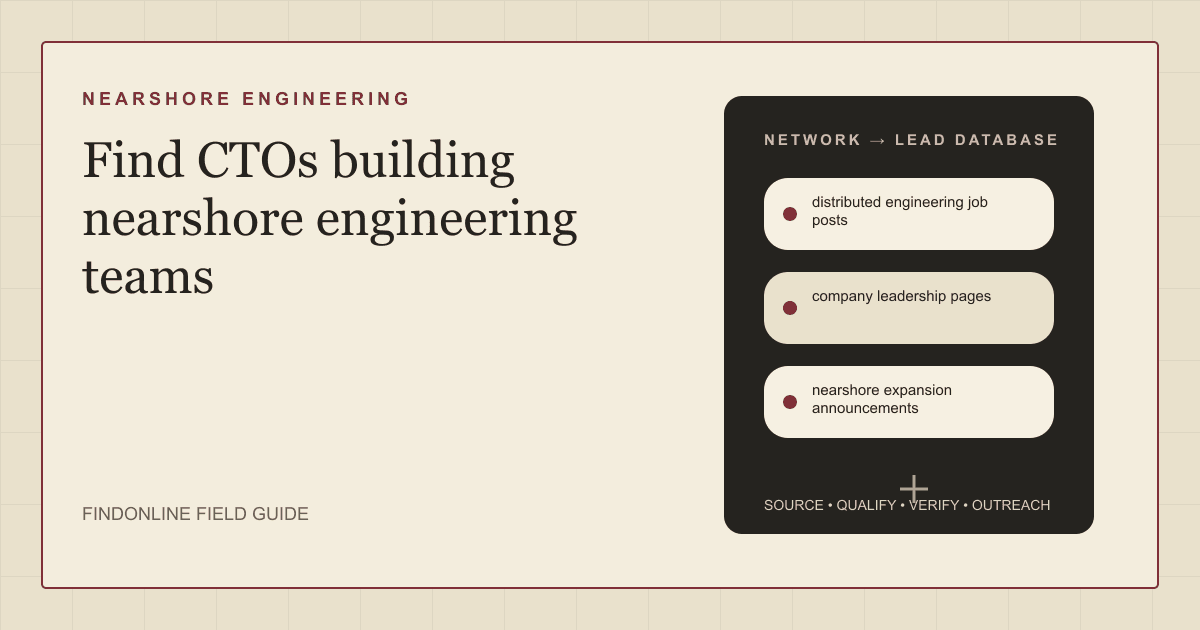
Find CTOs building nearshore engineering teams using distributed engineering job posts, company leadership pages, and nearshore expansion announcements, then verify hiring intent.
By Vaishnav Gupta13 min read
On this page
Quick answer: How to Find CTOs Building Nearshore Engineering Teams starts with three public signals: distributed engineering job posts that accept candidates outside the company's home country, company leadership pages that name the technology leader, and nearshore expansion announcements from companies, providers, and investment agencies. Target the CTO or VP of Engineering who owns the hiring plan, then confirm the team is actually being built before contacting anyone. Many YC startups are seeing breakout growth and are actively hiring for software engineers. Y Combinator software engineer jobs.
Who to target: which roles decide to build a nearshore engineering team?
Target the person who owns engineering headcount and the budget for external teams. For nearshore engineering and recruitment providers, use this research shortlist:
- Venture-backed startup with 20 to 200 engineers: the chief technology officer (CTO) or co-founder who owns hiring, with a head of talent as the day-to-day contact.
- Scaling technology company: the VP of Engineering or director of engineering who runs a specific product area and its open roles.
- Company with an existing distributed team: the engineering operations or technical program lead who coordinates time zones, contracts, and onboarding.
Treat titles as hypotheses. A recruiter posting the roles is an influencer; the CTO or VP of Engineering decides whether an external nearshore team is acceptable. GitLab's executive team page names Siva Padisetty as Chief Technology Officer. GitLab executive team.
Search within verified companies before widening titles. Sales Navigator filters people by company, title, function, and seniority, and saved searches and matching alerts support repeated CTO research. Sales Navigator filter documentation. For adjacent segments, use the recruitment and staffing prospecting context.
Lead sources: where do nearshore engineering plans surface first?
Use distributed engineering job posts for the earliest signal, company leadership pages for the decision-maker, and nearshore expansion announcements for timing and location context. Keep the three reviewed starting points:
- Distributed engineering job posts. Roles open to candidates in other countries or time zones show that a company already accepts distributed engineering. Y Combinator's job board lets you explore software engineer jobs by location, including San Francisco, New York, Los Angeles, Seattle, Boston, Austin, India, and remote jobs. Y Combinator software engineer jobs. Remote job boards add employer-side detail: We Work Remotely tells employers who need to hire full stack developers to quickly fill open remote roles with pre-vetted, on-demand talent. We Work Remotely programming jobs.
- Company leadership pages. Confirm the technology leader before outreach. Toptal's executive team page names Ismael Peinado as Chief Technology Officer, and pages like it separate the CTO from product, operations, and people leaders. Toptal executive team.
- Nearshore expansion announcements. Trade publications and investment agencies track where companies are placing teams. Nearshore Americas organizes its coverage by locations including Mexico, Argentina, Colombia, Costa Rica, and Brazil, which helps you spot companies opening delivery centers in a market you serve. Nearshore Americas. CINDE, Costa Rica's investment promotion agency, publishes nearshoring in Costa Rica and free trade zone guidance for companies locating there. CINDE news and resources.
Combine at least two sources per record; remote job posts alone may only mean individual contractor hiring.
Lead database: what should a verified CTO list contain?
Build one company record per technology company, linked to one record per engineering leader and one per hiring signal. Keep evidence separate from interpretation so a teammate can audit each nearshore engineering lead before it enters a campaign.
| Field | Where to obtain it | How to verify it |
|---|---|---|
| Company name and canonical domain | Job posts and leadership pages | Match the hiring entity to the operating company, not a staffing intermediary |
| Open engineering roles and regions | Distributed engineering job posts | Count roles, note time zone or country limits, and record the posting date |
| Team-building intent | Multiple related roles, hiring manager titles, or announcements | Distinguish a single contractor hire from a team of three or more |
| Technology leader and current title | Company leadership pages and professional profiles | Resolve conflicting employers, dates, and duplicate names |
| Talent owner | Job posts, people team pages, and profiles | Separate the budget sponsor from the recruiter running the search |
| Target markets | Nearshore expansion announcements and job locations | Confirm the country or time zone the company already accepts |
| Funding or growth trigger | Company announcements and public funding records | Verify the event and its date before scoring the lead |
| Contact route and next action | Published business contact details | Confirm identity; record replies and suppression requests |
Leave missing values unknown rather than guessing.
Use this reusable research prompt:
Research [company] for evidence that it is building a distributed or nearshore engineering team. Find open engineering roles and their location limits, the current CTO or VP of Engineering from the leadership page, the talent owner, and any announcement naming a new engineering location or growth plan. Classify the signal as individual contractor hiring, team build-out, or provider selection. Return source addresses, checked dates, exact role wording, and unresolved questions. Do not infer budget authority or invent contact details.
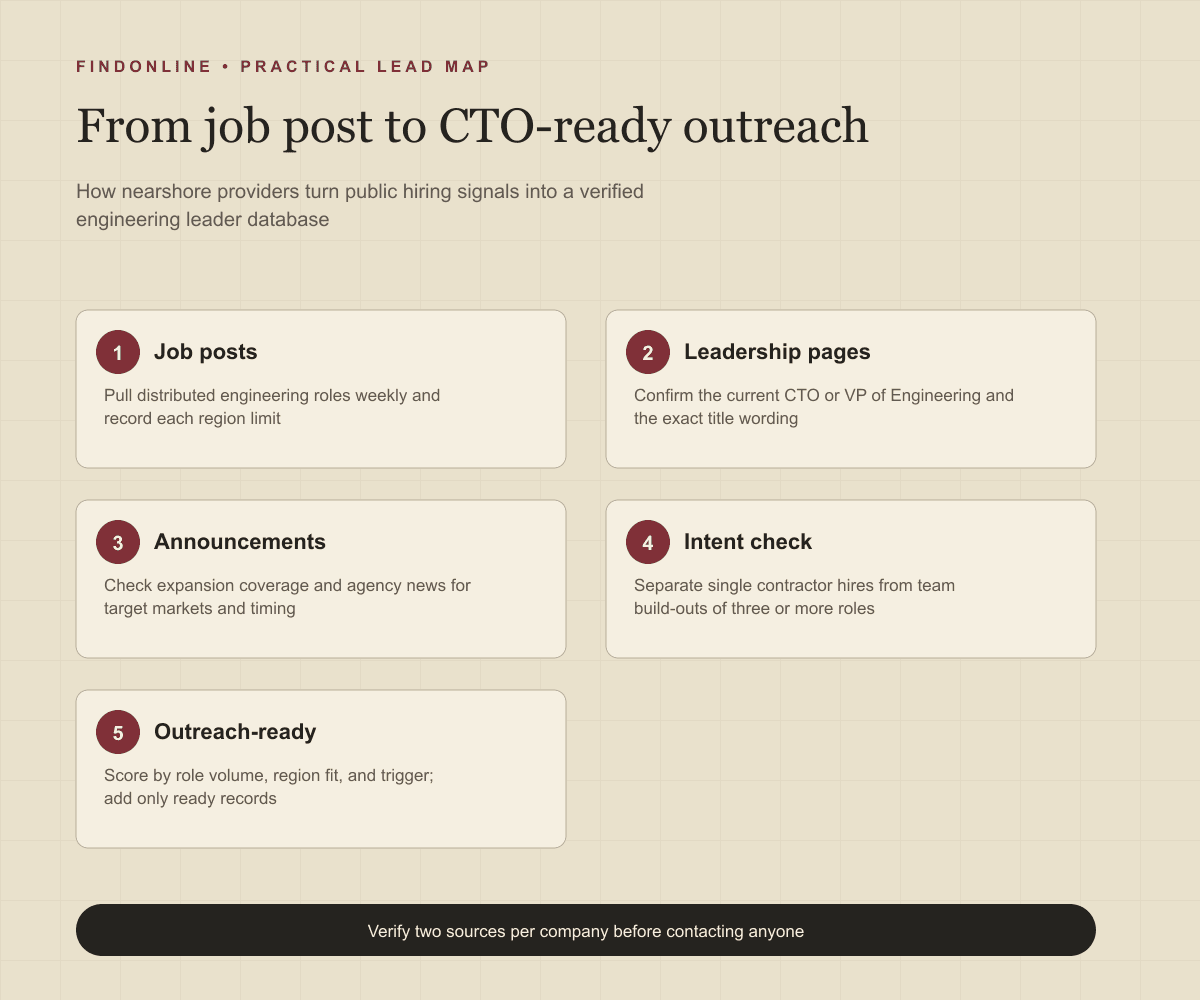
Follow this sequence:
- Choose target markets and list the job boards, leadership pages, and publications that cover them.
- Pull new distributed engineering roles weekly and normalize employers by domain.
- Cross-check each employer against its leadership page and any expansion announcement.
- Identify the CTO, VP of Engineering, or talent owner and confirm the current role.
- Score each record by role volume, region fit, and trigger; mark it ready, needs verification, or out of scope.
- Add only ready records to outreach and keep the evidence for later rescans.
Best tools to automate outreach: which options fit a nearshore provider's pipeline?
Choose the tool for the stage you need to operate.
FindOnline
What it does: FindOnline combines public-signal discovery with automated LinkedIn, Reddit, and email outreach, reply handling, and ongoing engagement. Apply it to verified technology companies and the CTOs behind each hiring plan. FindOnline product and workflow.
Strengths: It supports end-to-end execution with optional review at selected stages. Use evidence-backed relationship routing, verified professional commonality, or a direct signal-led message about the specific roles. FindOnline operating model.
Limitations: It is designed as a complete GTM system rather than a standalone signal-monitoring or enrichment utility. Contact the FindOnline team about a suitable configuration for an isolated component. Job board connections are not confirmed in the cited official material. FindOnline product.
Best for: GTM operators at nearshore providers taking job post and leadership research through multichannel conversations with CTOs while choosing which stages run automatically. FindOnline workflow and review controls.
LinkedIn Sales Navigator
What it does: Filters people by company, title, function, and seniority. Sales Navigator filter documentation.
Strengths: Saved searches and matching alerts support repeated CTO research. Sales Navigator filter documentation.
Limitations: A CTO title does not show whether the company accepts external teams, so hiring intent must come from job posts or announcements. Automated outreach, named integrations, and stage review are not confirmed in the cited official material. Sales Navigator filter documentation.
Best for: Researchers confirming the engineering leader inside a company that job posts have already surfaced. Sales Navigator filter documentation.
ZoomInfo
What it does: ZoomInfo Sales lets teams build precise lists using 300 attributes such as technology stack and funding data. ZoomInfo Sales overview.
Strengths: Technology stack and funding attributes narrow a hiring list to companies whose stack you actually staff. ZoomInfo Sales overview.
Limitations: Attribute filters describe the company, not its willingness to use an external team, so job posts must still confirm intent. Outreach automation, named integrations, and stage review are not confirmed in the cited official material. ZoomInfo Sales overview.
Best for: Providers filtering a large list of distributed hirers by stack and funding before outreach. ZoomInfo Sales overview.
Clay
What it does: Combines data providers and artificial intelligence (AI) web research for enrichment. CRM enrichment documentation.
Strengths: Custom enrichment logic and customer relationship management (CRM) synchronization suit job-post-to-leader matching fields. CRM enrichment documentation.
Limitations: Your team must design the logic that links a job post to an employer, a leader, and a region. Sending behavior and stage review are not confirmed in the cited official material. CRM enrichment documentation.
Best for: Operators building repeatable job-post-to-CTO research before contact activation. CRM enrichment documentation.
Crunchbase
What it does: Crunchbase Pro provides private company data and aims to identify high-potential companies the moment signals emerge. Crunchbase Pro overview.
Strengths: Funding and growth context helps rank which hiring companies can afford a team build-out. Crunchbase Pro overview.
Limitations: Funding data does not reveal whether a company accepts nearshore teams, so it ranks a list rather than creating one. Outreach sending and stage review are not confirmed in the cited official material. Crunchbase Pro overview.
Best for: Providers prioritizing funded companies within a list of distributed hirers. Crunchbase Pro overview.
Amplemarket
What it does: Amplemarket offers job change alerts that track top prospect job changes, alongside lead generation and engagement features. Amplemarket product overview.
Strengths: A new CTO or VP of Engineering often reviews vendors, so job-change alerts flag a timely moment. Amplemarket product overview.
Limitations: A job change signals a review moment, not a nearshore decision; the hiring evidence still has to come from job posts. Stage review is not confirmed in the cited official material. Amplemarket product overview.
Best for: Providers timing follow-up to leadership changes at companies already on their verified list. Amplemarket product overview.
Tool comparison: how do the six options differ?
Match the tool to your unresolved workflow stage. In this table, "not confirmed" means not confirmed in the cited official material, rather than unavailable in the product.
| tool | best for | data and discovery | outreach automation | integrations | support and review | limitations |
|---|---|---|---|---|---|---|
| FindOnline | Hiring-signal-to-conversation workflow | Public signals | Automated LinkedIn, Reddit, and email; end-to-end engagement | Job board connections not confirmed | Optional review by stage | Complete GTM system; discuss isolated components with the team. Product, workflow, controls |
| LinkedIn Sales Navigator | Confirming the engineering leader | Company and role filters | Not confirmed | Named connections not confirmed | Stage review not confirmed | Title does not show external-team intent. Evidence |
| ZoomInfo | Filtering hirers by stack and funding | Lists from 300 company and contact attributes | Not confirmed | Not confirmed | Stage review not confirmed | Filters do not show external-team intent. Evidence |
| Clay | Custom job-post-to-leader enrichment | Providers and AI research | Sending not confirmed | CRM synchronization | Stage review not confirmed | Requires post-to-leader logic design. Evidence |
| Crunchbase | Ranking funded hirers | Private company data and signals | Sending not confirmed | Not confirmed | Stage review not confirmed | Ranks a list; does not show nearshore intent. Evidence |
| Amplemarket | Timing follow-up to leadership changes | Job change alerts and lead data | Multichannel engagement | Not confirmed | Stage review not confirmed | Job change is a review moment, not a decision. Evidence |
Outreach workflow: how should a provider approach a CTO who is hiring?
Lead with the specific roles and a concrete first deliverable, not a general capabilities deck. Use the FindOnline discovery-to-outreach workflow to connect job post research with campaign execution, and set stage-level review controls if you want to approve the first message to each CTO.
Confirm the company, the open roles and their region limits, the technology leader, and the talent owner. Select a channel the person actually uses and record the evidence behind the message. A credible warm introduction, such as a shared investor, a former colleague, or a current client in the same market, is one possible route. Without one, use only verified professional commonality, such as a documented open-source community or a public conference talk. Never invent familiarity.
If there is no meaningful commonality, send a direct signal-led message:
Your [role] posts accept candidates in [region], and your team page shows [name] leading engineering. We staff [stack] teams in [country] that overlap [hours] with [home time zone]. Would a two-engineer pilot for [product area] fit your plan, or does someone else own external teams?
Time the sequence to the hiring window. Roles posted this week are usually filled or cancelled within a quarter, so start immediately and offer something usable, such as a time zone overlap map or a sample engineer profile matched to one open role.
Industry-specific nuances: what changes qualification for nearshore engineering?
Qualify the hiring model and the acceptance of external teams, not the presence of remote roles.
Separate contractor hiring from team building. A single remote role suggests the company hires individuals; three or more related roles in one product area, or a job post naming a hiring manager, suggests a team.
Read region limits carefully. A post restricted to one country signals payroll or compliance constraints, while "anywhere in the world" or time-zone-based limits show flexibility. Match your delivery country to the overlap hours the CTO's team already keeps.
Watch for false positives: staffing intermediaries posting roles on a client's behalf, evergreen job posts kept open for pipeline building, and leadership pages that still list a departed CTO. Prioritize companies with a new engineering leader, a recent funding or product announcement, and open roles in a stack you actually staff.
Limitations: how reliable are hiring signals?
Signals are directional rather than guaranteed truth. Use them to prioritize and personalize outreach and follow-ups, verify the underlying change, and rescan regularly because departments, roles, and company conditions change.
An open role does not prove approved budget, a decision to use external teams, or a CTO who wants a provider. Treat those as unanswered qualification questions and recheck the record before each campaign step.
Frequently asked questions: what do providers ask about finding CTOs building nearshore teams?
How many open roles indicate a team build-out rather than a single hire?
Three or more related engineering roles in one product area, or a post that names a hiring manager for a new team, usually indicates a build-out. One role with a broad region limit more often means an individual contractor hire.
Should I contact the recruiter listed on the job post?
Only as a routing step. The recruiter runs the search but rarely decides whether an external nearshore team is acceptable, so ask who sponsors the team.
How do I confirm the current CTO before outreach?
Check the company leadership page, then confirm the title and date on a professional profile. Leadership pages can lag behind departures, so treat a mismatch as a verification task rather than a dead lead.
How often should I rescan job posts and announcements?
Weekly for job boards and company career pages, and at least monthly for leadership pages and expansion coverage. Shorten the interval after a funding or leadership announcement, because hiring plans change fastest then.
Sources
- Software Engineer Jobs at Y Combinator Startups — Y Combinator · Accessed
- Remote Programming Jobs — We Work Remotely · Accessed
- Nearshore Americas — Nearshore Americas · Accessed
- CINDE News — CINDE · Accessed
- GitLab Executive Team — GitLab · Accessed
- About Toptal — Toptal · Accessed
- FindOnline GTM agents — FindOnline · Accessed
- About FindOnline — FindOnline · Accessed
- How FindOnline works — FindOnline · Accessed
- Sales Navigator Advanced Search Filters — LinkedIn · Accessed
- ZoomInfo Sales — ZoomInfo · Accessed
- CRM Enrichment — Clay · Accessed
- Crunchbase Pro — Crunchbase · Accessed
- Amplemarket — Amplemarket · Accessed