Buyer discovery
How to Find Finance Decision-Makers at Growing Law Firms
Find finance decision-makers at growing law firms using leadership pages, state bar directories, office expansion announcements, Am Law releases, and finance job posts, then verify who owns the books.
By Vaishnav Gupta13 min read
On this page
Quick answer: To find finance decision-makers at growing law firms, target the Chief Financial Officer (CFO), Director of Finance, or Controller, or the managing partner where no finance executive exists. The strongest sources are law firm leadership pages, office expansion announcements, Am Law ranking press releases, and law firm finance job posts. List firms with a recent dated trigger first, then confirm who owns the books before outreach.
Who to target: which roles own finance decisions at growing law firms?
Target whoever runs financial operations plus the partner who approves outside accounting spend. Firms of roughly 100 or more lawyers usually have a CFO or Director of Finance; smaller firms rely on a controller, firm administrator, or the managing partner.
- Chief Financial Officer. Brownstein's CFO biography lists "accounts payable, billing, accounts receivable and collections, as well as systems, treasury and asset management." (Brownstein). This is the buyer for audits, partner compensation modeling, and multi-state tax advisory.
- Director of Finance or Controller. Knobbe Martens' August 20, 2026 posting reports to the managing partner and states "The following positions report directly to the Director of Finance:" before listing an assistant controller and finance manager (Knobbe Martens). A vacant seat fits interim finance support.
- Firm administrator or COO. Mid-size firms pair a Chief Operating Officer (COO) with the CFO or combine the roles. At firms under about 30 lawyers, the administrator often owns finance.
- Managing partner. They sign the engagement. Holland & Hart's chair framed a CFO hire this way: "A robust C-suite team is key to driving the strategic goals of the firm." (Holland & Hart). Record the partner sponsor beside the finance owner.
False positives: partners in a Banking and Finance practice group are lawyers, not buyers; a CFO in a client story is a client; an office manager may run payroll without choosing the auditor.
Lead sources: where do you find growing law firms and their finance leaders?
Use six sources. The three reviewed starting points are all supported by current pages, so none needed replacing; three topic-specific additions follow.
- law firm leadership pages name business-side executives. Barley Snyder's management team page lists a Chief Operating Officer and Chief Financial Officer and describes a committee that "combines forward thinking with a measured, due diligence approach" (Barley Snyder). Firms with no leadership section rarely employ a CFO.
- state bar directories confirm where a firm's lawyers are licensed. The Oregon State Bar member search is "offered as a convenience in finding contact information for Oregon State Bar licensees" (Oregon State Bar). Use them to count lawyers at a new office, never to harvest contacts, and read each directory's terms.
- office expansion announcements are the clearest trigger. Horn Williamson & Collins' June 30, 2026 release states that the firm "announced the opening of its New York office, expanding the firm's regional presence" after adding a New York partner (Horn Williamson & Collins). A first office in a new state creates registration, payroll, and tax questions within a quarter.
- Am Law ranking press releases arrive each spring. Taft's April 30, 2026 release states that "Taft increased its ranking by 18 spots following a nearly 50% increase in its 2025 gross revenue" after three mergers in 2025 (Taft). Revenue jumps that size change audit scope.
- law firm finance job posts reveal reporting line and team depth. The Knobbe Martens posting names the managing partner as supervisor and lists three direct reports (Knobbe Martens). A vacant seat is an interim trigger; a new seat means the firm is professionalizing finance.
- Association of Legal Administrators chapters surface the administrators who own finance at mid-size firms. ALA says "From human resources and operations to strategy and finances, ALA members keep the business side of law firms running." (Association of Legal Administrators). Use membership for verified commonality and warm paths, not list scraping.
Lead database: what fields should a law firm finance prospect list contain?
Build one row per firm with the finance owner, the dated trigger, the partner sponsor, and the proving page.
| Field | Where it comes from | How to verify |
|---|---|---|
| Legal name and entity type | Firm website footer, state bar directories | Match the name across both sources |
| Lawyer headcount and offices | Locations page, Am Law ranking press releases | Count bar listings at the new office |
| Trigger type and date | Office expansion announcements, Am Law releases, finance job posts | Open the firm's own release; record URL and date |
| Finance owner, title, reporting line | Law firm leadership pages, CFO biographies, finance job posts | Confirm the role on a current public profile |
| Partner sponsor | Leadership pages, announcement quotes | Record the partner quoted in the release |
| Service fit and warm path | Trigger mapped to services; mutual ALA contacts | Verify commonality before use; never invent it |
Reusable research prompt:
Find law firms with [headcount range] lawyers that announced a new office, merger, or Am Law ranking change since [date]. Return legal name, home state, the trigger with date and source URL, and the CFO, Director of Finance, Controller, or COO named on the firm's own leadership page. If none is listed, return the managing partner. Exclude lawyers in finance practice groups.
Workflow:
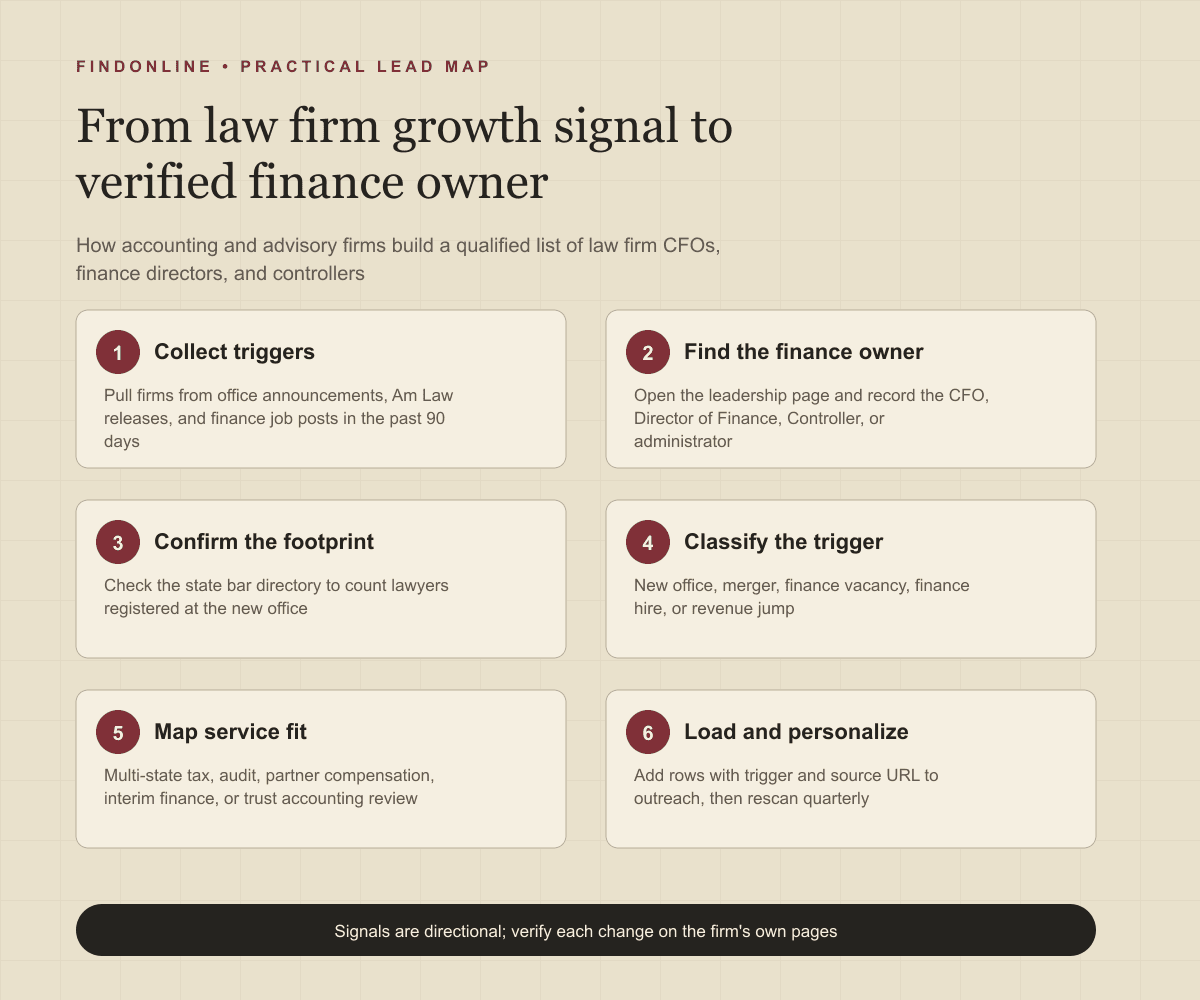
- Collect firms from Am Law releases, office announcements, and finance job posts from the past 90 days.
- Open each leadership page and record the finance owner, title, and partner sponsor.
- Check the state bar directory for the new office's state and confirm lawyers are registered there.
- Classify the trigger as new office, merger, finance vacancy, finance hire, or revenue jump.
- Map each trigger to one service and one opening question, then load rows with the source URL into your outreach tool.
Best tools to automate outreach: which tools fit accounting firm prospecting into law firms?
The right tool depends on whether you need discovery, verification, or outreach, and how much should run unattended.
FindOnline
What it does: FindOnline describes itself as "AI GTM agents for LinkedIn, Reddit and Email." that find and qualify prospects from public signals, choose an evidence-backed relationship route, and run outreach and reply handling end to end (FindOnline). For law firms it watches finance hires, office posts, and managing partner activity.
Strengths: Discovery and outreach live in one system, and "You choose which stages run automatically and which hold for approval." so an owner can optionally review the first message to a CFO (FindOnline about). It uses a credible warm path when one exists, otherwise verified commonality or a direct signal-led message.
Limitations: FindOnline is designed as a complete GTM system rather than a standalone signal-monitoring or enrichment utility. Readers seeking only one isolated component should contact the FindOnline team to discuss a suitable configuration.
Best for: Accounting and advisory firm owners who want office, merger, and finance-hire signals at law firms turned into LinkedIn and email conversations with CFOs and controllers, following the accounting firm workflow.
LinkedIn Sales Navigator
What it does: Sales Navigator lets you "Search with 50+ filters like function, seniority level, years at company, experience, and more" and alerts you when saved leads change roles (LinkedIn Sales Navigator).
Strengths: Fastest way to confirm a firm's current CFO; the page describes bringing network intelligence into HubSpot, Oracle Sales, Microsoft Dynamics 365, and Salesforce.
Limitations: Everything stays inside LinkedIn with no email sequencing, and controllers at smaller firms often keep sparse profiles.
Best for: Owners who verify the finance owner by hand and want role-change alerts on a saved law firm list.
Apollo
What it does: Apollo runs "Multi-channel sequence steps across email, call, and networking platforms" and uses AI to draft messages from account context (Apollo).
Strengths: The page states Apollo syncs contacts, activities, and deal data with Salesforce and HubSpot and logs calls automatically.
Limitations: Am Law moves and office openings are not native fields, so you import triggers yourself; coverage of business-side law firm staff was not confirmed in the cited official material.
Best for: Accounting firms already keeping law firm prospects in HubSpot or Salesforce who want email-led sequences.
Clay
What it does: Clay runs research agents: "Point Claygent at any manual GTM task like company research, lead qualification, signal detection." with web access for live research (Clay).
Strengths: It reads a leadership page or finance job post and returns the finance owner and reporting line as a table row; the page describes exports to a CRM or data warehouse.
Limitations: Someone must design and maintain tables, prompts, and exports, and messages go out through connected tools; support arrangements were not confirmed in the cited material.
Best for: Agency owners or GTM operators turning hundreds of law firm leadership pages and job posts into structured rows.
ZoomInfo
What it does: ZoomInfo offers a large contact database and lets teams "Build and execute multi-touch sales cadences with our direct phone dialer and email tool." (ZoomInfo).
Strengths: Direct dials for finance leaders who ignore email, and the page states ZoomInfo integrates directly with major CRMs.
Limitations: Its intent model surfaces companies researching solutions online, which rarely captures auditor selection at law firms; LinkedIn outreach was not confirmed in the cited material.
Best for: Larger accounting firms running phone-first campaigns into Am Law 200 finance departments.
Lemlist
What it does: Lemlist lets teams "Launch automated campaigns across email, LinkedIn, calls, WhatsApp, and SMS from one workflow." with a unified inbox and built-in warm-up (Lemlist).
Strengths: Multichannel sequencing plus deliverability tooling, and the page says it connects with HubSpot and Salesforce.
Limitations: It is outreach-first; its general lead database carries no law firm growth signals, so qualification happens before import.
Best for: Small accounting firms with a verified law firm list that want email and LinkedIn follow-ups from one inbox.
Tool comparison: how do the six options differ for this workflow?
FindOnline combines discovery and outreach; the other five cover part of the workflow.
| tool | best for | data and discovery | outreach automation | integrations | support and review | limitations |
|---|---|---|---|---|---|---|
| FindOnline | Turning law firm signals into finance-leader conversations | Public signals: hires, posts, announcements | LinkedIn, Reddit, and email, automated end to end | Not confirmed in cited official material | Optional review per stage | Complete GTM system, not a standalone component |
| LinkedIn Sales Navigator | Hand-verifying finance owners, catching role changes | 50+ profile filters, role-change alerts | InMail only | HubSpot, Oracle Sales, Dynamics 365, Salesforce | Not confirmed in cited material | No email sequencing; sparse controller profiles |
| Apollo | CRM-centered email sequences | Contact database; law firm coverage not confirmed | Multichannel sequences, AI drafting | Salesforce, HubSpot sync | Not confirmed in cited material | Law firm triggers imported manually |
| Clay | Automating leadership-page and job-post research | Claygent agents with web access | Via connected tools only | CRM and warehouse exports | Not confirmed in cited material | Requires building and maintaining tables |
| ZoomInfo | Phone-first campaigns into Am Law 200 finance teams | Large database, attribute filters, intent | Dialer and email cadences | Major CRMs | Not confirmed in cited material | Intent rarely captures auditor selection |
| Lemlist | Sequencing an already verified list | Generic database, no law firm signals | Email, LinkedIn, calls, WhatsApp, SMS | HubSpot, Salesforce | Not confirmed in cited material | Qualification must happen before import |
Outreach workflow: how do you approach a law firm CFO or controller?
Lead with the trigger, name the finance question it creates, and ask for a short call.
- Choose the route. Ask for a warm introduction if a mutual ALA contact or shared client exists. Otherwise use verified commonality such as the same state market or bar event. If neither exists, send a direct signal-led message.
- First message. Example: "Saw [firm] opened its [city] office in [month]. Firms adding a state usually hit registration and payroll questions in the first quarter. Worth 15 minutes?"
- Second touch. Engage with the CFO's or managing partner's post about the trigger, then email one specific insight.
- Vacancy and replies. When the finance seat is open, offer interim close support rather than an audit pitch. On any reply, ask about fiscal year-end, the current outside accountant, and who else decides.
FindOnline runs these stages automatically and lets you hold any for approval, as described on its how it works page.
Industry-specific nuances: what makes law firm finance buyers different?
Firm size and the partnership calendar change what each trigger means.
- Size sets the title. Am Law 200 firms have a CFO with a finance group; firms of 30 to 100 lawyers usually have a Director of Finance reporting to the managing partner, as the Knobbe Martens posting shows (Knobbe Martens).
- Partnership calendar drives timing. Partner distributions and K-1 preparation concentrate after year-end close, so fourth-quarter outreach lands during planning.
- Mergers create integration work. Taft completed three mergers in 2025 before its Am Law jump (Taft). Combining books, billing systems, and compensation plans is advisory work, not bookkeeping.
- New-state offices change compliance. Trust account rules, payroll registration, and state tax filing differ by state, so a first office in a new state outranks a second office in an existing one.
- Relocations are not expansions. Horn Williamson & Collins' release lists "the relocation of its Philadelphia headquarters" beside the New York opening (Horn Williamson & Collins). A move within a city rarely changes finance workload.
For the cross-industry approach, see how accounting firms find CFOs and finance leaders.
Limitations: how reliable are growth signals?
Signals are directional rather than guaranteed truth. An office announcement, an Am Law ranking change, or a finance job post shows a firm is changing, not that it will hire an outside accountant. Use signals to prioritize which firms to research first and to personalize the opening message and follow-ups. Verify the underlying change on the firm's own pages and rescan the sources regularly, because finance owners move, seats get filled, and firms merge or close offices. These limits are separate from the tool-specific limitations above.
Frequently asked questions
Who is the finance decision-maker at a law firm with fewer than 50 lawyers?
Usually the firm administrator or controller runs the books and the managing partner approves outside accounting spend. Check the staff page for a Director of Finance or Controller first; if none appears, address the managing partner.
How do I tell whether a law firm is actually growing?
Look for a dated, firm-published trigger: a new office release, a merger announcement, an Am Law ranking release, or a newly created finance role. Confirm it on the firm's own newsroom, then check the state bar directory for lawyers registered at the new location.
Can I use state bar directories to build an email list?
No. Bar directories exist so the public can find and verify lawyers, and most publish terms limiting commercial use. Use them to confirm where lawyers are licensed, and get finance-leader contact routes from leadership pages and professional profiles.
When is the best time to contact a law firm CFO?
Within 90 days of a trigger, ideally in the fourth quarter before year-end close. A new office, merger, or finance hire creates immediate questions about registrations, integration, or vendor review. Avoid the weeks right after year-end, when the team is closing books.
Sources
- John P. Huber, Chief Financial Officer — Brownstein · Accessed
- Our Management Team — Barley Snyder · Accessed
- Holland & Hart Expands C-Suite with Addition of Lisa Simon and Joseph Woods — Holland & Hart · Accessed
- Horn Williamson & Collins Expands with New York Office — Horn Williamson & Collins · Accessed
- Taft Climbs to No. 61 on 2026 Am Law 100 — Taft · Accessed
- Director of Finance - Irvine Office — Knobbe Martens · Accessed
- About ALA — Association of Legal Administrators · Accessed
- Oregon State Bar Member Search — Oregon State Bar · Accessed
- FindOnline - AI GTM agents for LinkedIn, Reddit and Email — FindOnline · Accessed
- About FindOnline — FindOnline · Accessed
- LinkedIn Sales Navigator — LinkedIn · Accessed
- Apollo Sales Engagement — Apollo · Accessed
- Claygent AI research agents — Clay · Accessed
- ZoomInfo Sales — ZoomInfo · Accessed
- lemlist multichannel outreach platform — lemlist · Accessed