Buyer discovery
How to Find Founders of Shopify App Companies
Build a verified list of Shopify app companies and founders, identify relevant business signals, and automate personalized outreach.
By Vaishnav Gupta11 min read
On this page
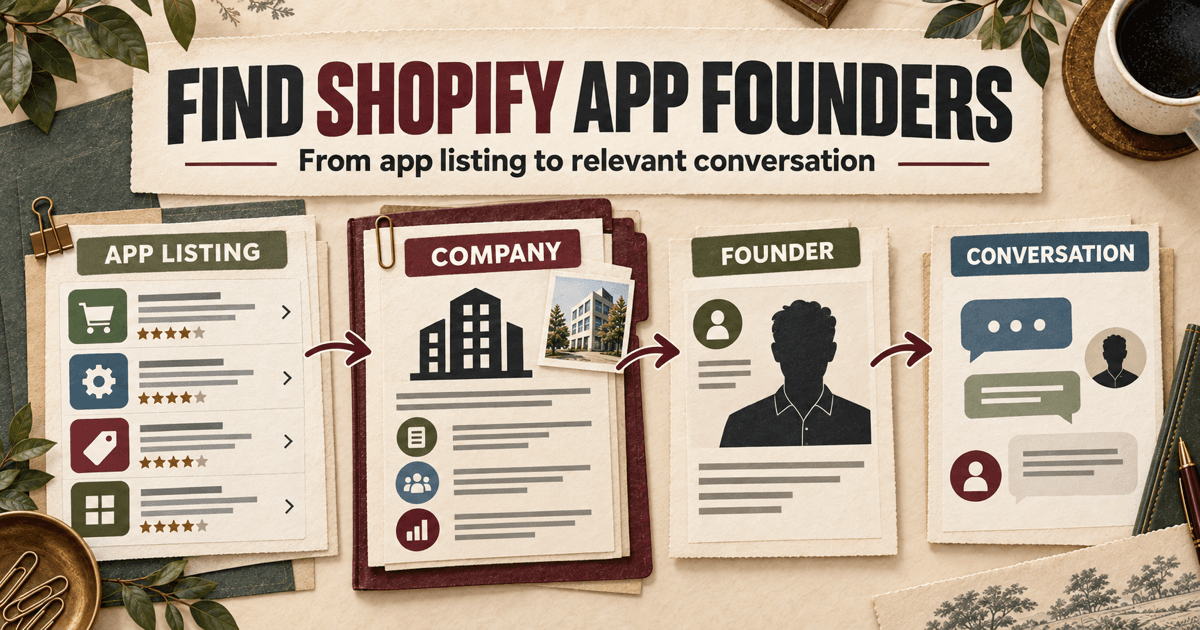
Quick answer: To find founders of Shopify app companies, choose an app category that fits your offer, collect relevant listings, trace each developer to its operating company, and verify who currently leads the business. Then prioritize companies using a recent signal and contact the person who owns the outcome, which may be the founder, a partnerships leader, or a growth leader.
This guide is for agencies, technology partners, and B2B service providers that need a usable Shopify app company database and a clear route into relevant conversations.
Who to target at Shopify app companies
A founder is often the right contact at a small app business, but company structure and your offer should determine the final target.
| App company situation | Start with | Also consider |
|---|---|---|
| Solo product or small team | Founder, cofounder, or owner | Technical cofounder for infrastructure offers |
| Growing single-app company | Founder or CEO | Growth, Partnerships, or Marketing lead |
| Multi-app studio | Founder or CEO | Portfolio lead or general manager |
| App owned by a larger company | Business-unit leader | Partnerships or product-marketing lead |
Match the role to the result you sell. An agency offering app-store positioning may need Growth. An integration company may need Partnerships. An infrastructure vendor may need the technical founder. If the app was acquired, verify whether the original founder still has an active role.
Lead sources that connect an app to its company and founder
Use each source to answer a different question.
- Shopify App Store category pages: Define the app universe by category, subcategory, and tag. Shopify says classifications help merchants discover apps and that an app's primary tag should represent its main function (Shopify app listing categories). Only fully visible apps appear in category pages, App Store search, and third-party search results (Shopify app listing visibility).
- App listings and developer links: Save the app name, listing URL, developer name, domain, use case, integrations, and category. The Shopify App Store marketing and conversion category shows how listings expose positioning, reviews, and Built for Shopify status.
- Developer privacy and legal pages: Reconcile the app brand, operating company, and legal entity. Shopify requires a privacy policy linked from the listing, but its contact details are not automatic permission for sales outreach (Shopify privacy requirements).
- Company website and LinkedIn: Require explicit founder evidence and confirm the role is current. Sales Navigator can narrow people by company, title, function, seniority, shared experience, and job changes (LinkedIn advanced search filters).
- Product updates and review patterns: Use launches, integrations, hiring, or public product activity to prioritize timing. Built for Shopify can bring added visibility, while App Store reviews are evaluated for recency, usefulness, and trust (Built for Shopify; Shopify app reviews). These signals provide context, not proof of demand.
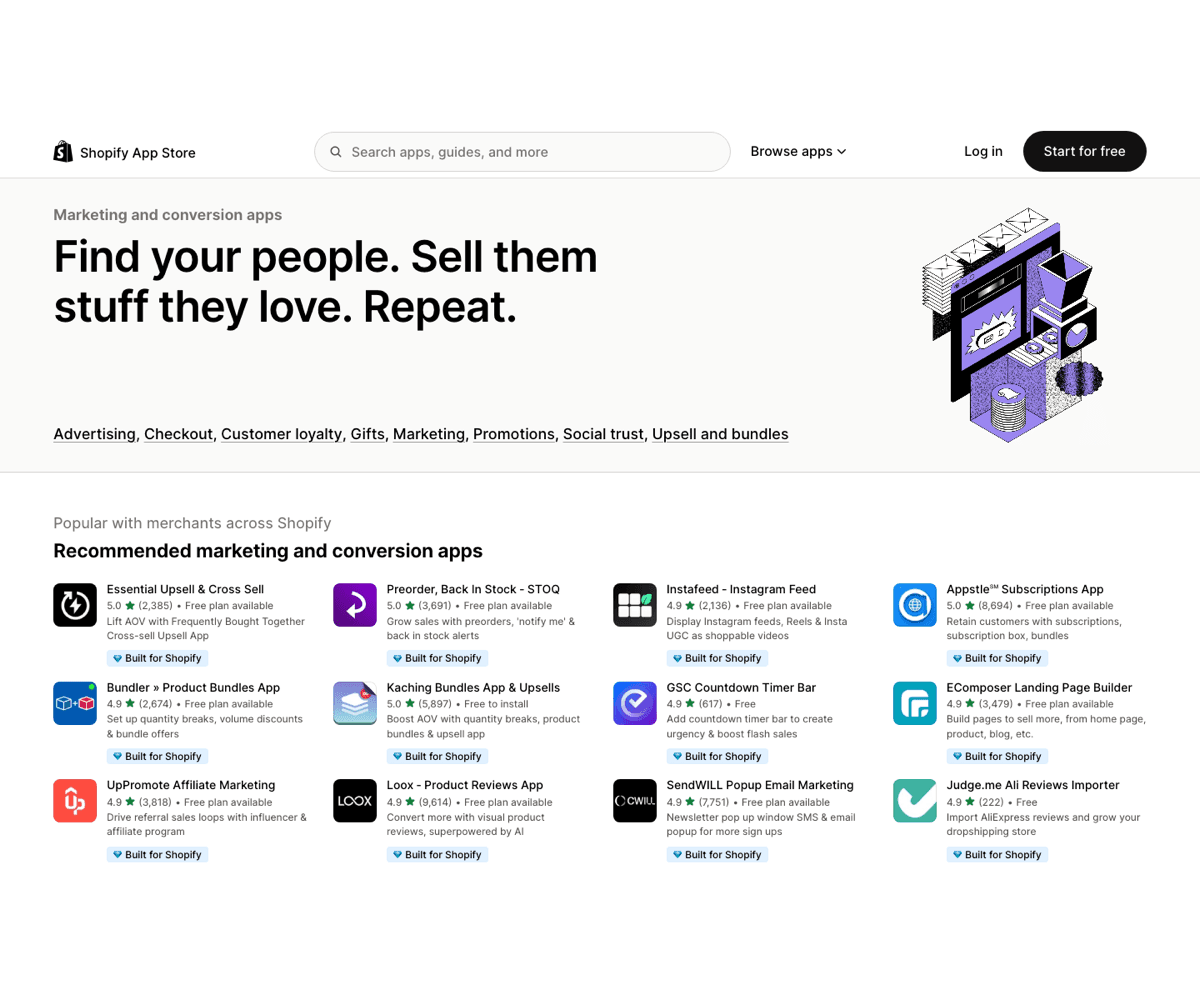
Shopify App Store category page captured on September 15, 2026. Check the live page because listings and labels change.
Lead database your team can act on
Use one company record with linked app and person records. This prevents duplicate outreach when one developer operates several apps.
| Field | Example | Acceptance rule |
|---|---|---|
| App record | Inventory Alert Pro; listing saved | Matches the chosen category and offer |
| Developer identity | Bright Cart Apps | Copied exactly from the listing |
| Company and domain | Bright Cart Labs | Company evidence and domain agree |
| Current leaders | Cofounder; Partnerships lead | Current role verified |
| Related apps | Inventory and preorder apps | Group only after identity matches |
| Recent signal | New warehouse integration | Source and date saved |
| Conversation angle | Partnership for shared customers | Signal connects to the offer |
| Next action | Contact Partnerships first | Owner, channel, date, and stop rule set |
Best tools to automate outreach
FindOnline - complete Shopify app prospecting and engagement
What it does: FindOnline discovers and qualifies companies and people from public signals, runs LinkedIn, Reddit, and email outreach, handles replies, and keeps relationships active. Its Shopify app workflow and complete GTM process connect research with continued engagement.
Strengths: It maps app-company context to the appropriate decision-maker, then uses a credible introduction, verified common ground, or a direct signal-led message. The workflow can run automatically, with optional review by stage.
Limitations: FindOnline is a complete GTM system, not a one-off directory export or isolated enrichment utility. For only one component, contact FindOnline about a suitable configuration.
Best for: Agencies, partners, and service providers that want discovery, outreach, reply handling, and long-term engagement in one system.
Shopify App Store - authoritative app discovery
What it does: The Shopify App Store provides public categories, listings, developer links, integrations, reviews, and product-quality labels.
Strengths: It is the first-party source for determining what an app does, who publishes it, and how Shopify classifies it.
Limitations: It has no verified founder field, and limited-visibility apps are absent from category and search results.
Best for: Building the initial app-company universe before resolving legal entities and current decision-makers.
LinkedIn Sales Navigator - current-role and relationship research
What it does: Sales Navigator narrows people by company, title, function, seniority, activity, job changes, and relationship context.
Strengths: It helps verify whether a founder remains active, find an alternative functional leader, and identify genuine shared professional context.
Limitations: It does not reliably map an app brand to its operating company, and a founder title may remain visible after operational authority changes.
Best for: Teams that have resolved the developer company and need hands-on verification of its current leaders.
Apollo - contact data and email sequences
What it does: Apollo supports contact research and sequences with automated email plus manual call and LinkedIn tasks (Apollo Sequences overview).
Strengths: It provides repeatable email follow-up after the target company, person, and message are already defined.
Limitations: It does not establish the app-to-company relationship or prove that a public product signal fits the offer. LinkedIn actions remain manual tasks.
Best for: Teams with a verified Shopify app founder list and an established email motion.
Common Room - cross-channel buying signals
What it does: Common Room Signals combines product, community, website, social, open-source, and public-web activity and connects those signals to people and accounts.
Strengths: It helps teams prioritize known app companies using several types of activity rather than relying on a single event.
Limitations: Signal coverage does not resolve a Shopify app brand to its current operating company or determine the most credible conversation route.
Best for: Shopify ecosystem teams that already know their target segment and want to prioritize accounts from multiple signal sources.
DeepSales - AI buyer discovery and outreach
What it does: DeepSales combines an international company database with buying signals, enrichment, personalized email and LinkedIn outreach, follow-up, reply handling, and CRM synchronization.
Strengths: It connects broad buyer discovery with multilingual outreach and routes warm responses back to the sales team.
Limitations: Its broad company coverage still requires Shopify App Store evidence to define the correct app-company universe and confirm developer ownership.
Best for: Teams seeking automated international prospecting after they have defined a clear Shopify app-company ICP.
Tool comparison
| Tool | Best for | Data and discovery | Outreach automation | Integrations | Support and review | Limitations |
|---|---|---|---|---|---|---|
| FindOnline | Complete research-to-relationship execution | Shopify, LinkedIn, Reddit, and public-web signals | Automated LinkedIn, Reddit, and email outreach, replies, and continued engagement | Coordinated GTM workflow | Optional review by stage | Complete system rather than a one-off export |
| Shopify App Store | Defining the app universe | First-party categories, listings, developer links, integrations, and reviews | None | Links to developer websites and product resources | Public documentation and App Store governance | No verified founder field |
| LinkedIn Sales Navigator | Verifying current leaders | Company, title, activity, job-change, and relationship filters | LinkedIn-native prospecting | CRM capabilities vary by edition | User validates company mapping and role ownership | Does not reliably connect every app brand to its operator |
| Apollo | Executing a prepared email motion | Contact and company database | Automated email with manual call and LinkedIn tasks | Mailbox and sales workflows | Team owns qualification and message quality | Requires a verified app-company-person map |
| Common Room | Prioritizing accounts from activity signals | Product, community, website, social, and public signals | Activates signal-led GTM plays | More than 50 native signal integrations plus configurable capture | Team defines signal relevance and response plays | Does not determine app ownership or the correct relationship route |
| DeepSales | Automated international buyer outreach | Company data plus funding, hiring, trade, and procurement signals | Automated email and LinkedIn follow-up, reply handling, and routing | Salesforce, HubSpot, Pipedrive, and Zapier | Warm responses route to the sales team | Needs Shopify-specific evidence to define and verify the app universe |
Use the Shopify App Store to define the market, Sales Navigator to verify current leaders, Apollo for a prepared email motion, Common Room to combine activity signals, and DeepSales for broad automated prospecting. FindOnline fits when Shopify-specific research, multichannel execution, reply handling, and continued relationship activity need to operate as one coordinated workflow.
Outreach workflow from app discovery to reply
- Define one offer and app segment. Example: integration partnerships for subscription apps.
- Collect app records. Save the listing, category, developer name, domain, and relevant product details.
- Resolve the company. Reconcile the app brand, developer name, official domain, and legal identity.
- Verify current leaders. Add the founder and the functional leader who owns your proposed outcome.
- Prioritize a dated signal. Use an integration, launch, hiring change, or category expansion connected to your offer.
- Choose the honest route. Use a credible introduction, verified professional commonality, or a direct signal-led message.
- Make one small ask. Do not open with a company biography or full product pitch.
- Coordinate follow-up. Stop when someone replies, rescan public signals, and continue useful engagement instead of closing the relationship after one campaign.
Use this first-message structure:
Hi Maya, I saw that [App] added [verified integration or feature]. We help Shopify app companies [relevant outcome], and the change connects to [specific reason]. Would a short [partner map, acquisition teardown, or technical checklist] be useful?
An agency can offer a merchant-acquisition teardown. An ecosystem partner can offer a shared-workflow map. An infrastructure provider can offer a checklist tied to the new feature.
Industry-specific nuances: app, company, and buyer are different records
| Situation | What to do |
|---|---|
| One company publishes several apps | Deduplicate at company level and preserve linked app records |
| App name differs from developer company | Trace the listing domain before person enrichment |
| App was acquired | Find the current operator and functional leader |
| Reviews show a recurring merchant issue | Use the aggregate theme for research, not reviewers as contacts |
| New integration or quality label appears | Prioritize it only when it connects to your offer |
Do not turn review counts into revenue estimates or claim that an app company has a problem because merchants mentioned one. A useful conversation connects a verified company action to a specific outcome.
Limitations: use app signals as direction, not certainty
Shopify app signals are directional, not guaranteed truth. A listing update, integration, hiring post, or review pattern can be stale or unrelated to an active buying project. Use signals to prioritize companies and personalize outreach and follow-ups, not to claim budget, urgency, or dissatisfaction.
Rescan sources at regular intervals because listings, ownership, roles, and product priorities change. Refresh the conversation angle when new evidence appears and expire stale signals.
The public App Store excludes custom apps and does not surface limited-visibility apps through normal search. A support or privacy contact helps identity research but is not marketing consent. For U.S. commercial email, follow the FTC CAN-SPAM guide.
Frequently asked questions
What is the fastest way to find founders of Shopify app companies?
Choose one App Store category, collect relevant app and developer names, resolve each developer domain, and verify a current founder on the company website and LinkedIn. Save the source and verification date with every person.
Does the Shopify App Store show the founder's name?
No. A listing identifies the app and developer, not a verified founder. Trace the developer to its official domain, then confirm the current founder from separate evidence.
Should I contact only the founder?
No. Contact the founder at a small founder-led company, but choose Partnerships, Growth, Marketing, Product, or Engineering when that role owns the result you sell. For an acquired app, start with the current operator.
How should I handle a company with several Shopify apps?
Create one company record and link all verified apps to it. Coordinate outreach at account level so the same person does not receive duplicate messages.
Which signal should I mention first?
Use the newest verified change that directly relates to your offer, such as an integration, launch, expansion, or relevant hiring move. Do not use ratings or reviews to claim the company is ready to buy.
Can the complete workflow run automatically?
Yes. FindOnline can automate research, qualification, LinkedIn, Reddit, and email outreach, reply handling, and continued engagement. Human review is optional by stage.
Sources
- Marketing and conversion apps — Shopify App Store · Accessed
- App listing categories — Shopify · Accessed
- App listing visibility — Shopify · Accessed
- Privacy requirements — Shopify · Accessed
- About Built for Shopify — Shopify · Accessed
- Manage app reviews in the Shopify App Store — Shopify · Accessed
- FindOnline for Shopify app owners — FindOnline · Accessed
- How FindOnline works — FindOnline · Accessed
- LinkedIn Sales Navigator Advanced Search Filters — LinkedIn · Accessed
- Sequences Overview — Apollo · Accessed
- Signals: Never miss a buying signal — Common Room · Accessed
- DeepSales AI sales agent — DeepSales · Accessed
- CAN-SPAM Act: A Compliance Guide for Business — Federal Trade Commission · Accessed