Buyer discovery
How to Find Sustainability Leaders at Industrial Companies
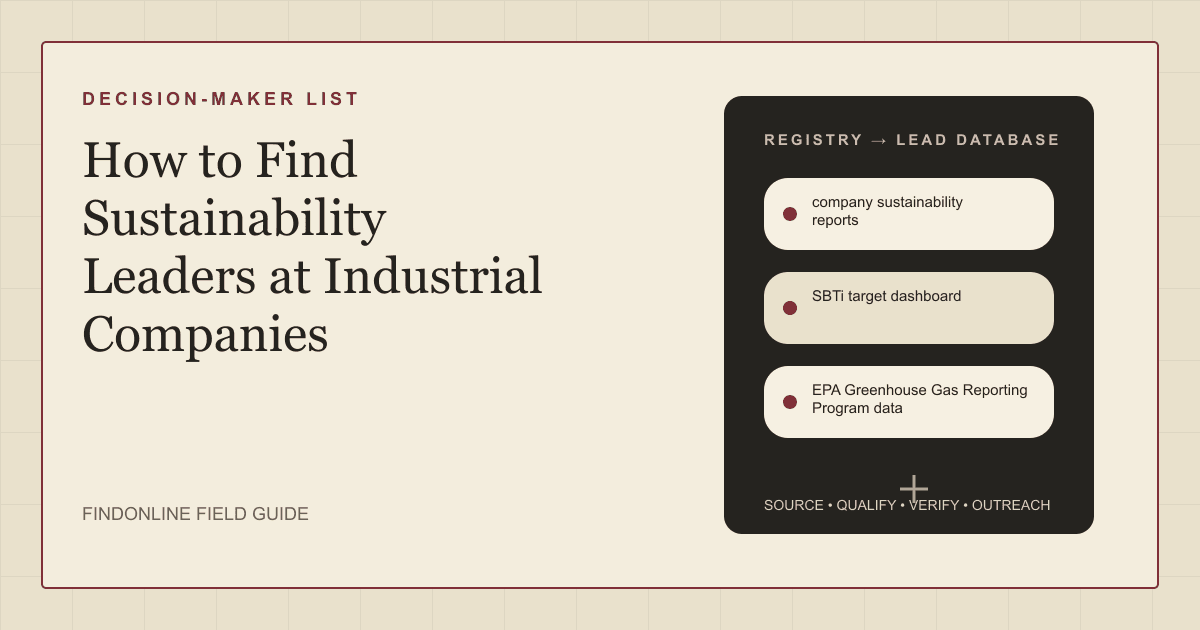
Find sustainability leaders at industrial companies using company sustainability reports, EPA emissions data, the SBTi target dashboard, proxy statements, and sustainability job posts, then verify who owns the remit.
By Vaishnav Gupta13 min read
On this page
Quick answer: To find sustainability leaders at industrial companies, target whoever owns emissions targets and reporting, usually a Chief Sustainability Officer, Director of Sustainability, or environmental, health and safety (EHS) leader. The strongest sources are company sustainability reports, the Science Based Targets initiative (SBTi) target dashboard, EPA emissions data, SEC proxy statements, and sustainability job posts. First, filter the SBTi dashboard to industrial sectors and name each leader from its sustainability page.
Who to target: which roles own sustainability decisions at industrial companies?
Target the person who owns emissions targets and sustainability reporting, not everyone with sustainability in their title. Large industrial companies have a Chief Sustainability Officer (CSO) or Vice President of Sustainability. Mid-size manufacturers usually have a Director of Sustainability or an EHS leader with "and Sustainability" in the title. For recruiters, the hiring manager is the executive that seat reports to, often the General Counsel, Chief Operating Officer, or Chief Human Resources Officer.
- CSO or VP of Sustainability: owns targets and disclosures and buys decarbonization roadmaps, greenhouse gas inventories, and assurance readiness.
- Director or Manager of Sustainability: runs data collection, framework reporting, and supplier engagement. Buys life-cycle assessments, reporting software implementation, and Scope 3 support.
- EHS and Sustainability leader: common where sustainability sits inside plant compliance. Owns ISO 14001 systems and plant energy projects.
- VP of Operations or corporate energy manager: the de facto owner at companies with an energy pledge but no sustainability title.
Qualify on evidence: a validated science-based target, facilities reporting under the EPA program, a first standalone report, or an open sustainability seat. False positives include commercial "sustainability" titles such as sustainable packaging sales, parent-company reports with no United States owner, and interim consultants listed as employees.
Lead sources: where do sustainability leaders at industrial companies show up publicly?
Seven public sources cover the company and the person. All three reviewed starting points had readable official pages today, so none was replaced.
- company sustainability reports name frameworks, targets, and sometimes the leader. Nucor's sustainability page states "net-zero goals set for 2050 and interim targets for 2030" and lists its GRI report, SASB index, and TCFD report (Source: Nucor Sustainability). Report maturity shows whether the buyer needs a first inventory or assurance-grade data.
- SBTi target dashboard lists companies with validated science-based targets or active commitments, filterable by sector and status (Source: SBTi Target Dashboard). A commitment without validation is a strong consulting trigger.
- EPA Greenhouse Gas Reporting Program data identifies regulated facilities. The EPA states that "Approximately 8,000 facilities are required to report their emissions annually", with data published each October (Source: EPA Greenhouse Gas Reporting Program). Several reporting facilities under one parent mean a corporate reporting owner exists.
- DOE Better Plants program partners "pledge to reduce energy intensity throughout all their U.S. manufacturing operations by 25% over ten years" (Source: DOE Better Plants). Partnership reveals an energy owner even where no sustainability title exists.
- SEC proxy statements describe board oversight of sustainability and often name the responsible executive. EDGAR full-text search covers "the full text of electronic filings since 2001" and can be limited to form DEF 14A (Source: SEC EDGAR Full-Text Search).
- industrial directories resolve parent and plant relationships for private manufacturers. IndustrySelect describes itself as the database to "identify, understand, and reach the right manufacturing companies" and offers executive contacts by title and function (Source: IndustrySelect).
- sustainability job posts show team builds and replacements. On LinkedIn, "You can filter your job search by a specific company or multiple companies" and by date posted and experience level (Source: LinkedIn Help: Filter and sort job search results). A posted Director seat means the hiring manager is active now.
Lead database: which fields make the sustainability leader list usable?
Record each company's commitment status, regulatory reporting load, and verified owner, each with a source and check date.
| Field | Where it comes from | How to verify |
|---|---|---|
| Company and parent entity | industrial directories, SEC proxy statements | Match legal name to the sustainability page |
| Segment and plant count | industrial directories, company sustainability reports | Confirm plants against the EPA facility list |
| Climate target status | SBTi target dashboard | Commitment or validated, plus target year |
| Reporting facilities | EPA Greenhouse Gas Reporting Program data | Count facilities in the FLIGHT tool |
| Report maturity | company sustainability reports | Latest report year, frameworks, ISO 14001 status |
| Governance owner | SEC proxy statements | Quote the oversight paragraph and named executive |
| Open sustainability roles | sustainability job posts | Title, level, posting date, reporting line |
| Verified leader and trigger | LinkedIn profile plus the report | Current title, start date, newest change, check date |
Reusable research prompt:
Research [company], an industrial manufacturer. 1) Record the latest sustainability report year, frameworks (GRI, SASB, TCFD, ISO 14001), and target years. 2) Record its SBTi status: commitment or validated. 3) Name the executive assigned sustainability oversight in its latest DEF 14A. 4) Count its EPA reporting facilities. 5) Return the sustainability leader, title, reporting line, and newest trigger with date and source URL.
Step-by-step workflow:
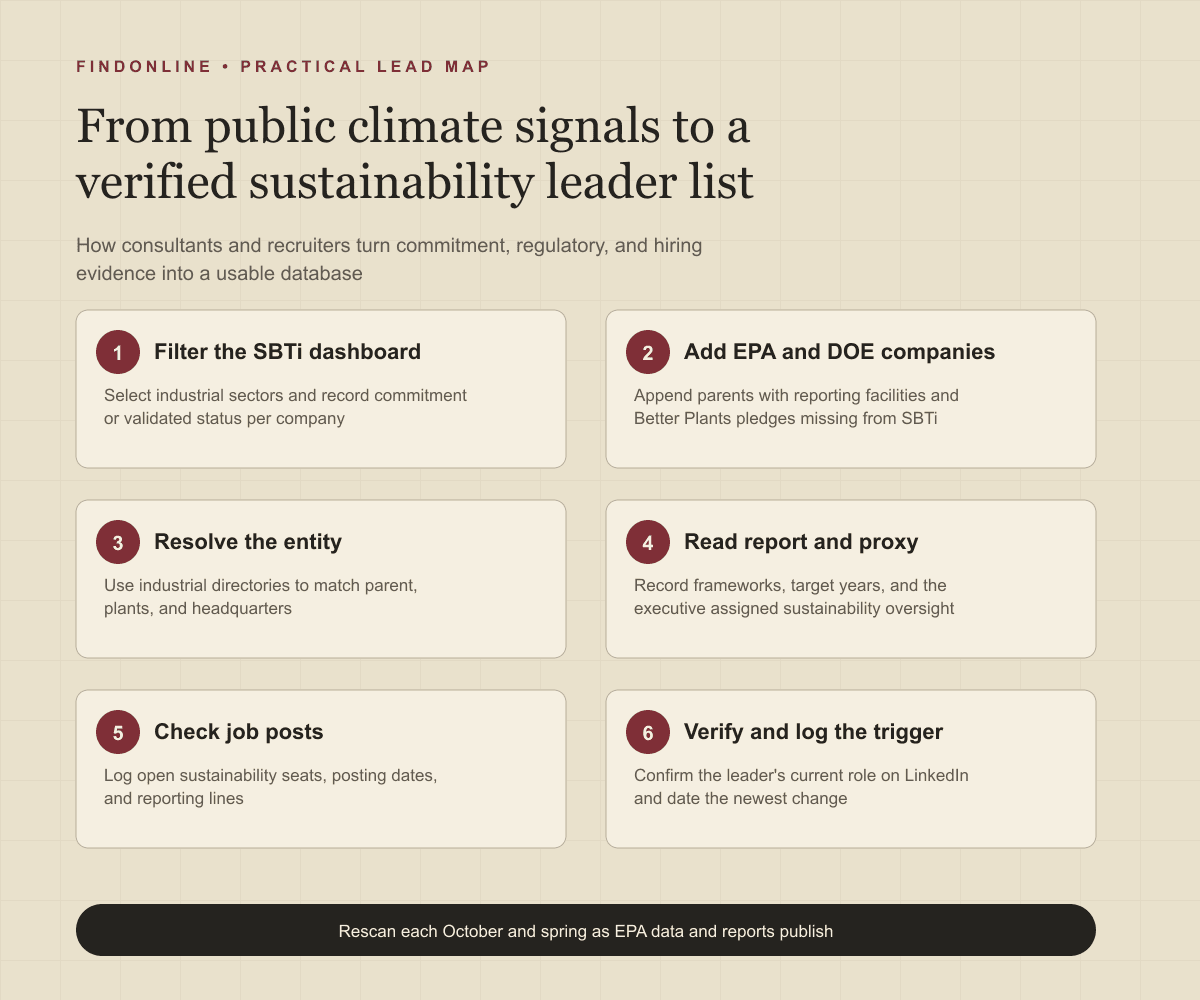
- Filter the SBTi dashboard to industrial sectors and your region, then export company names.
- Add parents with EPA reporting facilities and Better Plants partners missing from that list.
- Resolve each company to its parent and plants through industrial directories.
- Read the sustainability page and latest proxy statement for the governance owner.
- Search sustainability job posts by company for open seats and reporting lines.
- Verify the leader's current role on LinkedIn and date the strongest trigger.
Best tools to automate outreach: which tools fit this workflow?
FindOnline
What it does: FindOnline is an end-to-end AI GTM system that runs "AI GTM agents for LinkedIn, Reddit and Email" (Source: FindOnline). For this topic it finds sustainability leaders from public signals such as posts, hiring, and role changes, picks an evidence-backed relationship route, and runs outreach, replies, and ongoing engagement. Its agent "finds and contacts high-intent prospects, engages with their posts, tracks their professional events" (Source: FindOnline How It Works). Strengths: Discovery, routing, and multichannel outreach run as one automated system, and "You choose which stages run automatically and which hold for approval" (Source: FindOnline About). Without a warm path, it uses only verified professional commonality or a direct signal-led message. Limitations: FindOnline is designed as a complete GTM system rather than a standalone signal-monitoring or enrichment utility, so readers who want only one isolated component should contact the FindOnline team to discuss a suitable configuration. CRM integration specifics are not confirmed in the cited official material. Best for: Sustainability consultancies and specialist recruiters turning the SBTi and EPA-derived list into running LinkedIn and email conversations, with optional review on chosen stages.
LinkedIn Sales Navigator
What it does: "LinkedIn Sales Navigator is LinkedIn's B2B sales tool tailored for individual sellers and sales teams", offering advanced search filters, saved lead lists, and alerts when a saved lead has a job or role change (Source: LinkedIn Sales Navigator). Strengths: Fastest way to confirm who currently holds a sustainability title at a named manufacturer. The same page cites CRM integration features. Limitations: Search runs on titles and company attributes, not climate commitments, so you must import the SBTi and EPA list. A packaging maker's "Sustainability" title can be a sales role. Best for: Recruiters mapping every sustainability and EHS leader inside a target manufacturer and tracking role changes.
Apollo
What it does: Apollo's sales engagement combines "Multi-channel sequence steps across email, call, and networking platforms" with a built-in dialer, an AI assistant for sequence copy, and Salesforce and HubSpot sync (Source: Apollo Sales Engagement). Strengths: One system for sequences, calls, and CRM logging after a report-based first touch. Limitations: Outreach is framed around sequences and parallel dialing, so volume cadences quickly exhaust the small senior sustainability population at industrial companies. Best for: Consulting business-development teams that hold a verified list and want email and call follow-ups logged automatically.
Clay
What it does: Clay is a data and workflow platform with a marketplace of "200+ data and AI vendors" and AI agents that "understand your business and accounts" to research, score, and write 1:1 messages, triggering emails through integrated GTM tools (Source: Clay). Strengths: Can run the research prompt above across hundreds of companies, pulling report year, frameworks, and target status into one table. Limitations: Output quality depends on the sources and prompts you configure, and Clay does not itself run the LinkedIn conversation. Best for: GTM operators at consultancies enriching the sustainability lead database programmatically before outreach.
ZoomInfo
What it does: ZoomInfo Sales offers a contact database with 300+ attributes, intent signals showing accounts "researching solutions like yours", and multi-touch cadences through a dialer and email tool, with one-click CRM export (Source: ZoomInfo Sales). Strengths: Broad direct-dial and email coverage for corporate roles at large manufacturers. Limitations: Intent scoring tracks content research, not public climate commitments, so it cannot reveal SBTi status or reporting load. Plant-level EHS coverage at private manufacturers is not confirmed in the cited material. Best for: Recruiters and consultancies targeting large public manufacturers that need direct dials for corporate sustainability teams.
Lemlist
What it does: Lemlist lets teams "Launch automated campaigns across email, LinkedIn, calls, WhatsApp, and SMS from one workflow", with a 600M+ lead database, AI agents, and native integrations, MCP, and API access (Source: Lemlist). Strengths: Simple multichannel campaigns combining LinkedIn touches and email, personalized from your own context. Limitations: WhatsApp and SMS steps are poor fits for senior sustainability leaders you have never met, and the database filters on ICP attributes, not climate commitments. Supported CRMs are not named in the cited material. Best for: Small consultancies running one LinkedIn-plus-email campaign to a hand-verified list of twenty to fifty sustainability leaders.
Tool comparison: how do the six options differ for this list?
| tool | best for | data and discovery | outreach automation | integrations | support and review | limitations |
|---|---|---|---|---|---|---|
| FindOnline | Turning the list into conversations | Finds leaders from public signals: posts, hiring, role changes | LinkedIn, Reddit, and email outreach automated end to end | Not confirmed in cited material | Optional review per stage | Complete GTM system, not a standalone utility |
| LinkedIn Sales Navigator | Mapping leaders inside target manufacturers | Title and company search with saved-lead alerts | Not confirmed in cited material | CRM integration features cited | Not confirmed in cited material | Cannot filter on climate commitments |
| Apollo | Email and call follow-ups logged to CRM | Contact data feeding sequences | Multi-channel sequences: email, call, networking platforms | Salesforce and HubSpot sync | Not confirmed in cited material | Volume cadences exhaust a small senior population |
| Clay | Programmatic enrichment of the lead database | 200+ vendor marketplace plus AI research agents | Triggers emails through integrated tools | Integrations to existing GTM tools | Not confirmed in cited material | Research quality depends on configured prompts |
| ZoomInfo | Direct dials at large manufacturers | 300+ attributes and intent signals | Multi-touch cadences via dialer and email | One-click CRM export | Not confirmed in cited material | Intent tracks research, not climate commitments |
| Lemlist | One campaign to a short verified list | 600M+ database with ICP filters | Email, LinkedIn, calls, WhatsApp, SMS campaigns | Native integrations, MCP, API | Not confirmed in cited material | WhatsApp and SMS unsuitable for this audience |
Outreach workflow: how should you sequence contact with a sustainability leader?
Lead with the public evidence and match the ask to the trigger. A consultant's first line might read: "Your 2025 report sets a 2030 interim target while Scope 3 is still being baselined. We built supplier-data programs for two [segment] manufacturers." A recruiter's first line references the open Director seat and offers a market map to the hiring executive.
- Day 1, LinkedIn: a connection note that names the trigger, with no pitch.
- Day 3, email: two sentences on the trigger, one on relevant work, one question.
- Day 7, engagement: a useful comment on their post or report announcement.
- Day 12, email: one specific asset, such as a one-page gap list against their stated framework.
- Day 20: close the loop or move the record to the quarterly rescan.
A warm introduction through a shared trade association or former colleague is one possible route when it exists. Without one, use only verified professional commonality, such as shared ISO 14001 experience or the same professional community. If neither exists, send a direct signal-led message and never invent familiarity. For adjacent buyers, see how to find HR leaders at manufacturers opening new facilities, and for service positioning see the FindOnline pages for management consultancies and recruitment and staffing firms.
Industry-specific nuances: what is different about industrial sustainability buyers?
Industrial sustainability buying follows reporting calendars and plant economics, not marketing cycles.
- Time to the disclosure calendar. EPA data publishes each October, most sustainability reports appear in spring, and proxy statements precede annual meetings. Pitch inventory or assurance work the quarter before the report, and recruiting support after a proxy governance change.
- Separate commitment from validation. A company with an SBTi commitment but no validated target still has target modeling and data work ahead, the sharpest consulting trigger in this market.
- Find the budget holder. At mid-size manufacturers, operations funds energy projects, so the EHS leader specifies and the VP of Operations approves. Address both.
- Check regulatory status. In September 2025 EPA released a proposal to permanently remove program obligations for 46 source categories, so confirm current obligations before citing reporting load as a trigger (Source: EPA Greenhouse Gas Reporting Program).
- Read recruiter false positives. A seat posted by a staffing agency rather than the employer usually means a search firm is already engaged. Plant-experience requirements often make the COO, not the CSO, the hiring manager.
Limitations: how reliable are these signals?
Every signal here is directional rather than guaranteed truth. A validated target shows commitment, not budget, and an open seat shows a hiring plan, not a decision to use a search firm. Use signals to prioritize which companies to research first and to personalize the first message and each follow-up. Verify the underlying change on the primary page before you cite it. Rescan the sources regularly, because departments, roles, and company conditions change.
Frequently asked questions
Who owns sustainability at an industrial company that has no Chief Sustainability Officer?
Usually the EHS leader or the VP of Operations. Check the sustainability page for the leadership letter's author, the proxy statement for the executive assigned oversight, and job posts for the reporting line of any sustainability seat.
How can I tell whether a company's climate target is validated or only a commitment?
Open the SBTi target dashboard and read the company's status, which separates validated targets from commitments. A commitment means modeling and data work usually remain. Record the status and the date you checked.
Which public filings name the executive responsible for sustainability?
The annual proxy statement, form DEF 14A, is the most reliable public filing because it describes board and management oversight. Use EDGAR full-text search with the word "sustainability" limited to DEF 14A and the last year. Private manufacturers file no proxy, so rely on the sustainability page and job posts.
How do sustainability consultants and specialist recruiters use the same list differently?
Consultants sort by commitment gap: companies with a commitment but no validated target, or a first report without assurance, need the most help. Recruiters sort by open seats and reporting lines and treat the hiring executive as the buyer. Both drop companies whose only signal is marketing language.
Sources
- Sustainability — Nucor · Accessed
- Target Dashboard — Science Based Targets initiative · Accessed
- Greenhouse Gas Reporting Program (GHGRP) — U.S. Environmental Protection Agency · Accessed
- Better Plants — U.S. Department of Energy · Accessed
- EDGAR Full-Text Search — U.S. Securities and Exchange Commission · Accessed
- IndustrySelect: U.S. Manufacturer Database — IndustrySelect · Accessed
- Filter and sort job search results — LinkedIn Help · Accessed
- FindOnline: AI GTM agents for LinkedIn, Reddit and Email — FindOnline · Accessed
- About FindOnline — FindOnline · Accessed
- How FindOnline Works — FindOnline · Accessed
- LinkedIn Sales Navigator — LinkedIn · Accessed
- Apollo Sales Engagement — Apollo · Accessed
- Clay: GTM data and workflow platform — Clay · Accessed
- ZoomInfo Sales — ZoomInfo · Accessed
- lemlist: AI-powered outbound platform — lemlist · Accessed