Buyer discovery
How to Find Consulting Partners Launching AI Practices
Find consulting partners launching AI practices using official announcements, practice pages, and biographies. Verify ownership and qualify recruitment or service fit.
By Vaishnav Gupta11 min read
On this page
Quick answer: How to Find Consulting Partners Launching AI Practices starts with partners responsible for artificial intelligence (AI) service delivery, practice growth, or specialist hiring. Combine consultancy practice pages, partner biographies, and AI practice launch announcements. First, record a dated launch and verify its named leader against a current biography before assessing recruitment or service-provider fit.
Who to target: which partners own the new practice?
Target the partner accountable for the offering and identify the operational buyer separately. For recruitment, investigate the practice leader alongside talent acquisition or resource management. For specialist delivery services, investigate the delivery partner, capability lead, or alliance owner.
Search titles such as AI practice partner, data and AI leader, managing director, and head of AI transformation. Ask who owns the relevant geography, client sector, and workstream. A global spokesperson may establish the practice without owning your proposed engagement.
Bain's biography identifies Chuck Whitten as a senior partner and global head of its digital capabilities. That establishes leadership context, not an active recruitment mandate or newly launched practice. Use biographies this way when validating consultancy decision-makers. Partner biography
For recruitment-specific campaigns, use the workflow for recruitment and staffing firms. For delivery partnerships, align your offer with the consultancy prospecting workflow.
Lead sources: where can you verify an AI practice launch?
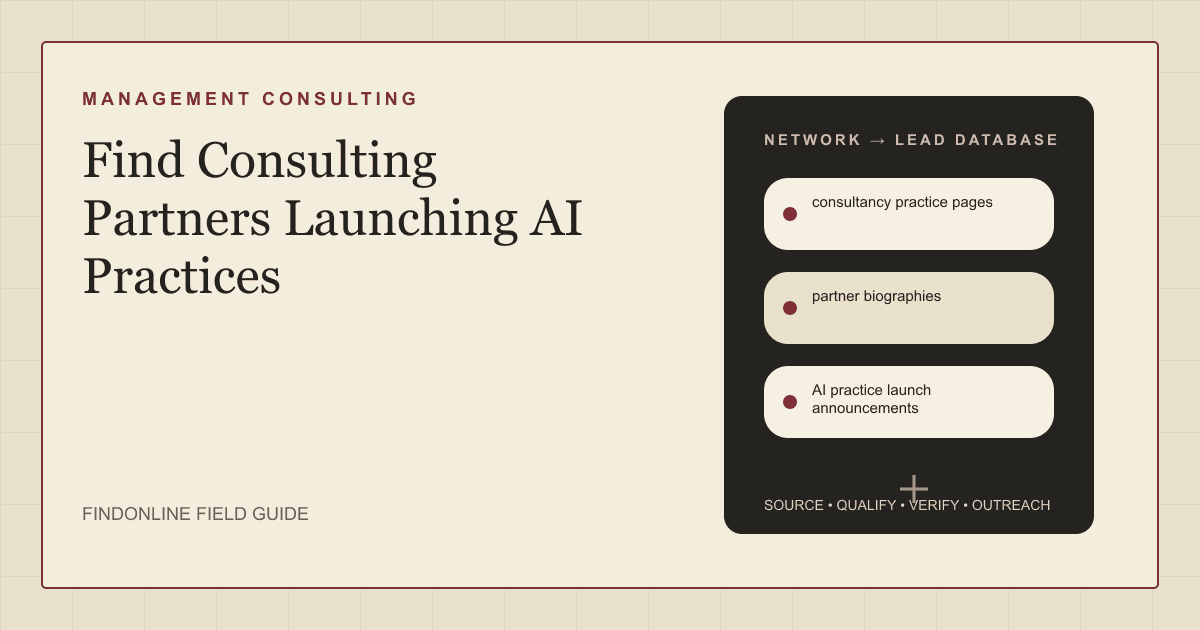
Use all three reviewed sources together. Announcements establish the event, practice pages explain the offering, and biographies establish responsibility.
AI practice launch announcements: Search the firm's newsroom for explicit launch or expansion wording. Deloitte's announcement describes a dedicated agentic transformation practice spanning strategy, implementation, governance, and adoption. Record the event date separately from your retrieval date; this example was checked on September 23, 2026. Deloitte practice announcement
Consultancy practice pages: Capture what the firm sells. Bain's AI consulting page describes building use cases from proof of concept to production. Use that delivery scope to distinguish implementation work from generic thought leadership. An established offering still needs separate evidence of a launch or meaningful expansion. Bain's readable official service page replaces an unavailable practice-page example while retaining this discovery source. Bain AI consulting services
Partner biographies: Match the practice, office, and named leader to current responsibilities. Keep ambiguous ownership unresolved until another firm page or a direct reply clarifies it. A biography containing “AI” alone does not establish budget authority.
Use these reusable searches:
consulting "AI practice" "launch" "[region]"site:[firm-domain] "artificial intelligence" "partner"site:[firm-domain] "agentic" "practice" "careers"
Search results are discovery pointers. Open the underlying firm page before recording a claim. Exclude software product launches, internal employee AI rollouts, and conference appearances unless they also establish a client-facing management-consulting practice.
Lead database: what evidence belongs in each record?
Build one record per firm, practice, geography, and responsible partner. Keep observed facts separate from your service-fit hypothesis.
| Field | Source | Verification rule |
|---|---|---|
| Firm and contracting entity | Firm footer and office page | Separate member firms and acquired brands |
| Practice name and launch type | Launch announcement | Classify new practice, expansion, alliance, or rebrand |
| Event date and checked date | Announcement and research log | Do not use crawl date as launch date |
| AI delivery scope | Consultancy practice page | Record strategy, engineering, governance, or adoption explicitly |
| Partner and regional remit | Partner biography | Match employer, office, practice, and current role |
| Talent or delivery trigger | Firm careers or service announcement | Preserve role, location, workstream, and evidence URL |
| Operational co-buyer | Team page or direct confirmation | Separate talent, delivery, and alliance responsibility |
| Service-fit hypothesis | Researcher's assessment | Label inference and the unanswered question |
| Contact route and status | Public professional source and replies | Record provenance, objections, and last verification |
Use this reusable research prompt:
Find management consultancies in [region] announcing a client-facing AI practice launch or substantive expansion within [date range]. Return the official announcement, event date, practice page, responsible partner biography, geography, delivery scope, and relevant hiring or delivery evidence. Separate facts from inferences. Mark missing fields unknown. Exclude internal AI adoption, product launches, and undated service pages as launch proof.
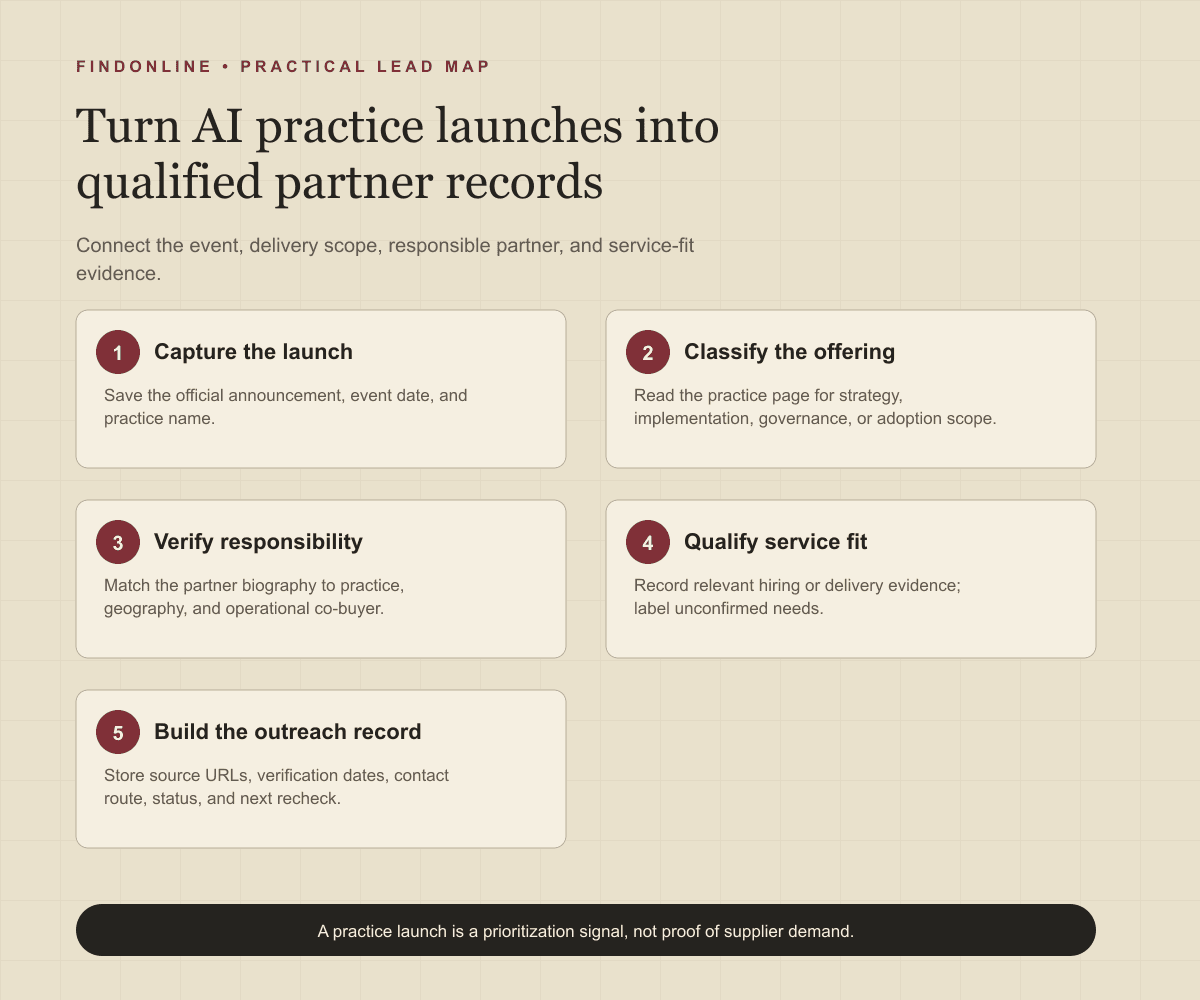
Follow five steps:
- Capture the event. Save the official URL and exact launch description.
- Classify the practice. Match the offering to your recruitment specialty or delivery capability.
- Resolve ownership. Verify the partner and identify the operational co-buyer.
- Qualify the need. Seek a matching vacancy, implementation workstream, or explicit partner requirement.
- Publish the record. Deduplicate by practice and geography, assign an owner, and set a recheck date.
Use three statuses: research required, qualified for outreach, and exclude. Require event evidence, current responsibility, and a plausible service match before outreach. Missing supplier demand becomes a discovery question, never an invented fact.
Best tools to automate outreach: which options fit this workflow?
Choose according to the work required: partner discovery, custom research, sequencing, or the full go-to-market (GTM) workflow. These evaluations distinguish documented capabilities from unconfirmed details.
FindOnline
What it does: Combines public-signal prospect discovery with automated outreach on LinkedIn, Reddit, and email, connecting practice activity to ongoing engagement. Product overview Workflow
Strengths: Runs the process end to end with optional stage-level review, so teams can review ambiguous practice ownership while automating other stages. Review controls
Limitations: Designed as a complete GTM system rather than a standalone signal-monitoring or enrichment utility; contact the FindOnline team about a suitable single-component configuration. Specific external integrations are not confirmed in the cited official material. Product scope
Best for: Specialist providers connecting verified practice-launch signals to partner conversations and follow-ups through one workflow. Workflow fit
LinkedIn Sales Navigator
What it does: Filters professional leads by company, title, function, and seniority. Search documentation
Strengths: Saved searches and alerts support tracking relevant partner changes. Search documentation
Limitations: A role match does not establish a practice-launch event; attach newsroom evidence. Automated outreach, specific integrations, and approval controls are not confirmed in the cited official material. Documented scope
Best for: Recruiters mapping the partner and operational buyer after finding a launch. Search documentation
Clay
What it does: Claygent researches companies and qualifies leads using custom tasks. Claygent documentation
Strengths: Reasoning traces help inspect why a practice passed qualification. Claygent documentation
Limitations: Custom research requires prompt testing and iteration. Native sending and approval gates are not confirmed in the cited official material. Setup guidance
Best for: Operators extracting practice scope and service-fit evidence across varied consultancy websites. Research scope
Apollo
What it does: Sequences combine automatic emails with manual email, phone, and LinkedIn tasks. Sequence documentation
Strengths: Previewing emails and editing sequence steps supports campaign preparation. Sequence documentation
Limitations: Required manual tasks must be completed or skipped before contacts advance. Launch discovery and named integrations are not confirmed in the cited official material. Task behavior
Best for: Recruitment teams sequencing an already qualified partner list. Sequence scope
Common Room
What it does: Connects business contact, organization, and signal sources. Integration documentation
Strengths: Workflows can add people to personalized sequences through sales-engagement integrations. Automation playbook
Limitations: The cited automation workflow depends on a connected sending platform. Stage approval controls are not confirmed in the cited official material. Workflow dependency
Best for: Providers joining consultancy signals to existing Apollo, Outreach, or Salesforce workflows. Integration documentation
Lemlist
What it does: Builds email, LinkedIn, and call campaigns around imported leads. Campaign documentation
Strengths: Supports lead previews and imports through customer relationship management (CRM) systems, an application programming interface (API), or Zapier. Campaign documentation
Limitations: Its sending algorithm controls spacing between leads on follow-up steps; that spacing cannot be manually adjusted. This differs from configuring a campaign's sequence delays. Timing rules
Best for: Specialist providers running a prepared partner campaign with branching follow-ups. Campaign documentation
Tool comparison: how do the six options differ?
Use this table to compare workflow fit. “Unconfirmed” means not confirmed in the cited official material, rather than evidence that a feature does not exist.
| tool | best for | data and discovery | outreach automation | integrations | support and review | limitations |
|---|---|---|---|---|---|---|
| FindOnline | Launch-to-partner engagement | Public signals | Automated LinkedIn, Reddit, and email; end to end | Unconfirmed | Optional review by stage | Complete GTM scope; discuss isolated components with team. Overview Controls Workflow |
| LinkedIn Sales Navigator | Partner mapping | Role and company filters | Unconfirmed | Unconfirmed | Approval controls unconfirmed | Role match cannot prove launch. Documentation |
| Clay | Practice-scope research | Custom company research | Native sending unconfirmed | Specific setup unconfirmed | Reasoning traces | Prompt testing required. Documentation |
| Apollo | Qualified-list sequencing | Launch discovery unconfirmed | Automatic emails; manual channel tasks | Unconfirmed | Email preview and editing | Required tasks can block progression. Documentation |
| Common Room | Connected signal workflows | Business contacts and signals | Sequence enrollment through integrations | Apollo, Outreach, Salesforce | Approval controls unconfirmed | Cited sending workflow needs connected platform. Integrations Workflow |
| Lemlist | Prepared partner campaigns | Imported leads | Multistep campaigns | CRM, API, Zapier | Lead preview | Algorithm controls follow-up spacing between leads. Documentation |
Outreach workflow: how should you approach the partner?
Lead with the verified change and a narrow question about the corresponding workstream. Do not describe a launch as proof that the firm lacks talent or delivery capacity.
Your announcement describes a new [AI practice] serving [sector]. We specialize in recruiting [specific role] for [delivery context]. Are you building that capability internally, or is specialist recruitment support relevant to this launch?
For delivery services, replace the recruitment sentence with a concrete capability, such as model evaluation or data integration, supported by your experience. Ask whether the partner owns that workstream before requesting a meeting.
Use a credible warm introduction when one exists. Otherwise, configure FindOnline's relationship route around verified professional commonality, such as industry, role, education, communities, or shared context. Never invent familiarity. When neither route is meaningful, use a direct signal-led message within its discovery-to-engagement workflow. FindOnline workflow
Follow up with one useful detail tied to the announced scope. Record replies centrally, stop unwanted outreach, and avoid contacting several partners with identical messages. Public Reddit participation is usable context only when professional identity is already explicit; do not identify anonymous users.
Industry-specific nuances: which signals imply a useful service match?
Match the service to the practice's delivery model before prioritizing the account. Treat these as qualification hypotheses, not assumptions about a particular consultancy.
- Strategy-led practice: Ask about sector expertise, operating-model design, and change-management capability before proposing engineering recruitment.
- Implementation-led practice: Check the technology ecosystem, deployment geography, and delivery skills before offering specialists.
- Governance-led practice: Establish whether the need concerns technical evaluation, organizational controls, or legal advice; avoid blurring professional scopes.
- Alliance-led expansion: Determine whether the consultancy, technology partner, or delivery subcontractor owns the relevant work.
Separate permanent hiring, contingent staffing, and subcontracted delivery in the database. Ask about client-facing experience, travel expectations, confidentiality requirements, and supplier onboarding before presenting candidates or proposing access to client systems.
Distinguish the practice's client sector from the consultancy's industry. A manufacturing-focused AI practice needs manufacturing delivery context, but the prospect account remains a management consultancy.
Limitations: what can these signals actually prove?
Signals are directional rather than guaranteed truth. A launch, biography, or job opening helps prioritize and personalize outreach and follow-ups, but cannot confirm external supplier demand.
Verify the underlying change before acting. Keep contradictory sources and unresolved responsibilities visible. Rescan signals regularly because departments, roles, and company conditions change; recheck launch status and ownership before restarting a dormant campaign.
Frequently asked questions: what should you resolve before outreach?
How do I distinguish a new AI practice from a rebrand?
Look for an explicit organizational change and supporting delivery evidence. Compare the announcement with older service descriptions, current leadership, and relevant openings. If only the name changed, classify it as a rebrand rather than a new buying trigger.
Which partner should a specialist recruiter contact first?
Start with the partner responsible for the relevant practice and geography. Ask who owns the hiring requirement and agency relationship, then include that operational buyer. Do not assume the announcement's quoted executive commissions recruitment services.
Does an AI job opening prove the consultancy uses recruiters?
No, a vacancy proves only that a role is advertised. Confirm whether external recruiters are accepted and whether your specialty matches the requirement. Keep supplier access separate from hiring activity.
Can an established AI consultancy qualify for this list?
Yes, if there is evidence of a substantive new practice or expansion within your chosen scope. An existing AI service page alone is insufficient. Record the specific change so outreach does not incorrectly congratulate the firm on its first AI offering.
What should I do when the practice leader is unclear?
Keep the record in research status and investigate regional or capability leadership. If responsibility remains ambiguous, ask a concise routing question through a public professional contact route. Do not fill the gap with an inferred decision-maker.
Sources
- Chuck Whitten — Bain & Company · Accessed
- Deloitte Launches Google Cloud Agentic Transformation Practice — Deloitte · Accessed
- AI Consulting Services — Bain & Company · Accessed
- FindOnline GTM Agents — FindOnline · Accessed
- About FindOnline — FindOnline · Accessed
- How FindOnline Works — FindOnline · Accessed
- Sales Navigator Advanced Search Filters — LinkedIn · Accessed
- Claygent — Clay · Accessed
- Create a Sequence — Apollo · Accessed
- Business Integrations — Common Room · Accessed
- Put signal-based prospecting on autopilot — Common Room · Accessed
- Create a lemlist campaign — Lemlist · Accessed