Buyer discovery
How to Find Family Business Owners Planning Succession
Find family business owners planning succession using family business center member directories, generational CEO transition announcements, company history pages, and regional awards, then verify owner and stage.
By Vaishnav Gupta14 min read
On this page
Quick answer: To find family business owners planning succession, target the controlling owner or CEO of second- and third-generation companies and the named next-generation successor. The strongest discovery sources are family business center member directories, generational CEO transition announcements, company history pages, and regional family business awards. Start by exporting one center's member list and tagging each company's generation and leadership stage.
Who to target: which roles own the succession decision?
Target three people at each family company: the controlling owner, usually the CEO or chairman; the next-generation leader who has moved into a president, chief operating officer (COO), or general manager role; and, in larger families, the board chair or family council lead. Accounting and advisory firm owners sell valuation, estate and gift tax planning, buy-sell agreements, and entity restructuring to this group, so both the owner and the successor belong in the record.
The planning gap is wide. Family Business Magazine's report on PwC's US Family Business Survey noted that in the 2021 survey only 34% said they had a robust succession plan that was documented and communicated to stakeholders (Family Business Magazine). PwC's own survey pages returned HTTP 403 to the research browser, so the magazine's report stands in.
The readiness signal is a published role change inside the family. Koopman Lumber announced that Denise (Koopman) Brookhouse would become CEO on January 1, 2026, succeeding Dirk Koopman, and Dirk described the transition as a natural step for the third-generation company (The Hardware Connection). A company at that stage has already made ownership decisions. A company whose next generation was just named president is usually one to three years earlier, which is the better advisory window.
Remove these false positives before outreach:
- Companies that keep a family name after a private equity or strategic sale.
- Family-owned companies that hired a non-family CEO with no ownership change under way.
- First-generation founders with no family in the business, where a sale is the likely path.
Lead sources: where do succession-stage family businesses appear in public?
Combine a membership universe with a transition signal. Four of the sources below are specific to family enterprise rather than generic prospecting defaults.
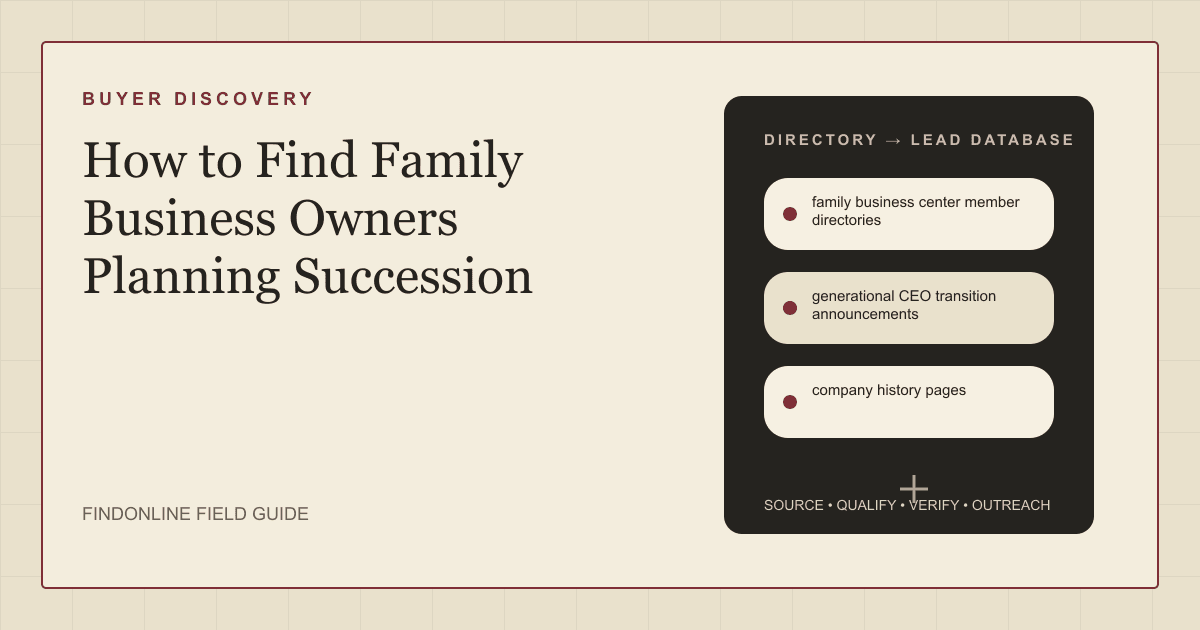
- family business center member directories list companies that already identify as family-owned. The University of Toledo Family Business Center invites visitors to search its database for an overview of member companies including contact information, and describes itself as a non-solicitation organization (University of Toledo Family Business Center). Use these lists to define the universe, never as a mailing list. The Kennesaw State Family Enterprise Center describes its membership as designed for family businesses seeking stronger peer relationships and strategic guidance (Kennesaw State University). The Conway Center in Columbus does not publish a current member directory, so the Toledo and Kennesaw centers stand in for the reviewed hint.
- generational CEO transition announcements are the strongest timing signal. The Koopman release, dated December 3, 2025, named the successor, the outgoing CEO, the effective date, and the generation in one story (The Hardware Connection). Search trade publications in your target industries for "third-generation", "succeeds her father", and "named president".
- company history pages reveal the generation in control and whether the next one is inside. Koopman Lumber's about page states that members of the fourth generation are actively working in the business (Koopman Lumber). A page naming a founding year, a second- or third-generation owner, and younger family members in operating roles describes live succession.
- regional family business awards pre-qualify companies on governance. Twin Cities Business reported on August 28, 2026 that its 2026 Minnesota Family Business Awards honorees were evaluated based on management, governance, organizational structure, transition plan, success, and other key factors (Twin Cities Business). Most metro business journals run a similar program with public honoree lists.
- LinkedIn owner profiles confirm who holds which title today. LinkedIn's profile help page describes the Experience section as covering professional positions and experience, including jobs, volunteering, military, board of directors, nonprofit, or pro sports (LinkedIn Help). A founder who now lists a board seat while a child lists president is a visible transition.
Lead database: which fields make a family succession list usable?
Record ownership, generation, and transition stage, not just a contact. The table is built for an accounting and advisory firm; adjust the service-fit logic to your practice.
| Field | Where it comes from | How to verify |
|---|---|---|
| Legal entity and trade name | Center member list, state registry | Match registry name to website footer |
| Founding year and generation in control | Company history page | Count named generations |
| Controlling owner and title | History or leadership page | Match title on LinkedIn |
| Next-generation leader and role | Transition announcement, leadership page | Confirm start date on LinkedIn |
| Transition stage | Announcement, history page | Tag none, successor in role, announced, completed |
| Trigger date | Announcement or award date | Record publication date, not discovery date |
| Ownership exceptions | Acquisition news, company news page | Flag private equity, ESOP, strategic owner |
| Named advisers | Release quotes, award profiles | Record any CPA or law firm named |
Research prompt to reuse for each company:
Company: [company name], [city], [state]
1. From the history page, list the founding year, each generation named, and the current owner's generation.
2. From leadership pages and releases since [year], list any family member named CEO, president, COO, or chairman, with effective dates.
3. Note any acquisition, private equity investment, or ESOP since [year].
4. Classify transition stage: none, successor in role, announced, completed.
5. Return the URL for every fact.
Workflow:
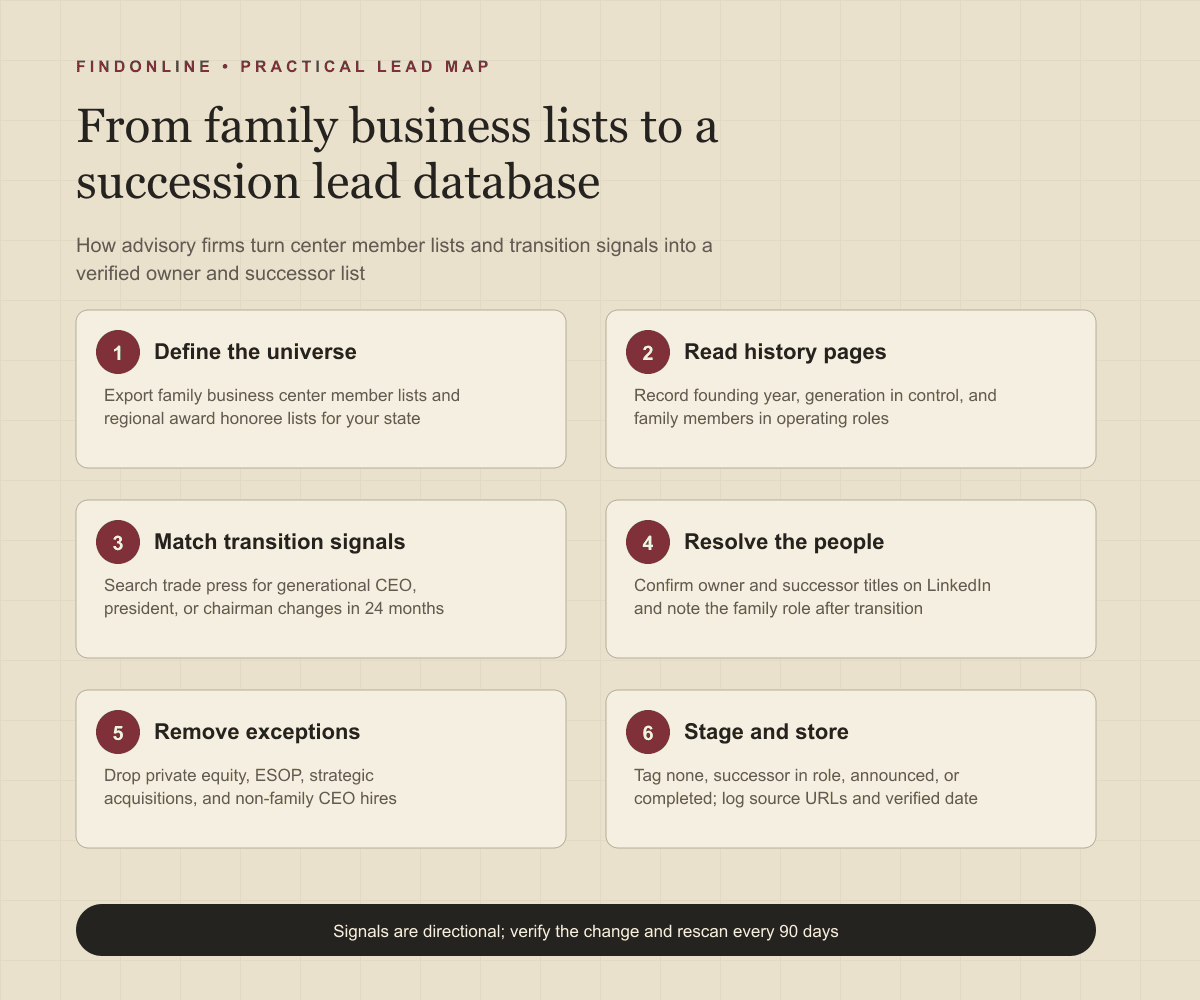
- Export one center member list and one regional award honoree list for your state.
- Open each company history page and fill the generation and owner fields.
- Search trade press and the company news page for a generational transition in the last 24 months.
- Resolve the owner and successor on LinkedIn and record current titles.
- Remove private equity, ESOP, and non-family CEO exceptions, then rank announced transitions first and successor-in-role companies second.
The same ownership-first logic applies when you qualify owners of growing HVAC and plumbing companies, where entity type decides who signs the engagement letter.
Best tools to automate outreach: which tools fit a family succession list?
Family succession lists are small, signal-led, and relationship-sensitive, so judge each tool on public signals, verification, and measured multi-channel outreach.
FindOnline
What it does: FindOnline is an end-to-end AI go-to-market (GTM) system whose agents find and contact high-intent prospects from public signals and run outreach on LinkedIn, Reddit, and email; the company describes the product as AI GTM agents for LinkedIn, Reddit and Email (FindOnline). Here the public signals are the transition announcement, the LinkedIn role change, and the history page.
Strengths: The workflow runs from signal to reply handling, and you choose which stages run automatically and which hold for approval, so a firm can hold the first founder message for optional review while follow-ups run automatically (FindOnline). A warm path such as a shared center sponsor is one possible route; otherwise outreach uses verified professional commonality or leads with the signal directly.
Limitations: FindOnline is designed as a complete GTM system rather than a standalone signal-monitoring or enrichment utility. A firm that wants only transition alerts or only enrichment should contact the FindOnline team to discuss a suitable configuration.
Best for: Accounting and advisory firm owners who want succession-stage family businesses found from public signals, qualified, and worked across LinkedIn and email with optional review on the first touch.
LinkedIn Sales Navigator
What it does: Sales Navigator is LinkedIn's prospecting layer that lets you search with 50+ filters like function, seniority level, years at company, experience, and more (LinkedIn Sales Navigator).
Strengths: Tenure filters surface founders and second-generation owners with decades at one company. LinkedIn describes Success Plans as providing structured onboarding, training, and support to drive product adoption (LinkedIn Sales Navigator).
Limitations: There is no family-ownership or generation filter, so ownership structure must be read from history pages and announcements first, and many owners of smaller family firms keep thin profiles.
Best for: Firm owners who already hold a center or award list and need current titles for the owner and successor.
Apollo
What it does: Apollo pairs a contact database with sales engagement; its sequences support multi-channel sequence steps across email, call, and networking platforms (Apollo).
Strengths: Sequences keep a small succession list moving, and Apollo syncs contacts, activities, and deal data with CRMs like Salesforce and HubSpot (Apollo). Support terms are not confirmed in the cited official material.
Limitations: Apollo assumes the list is already qualified; it does not identify family ownership or generational transitions, so every record needs its stage tag before entering a sequence.
Best for: Advisory firms with a verified owner list that want CRM-synced email and call sequences.
Clay
What it does: Clay is a data orchestration workspace offering one contract to buy data from 200+ data and AI vendors, and it can trigger emails, ads, and more with integrations to your existing GTM tools (Clay).
Strengths: A Clay table can hold the fields above, run AI research against each history page, and push qualified rows to a sender. The support model is not confirmed in the cited official material.
Limitations: Clay is an enrichment and routing layer, not an outreach or reply-handling system, so your team must build the table logic and connect a separate sender.
Best for: GTM operators inside an advisory firm automating history-page and announcement research across hundreds of family companies.
ZoomInfo
What it does: ZoomInfo is a B2B database offering access to 420M+ global contacts including 120M+ direct dials and 145M+ companies (ZoomInfo).
Strengths: Direct dials reach founders who rarely answer LinkedIn, and you can export prospects to your CRM in one click (ZoomInfo). The support model is not confirmed in the cited official material.
Limitations: ZoomInfo's intent signals rest on web visits and content consumption, which rarely capture a closely held family's succession discussions.
Best for: Larger advisory practices that need phone numbers for owners across many states and already run a CRM.
Lemlist
What it does: Lemlist is a multichannel campaign tool; teams can launch automated campaigns across email, LinkedIn, calls, WhatsApp, and SMS from one workflow (Lemlist).
Strengths: Conditional steps pause a sequence when a founder replies, and the company says its support team is just a click away via the in-app chat (Lemlist). Integrations are not confirmed in the cited official material.
Limitations: Lemlist starts once you have a list; it has no family-ownership or transition discovery, so the generational signal must be written into custom fields.
Best for: Small advisory firms sending a low-volume, personalized sequence to a hand-verified list of owners and successors.
Tool comparison: how do the six options differ for this list?
| tool | best for | data and discovery | outreach automation | integrations | support and review | limitations |
|---|---|---|---|---|---|---|
| FindOnline | Advisory firms working succession signals end to end | Public signals: role changes, announcements, posts | LinkedIn, Reddit, and email outreach automated | Not confirmed in the cited official material | Optional review: hold chosen stages for approval | Complete GTM system, not a standalone monitoring utility |
| LinkedIn Sales Navigator | Resolving owners and successors to current titles | 50+ filters including seniority and years at company | None confirmed; manual messaging | Not confirmed in the cited official material | Success Plans with onboarding, training, and support | No family-ownership or generation filter |
| Apollo | CRM-synced email and call sequences | Contact database; no ownership data | Multi-channel sequences across email, call, networking platforms | Syncs with Salesforce and HubSpot | Not confirmed in the cited official material | Assumes the list is already qualified |
| Clay | Automating history-page research | 200+ data and AI vendors under one contract | Triggers emails through integrations; not a sender | Connects to existing GTM tools | Not confirmed in the cited official material | Needs table building and a separate sender |
| ZoomInfo | Direct dials for owners across states | 420M+ contacts, 120M+ direct dials | Not confirmed in the cited official material | One-click CRM export | Not confirmed in the cited official material | Intent signals miss closely held decisions |
| Lemlist | Low-volume personalized sequences | Campaign tool; discovery not confirmed | Automated campaigns across email, LinkedIn, calls, WhatsApp, SMS | Not confirmed in the cited official material | In-app chat support | No ownership or transition discovery |
Outreach workflow: how should an advisory firm approach an owner planning succession?
Lead with the public signal and the service it implies, and reach the owner and successor in parallel.
- Time the first touch. Contact announced transitions within 30 days of the release, award honorees in the month after the ceremony, and successor-in-role companies around anniversaries named on the history page.
- Choose the route. A center sponsor, mutual adviser, or shared board connection makes a warm introduction one possible route. Without one, use only verified professional commonality such as industry, region, or association membership. With neither, send a direct message anchored to the signal.
- Write to the stage. For announced transitions, offer buy-sell agreement review and the outgoing owner's estate and gift planning. For successor-in-role companies, offer a valuation baseline and ownership transfer modeling.
- Sequence the channels. Open on LinkedIn with a note that names the announcement, follow by email with one specific question, and stop on any reply.
- Hand off. Log the trigger date and stage, then schedule a 90-day rescan.
The FindOnline workflow runs these steps from signal detection to reply handling, and the accounting firm page shows how firms position transition services.
Industry-specific nuances: what is different about family business buyers?
- The founder rarely leaves. In the Koopman transition, Dirk will move into a newly created role as president rather than exiting (The Hardware Connection). Plan for two decision-makers for years after the announcement, and address the outgoing generation's tax and estate questions alongside the successor's operating needs.
- Transfers carry legal and tax weight. The Small Business Administration notes that transferring ownership of a family business may have legal impacts, with estate and gift tax obligations attached (U.S. Small Business Administration). Lead with that specific work rather than generic bookkeeping.
- Center memberships carry non-solicitation norms. Treat member lists as a universe definition and approach members through public signals and your own channels, never by implying the center endorsed your outreach.
- Fourth-generation presence changes the service. A history page that places the fourth generation in operating roles signals multi-branch ownership, so shareholder agreements and governance matter more than a simple parent-to-child transfer.
- Incumbent advisers are often named. Award profiles and releases sometimes quote the family's CPA or attorney, so open with a second-opinion valuation or specialist tax work rather than a full switch.
Limitations
Every signal in this workflow is directional rather than guaranteed truth. A transition release confirms a title change, not an open advisory engagement, and a history page can be years out of date. Use signals to prioritize which families to contact first and to personalize the opening message and follow-ups, then verify the underlying change on the company site and LinkedIn before you send. Rescan sources regularly, because successors change roles, families sell, and award lists refresh every year.
Frequently asked questions
How do you tell if a family business is actually planning succession?
Look for a next-generation family member in an operating leadership role, a founder moving to chairman or president, or a published transition announcement. A history page that names several generations but no younger family member in the business is weaker evidence. Treat any single signal as a reason to research, not a confirmed plan.
Should an accounting firm contact the owner or the successor first?
Contact both, with different messages. The outgoing owner decides on estate, gift, and valuation work, while the successor usually drives operating changes and chooses future advisers. Parallel, stage-specific notes avoid being filtered by the wrong person.
Can you use a family business center member list for cold outreach?
Use it to define your universe, not as a mailing list. Several centers describe themselves as non-solicitation organizations, so research each member from public sources and reach them through your own channels with a signal-led message. Never suggest the center introduced you unless it did.
How far before a transition should advisory outreach start?
One to three years before the handover is the most useful window, which usually matches the successor being named president or COO. By the time a CEO transition is announced, valuation and ownership decisions are often made, although post-transition tax and governance work remains open.
Sources
- PwC survey highlights continued strength of family business sector — Family Business Magazine · Accessed
- Koopman Lumber Announces CEO Transition as Third Generation Takes the Helm — The Hardware Connection · Accessed
- UToledo Family Business Center — University of Toledo · Accessed
- Family Enterprise Center Membership — Kennesaw State University · Accessed
- About Koopman Lumber — Koopman Lumber · Accessed
- 2026 Minnesota Family Business Awards — Twin Cities Business · Accessed
- Your LinkedIn profile | LinkedIn Help — LinkedIn · Accessed
- FindOnline - AI GTM agents for LinkedIn, Reddit and Email — FindOnline · Accessed
- About FindOnline — FindOnline · Accessed
- LinkedIn Sales Navigator — LinkedIn · Accessed
- Apollo Sales Engagement — Apollo · Accessed
- Clay - Go to market with unique data and the ability to act on it — Clay · Accessed
- ZoomInfo Sales — ZoomInfo · Accessed
- lemlist - Multichannel outreach platform — Lemlist · Accessed
- Close or sell your business — U.S. Small Business Administration · Accessed