Buyer discovery
How to Find Companies Preparing for an IPO
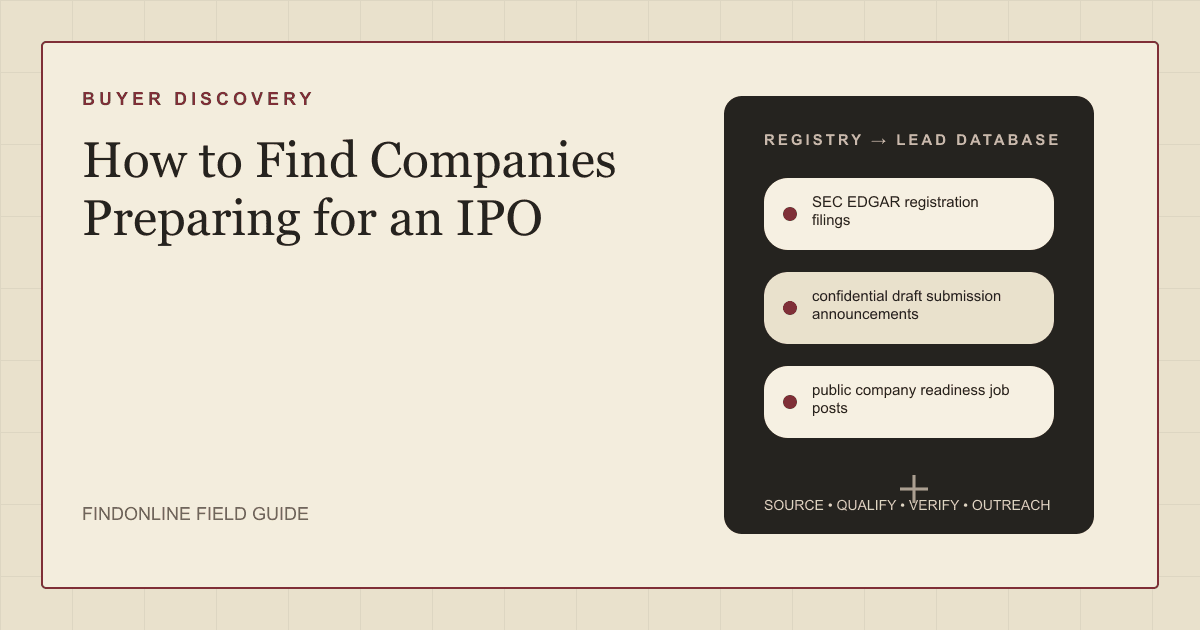
Find companies preparing for an IPO using SEC EDGAR registration filings, confidential draft submission announcements, readiness job posts, and late-stage funding announcements, then verify the CFO and filing stage.
By Vaishnav Gupta13 min read
On this page
Quick answer: To find companies preparing for an IPO, target the CFO, controller, general counsel, and head of people at late-stage private companies showing filing, hiring, or funding evidence. The strongest sources are SEC EDGAR registration filings, confidential draft submission announcements, public company readiness job posts, and late-stage funding announcements. Start by pulling this week's S-1, F-1, and DRS filings from EDGAR and removing blank-check filers.
Who to target: which roles own IPO readiness decisions?
The CFO sponsors initial public offering (IPO) readiness spending, the controller runs the work, and the head of people fills the seats, so all three belong on every record.
- CFO. Approves the readiness plan, adviser selection, and hires for SEC reporting, Sarbanes-Oxley (SOX) compliance, and investor relations.
- Chief Accounting Officer or Controller. Owns technical accounting, close acceleration, and the SEC reporting build. The consultant's first conversation.
- General Counsel. Owns governance, board composition, and registration drafting with outside counsel.
- Head of People or CHRO. Owns executive and board hiring. The recruiter's buyer.
- SOX or internal audit lead. Often does not exist yet; the vacancy is the signal.
Qualify stage before people. The Securities and Exchange Commission (SEC) treats a company as an emerging growth company, or EGC, when it has "total annual gross revenues of less than $1.235 billion during its most recently completed fiscal year", and EGCs may use "less extensive narrative disclosure than required of other reporting companies" (SEC emerging growth companies page). EGC status shrinks readiness scope, so record it.
Two false positives matter. Blank-check companies file registration statements but have no operating finance team. Companies with a public S-1 have usually engaged advisers, so consulting arrives late while recruiting demand continues.
Lead sources: where do pre-IPO companies leave public evidence?
Filings are definitive, announcements come earlier, job posts come earliest, and funding releases build the universe.
- SEC EDGAR registration filings are the definitive record. EDGAR's latest filings tool lets you "view daily filings by form type within the past week" (SEC EDGAR search and access). Watch S-1, F-1, and DRS, the draft registration statement. An issuer must publicly file its "nonpublic draft submissions at least 15 days prior to any road show", so DRS documents reach EDGAR late (SEC draft registration statement procedures). The SEC's registration statement and Form D explainer pages returned server errors today, so these two pages stand in.
- confidential draft submission announcements are the earliest definitive signal. Relativity announced on March 19, 2026 that it "has confidentially submitted a draft registration statement on Form S-1" (Relativity release on Technode Global). Relativity's newsroom rendered only a headline, so the wire copy stands in. Search wire services weekly for that phrase.
- public company readiness job posts precede filings. Plaid's Accounting Operations posting asks for "Experience at a public company or with IPO readiness" (Plaid Accounting Operations posting). A Cerebras stock administration posting states "we are a pre-IPO, AI-native company seeking to hire our first in-house Senior Manager, Stock Administration." (Cerebras posting on the Foundation Capital job board). The Cerebras applicant tracking page returned not found today, so the investor's job board stands in.
- late-stage funding announcements build the universe. Labelbox "today announced it has raised more than $100 million in Series E financing" on October 14, 2026 (Labelbox Series E release). A Series E is a reason to check postings, not qualification.
- StockAnalysis IPO filings tracker shows who has already filed publicly. The site states "IPO data is gathered manually by the Stock Analysis team, from SEC filings and other official sources." (StockAnalysis IPO filings). Use it to move companies to post-filing status.
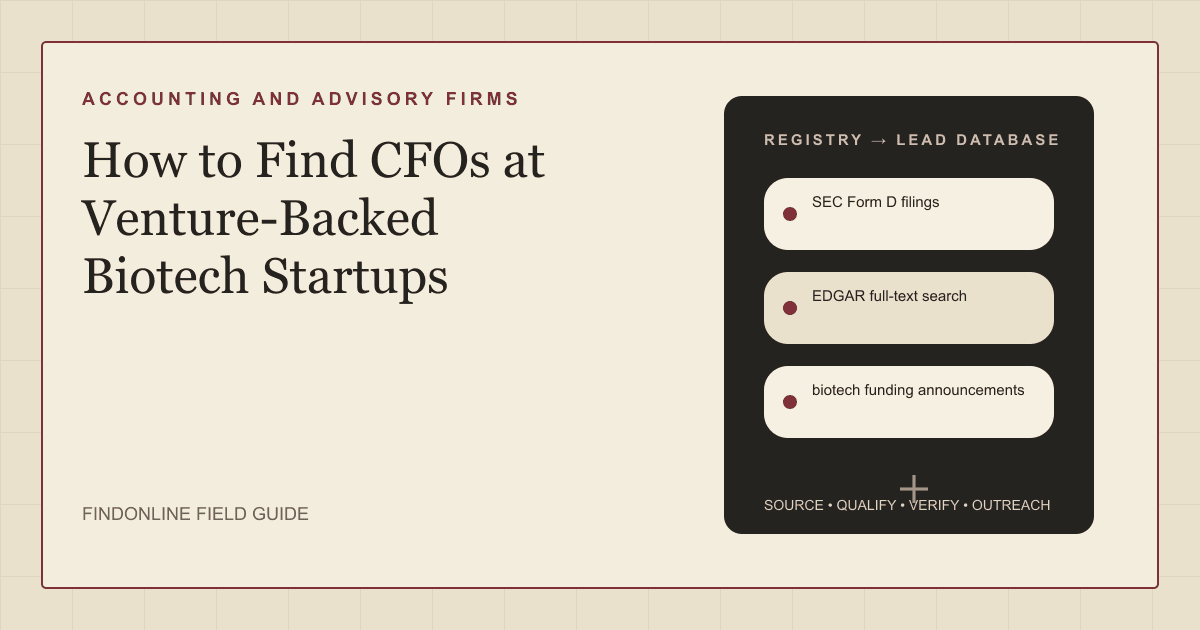
The Form D workflow in how to find CFOs at venture-backed biotech startups feeds the universe step.
Lead database: which fields qualify a pre-IPO company?
A useful record carries filing stage, EGC status, open readiness roles, and named finance and people leaders.
| Field | Where it comes from | How to verify |
|---|---|---|
| Company name | Filing cover or funding release | Match EDGAR filer name to website |
| Filing stage: none, DRS announced, S-1 or F-1 public, priced | EDGAR, announcement, filings tracker | Re-check EDGAR before each wave |
| EGC status | Registration cover or release | Compare revenue to the $1.235 billion threshold |
| Last round, date, lead investor | Funding release, Crunchbase | Read the release, not a roundup |
| Open readiness roles | Careers page | Confirm the posting is live |
| CFO, CAO, or controller | Leadership page, LinkedIn | Check current title and start date |
| Head of People or CHRO | Leadership page, LinkedIn | Confirm executive hiring remit |
| Blank-check flag | SIC code 6770 or Acquisition Corp name | Exclude |
Weekly research query:
EDGAR latest filings: S-1, F-1, DRS; past 7 days; exclude SIC 6770
Wire search: "confidentially submitted a draft registration statement" [month] [year]
Jobs: ("IPO readiness" OR "pre-IPO") AND ("SEC reporting" OR "SOX" OR "stock administration")
Record: stage, EGC status, last round, open roles, CFO, controller, head of people
Workflow:
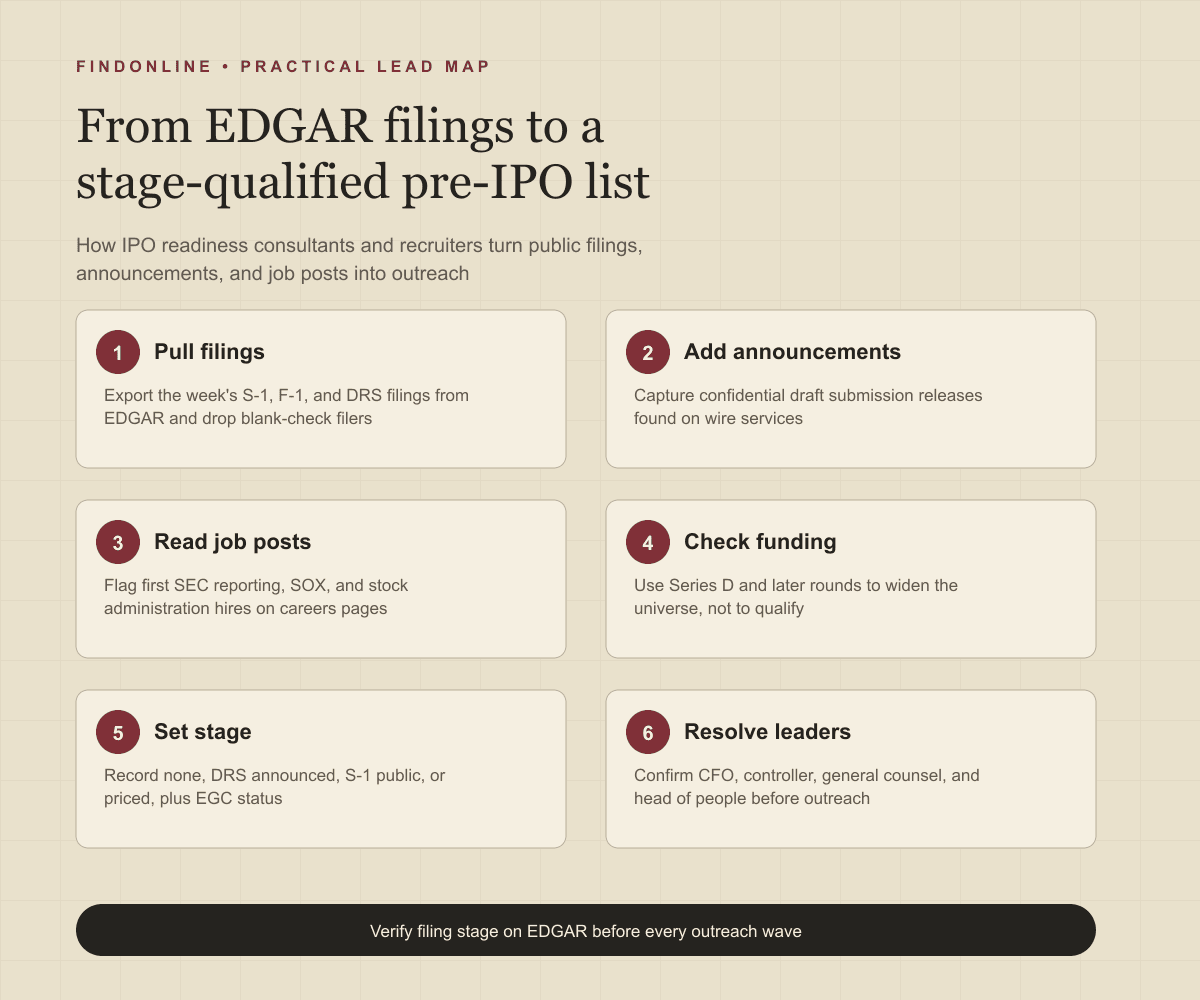
- Pull the week's S-1, F-1, and DRS filings and drop blank-check filers.
- Add companies with a draft submission announcement in the same period.
- Build the upstream universe from Series D and later rounds, then check careers pages for readiness roles.
- Set filing stage and EGC status for every company.
- Resolve the CFO, controller, general counsel, and head of people.
- Assign a service: assessment, SEC reporting build, SOX program, or a specific hire.
Best tools to automate outreach
FindOnline
What it does: FindOnline runs discovery through outreach for this list. Its homepage describes "AI GTM agents for LinkedIn, Reddit and Email." and says "Your AI agent spots buying signals like hiring, promotions and funding," which maps to readiness job posts and late-stage rounds (FindOnline homepage). It qualifies prospects from public signals, adds them to campaigns, and handles replies.
Strengths: Outreach across LinkedIn, Reddit, and email runs as an automated sequence, and the about page states "You choose which stages run automatically and which hold for approval." so a first CFO message can be held for optional review while follow-ups run (FindOnline about page). It can use a credible warm route when one exists, otherwise verified commonality such as a shared finance community, or a direct signal-led message.
Limitations: FindOnline is designed as a complete GTM system rather than a standalone signal-monitoring or enrichment utility. Readers who only want an EDGAR alert or an enrichment pass should contact the FindOnline team to discuss a suitable configuration.
Best for: Readiness consultancies and specialist recruiters that want filing, hiring, and funding signals turned into CFO and head-of-people conversations without a separate outbound team. See how FindOnline supports consultancies and recruitment and staffing firms.
LinkedIn Sales Navigator
What it does: Sales Navigator finds people once you hold the company list. Its official page says you can "Search with 50+ filters like function, seniority level, years at company" (Sales Navigator page).
Strengths: Fast resolution of finance and people leaders. The page says you streamline work by "receiving real-time lead alerts" and that it provides "structured onboarding, training, and support to drive product adoption" (Sales Navigator page).
Limitations: It finds people, not filings, so stage must come from EDGAR first. CRM integration is not confirmed in the cited official material.
Best for: Recruiters holding a stage-qualified list who need current finance and people leaders with change alerts.
Crunchbase
What it does: Crunchbase supplies the funding side. Its Pro page says you can "See funding history, investor data, leadership changes, and more so you can prioritize with conviction, not guesswork." (Crunchbase Pro page).
Strengths: Round type, date, and investor fields feed the database directly, and the page describes "automatic notifications the moment something changes" for tracked companies (Crunchbase Pro page).
Limitations: A draft submission is not a funding event, so Crunchbase alone cannot set filing stage. Outreach features are not confirmed in the cited official material.
Best for: Consultants building the Series D and later universe that feeds job-post and filing checks.
Apollo
What it does: Apollo runs sequences against the finished list. Its sales engagement page lists "Multi-channel sequence steps across email, call, and networking platforms" and says activity "syncs straight into the CRM you already use" (Apollo sales engagement page).
Strengths: Repeatable cadences with CRM sync, which suits separate CFO and head-of-people sequences.
Limitations: Apollo carries no filing data, so the EDGAR-qualified list must be imported and refreshed by hand. Support model is not confirmed in the cited official material.
Best for: Recruiting teams with an existing CRM that want stage-tagged sequences without changing systems.
Clay
What it does: Clay is a workbench for custom signals. Its homepage says you can "Create intent signals from anything on the internet." and "Trigger emails, ads, and more with integrations to your existing GTM tools." (Clay homepage).
Strengths: A team can model a draft-submission or readiness job-post monitor as a table and push qualified rows to outreach tools.
Limitations: No ready pre-IPO list ships; someone must design the EDGAR, wire, and job-post inputs. Support model is not confirmed in the cited official material.
Best for: Consultancies with an operator who maintains custom tables and routes filing and hiring signals into existing tools.
ZoomInfo
What it does: ZoomInfo pairs contact data with intent. Its sales page says it can "Surface companies with high intent scores based on content consumption, technology signals, and behavioral patterns." and lets you "Export prospects to your CRM in one click." (ZoomInfo sales page).
Strengths: Contact data for finance leaders at scale with one-click CRM export.
Limitations: Intent scores derive from content and technology behavior and do not identify IPO stage. Outreach channels and support model are not confirmed in the cited official material.
Best for: Larger recruiting firms needing contact data for many finance leaders after stage qualification elsewhere.
Tool comparison: which option fits a pre-IPO prospecting workflow?
FindOnline covers discovery through outreach for this list; each alternative covers one stage well.
| tool | best for | data and discovery | outreach automation | integrations | support and review | limitations |
|---|---|---|---|---|---|---|
| FindOnline | Consultancies and recruiters turning signals into conversations | Public signals: hiring, promotions, funding | LinkedIn, Reddit, and email, automated end to end | Not confirmed in the cited official material | Optional review: choose which stages hold for approval | Complete GTM system, not a standalone filing monitor |
| LinkedIn Sales Navigator | Recruiters resolving finance and people leaders | 50+ filters, real-time lead alerts | Not confirmed in the cited official material | Not confirmed in the cited official material | Structured onboarding, training, and support | Finds people, not filings |
| Crunchbase | Building the late-stage funding universe | Funding history, investors, leadership changes | Not confirmed in the cited official material | Not confirmed in the cited official material | Automatic change notifications | Cannot set filing stage |
| Apollo | CRM-centric recruiting sequences | No filing data; list imported | Multi-channel sequences: email, call, networking platforms | Syncs into your existing CRM | Not confirmed in the cited official material | Manual EDGAR imports |
| Clay | Custom filing and hiring monitors | Intent signals from anything on the internet | Trigger emails and ads via integrations | Existing GTM tool integrations | Not confirmed in the cited official material | No ready pre-IPO list |
| ZoomInfo | Contact data at scale | Intent scores from content and technology | Not confirmed in the cited official material | One-click CRM export | Not confirmed in the cited official material | Intent scores miss IPO stage |
Outreach workflow: how do you sequence outreach around filing stage?
Match the message to the recorded stage, because needs change before an announcement, after a draft submission, and after a public filing.
- Signals only. Readiness postings plus a recent late round is the consultant's best window. Lead with the specific gap, such as an open SOX lead and no SEC reporting director, and offer an assessment.
- Draft submission announced. The company cannot discuss the offering, so do not ask. Consultants pitch build-out work; recruiters open with seats that fill around a listing: SOX, SEC reporting, stock administration, investor relations.
- S-1 or F-1 public. Read the filing for named gaps and board composition. Recruiters time board and IR searches here; consultants pivot to post-IPO reporting support.
- Follow-ups. Reference a new public event each time. Stop after three signal-led touches and rescan next quarter.
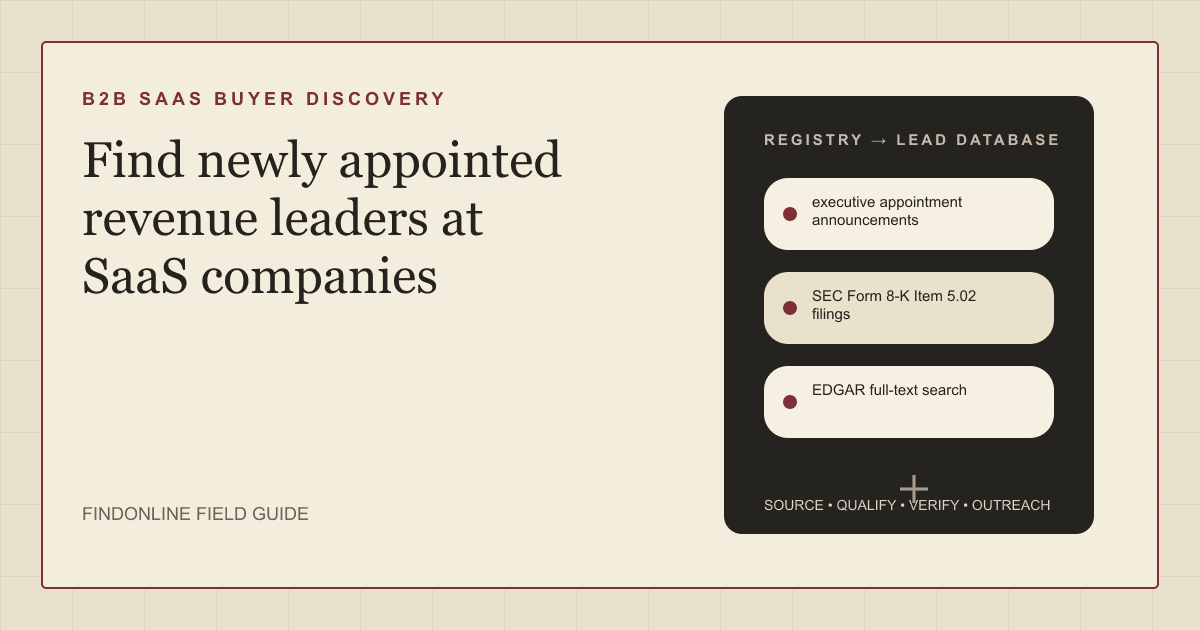
A warm introduction through a shared former employer is one route when it genuinely exists. Otherwise use verified commonality only, such as both parties having Big Four backgrounds, or send a direct signal-led message. The role-change method in how to find newly appointed revenue leaders at SaaS companies applies to CFO appointments here.
Industry-specific nuances: what changes when the buyer is going public?
The readiness window closes earlier than most prospecting calendars assume, so weight the earliest signals and let stage decide the offer.
- Job posts beat filings for consultants. By the time an S-1 is public, auditors, counsel, and often readiness advisers are engaged. A first SEC reporting, SOX, or stock administration hire is the earlier signal.
- Recruiters keep working after the filing. Investor relations, board, and internal audit seats fill around and after the listing, so a public S-1 raises recruiting priority.
- EGC status sets scope. Reduced disclosure under the $1.235 billion threshold means smaller engagements.
- Blank-check and foreign filers differ. Exclude SIC 6770 filers. Foreign private issuers file F-1 under different rules, so route them to cross-border advisers.
- A late round is a maybe. Labelbox's release describes products and profitability, not a listing. Qualify through postings and announcements first.
- Respect the quiet company. A company in confidential review will not confirm plans. Make outreach useful without asking.
Limitations: how much should you trust these signals?
Every signal here is directional rather than guaranteed truth. A readiness posting may be a replacement hire, a draft submission may never become a public filing, and a late round may fund an acquisition. Use signals to prioritize which companies get attention and to personalize the opening message and follow-ups, then verify the change on EDGAR, the careers page, and the leadership page. Rescan monthly, because roles fill, filings get withdrawn, and CFOs change before a listing.
Frequently asked questions
How can you tell a company is preparing for an IPO before it files?
Look for first-time readiness hires and an announcement of a confidential draft submission. Postings for SEC reporting, SOX, stock administration, or investor relations leads that say pre-IPO usually precede any filing.
Do confidential draft registration statements appear on EDGAR?
Only after the company publicly files. Issuers must publicly file nonpublic draft submissions at least 15 days before a road show, so earlier submissions stay invisible. The company's own announcement is the earlier evidence.
Which decision-maker should an IPO readiness consultant contact first?
Start with the controller or chief accounting officer and copy the CFO. The controller owns the SEC reporting and close work, while the CFO approves spend. A missing controller is itself the opening message.
Is a Series E round proof that a company is going public?
No. Late rounds fund growth, acquisitions, or secondary liquidity as often as listings. Treat one as a reason to check careers pages and wire services, and only then record the company as pre-IPO.
How often should a pre-IPO prospect list be refreshed?
Weekly for filings and announcements, monthly for roles and leaders. EDGAR's latest filings tool covers the past week by form type, and readiness roles fill quickly.
Sources
- Emerging Growth Companies — U.S. Securities and Exchange Commission · Accessed
- EDGAR Search and Access — U.S. Securities and Exchange Commission · Accessed
- Draft Registration Statement Processing Procedures Expanded — U.S. Securities and Exchange Commission · Accessed
- Relativity Announces Confidential Submission of Draft Registration Statement for Proposed Initial Public Offering — Technode Global (PR Newswire Asia) · Accessed
- Accounting Operations - Plaid Careers — Plaid · Accessed
- Senior Manager - Stock Administration at Cerebras — Foundation Capital Portfolio Careers · Accessed
- Labelbox Raises $100 Million in Series E Funding to Advance Reinforcement Learning and Enterprise AI Agents — PR Newswire · Accessed
- IPO Filings — Stock Analysis · Accessed
- FindOnline - AI GTM agents for LinkedIn, Reddit and Email — FindOnline · Accessed
- About FindOnline — FindOnline · Accessed
- LinkedIn Sales Navigator — LinkedIn · Accessed
- Crunchbase Pro — Crunchbase · Accessed
- Apollo Sales Engagement — Apollo · Accessed
- Clay - Go to market with unique data and the ability to act on it — Clay · Accessed
- ZoomInfo Sales — ZoomInfo · Accessed