Buyer discovery
How to Find Founders of Slack App Companies
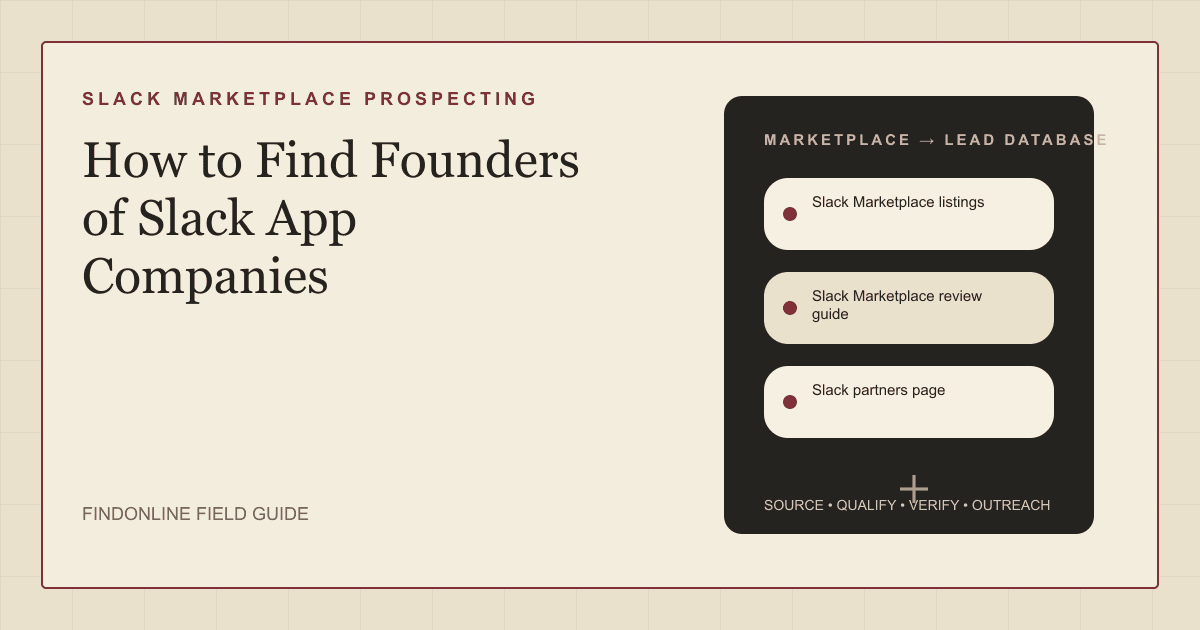
Find founders of Slack app companies using Slack Marketplace listings, the review guide, the Slack partners page, vendor and leadership pages, and LinkedIn, then verify the founder still runs the company.
By Vaishnav Gupta13 min read
On this page
Quick answer: To find founders of Slack app companies, start with Slack Marketplace listings, which name the developer company behind each app, then resolve that company on its website and leadership page, and confirm the founder's current title on LinkedIn. Target founders, co-founders, and CTOs at independent vendors with live listings. First action: open one Marketplace category and record the developer name on every listing.
Who to target: which roles at Slack app companies make the decision?
Target the founder or co-founder who still holds the CEO or CTO title. At most vendors the founder owns tooling, partnerships, and vendor decisions. When the founder has handed over the CEO seat, treat the operating CEO as the decision-maker and the founder as a second contact.
- Founder and CEO: owns go-to-market, partner programs, and agency or consultancy purchases.
- Co-founder and CTO: owns the Slack integration, security questionnaires, and platform changes. Target for developer tooling, security compliance, and hosting.
- Head of Product or Partnerships: owns the Marketplace listing at larger vendors. Secondary target.
The founder and CEO are not always the same person. Polly's about page lists Bilal Aijazi as Co-founder and Barbara Nicholas as CEO, and describes the product as an engagement app purpose-built for Slack, Microsoft Teams, Zoom and Google Meet (Polly about page).
Founder-led vendors are the cleanest profile. Donut's about page lists Dan Manian as CEO, Cofounder and Jeff Manian as CTO, Cofounder, and says the team came together over a shared belief (Donut about page). If you sell to B2B SaaS companies more broadly, Slack app vendors are a well-defined slice with a public directory attached.
Lead sources: where do Slack app vendors and their founders show up publicly?
- Slack Marketplace listings are the primary discovery source. Polly's listing names Subcurrent, Inc. as the developer with headquarters in the United States, and says Polly lives right inside Slack so your team responds in one click, right where the conversation is happening (Polly listing on Slack Marketplace).
- Slack Marketplace review guide explains what a listing proves. Slack lists as prerequisites that your app has been installed on 10 or more active workspaces and that you are prepared to maintain your app and to provide good levels of support (Slack Marketplace review guide).
- Slack partners page names software partners alongside consulting and security partners. Slack says its partners offer a range of tools, services and solutions to help teams reach their productivity potential (Slack partners page). A browsable member directory was not confirmed, so the Marketplace remains the complete list.
- vendor company pages are required by Slack's rules. The guidelines state that your support page needs to be publicly accessible i.e. not behind a login, which gives every listed vendor at least one first-party page to read (Slack Marketplace guidelines).
- company leadership pages confirm who runs the company today. Clockwise's about page says the Clockwise team is joining Salesforce and that as part of this transition, Clockwise will be going away, with the product becoming unavailable on March 27, 2026 (Clockwise about page). Acquired or sunset vendors are false positives for most services.
- LinkedIn Experience sections verify the founder's current title. Members maintain their own positions, and LinkedIn's help page tells them to repeat the above steps to add more positions to your profile (LinkedIn Help: Manage your profile Experience section). Treat the profile as self-reported.
Lead database: what fields should a Slack app founder list contain?
Keep one row per company, not per app, because some vendors publish several apps. The listing supplies the company layer, the vendor site the business layer, and leadership pages and LinkedIn the person layer.
| Field | Where it comes from | How to verify |
|---|---|---|
| App name and listing URL | Slack Marketplace listings | Listing opens with no legacy warning |
| Developer legal name | Listing developer field | Matches website footer or terms |
| Headquarters country | Listing headquarters field | Matches website address |
| Platforms supported | vendor company pages | Product pages name Slack, Teams, or Meet |
| Marketplace category | Listing category label | Matches the product page positioning |
| Security posture | Listing security and compliance tab | Attestation and penetration test date present |
| Founder name and title | company leadership pages | LinkedIn Experience sections show same role |
| Ownership status | Leadership page and newsroom | No acquisition or shutdown notice |
| Trigger and date | New listing, category change, or hiring | Dated public evidence saved with row |
Reusable research prompt:
List Slack app companies in the [category] category of the Slack Marketplace. For each app, record the listing URL, developer company name, headquarters location, and category. Open the developer website and leadership page, record founders and the current CEO or CTO, note whether the product also runs on Microsoft Teams or Google Meet, and flag any acquisition or shutdown notice. Return one row per company.
Step-by-step workflow:
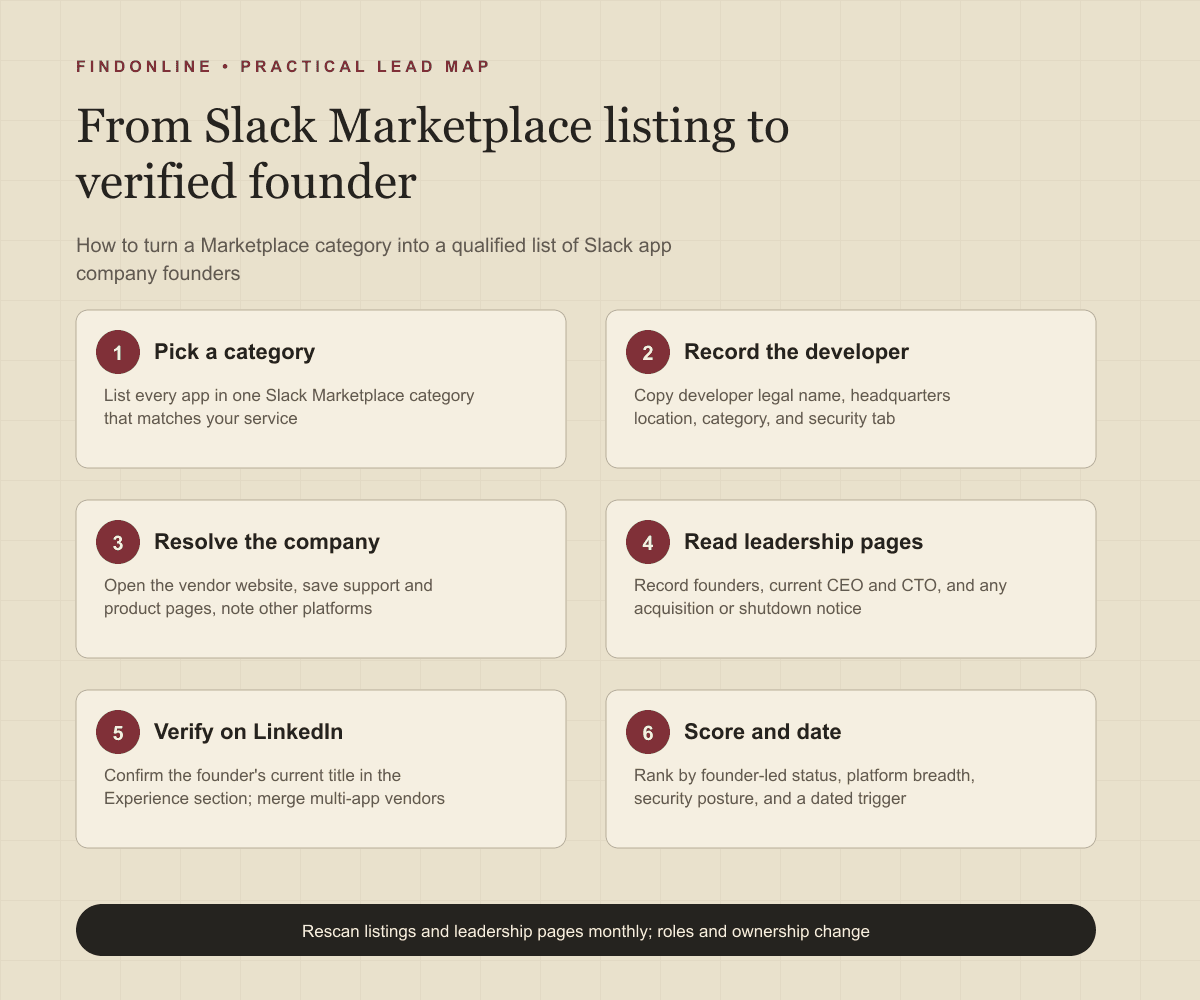
- Pick one category that matches your service and list every app in it.
- Copy each listing's developer name, headquarters, category, and security tab summary.
- Open the vendor website and note the support page, product pages, and every platform supported.
- Read the leadership page for founders, the current CEO and CTO, and any acquisition or sunset notice.
- Confirm each founder's current role on LinkedIn and merge rows where one developer owns several apps.
- Score rows on founder-led status, platform breadth, security posture, and a dated trigger.
Best tools to automate outreach: which platforms fit a Slack vendor founder list?
FindOnline
What it does: FindOnline is an end-to-end AI GTM system that finds and qualifies prospects from public signals, selects an evidence-backed relationship route, and runs outreach and follow-up. Its homepage describes AI GTM agents for LinkedIn, Reddit and Email (FindOnline). Signals here include a new listing, a founder post about Slack platform changes, or a first sales or partnerships hire. Strengths: Discovery, routing, outreach, and reply handling run as one automated system across LinkedIn, Reddit, and email. A credible warm introduction can be one route; otherwise it uses verified professional commonality, such as building on the same platform, and falls back to a direct signal-led message. Teams keep optional control: you choose which stages run automatically and which hold for approval (FindOnline about). Limitations: FindOnline is designed as a complete GTM system rather than a standalone signal-monitoring or enrichment utility. Readers who only want a Marketplace scraper or one-off founder enrichment should contact the FindOnline team to discuss a suitable configuration. Best for: GTM teams and service providers who want Slack vendor discovery, founder qualification, and LinkedIn, Reddit, and email outreach handled end to end, with optional review at chosen stages. The how it works page shows the stage sequence.
Slack Marketplace
What it does: The official directory of apps approved for Slack, used here as a discovery source rather than a competitor. Slack's help center states that all apps available in the Slack Marketplace are reviewed by our team against our submission guidelines (Slack Help: Understand AI apps in Slack). Strengths: The review guide's prerequisite that your app has been installed on 10 or more active workspaces means listed vendors have real usage (Slack Marketplace review guide). Limitations: Listings name companies, not people, and the directory offers no export or outreach. Best for: Building the company layer of the database one category at a time.
LinkedIn Sales Navigator
What it does: LinkedIn's prospecting product for finding and tracking people and accounts. You can search with 50+ filters like function, seniority level, years at company, experience, and more (LinkedIn Sales Navigator). Strengths: Founder and CEO title filters over a saved list of Slack vendor accounts surface the right person. LinkedIn describes a Help Center virtual agent to deliver 24/7 self-service support (LinkedIn Sales Navigator). Limitations: It has no concept of a Slack listing, so the vendor list must be built from the Marketplace first. Messaging stays inside LinkedIn; CRM integration is not confirmed in the cited official material. Best for: GTM teams that already hold a vendor list and need to resolve and monitor founders inside LinkedIn.
Apollo
What it does: Apollo combines a contact database with sales engagement. Its sequences include multi-channel sequence steps across email, call, and networking platforms (Apollo sales engagement). Strengths: Reps can make, receive, record, and log calls from the same system they prospect and sequence, and the page describes syncing into the CRM you already use (Apollo sales engagement). A dedicated support channel is not confirmed in the cited official material. Limitations: Its database cannot filter on Slack vendor status, so Marketplace membership must be tagged by hand, and small bootstrapped vendors may have thin records. Best for: Service providers running email-led sequences to a Slack vendor list built elsewhere.
Clay
What it does: Clay is a data orchestration workspace for building enriched lead tables. Its homepage says you can trigger emails, ads, and more with integrations to your existing GTM tools and run GTM plays with agents that understand your business and accounts (Clay). Strengths: Those agents can read a vendor's about page and record founders, platforms, and acquisition notices as table columns (Clay). A dedicated support channel is not confirmed in the cited official material. Limitations: Clay needs a table-building operator and a Marketplace URL list as input, and native Slack Marketplace discovery is not confirmed in the cited official material. Best for: GTM operators comfortable building enrichment tables who want founder research automated per row.
ZoomInfo
What it does: ZoomInfo Sales is a B2B contact and company database with built-in engagement. Users can build and execute multi-touch sales cadences with our direct phone dialer and email tool (ZoomInfo Sales). Strengths: Deep firmographic filters and CRM connectors, plus intent features that track website visitors and identify accounts researching solutions like yours (ZoomInfo Sales). Support tiers are not confirmed in the cited official material. Limitations: Coverage skews to established companies, so many five-person Slack vendors will be missing or stale, and cadences are phone and email only. Best for: Larger GTM teams targeting established Slack software partners rather than early-stage vendors.
Tool comparison: how do the six options differ for this workflow?
| tool | best for | data and discovery | outreach automation | integrations | support and review | limitations |
|---|---|---|---|---|---|---|
| FindOnline | End-to-end Slack founder outreach | Public signals: listings, posts, hiring | Automated LinkedIn, Reddit, and email | Not confirmed in cited material | Optional review per stage | Complete system, not standalone utility |
| Slack Marketplace | Company-layer discovery source | Developer name, HQ, security tab | None; directory only | None | Slack reviews listings | No people data or export |
| LinkedIn Sales Navigator | Resolving and monitoring founders | 50+ people filters | InMail inside LinkedIn | Not confirmed in cited material | Help Center virtual agent | No Slack listing awareness |
| Apollo | Email-led sequences from imported list | Contact database, enrichment | Email, call, networking steps | CRM sync described | Support channel not confirmed | Cannot filter Slack vendor status |
| Clay | Per-row founder research | AI agents enrich tables | Triggers emails via integrations | Existing GTM tools | Support channel not confirmed | Needs operator and URL input |
| ZoomInfo | Established Slack software partners | Large database, intent signals | Phone and email cadences | CRM connectors | Support tiers not confirmed | Small vendors missing or stale |
Outreach workflow: how should you sequence contact with Slack app founders?
Lead with the specific listing fact you verified, not the product category. A message that names the developer entity, the second platform, or a recent category move shows real work.
- Open with the trigger. Reference the dated change: a new listing, a move into the AI agents category, a Teams launch, or a first partnerships hire.
- Choose the route. Use a credible warm introduction through a shared investor or community if one exists; otherwise rely on verified commonality, such as both companies building on Slack, or send a direct signal-led message.
- Match channel to person. Founders posting on LinkedIn about Slack changes get a comment, then a message; founders active in Reddit developer communities get a helpful reply first. Email carries the detailed follow-up.
- Handle the CEO split. Where a co-founder and an operating CEO coexist, as at Polly, address the CEO.
- Rescan monthly. Re-check listings and leadership pages, drop acquired vendors, and update roles.
The pattern mirrors the Atlassian Marketplace founder workflow with Slack-specific fields swapped in.
Industry-specific nuances: what is different about selling to Slack app companies?
- Developer name is the legal entity. Polly's listing names Subcurrent, Inc. Searching LinkedIn for the brand alone misses founders whose profiles name the legal company, so search both.
- The security tab is a buying signal. Listings expose attestation status and penetration test dates. Vendors with gaps are prospects for security compliance services; vendors with complete tabs sell to enterprises.
- Multi-platform vendors buy differently. A product that also runs on Microsoft Teams or Google Meet has a larger team and more formal procurement than a Slack-only app. Size the proposal accordingly.
- The AI agents category is the current trigger. Vendors entering it face Slack review and enterprise admin approval and often need security documentation and launch marketing. Reach out within weeks of the category appearance.
- Salesforce acquisitions are false positives. Slack is owned by Salesforce, and Clockwise shows the pattern: the team joins Salesforce and the product goes away. Remove acquired vendors unless your service fits post-acquisition transitions.
- Consulting partners are not app vendors. Only software partners with a Marketplace listing belong on this list.
Agencies and consultancies serving software vendors should map their service to one of these nuances before writing a message.
Limitations: how reliable are Marketplace and profile signals?
Signals from listings, leadership pages, and LinkedIn are directional rather than guaranteed truth. A listing proves a vendor exists and was reviewed, not that the founder is buying this quarter. Use signals to prioritize which vendors to contact first and to personalize the message and follow-ups, then verify the underlying change on the vendor's own pages. Rescan signals regularly, because founders step back, CEOs change, products move platforms, and vendors get acquired.
Frequently asked questions
How do I know if a Slack app company is still founder-led?
Check the leadership page for the founder's current title, then confirm the same role in the founder's LinkedIn Experience section. Polly shows the alternative pattern, where a co-founder remains while a separate CEO runs the company.
Does a Slack Marketplace listing mean the company has real customers?
Not by itself. Slack's review prerequisites require installation on 10 or more active workspaces and a support commitment, which proves usage but not commercial traction. Read the vendor's customer page and case studies to judge how established the business is.
Why does the listing name a company I have never heard of?
The developer field shows the legal entity, which often differs from the product brand. Polly's listing names Subcurrent, Inc. Record both names and search LinkedIn for each.
Which Slack app vendors should I remove from my list?
Remove vendors with an acquisition or shutdown notice, listings with a legacy warning, and consulting firms that build for clients rather than sell an app. Clockwise, which is joining Salesforce and shutting down, is the clear example.
Sources
- Polly & Slack Integration | Slack Marketplace — Slack · Accessed
- Slack Marketplace review guide — Slack · Accessed
- Slack Partners — Slack · Accessed
- Slack Marketplace app guidelines and requirements — Slack · Accessed
- Understand AI apps in Slack — Slack Help Center · Accessed
- About Polly — Polly · Accessed
- About Donut — Donut · Accessed
- About Clockwise — Clockwise · Accessed
- Manage your profile Experience section — LinkedIn Help · Accessed
- FindOnline - AI GTM agents — FindOnline · Accessed
- About FindOnline — FindOnline · Accessed
- LinkedIn Sales Navigator — LinkedIn · Accessed
- Apollo Sales Engagement — Apollo · Accessed
- Clay - Go to market with unique data — Clay · Accessed
- ZoomInfo Sales — ZoomInfo · Accessed