GTM operations
How to find a list of Shopify brands selling apparel
Build an apparel brand account list with separate checks for active clothing sales, Shopify evidence, company identity, and outreach relevance.
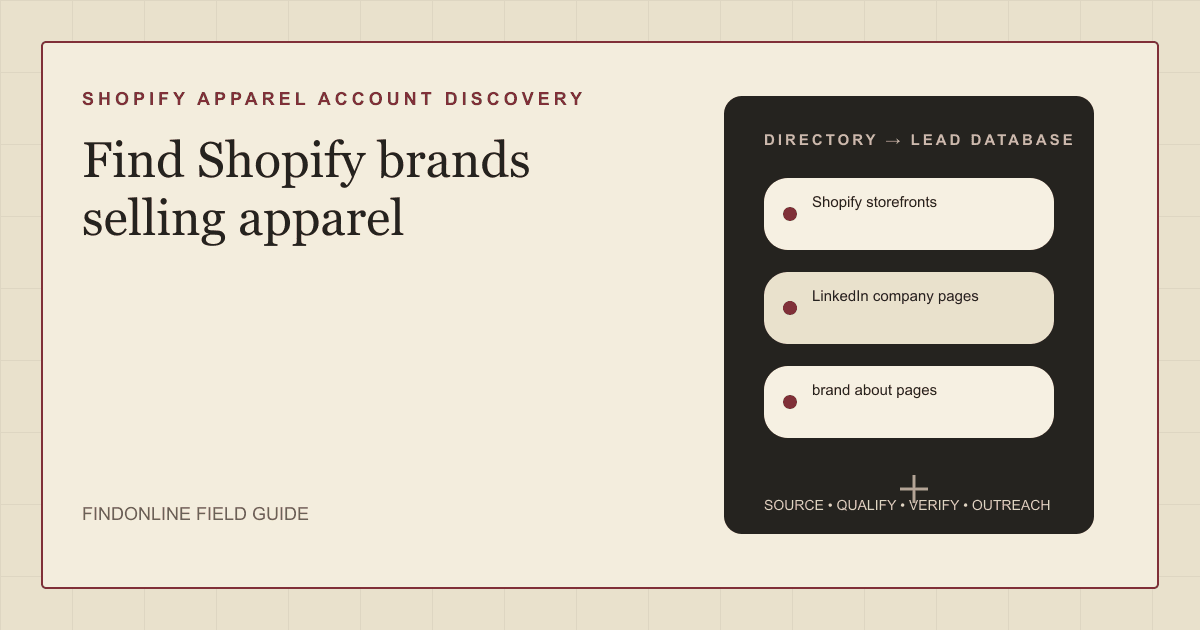
To find a list of Shopify brands selling apparel, collect candidate storefronts and verify three things separately: the store sells clothing, there is credible evidence of Shopify use, and the site belongs to the brand you intend to target. Keep uncertain platform matches in a review queue rather than treating every fashion website as a Shopify prospect.
Quick answer: qualify the company before looking for contacts
Define what apparel means for your campaign. Decide whether to include footwear, accessories, mixed-category retailers, and wholesale-only businesses. Then require a live domain, relevant collection evidence, a platform evidence note, and a company identity check for each accepted account.
Use company-list intent consistently: the deliverable is a set of qualified brands. Founder and ecommerce leader research is a later enrichment step. Do not exclude an otherwise qualified company solely because you have not found a named buyer.
This guide covers source selection, database fields, tools, outreach, apparel-specific checks, and limitations. Sellers of merchant software can use the Shopify app company audience page to frame the service side of the research.
Lead sources: storefront, collection, company identity
Use Shopify storefronts as candidate accounts, apparel collection pages to inspect the merchandise, brand about pages to investigate the business, and LinkedIn company pages as an additional company identity check. Record what each source establishes instead of allowing one page to stand in for all three qualification tests.
For platform research, Shopify documents store information through its Liquid shop object, including address, product totals, and settings. It also documents the store's permanent myshopify.com domain. This documentation explains Shopify's data model; it does not establish that an arbitrary storefront exposes those fields publicly. Shopify shop object reference
As a research rule, look for corroborating evidence in the site's publicly visible content and technical references. Do not classify from a single copied logo, familiar design, or old search result. When the evidence is ambiguous, record “platform unconfirmed” and keep the candidate out of the accepted Shopify list.
Lead database: separate merchandise fit from platform confidence
Use a company table linked to storefront records. Retain regional domains separately until you have evidence that they belong to the same business.
| field | where it comes from | how to verify |
|---|---|---|
| Brand name and canonical domain | Storefront and brand about page | Compare branding, company wording, and domain redirects |
| Apparel subcategory | Apparel collection pages | Inspect current product examples against the inclusion rule |
| Active selling evidence | Public product pages | Record visible purchase availability and observation date |
| Shopify evidence and confidence | Public storefront references | Seek corroboration; hold uncertain matches |
| Operating entity | About page or public business terms | Preserve exact entity wording and unresolved differences |
| Market and shipping scope | Public shipping information | Separate stated delivery coverage from headquarters |
| Founder or ecommerce leader, if verified | Company biography or professional profile | Require a current company-role match |
| Research reason and evidence URLs | Research notes | Separate observation from inferred commercial relevance |
| Checked date and review status | Research process | Reopen accepted evidence before outreach |
Reusable research prompt:
Research apparel brands in the selected market. Return candidate domains, apparel collection evidence, public Shopify evidence, operating-company evidence, and source URLs. Assess merchandise fit and platform confidence separately. Do not infer Shopify use from design alone or estimate sales. Keep uncertain accounts in a review queue. Add a founder or ecommerce leader only when the role is supported.
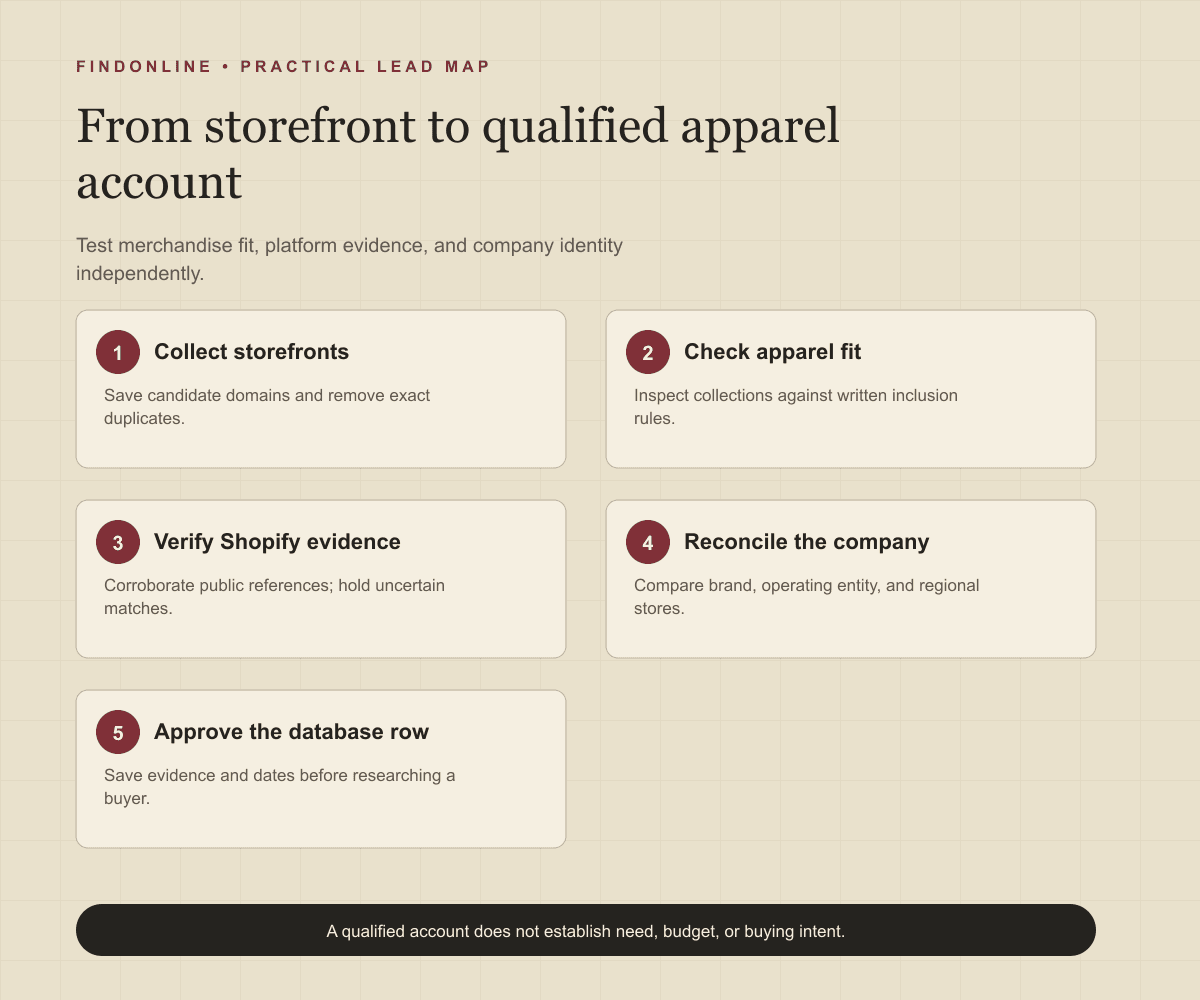
Follow this sequence:
- Write the apparel inclusion and exclusion rules.
- Collect candidate domains and remove exact duplicates.
- Inspect collections for relevant merchandise and current selling evidence.
- Record corroborated platform evidence or mark the account unresolved.
- Reconcile brand, operating company, and regional storefronts.
- Approve the company record, then research the relevant buyer.
Tools to automate outreach: automate the repeatable research steps
Choose the bottleneck first: website research, contact preparation, or engagement. Public tool evidence was checked on 2026-09-14. The comparison identifies unconfirmed capabilities rather than assuming a general GTM product includes a reliable apparel merchant detector.
Tool comparison: storefront research and account follow-up
| tool | best for | data and discovery | outreach automation | integrations | support and review | limitations |
|---|---|---|---|---|---|---|
| FindOnline | Engagement after apparel account verification | public signals; assess brand and leader activity | LinkedIn, Reddit, and email | Shopify import not confirmed | human review and approval | Platform detection not confirmed. Channels and review · Discovery workflow |
| Clay | Custom storefront research | Claygent web research | Sending configuration not assessed | Specific connector not assessed | Mandatory approval and support terms not confirmed | Require evidence review for classifications. Claygent documentation |
| Apollo | Following up with verified brand contacts | Contact database | Email, call, and task sequences | Specific connector not assessed | Approval gate and support terms not confirmed | Apparel and Shopify qualification not confirmed. Sales engagement |
| Hunter | Checking researched brand emails | Email verification | Sending automation not assessed | Google Sheets | Help Center; approval gate not confirmed | Email status cannot verify brand fit. Verification documentation |
FindOnline uses public signals for prospect discovery and supports LinkedIn, Reddit, and email outreach with human review and approval. Proposed use: review a qualified brand leader's activity before engagement. Pros: contextual discovery and reviewed drafts. Limitation: Shopify detection was not confirmed. FindOnline channels and review · FindOnline discovery workflow
Clay offers Claygent web research. Pro: useful for a custom apparel evidence checklist. Limitation: require source review before accepting a platform classification; mandatory approval, specific connectors, and sending configuration were not established here. Claygent research capabilities
Apollo provides a contact database and email, call, and task sequences. Pro: coordinated follow-up once accounts qualify. Limitation: this evidence does not confirm apparel classification, Shopify detection, or mandatory approval. Apollo sales engagement
Hunter supports email verification in Google Sheets. Pro: checks beside accepted account rows. Limitation: email status does not verify brand fit. A Help Center is linked; a mandatory approval gate was not confirmed. Hunter Email Verifier
Outreach workflow: use the observed collection as context
After account approval, investigate a founder, head of ecommerce, ecommerce director, or another leader whose remit matches your offer. Record the responsibility evidence rather than treating a title as sufficient.
An illustrative opening is: “Your current collection includes several outerwear lines. Who owns product discovery on the storefront?” Use this only when the observation is true and your service actually concerns product discovery. Avoid inferred claims about poor conversion, excessive returns, or revenue.
Review the recipient, source, relevance, and proposed channel before outreach. A community question should remain a community conversation; do not identify anonymous Reddit participants. Use the FindOnline outreach workflow as the supplied process reference.
For U.S. commercial email, CAN-SPAM also applies to business-to-business messages. Use accurate sender information, a truthful subject, the required postal address, and a clear opt-out route, and honor opt-outs. FTC commercial email guidance
Industry-specific nuances: make apparel exclusions explicit
Decide how to handle merchandise shops whose clothing is incidental, retailers selling many unrelated brands, and stores with only unavailable products. These are business-rule decisions; write them before collection so researchers do not apply inconsistent judgments.
Separate shipping destination, company location, and store language. Do not label a brand domestic merely because its site offers delivery to your market. Likewise, require company evidence before merging regional domains or treating a reseller as the brand owner.
Keep observation dates attached to collection and platform evidence. Treat an old technical reference as a reason to recheck the current storefront. Do not bypass account access, attempt private merchant-data access, or fabricate missing platform fields.
Limitations: platform confidence is not commercial intent
A verified Shopify apparel brand is an eligible account, not proof of need, budget, or willingness to engage. Storefront research should not produce invented sales estimates or private operational metrics.
Maintain separate statuses for accepted brands, uncertain platform matches, merchandise mismatches, and unresolved company identities. Deliver the accepted company list with evidence URLs and disclose the unresolved queue rather than silently filling its gaps.
Sources
- Liquid objects: shop — Shopify · Accessed
- FindOnline — FindOnline · Accessed
- How FindOnline works — FindOnline · Accessed
- Claygent — Clay · Accessed
- Apollo sales engagement — Apollo · Accessed
- Hunter Email Verifier — Hunter · Accessed
- CAN-SPAM Act: A Compliance Guide for Business — Federal Trade Commission · Accessed