Buyer discovery
How to Find Podcast Guests in Your Target Market
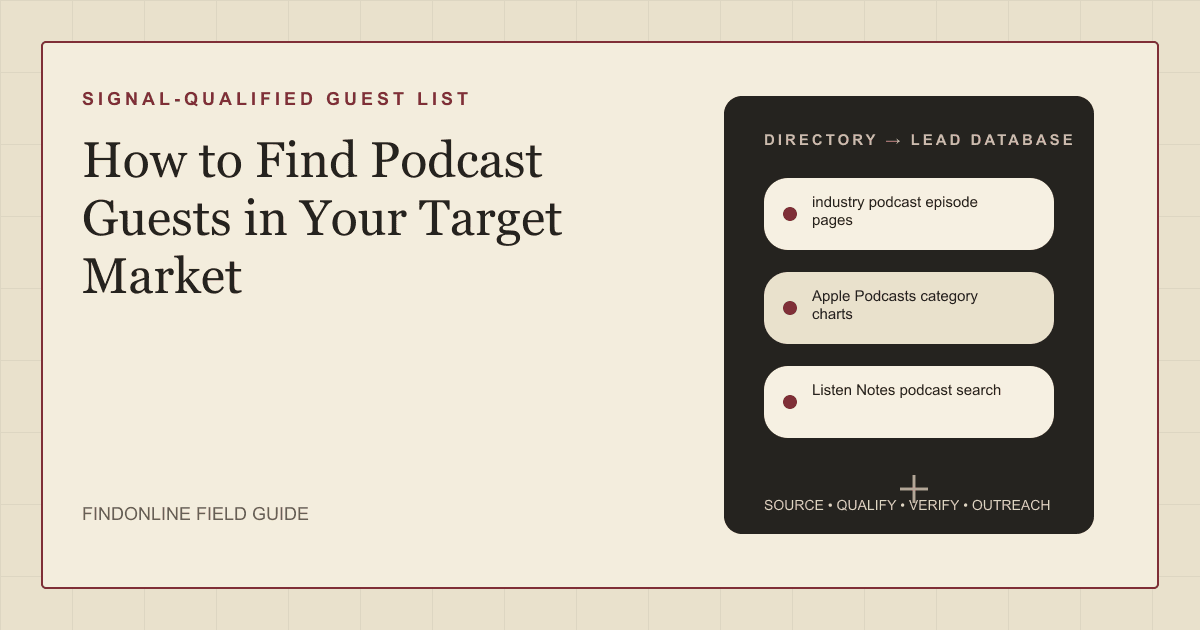
Find podcast guests in your target market using industry podcast episode pages, Apple Podcasts category charts, Listen Notes search, guest criteria pages, and LinkedIn profiles, then verify role and fit.
By Vaishnav Gupta13 min read
On this page
Quick answer: To find podcast guests in your target market, look for founders, VPs, and functional heads at accounts you want as customers who have already appeared on shows your buyers hear. The strongest sources are industry podcast episode pages, Apple Podcasts category charts, Listen Notes podcast search, and guest LinkedIn profiles. Start by listing ten adjacent shows and copying each one's last twenty guests.
Who to target: which podcast guests are worth inviting?
Invite people who are both a credible voice for your listeners and a decision-maker at a company inside your ideal customer profile (ICP). A guest who meets only one test either weakens the show or wastes the relationship.
Prioritize these roles:
- Founders and CEOs of ICP companies, who can usually accept an invitation without approval.
- VPs and heads of the function you sell into, such as a VP of Marketing, Chief Revenue Officer, or Head of Engineering.
- Directors with a specific operating story, when the senior leader is unreachable or over-booked.
- Booking gatekeepers: a communications lead, an executive assistant, or an outside booking agency that manages the guest's calendar.
Rank each person on four signals:
- Proven guest: a named appearance on another show in the past 12 months.
- Promotes appearances: they share their episodes publicly.
- Fresh story: a launch, funding round, book, or new role gives them a reason to talk now.
- Account fit: their company matches your segment, size, and buyer function.
Guest lists from focused shows are already segmented. SaaS Club describes its format this way: "Every week, one founder breaks down how they grew" (SaaS Club podcast). If you sell to B2B software founders, that archive is a ready-made candidate pool.
Lead sources: where do you find proven guests in your market?
Use five sources, moving from shows to people. The reviewed starting point "podcast directories" is split into two named directories because each does a different job. Podchaser and MatchMaker.fm blocked our research browser, so neither is used here.
- industry podcast episode pages: The primary source. Each page names a guest, their company, and the topic they chose to discuss. One SaaS Club episode page, for example, recounts how guest Rajiv Khaneja of AdButler landed a first enterprise deal (SaaS Club episode). Copy the name, company, episode URL, and topic.
- Apple Podcasts category charts: Use these to find the adjacent shows. Apple says it recommends shows based on more than 100 categories and subcategories, and that charts are associated with categories (Apple Podcasts for Creators). Its Business category includes Entrepreneurship, Management, and Marketing subcategories.
- Listen Notes podcast search: Use it to check a named person's appearance history. Listen Notes says its search lets listeners find podcast episodes interviewing or talking about a person (Listen Notes).
- podcast guest criteria pages: Some shows publish who they accept. These pages tell you which roles and company stages an adjacent show has already filtered for.
- guest LinkedIn profiles: Confirm the current role and look for promotion behavior. LinkedIn says the Featured section lets members showcase samples of their work to people who view their profile (LinkedIn Help). A podcast link there marks someone who values appearances.
For a related event-based method, see the guide to finding speakers at B2B conferences.
Lead database: what should a podcast guest list contain?
A useful guest database stores the appearance evidence, the account fit, and the booking route for each person. Keep one row per guest, not one per episode.
| Field | Where it comes from | How to verify |
|---|---|---|
| Guest name and current title | Episode page | Current role on the guest's LinkedIn profile |
| Company and ICP fit | Company website | Segment, size, and buyer function match |
| Show and episode URL | Episode page | Open the link and confirm the guest |
| Appearance date | Podcast app or directory listing | Within the past 12 months |
| Topic angle | Episode title and notes | Different from the angle you will propose |
| Promotion behavior | LinkedIn posts and Featured section | Episode shared publicly by the guest |
| Booking route | Guest website, profile, or agency credit | Direct, assistant, or agency contact confirmed |
| Relationship route | Your customer relationship management (CRM) system and network | Verified connection or commonality only |
Reusable research prompt:
List guests from the last 20 episodes of [show name] at [show URL].
For each guest return: full name, title and company as stated on the episode page, episode URL, and topic.
Flag guests whose company matches [industry] and [size range] and whose role is [buyer function].
Mark any field you cannot confirm on the page as unverified.
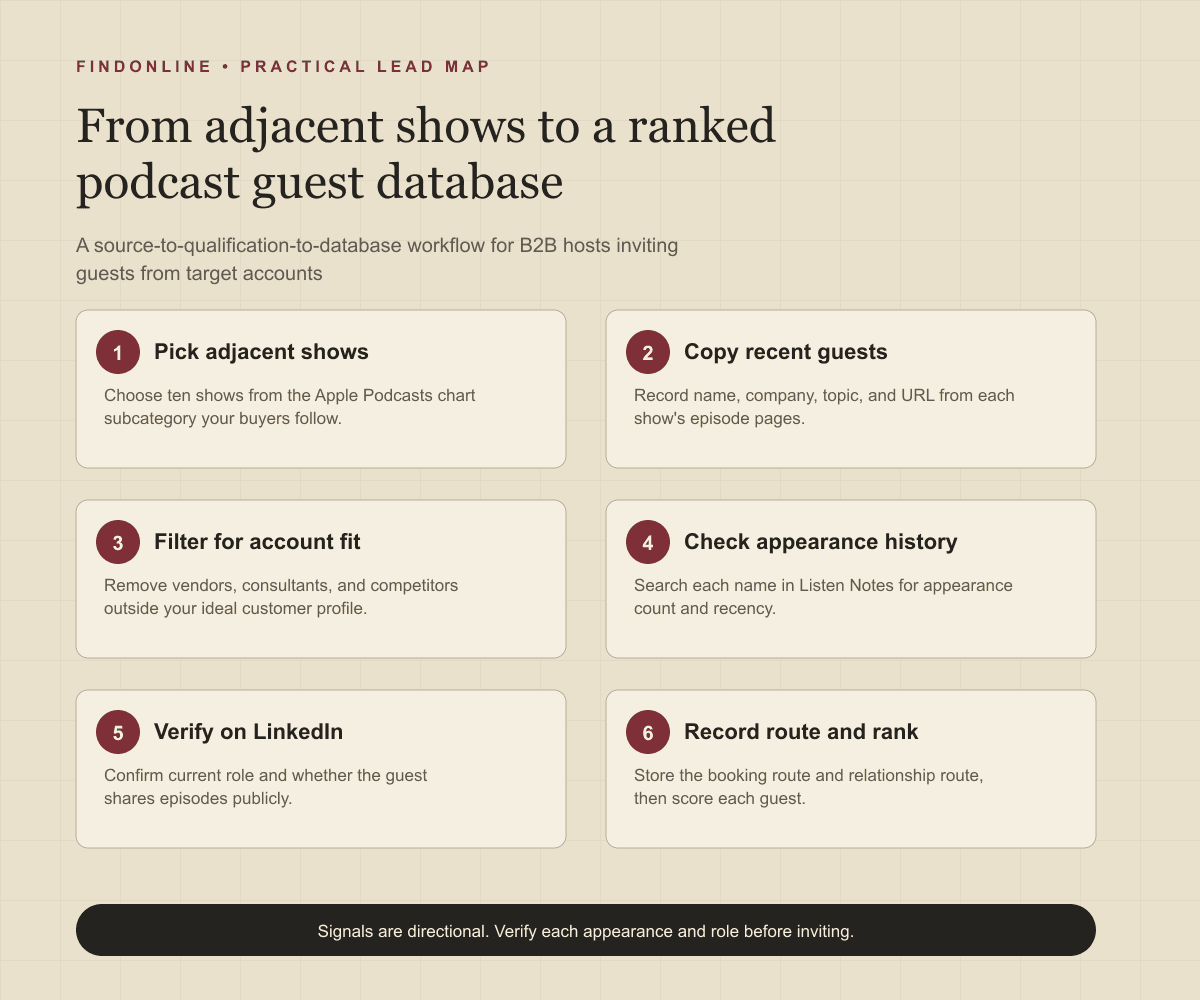
Step-by-step workflow:
- Pick ten shows from the chart subcategory your buyers follow.
- Copy the last twenty guests from each show's episode pages.
- Remove vendors, consultants, and competitors that fall outside your ICP.
- Check each remaining name in podcast search for appearance count and recency.
- Verify current role and promotion behavior on LinkedIn.
- Record the booking route, then score and rank.
Best tools to automate outreach: which options fit guest booking?
Six options cover different parts of guest booking, from verifying roles to sending invitations. None of the cited pages confirms a podcast appearance dataset, so the guest list itself still comes from the sources above.
FindOnline
What it does: FindOnline is a go-to-market (GTM) system that finds and qualifies prospects from public signals, then runs outreach end to end. Its homepage says it "Puts prospects who post, comment and update their profile at the top of your outreach queue" (FindOnline). Its agent "reaches out to them over LinkedIn and email" (FindOnline about). FindOnline's product facts also list Reddit as an outreach channel, which the cited pages did not confirm on November 13, 2026.
Strengths: Review is optional and set per stage: "You choose which stages run automatically and which hold for approval" (FindOnline about). A credible warm introduction is one possible route. Without one, outreach adapts to verified professional commonality such as industry, role, or community. Without either, it sends a direct signal-led invitation.
Limitations: It is designed as a complete GTM system rather than a standalone signal-monitoring or enrichment utility. Teams that want only one isolated component should contact the FindOnline team to discuss a suitable configuration.
Best for: B2B founders and GTM teams who want guest discovery, invitations, follow-ups, and the post-episode relationship handled in one system.
LinkedIn Sales Navigator
What it does: LinkedIn's prospecting product lets users "Search with 50+ filters like function, seniority level, years at company" (LinkedIn Sales Navigator). In this workflow it confirms that a guest named on an episode page still holds the role and works at a target account.
Strengths: Role and seniority filters make current-title checks fast. On support, LinkedIn states: "It provides structured onboarding, training, and support to drive product adoption" (LinkedIn Sales Navigator).
Limitations: It holds profile data, not podcast data, so it cannot tell you who has guested where. Automated multi-step sequences and integrations were not confirmed in the cited official material.
Best for: Hosts who already hold a guest list and need role verification and account mapping.
Apollo
What it does: Apollo's sales engagement product offers "Multi-channel sequence steps across email, call, and networking platforms" (Apollo).
Strengths: Invitation activity stays beside the account record. The page states that "Apollo syncs contacts, activities, and deal data with CRMs like Salesforce and HubSpot" (Apollo).
Limitations: Sequences are designed for sales cadences, so a guest invitation needs a shorter, editorial-first sequence that you build by hand. Its support model was not confirmed in the cited official material.
Best for: GTM teams that want each guest invitation step logged in the CRM beside the target account.
Clay
What it does: Clay is a data orchestration platform offering "One contract to buy data from 200+ data and AI vendors" (Clay). You can paste a guest table in and enrich each row.
Strengths: Enriched rows can feed your sending tools. Clay says users can "Trigger emails, ads, and more with integrations to your existing GTM tools." (Clay).
Limitations: Someone must design and maintain the table logic, which is heavy for a show booking a few guests a month. Native sending and the support model were not confirmed in the cited official material.
Best for: GTM operators with a long guest list from many shows who need enrichment and scoring before invitations.
Lemlist
What it does: Lemlist is a multichannel outreach tool. Its page says users can "Reach leads via email, LinkedIn, calls, WhatsApp, and SMS." (lemlist).
Strengths: The page says the product "connects seamlessly with tools like HubSpot and Salesforce" and that "our support team is just a click away" (lemlist).
Limitations: Its campaign-first design starts after the list exists, and calls, WhatsApp, and SMS rarely suit a first invitation to an executive.
Best for: Small teams sending a short, personal guest invitation sequence across email and LinkedIn.
HeyReach
What it does: HeyReach automates LinkedIn outreach. Its page says users can "Automate actions such as connection requests, messages, voice notes, and profile views." (HeyReach).
Strengths: It connects to email senders through "Native integrations with Instantly, Smartlead, and EmailBison that are simple to use." (HeyReach).
Limitations: It is LinkedIn-centered, so guests booked through an assistant or agency inbox need a separate email tool. Its support model was not confirmed in the cited official material.
Best for: Agency owners booking guests for client shows where LinkedIn is the main invitation channel.
Tool comparison: how do the six options compare for guest outreach?
The options differ mainly in whether they discover people, verify them, or send invitations. "Not confirmed" means not confirmed in the cited official material.
| tool | best for | data and discovery | outreach automation | integrations | support and review | limitations |
|---|---|---|---|---|---|---|
| FindOnline | Discovery, invitations, and follow-up in one system | Finds and qualifies guests from public signals | Automated LinkedIn, Reddit, and email outreach; Reddit not confirmed on cited pages | Not confirmed | Optional review at chosen stages | Complete GTM system, not a standalone utility |
| LinkedIn Sales Navigator | Verifying roles on an existing guest list | 50+ search filters including function and seniority | Automated sequences not confirmed | Not confirmed | Structured onboarding, training, and support | No podcast appearance data |
| Apollo | Logging invitations beside CRM accounts | Podcast data not confirmed | Multi-channel sequence steps | Salesforce and HubSpot CRM sync | Not confirmed | Sales-cadence design needs manual adaptation |
| Clay | Enriching and scoring long guest lists | Marketplace of 200+ data and AI vendors | Triggers emails through integrations | Existing GTM tools | Not confirmed | Table logic needs an owner |
| Lemlist | Short personal invitation sequences | Podcast data not confirmed | Email, LinkedIn, calls, WhatsApp, SMS | HubSpot and Salesforce | In-app chat support | Starts only after the list exists |
| HeyReach | Agencies inviting guests on LinkedIn | Podcast data not confirmed | LinkedIn requests, messages, voice notes | Instantly, Smartlead, EmailBison | Not confirmed | LinkedIn-centered; email needs another tool |
Outreach workflow: how do you invite a target-market guest?
Lead with a specific episode idea, not with your product. A guest invitation is an editorial offer, and it should read like one.
- Open with the angle. Name the episode topic and why this person is the right voice for it.
- Cite the verified appearance. Reference the episode you heard and one point from it, then propose a different angle.
- Choose the route. Use a credible warm introduction when one exists. Otherwise mention only verified commonality, such as a shared community or role. If neither exists, send a direct, signal-led invitation.
- Make yes easy. State the format, length, recording window, and that questions arrive in advance.
- Follow up twice. Add something new each time, such as a draft question list.
- Keep the recording clean. Do not pitch during the episode. Continue the relationship afterward with clips, a thank-you, and a relevant introduction.
Teams that want this sequence run for them can see how FindOnline's workflow stages fit together, or review the approach for B2B SaaS teams.
Industry-specific nuances: what is different about recruiting podcast guests?
Podcast guesting has its own false positives and timing rules, and they differ from ordinary prospecting.
- The guest circuit is full of sellers. Consultants and vendors pitch shows constantly. Frequent appearances can mean a professional guest, not a buyer. Check the company against your ICP before the appearance count.
- Published guest bars pre-qualify lists. SaaS Club's guest page asks for an "Active B2B SaaS or AI startup founder, typically serving as CEO" and sets a minimum revenue bar (SaaS Club guest pitches). Guests of shows with a stated bar have already passed it.
- Promotion windows drive acceptance. People say yes when they have a launch, book, funding round, or new role to discuss. Invite inside that window.
- Repeated stories lose listeners. If a guest told the same story on five shows, offer a narrower angle they have not covered.
- Agency-booked guests route differently. When an episode credits a booking agency, send the invitation to the agency and copy the guest.
- Large-company guests need approval. Executives at public or regulated companies often need communications sign-off, so allow extra lead time.
- Choose charts by buyer function. Pick the subcategory your buyer listens to, not the one your product belongs to.
Limitations: how reliable are podcast guest signals?
Guest signals are directional, not guaranteed truth. A past appearance shows willingness to be interviewed, not interest in your product or availability this quarter. Use signals to prioritize who to invite first and to personalize invitations and follow-ups. Verify the underlying change, such as the role, the launch, or the appearance itself, on a primary page before you reference it. Rescan your sources regularly, because guests change roles, companies shift focus, and shows update their guest criteria.
Frequently asked questions
How do I find guests for a B2B podcast when I have no audience yet?
Start with directors and founders at smaller ICP companies who have guested on one or two niche shows. They accept more readily than well-known executives and still give you a relevant conversation. Offer a tight topic, a short recording, and clips they can reuse.
Should I invite prospects or only customers as podcast guests?
Invite both, as long as each guest can teach your listeners something. Customers bring proof and candor, while prospects widen your reach inside target accounts. Never make the invitation conditional on a sales meeting.
How many shows should I review to build a first guest list?
Ten adjacent shows with twenty recent episodes each gives about two hundred names before filtering. After removing vendors, competitors, and poor-fit companies, expect a much shorter list. Add more shows only when that list runs out.
What should a podcast guest invitation email include?
It should include the proposed episode angle, why the guest fits, the format and length, and a recording window. Reference one verified detail from a past appearance. Keep product description out of the first message.
How do I verify that someone really appeared on a podcast?
Open the episode page and confirm the guest's name and company there. Then search the name in a podcast search engine to confirm the listing and date. Do not rely on a profile claim alone.
How often should I refresh my podcast guest list?
Refresh it at least once a quarter, or monthly if you publish weekly. New episodes appear constantly, and guests change roles. Re-verify the current title before every invitation.
Sources
- The SaaS Podcast — SaaS Club · Accessed
- Enterprise Sales Without Salespeople - Rajiv Khaneja, AdButler — SaaS Club · Accessed
- Guest Pitches — SaaS Club · Accessed
- Apple Podcasts categories — Apple Podcasts for Creators · Accessed
- Listen Notes podcast search engine — Listen Notes · Accessed
- Manage featured samples of your work on your LinkedIn profile — LinkedIn Help · Accessed
- LinkedIn Sales Navigator — LinkedIn · Accessed
- Apollo sales engagement — Apollo · Accessed
- Clay homepage — Clay · Accessed
- lemlist homepage — lemlist · Accessed
- HeyReach homepage — HeyReach · Accessed
- FindOnline homepage — FindOnline · Accessed
- About FindOnline — FindOnline · Accessed