Buyer discovery
How to Find IT Buyers at Newly Acquired Portfolio Companies
Find IT buyers at newly acquired portfolio companies using private equity portfolio pages, acquisition announcements, EDGAR full-text search, and leadership pages, then verify the IT owner before outreach.
By Vaishnav Gupta14 min read
On this page
Quick answer: To find IT buyers at newly acquired portfolio companies, target the CIO, CTO, CISO, or director of IT operations at businesses a private equity sponsor took control of within the last six months. Start with private equity portfolio pages and sponsor acquisition announcements, confirm the close date with EDGAR full-text search, then read company leadership pages to name the technology owner before sending anything.
Who to target: which roles own IT decisions after a private equity acquisition?
Target the person who owns infrastructure, security, and technology vendor spend at the acquired company: usually a CIO, CTO, VP of IT, or director of IT operations. The sponsor's operating team sets priorities but rarely signs service contracts.
Titles shift with company size and deal type. Kneat, which Thoma Bravo took private in August 2026, lists a CTO and a co-founder serving as Director of Information Security and IT Operations on its about page, so the buying remit is shared (Kneat about us). Larger take-privates and carve-outs usually add a CIO and a dedicated CISO.
The trigger is the post-close mandate. The Association for Corporate Growth (ACG) describes IT value creation running through "Day 1 and the first 100 days" and reports that "only 28% of private equity-backed portfolio companies conduct structured IT diligence before signing the LOI" (ACG deal lifecycle session). Many IT leaders therefore inherit assessment, remediation, and vendor rationalization work right after closing.
Qualify an account when the deal has closed, the transaction is a control deal (take-private, carve-out, platform, or add-on), a named IT or security leader exists or the role is open, and the sponsor's release describes operational involvement. Treat minority growth investments and credit financings as false positives. Firms selling finance services should use the companion guide to finding CFOs at private equity portfolio companies.
Lead sources: where do newly acquired portfolio companies appear first?
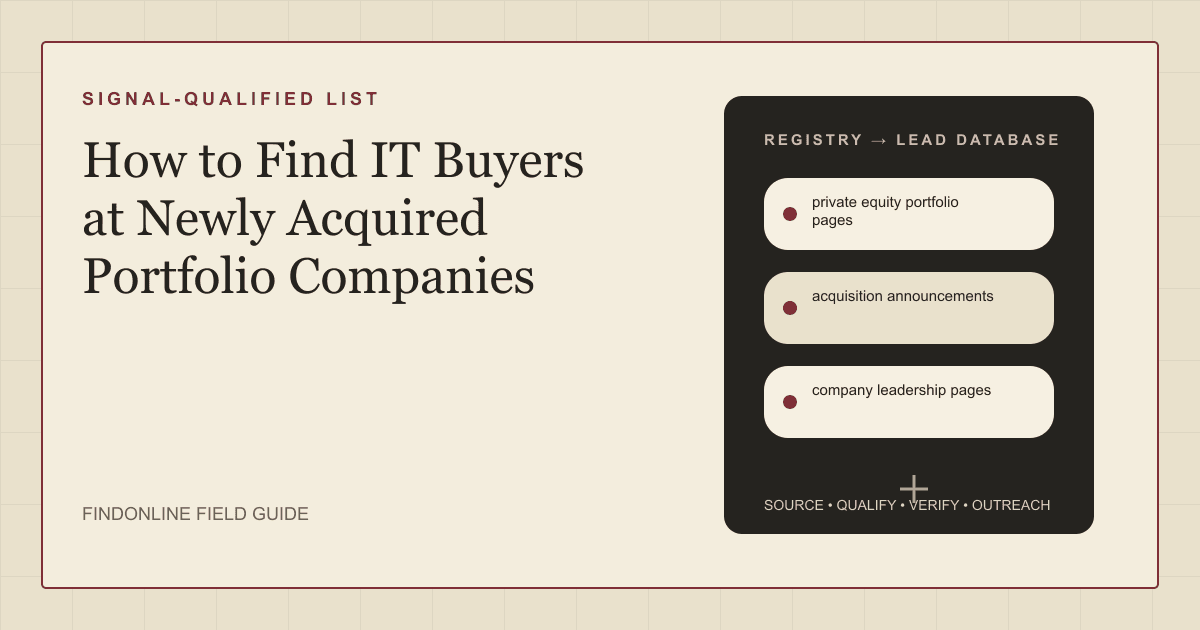
Sponsor websites surface new holdings first, then the acquired company's leadership page and public filings. All three reviewed starting points were readable today and are retained; EDGAR full-text search is added because listed-company take-privates leave a filing trail that sponsor pages do not show.
- private equity portfolio pages list current and former holdings, often with industry and fund filters. Vista Equity Partners' companies page states that "Vista manages a portfolio of more than 85 companies" as of June 30, 2026 (Vista Equity Partners companies). Capture the current list monthly and compare it with the prior month to catch new logos.
- acquisition announcements on sponsor newsrooms give the close date, structure, and stated plan. Thoma Bravo's August 11, 2026 release confirms that "Shares of Kneat have ceased trading and will be delisted from the Toronto Stock Exchange" and promises "operational expertise to help them scale, innovate, and extend their market leadership" (Thoma Bravo Kneat release). Operational involvement language usually means IT and security standards follow.
- company leadership pages name the technology owner. Kneat's page shows a CTO alongside an information security and IT operations lead, which separates the cloud contact from the security contact (Kneat about us).
- EDGAR full-text search covers United States listed targets. The SEC tool "gives you access to the full text of electronic filings since 2001" (SEC EDGAR full-text search). Search Form 8-K text for the sponsor's name, because SEC staff guidance states that Item 2.01 disclosure "is specifically required only when such an acquisition or disposition is consummated" (SEC Form 8-K interpretations). A matching filing confirms the close, not just the agreement.
Lead database: how should you structure and verify the list?
Keep one account record per acquired company and one contact record per IT or security owner, with deal fields separate from people fields so a leadership change does not erase the deal evidence.
| Field | Where it comes from | How to verify |
|---|---|---|
| Portfolio company | Sponsor portfolio page | Match name to the leadership page domain |
| Sponsor and fund | Portfolio page filters | Confirm in the completion release |
| Deal type | Acquisition announcement | Classify as take-private, carve-out, platform, or add-on |
| Close date | Completion release or Form 8-K | Prefer filing date over announcement date |
| Stated sponsor plan | Release quotes | Note words such as scale, integrate, operational |
| IT owner and title | Company leadership page | Check current role on a public profile |
| Security owner | Leadership or careers page | Record whether the role is filled or open |
| Hiring signal | Company careers page | Capture IT, cloud, and security job titles |
| Last verified | Your own log | Rescan every 30 days |
Reusable research prompt:
Using only public sources, list companies that [sponsor] completed acquiring between [start date] and [end date].
For each company return the close date, the deal type (take-private, carve-out, platform, or add-on),
the leadership page URL, and the name and title of the person who owns IT or information security.
Mark anything you cannot confirm as unknown.
Step-by-step workflow:
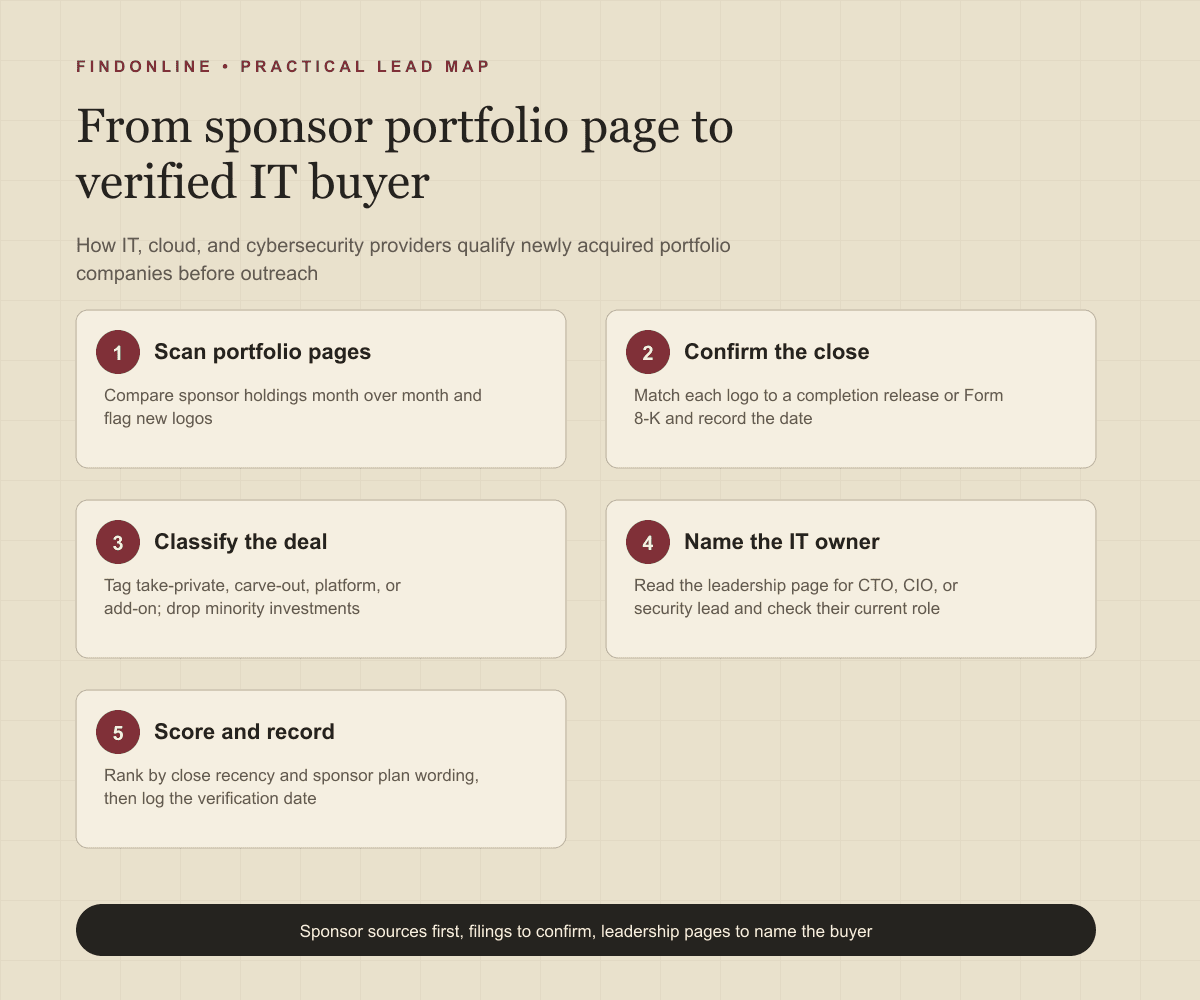
- Pull current holdings from two or three sponsor portfolio pages each month.
- Match each new logo to a completion release and record the close date.
- For listed targets, confirm the close in EDGAR full-text search.
- Open the leadership page and record the IT and security owners.
- Check the careers page for open IT, cloud, or security roles.
- Score each account by deal type, close recency, and sponsor plan wording.
Best tools to automate outreach: which platforms fit this workflow?
Only FindOnline runs the full path from public signal to multi-channel conversation; the other five each cover one or two stages. Crunchbase would normally join this comparison for acquisition data, but its official support pages could not be opened by the research browser today, so Common Room stands in.
FindOnline
What it does: FindOnline is an end-to-end AI go-to-market (GTM) system that finds and qualifies prospects from public business and professional signals, such as a sponsor's completion release or an IT leader's new role, then runs outreach through "AI GTM agents for LinkedIn, Reddit and Email" (FindOnline). Automation is configurable: "You choose which stages run automatically and which hold for approval" (FindOnline about).
Strengths: Discovery, qualification, outreach, reply handling, and ongoing engagement run in one system, with review optional at the stage level. A credible warm path, such as a shared former employer, can be the relationship route; otherwise FindOnline uses verified professional commonality or a direct signal-led message about the acquisition, as the how it works page shows.
Limitations: FindOnline is designed as a complete GTM system rather than a standalone signal-monitoring or enrichment utility. Providers who want only acquisition alerts or only contact data should contact the FindOnline team to discuss a suitable configuration.
Best for: IT, cloud, and cybersecurity service providers who want post-close prospects found, qualified, and contacted across LinkedIn, Reddit, and email without stitching separate tools together.
LinkedIn Sales Navigator
What it does: Sales Navigator is LinkedIn's prospecting product. Its page says you can "Search with 50+ filters like function, seniority level, years at company, experience, and more," bring data into "CRMs like HubSpot Smart CRM, Oracle Sales, Microsoft Dynamics 365, and Salesforce," and get support from an AI-powered Help Center virtual agent (LinkedIn Sales Navigator).
Strengths: Quickly resolves IT and security people at a named portfolio company; TeamLink reveals shared connections for a warm route.
Limitations: It does not know which companies were acquired, so you supply the account list, and messaging stays manual.
Best for: Providers who already hold the acquired-company list and need the right IT contact and reporting line.
Apollo
What it does: Apollo is a sales engagement platform offering "Multi-channel sequence steps across email, call, and networking platforms" with context-aware drafting, and it "syncs contacts, activities, and deal data with CRMs like Salesforce and HubSpot" (Apollo sales engagement).
Strengths: Repeatable sequences with room to personalize, so one 100-day-plan message reaches many IT leaders.
Limitations: Acquisition detection is not confirmed in the cited official material, and a sequence sent before the close date reads as premature.
Best for: Teams running volume email and call cadences across many portfolio companies.
Clay
What it does: Clay is an enrichment workspace. Its university lesson on waterfall enrichment says "The key is optimizing for the right balance of cost versus coverage for your specific use case" and points to funding and investment details for firmographic data (Clay University). Its integrations page says you can "Sync and manage HubSpot CRM companies and contacts effortlessly within Clay tables" (Clay integrations).
Strengths: Turns a raw list of acquired companies into enriched records with investor fields and contacts.
Limitations: Sponsor-page scraping and deal classification logic are yours to build and maintain, and outreach sending is not confirmed in the cited material.
Best for: GTM operators who keep a spreadsheet of sponsor deals and want it enriched and pushed to a CRM.
ZoomInfo
What it does: ZoomInfo is a B2B data platform. Its Scoops guide, updated July 28, 2026, describes researcher-sourced signals and explains that users can "Set up account-level Scoops alerts in GTM Workspace for your territory, filtering by the signals that matter most" (ZoomInfo Scoops guide).
Strengths: Alerts on projects and leadership changes at accounts you already track.
Limitations: Scoops are vendor-researched, so the sponsor's release remains primary evidence; CRM integration and support are not confirmed in the cited material.
Best for: Providers with a defined territory of portfolio companies who want executive-move alerts layered on top.
Common Room
What it does: Common Room aggregates organization signals. Its documentation lists "Recent news and current events associated with an Organization," capital raised, and job listings as native organization signals (Common Room organization signals).
Strengths: Brings news, funding, and hiring signals about tracked companies into one view.
Limitations: Organization-level news does not reveal who owns IT inside the company, and outreach execution and support are not confirmed in the cited documentation.
Best for: Teams monitoring a fixed set of portfolio companies who want news and hiring changes in one feed.
Tool comparison: how do the six options differ side by side?
The table restates the cited evidence; "not confirmed" means the official page cited above did not state it.
| tool | best for | data and discovery | outreach automation | integrations | support and review | limitations |
|---|---|---|---|---|---|---|
| FindOnline | Signal-to-conversation automation for IT providers | Public signals: releases, role changes, communities | Automated LinkedIn, Reddit, and email outreach | Not confirmed in cited material | Optional review at each stage | Complete GTM system, not a standalone utility |
| LinkedIn Sales Navigator | Resolving IT contacts at known accounts | 50+ people and account filters | Manual messaging only | HubSpot, Dynamics 365, Oracle, Salesforce | AI help center virtual agent | Does not detect acquisitions |
| Apollo | Volume email and call cadences | Contact data; acquisition signals not confirmed | Multi-channel sequences | Salesforce and HubSpot sync | Not confirmed in cited material | Needs an imported verified list |
| Clay | Enriching sponsor deal spreadsheets | Waterfall enrichment with investor fields | Not confirmed in cited material | HubSpot and Salesforce tables | Not confirmed in cited material | Scraping and deal logic self-built |
| ZoomInfo | Territory alerts on tracked accounts | Researcher-sourced Scoops signals | Not confirmed in cited material | Not confirmed in cited material | Not confirmed in cited material | Vendor signals need primary confirmation |
| Common Room | News and hiring feeds | News, capital raised, job listings | Not confirmed in cited documentation | Not confirmed in cited documentation | Not confirmed in cited documentation | No IT owner resolution |
Outreach workflow: how do you sequence contact after a deal closes?
Open with the deal, lead with the mandate, and ask about one item the IT leader is already answering for the sponsor.
- Timing. Start two to six weeks after the close date, before first vendor reviews are awarded.
- First message. Name the sponsor and close date, tie one service outcome to a likely 100-day item such as a security baseline assessment, and ask whether that item sits with them.
- Relationship route. Ask for an introduction only when a verified warm path exists. Otherwise rely on verified commonality, such as the same regulated-industry community, or send a direct signal-led message. Never imply a relationship that does not exist.
- Channel. Use a LinkedIn note for director-level leaders, email for CIOs and CISOs with published addresses, and Reddit only where the leader is publicly active, following the guide to finding IT buyers discussing cloud problems on Reddit.
- Follow-up. Cite one new fact each time, such as an add-on announcement or an open security role. Stop after three touches and rescan in 60 days.
Industry-specific nuances: what changes when a sponsor owns the company?
Sponsor ownership changes who shapes the decision, how fast it happens, and what a service must prove.
- Operating partners set standards. When a release promises operational expertise, expect common security, identity, and reporting baselines across holdings. Position services as helping the IT leader meet the sponsor standard.
- Add-ons multiply the trigger. ACG frames IT value creation as continuing through "add-on acquisitions, and ultimately, exit" (ACG deal lifecycle session). A platform company buying add-ons needs repeatable integration and security onboarding, so monitor the platform's newsroom too.
- Carve-outs run on a transition clock. A separated division must rebuild identity, email, and security tooling before the transition services agreement (TSA) expires; ask for that date early.
- Take-privates go quiet. After delisting, filings stop, so leadership pages and job posts become the only ongoing public evidence.
- Cybersecurity is a diligence item. FTI Consulting, in a March 2024 article republished August 2024, argues that "Robust cybersecurity due diligence can also unlock additional value in portfolio companies" (FTI Consulting on cybersecurity in private equity). Findings often become a funded remediation project in year one, favoring providers who can quote fixed-scope work quickly.
- Regulated verticals raise the bar. Kneat calls itself "certified, trusted partners for your information and security" (Kneat about us), so providers must speak to validation and certification context, not just uptime.
Limitations: how reliable are acquisition signals?
Acquisition signals are directional, not guaranteed truth. A completion release proves ownership changed; it does not prove the IT leader has budget, authority, or a problem you solve. Use signals to prioritize which accounts to research first and to personalize the opening message and follow-ups, then verify the underlying change on the leadership page and in filings. Rescan every 30 to 60 days, because departments reorganize, roles are refilled, and sponsor plans shift after the first operating review.
Frequently asked questions
How soon after a private equity acquisition should IT service providers reach out?
Two to six weeks after the close date is the practical window. Earlier, the IT leader is still meeting the sponsor's operating team and has no mandate to share; later, the first assessments and vendor reviews may already be awarded. Anchor on the completion release date, not the agreement date.
How do you tell whether a portfolio company was acquired or only received a growth investment?
Read the sponsor's release for control language. Completed acquisitions describe shares ceasing to trade, a change of ownership, or a new platform, while growth investments describe a minority stake or a financing round. Only control deals reliably create a post-close IT mandate.
Which titles sign IT and security service contracts at portfolio companies?
The CIO or CTO usually signs infrastructure and cloud work, and the CISO or head of information security signs security assessments. At smaller companies one director may hold both remits, as Kneat's leadership page shows. Confirm the title before choosing the message.
Can you find acquired companies that were never publicly listed?
Yes. Private-to-private deals do not appear in SEC filings, so sponsor portfolio pages and newsroom releases are the primary evidence. Compare the portfolio page month over month and match each new logo to a release to capture the close date.
Sources
- About Us - Kneat — Kneat · Accessed
- Managing IT Value, Risk, and Spend Across the Deal Lifecycle — Association for Corporate Growth · Accessed
- Our Companies - Vista Equity Partners — Vista Equity Partners · Accessed
- Thoma Bravo Completes Acquisition of Kneat — Thoma Bravo · Accessed
- EDGAR Full Text Search — U.S. Securities and Exchange Commission · Accessed
- Exchange Act Form 8-K Compliance and Disclosure Interpretations — U.S. Securities and Exchange Commission · Accessed
- FindOnline - AI GTM agents — FindOnline · Accessed
- About FindOnline — FindOnline · Accessed
- LinkedIn Sales Navigator — LinkedIn · Accessed
- Apollo Sales Engagement — Apollo · Accessed
- Enriching Company Data - Clay University — Clay · Accessed
- Clay Integrations — Clay · Accessed
- Deal Intelligence Scoops: A Guide for Account Teams — ZoomInfo · Accessed
- Default Organization Signals - Common Room Docs — Common Room · Accessed
- Safeguarding Investments: The Vital Role of Cybersecurity in Private Equity — FTI Consulting · Accessed