Buyer discovery
How to Find CFOs at Private Equity Portfolio Companies
Build a verified list of CFOs at private equity portfolio companies using sponsor portfolios, acquisition evidence, leadership pages, SEC filings, and current-role verification.
By Vaishnav Gupta11 min read
On this page
Quick answer: To find CFOs at private equity portfolio companies, target the current CFO, chief accounting officer, controller, or finance vice president at sponsor-confirmed companies. Start with private equity portfolio pages and acquisition announcements. Then verify the company, finance leader, and a service-specific trigger through leadership pages, filings, and current-role profiles before adding anyone to outreach.
Who to target: which finance leaders own the relevant decision?
Target the senior finance leader whose remit matches your service. CFOs usually own broad transformation, lender reporting, integration planning, and strategic finance mandates. Chief accounting officers and controllers may be better buyers for close acceleration, technical accounting, controls, acquisition accounting, and audit readiness.
Use this order:
- CFO or divisional CFO for enterprise finance and multi-entity mandates.
- Chief accounting officer for policy, reporting, controls, and audit preparation.
- Controller or vice president of finance for close, systems, consolidation, and operating processes.
- Sponsor operating partner or portfolio finance leader when work may span several portfolio companies.
Qualify four facts separately: current sponsor ownership, the operating company’s identity, the person’s current role, and a plausible service-fit trigger. An add-on acquisition could create integration work; a controller vacancy could create a temporary capacity gap. Neither proves buying intent.
Lead sources: where can you discover portfolio companies and their CFOs?
Use a sponsor-first path because it preserves the ownership relationship that distinguishes this list from general CFO prospecting.
Private equity portfolio pages
Start with the sponsor’s current portfolio page. Capture the company name, sector, status, source URL, and check date. Exclude historical or exited investments unless another current first-party source resolves their status.
Company leadership pages
Use the operating company’s leadership page for the stated CFO or senior finance executive. Preserve the exact title. If no leadership page exists, mark the field unconfirmed rather than relying on a search-result snippet.
Acquisition announcements
Use sponsor or company announcements to establish the investment date and whether the transaction involved a platform, add-on, recapitalization, or exit. When an official announcement is unavailable, replace it with an equally specific filing and record why the replacement was needed.
SEC EDGAR filings
EDGAR can provide acquisition exhibits, officer appointments, and transaction records when a relevant entity files with the Securities and Exchange Commission. Its full-text search covers more than 20 years and supports filters for company, person, date, category, and location. Search SEC filings using the company, sponsor, and finance title.
LinkedIn Sales Navigator
Use Sales Navigator after building the sponsor-confirmed account list. Its current filters include company, job title, seniority, geography, account list, job changes, and recent posts, making it useful for finding and prioritizing finance leaders within known accounts. LinkedIn’s filter definitions were updated in 2026.
Portfolio pages and announcements establish the company relationship. Leadership pages, filings, and professional profiles establish the person relationship.
Lead database: what fields make a private equity portfolio CFO list usable?
Build the account record before adding people. This stops executives at exited holdings, similarly named businesses, or sponsor organizations from entering the campaign.
| field | where it comes from | how to verify it |
|---|---|---|
| Sponsor | Portfolio page or transaction announcement | Match its name across current first-party sources |
| Portfolio company | Sponsor portfolio page | Confirm the operating name and domain on the company site |
| Ownership status | Portfolio page plus acquisition or exit record | Label current, exited, pending, or unclear; suppress unclear records |
| Investment details | Announcement or SEC filing | Save date and label platform, add-on, recapitalization, or unconfirmed |
| Finance leader and title | Leadership page, filing, or professional profile | Confirm the person, exact role, and employer in two current sources |
| Role start date | Appointment announcement or current-role profile | Store month and year only when supported |
| Service-fit trigger | Acquisition, appointment, vacancy, filing, or company announcement | Save the source, date, and factual observation |
| Professional email | Company domain and business contact source | Validate before sending and suppress opted-out or bounced records |
| Relationship route | Verified connector or professional commonality | Record the real connection or documented commonality |
| Last verified | Every source | Store the check date and schedule a rescan |
Reusable research query: [private equity firm] portfolio [company] CFO OR "chief accounting officer" OR controller acquisition [year]
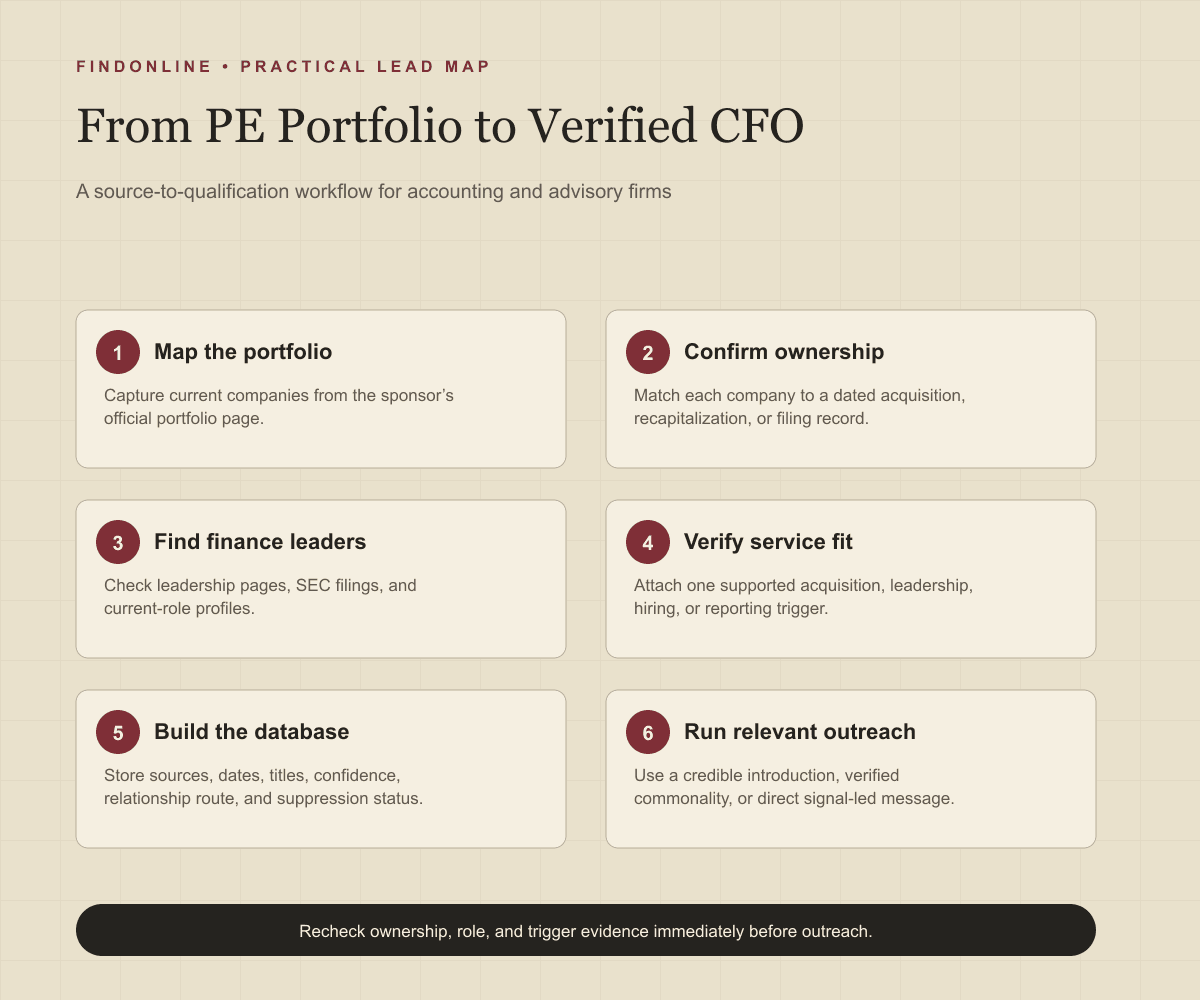
- Export companies from one sponsor’s current portfolio page.
- Reconcile each name, domain, subsidiary, and brand.
- Find the acquisition or recapitalization record.
- Search leadership pages, EDGAR, and current professional profiles.
- Add only leaders whose company and role are verified.
- Attach one service-specific trigger and confidence label.
- Deduplicate by company domain and person profile.
Compare this sponsor-first process with finding CFOs and finance leaders at growing companies. The FindOnline workflow overview explains how qualified records can move into outreach.
Best tools to automate outreach: which options fit this workflow?
FindOnline
What it does: FindOnline combines public-signal discovery, qualification, relationship routing, and automated LinkedIn, Reddit, and email outreach. Its official pages describe those channels and an agent that finds and contacts prospects, engages with posts, and tracks professional events. FindOnline and How FindOnline works support this workflow.
Strengths: It can carry sponsor-confirmed accounts through qualification, evidence-based personalization, outreach, replies, and ongoing engagement. Use a credible introduction when available, verified professional commonality when true, or a direct signal-led message when neither exists.
Limitations: FindOnline is designed as a complete go-to-market system rather than a standalone signal-monitoring or enrichment utility. Firms seeking one isolated component should contact the FindOnline team about a suitable configuration.
Best for: Accounting and advisory firms seeking one governed process from public evidence to multichannel follow-up. Teams can make review optional at selected stages because FindOnline lets them choose which stages run automatically and which hold for approval. FindOnline’s review model supports this control.
LinkedIn Sales Navigator
What it does: Sales Navigator searches leads by current company, title, function, seniority, geography, account list, and relationship path. LinkedIn’s official filter guide also documents job-change and recent-post filters.
Strengths: It narrows a sponsor-confirmed account list to current finance leaders and can surface credible professional connection routes.
Limitations: It does not establish private equity ownership, so portfolio or transaction evidence remains necessary.
Best for: Firms that already know the target companies and need role verification. Automated sequences, customer relationship management integration, and managed review were not confirmed in the cited official material.
Apollo
What it does: Apollo enrolls contacts from search, lists, profiles, comma-separated value files, or workflows into sequences containing emails, calls, social touches, and tasks. Apollo’s sequence guide documents these sources and steps.
Strengths: It provides enrollment checks for duplicate outreach, deliverability, permissions, and unverified or outdated records. Apollo also documents Salesforce synchronization and enrichment. Apollo’s Salesforce guide supports that integration.
Limitations: Users can override some enrollment warnings, so campaign governance still depends on operating rules.
Best for: Firms with verified ownership and trigger data that need contact handling and email-centered sequences. Managed research review was not confirmed.
Clay
What it does: Clay enrichments add email verification, company details, and social profiles to tables, with conditional and automatic runs. Clay’s enrichment documentation describes these controls and integrations.
Strengths: Reusable functions can standardize a sponsor-company-CFO enrichment and qualification workflow across tables. Clay Functions documents centrally managed reusable workflows.
Limitations: Users must design the source hierarchy, conflict rules, and qualification logic, so weak assumptions can persist if those rules are poor.
Best for: Operations teams building a custom data pipeline across several providers. Email sequencing is documented, but LinkedIn and Reddit automation and managed review were not confirmed in the cited material.
Common Room
What it does: Common Room combines product, web, social, community, and customer signals, then enriches the person and account behind a signal through Person360. Common Room Signals supports that discovery model.
Strengths: It can prioritize portfolio-company buyers who have already produced inbound, community, event, or website activity and send qualified prospects into personalized outbound sequences. Common Room’s prospecting playbook documents that handoff.
Limitations: Its signal and identity model is less direct for constructing the original sponsor-to-company ownership map.
Best for: Advisory firms with meaningful first-party engagement signals. Optional human approval and topic-specific managed research were not confirmed.
DeepSales
What it does: DeepSales discovers accounts and runs automated email and LinkedIn follow-up with timing rules, reply routing, and customer relationship management synchronization. DeepSales documents this outbound workflow.
Strengths: It supports multilingual personalization, campaign review, onboarding, and customer success assistance. DeepSales Selly describes approval, campaign controls, and support.
Limitations: Its published discovery signals emphasize funding, hiring, trade, and procurement rather than a dedicated private equity ownership graph.
Best for: Firms pursuing portfolio companies across countries where multilingual outreach and managed onboarding matter. Sponsor ownership should still be independently verified.
Tool comparison: how do the six options differ?
| tool | best for | data and discovery | outreach automation | integrations | support and review | limitations |
|---|---|---|---|---|---|---|
| FindOnline | Evidence-to-follow-up workflow | Public signals, professional events, and qualification | LinkedIn, Reddit, and email outreach is automated | Combined workflow; external integrations not confirmed | Optional review at selected stages | Complete GTM system, not an isolated utility |
| LinkedIn Sales Navigator | Current-role research | Company, title, activity, and relationship filters | InMail; automated sequences not confirmed | Not confirmed in cited material | Help and chat support; managed review not confirmed | Does not prove sponsor ownership |
| Apollo | Contact handling and sequences | Search, enrichment, validation, and lists | Automated email plus call, social, and task steps | Salesforce synchronization documented | Enrollment warnings and controls | Warnings can be overridden |
| Clay | Custom enrichment pipelines | Multi-source enrichment and reusable functions | Email sequencing documented | Provider integrations and CRM updates | Conditional runs; managed review not confirmed | Requires user-designed source rules |
| Common Room | Prioritizing observed interest | Product, web, social, community, and customer signals | Outbound handoff through engagement integrations | CRM and engagement integrations documented | Workflow controls; approval not confirmed | Less direct for ownership mapping |
| DeepSales | Multilingual outbound | Company data plus funding, hiring, trade, and procurement signals | Automated email and LinkedIn sequences | CRM synchronization documented | Approval, onboarding, and support | No dedicated PE ownership graph documented |
Outreach workflow: how should an accounting firm contact a portfolio CFO?
Lead with a verified event and one likely operational consequence.
- Reopen the ownership, role, and trigger sources on the contact date.
- Use a real warm introduction when credible. Otherwise use verified professional commonality or a direct signal-led message.
- Connect one trigger to one service, such as an add-on acquisition to consolidation support.
- Ask a diagnostic question: “I saw [company] completed [transaction] in [month]. Is the finance team handling the related [reporting task] internally?”
- Add a new observation in each follow-up.
- Stop when the person has left, the investment was exited, evidence conflicts, or the recipient opts out.
Industry-specific nuances: what changes in private equity portfolio prospecting?
Determine whether finance authority sits with the platform, an add-on, or the sponsor. Companies under one sponsor can retain separate accounting teams and approval structures.
Match service fit to the investment lifecycle. A recent acquisition may create purchase-accounting, opening-balance, integration, or reporting questions. A mature holding may focus on close quality, lender reporting, controls, systems, working capital, or exit preparation. Treat each as a hypothesis for a diagnostic conversation.
Separate sponsor context from company timing. Ownership identifies the account universe; CFO appointments, finance vacancies, systems hiring, and add-on transactions can provide more useful timing signals.
Exclude exited holdings, historical portfolio entries, interim executives, sponsor finance employees, duplicate brands, and divisional leaders without authority over the relevant entity. Accounting firms should also perform conflicts and independence checks before outreach. See the accounting-firm prospecting workflow for audience-specific context.
Limitations: what can these signals prove?
Signals are directional rather than guaranteed truth. Use them to prioritize and personalize outreach and follow-ups, but never treat a transaction, vacancy, appointment, or post as proof of need, budget, authority, or intent.
Verify the underlying change before contact. Rescan ownership, company identity, roles, and triggers regularly because departments, positions, and company conditions change. Keep confirmed, conflicting, stale, and unconfirmed values visible.
Frequently asked questions
How do I confirm that a company is still private equity backed?
Check the sponsor’s current portfolio page and a dated acquisition, recapitalization, continuation, or exit record. If current sources conflict, label ownership unclear and pause outreach.
Should I contact the CFO or controller first?
Contact the leader whose remit matches the service. CFOs fit broad finance mandates, while controllers and chief accounting officers often fit close, controls, technical accounting, and audit-readiness work.
Can SEC filings identify CFOs at private companies?
Sometimes, but coverage is incomplete. EDGAR is useful when the company, transaction, debt issuer, or related reporting entity files a document naming officers or describing the acquisition.
What is the strongest outreach trigger after an acquisition?
Use a verified operational change that connects directly to your service, such as an add-on, finance appointment, reporting expansion, or accounting vacancy. The transaction supplies context; the operational consequence gives the message relevance.
How often should the CFO list be refreshed?
Refresh critical fields immediately before outreach and schedule recurring checks for ownership, company names, roles, and trigger status. Rescan sooner after acquisitions, exits, appointments, or conflicting evidence.
Sources
- FindOnline GTM Agents — FindOnline · Accessed
- About FindOnline — FindOnline · Accessed
- How FindOnline Works — FindOnline · Accessed
- Search Filings — U.S. Securities and Exchange Commission · Accessed
- Sales Navigator Lead and Account Search Filter Definitions — LinkedIn · Accessed
- Add Contacts to a Sequence — Apollo · Accessed
- Integrate Salesforce with Apollo — Apollo · Accessed
- Enrichments — Clay · Accessed
- Functions — Clay · Accessed
- Signals — Common Room · Accessed
- Put Signal-Based Prospecting on Autopilot — Common Room · Accessed
- AI Sales Agent That Finds Buyers and Connects You for Meetings — DeepSales · Accessed
- Selly AI Sales Agent — DeepSales · Accessed