Buyer discovery
How to Find SaaS Companies Pursuing SOC 2 Compliance
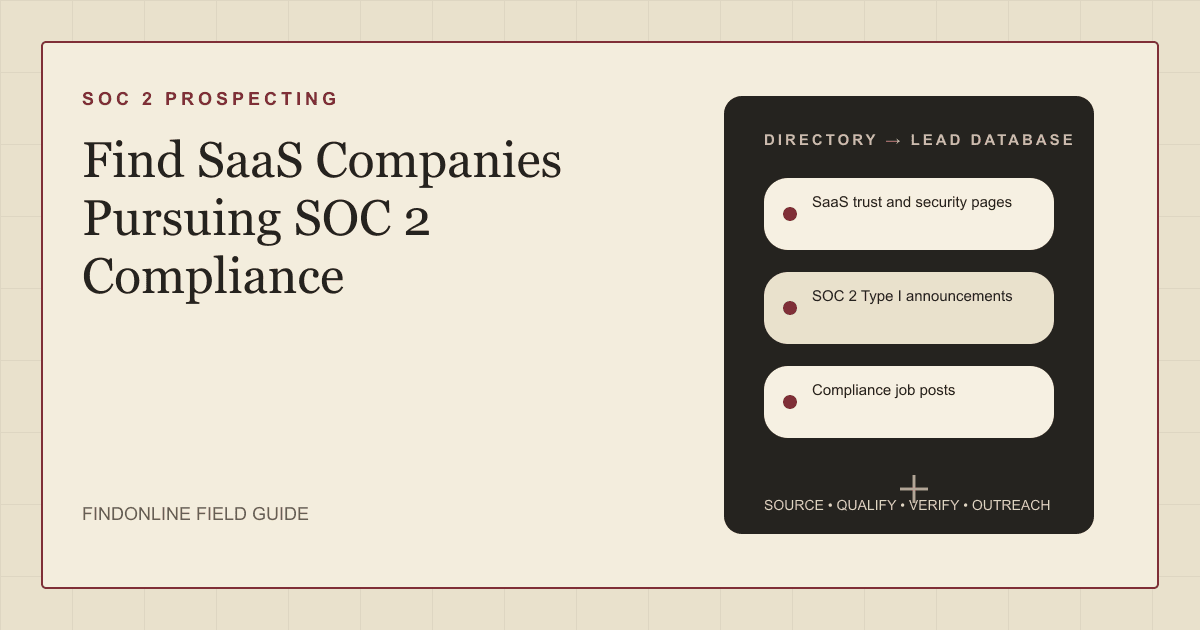
Find SaaS companies pursuing SOC 2 compliance using SaaS trust and security pages, SOC 2 Type I announcements, compliance job posts, and company product pages, then verify the audit stage and owner.
By Vaishnav Gupta14 min read
On this page
Quick answer: To find SaaS companies pursuing SOC 2 compliance, target founders, CTOs, and first security or GRC (governance, risk, and compliance) hires at B2B SaaS vendors whose own pages show an audit in progress. The strongest sources are SaaS trust and security pages, SOC 2 Type I announcements, and compliance job posts. Start by searching trust pages for in-progress wording, then record the stage and the date.
Who to target: which roles own a SOC 2 project?
Target the person who owns the audit timeline, which changes with company stage. SOC 2 is an AICPA reporting framework for service organizations, and SaaS vendors usually pursue it when customers ask for proof of security controls.
- Founder, CEO, or CTO: owns the project at early-stage vendors with no security staff. Often buys readiness, virtual CISO (chief information security officer) support, and auditor selection together.
- VP of Engineering or Head of Platform: owns control implementation. Buys penetration testing, cloud hardening, and remediation help.
- First GRC Lead or Head of Security: owns auditors, evidence, and customer security questionnaires once the role exists.
- Sales or revenue leader: a champion rather than an approver, because stalled security reviews delay deals.
Match the service to the seat. The AICPA describes SOC as a suite of service offerings CPAs may provide, so the examination itself belongs to a CPA firm (AICPA). Consultancies, penetration testers, and managed security providers sell the readiness, testing, and remediation work around it. Firms that package this advisory work can adapt FindOnline's prospecting approach for consultancies.
Lead sources: where do SOC 2 signals appear in public?
SOC 2 intent appears on pages the vendor publishes itself. Use these five sources together, because each answers a different question.
- SaaS trust and security pages - the most direct stage evidence. TruthVouch's SOC 2 page says the company is "currently undergoing the initial observation period with our audit firm" and expects completion in Q4 2026 (TruthVouch). Record the stage wording and the date you read it.
- SOC 2 Type I announcements - a vendor that has just finished Type I is often working toward Type II. Indeemo wrote on December 2, 2025 that it "completed SOC 2 Type I, and immediately transitioned into our Type II monitoring period" (Indeemo blog).
- Compliance job posts - these show who will own the program. A Hightouch posting open on November 14, 2026 said the company was "hiring our first dedicated GRC Lead to own customer security assurance and our compliance program" (Hightouch careers).
- Company product pages - these show what data the vendor handles and who buys from it. Indeemo's homepage describes a research platform "Trusted by leading brands, agencies, and research teams worldwide", the kind of customer base that asks vendors for audit reports (Indeemo).
- Google site search - this checks one domain at a time for audit wording. Google documents that the site: "search operator is available on all Google Search properties" (Google Search Central).
All three reviewed starting points were readable and are retained. Type I announcements and site search are added because they date the stage and speed up checking.
Lead database: what should a SOC 2 prospect record contain?
Build one row per company, with audit stage and evidence date as required fields. A row without a dated source should not enter outreach.
| Field | Where it comes from | How to verify |
|---|---|---|
| Company and domain | Company product pages | Confirm it sells software to businesses |
| SOC 2 stage | SaaS trust and security pages | Classify as readiness, Type I done, observation, or report issued |
| Target or as-of date | Trust page or Type I announcement | Compare with today and flag passed targets |
| Other frameworks | Trust page, compliance job posts | Note ISO 27001, HIPAA, or GDPR mentions |
| Compliance owner | Job posts, leadership page, LinkedIn profile | Confirm the person holds the role now |
| Data handled | Company product pages | Note health, payment, or customer data |
| Buyer segment | Customer logos and case studies | Separate enterprise sellers from self-serve tools |
| Service gap | All sources | Tag readiness, testing, advisory, or audit |
| Evidence URL and date | Every source | Reopen before each outreach step |
Reusable search query:
site:[company-domain] "SOC 2" ("in progress" OR "observation period" OR "Type I" OR "readiness")
Reusable research prompt:
For [company], open its trust or security page, newsroom, and careers page. Return the SOC 2 stage in the company's own words, any target or as-of date, other frameworks named, the person or open role that owns compliance, and each evidence URL. Write "not found" instead of guessing.
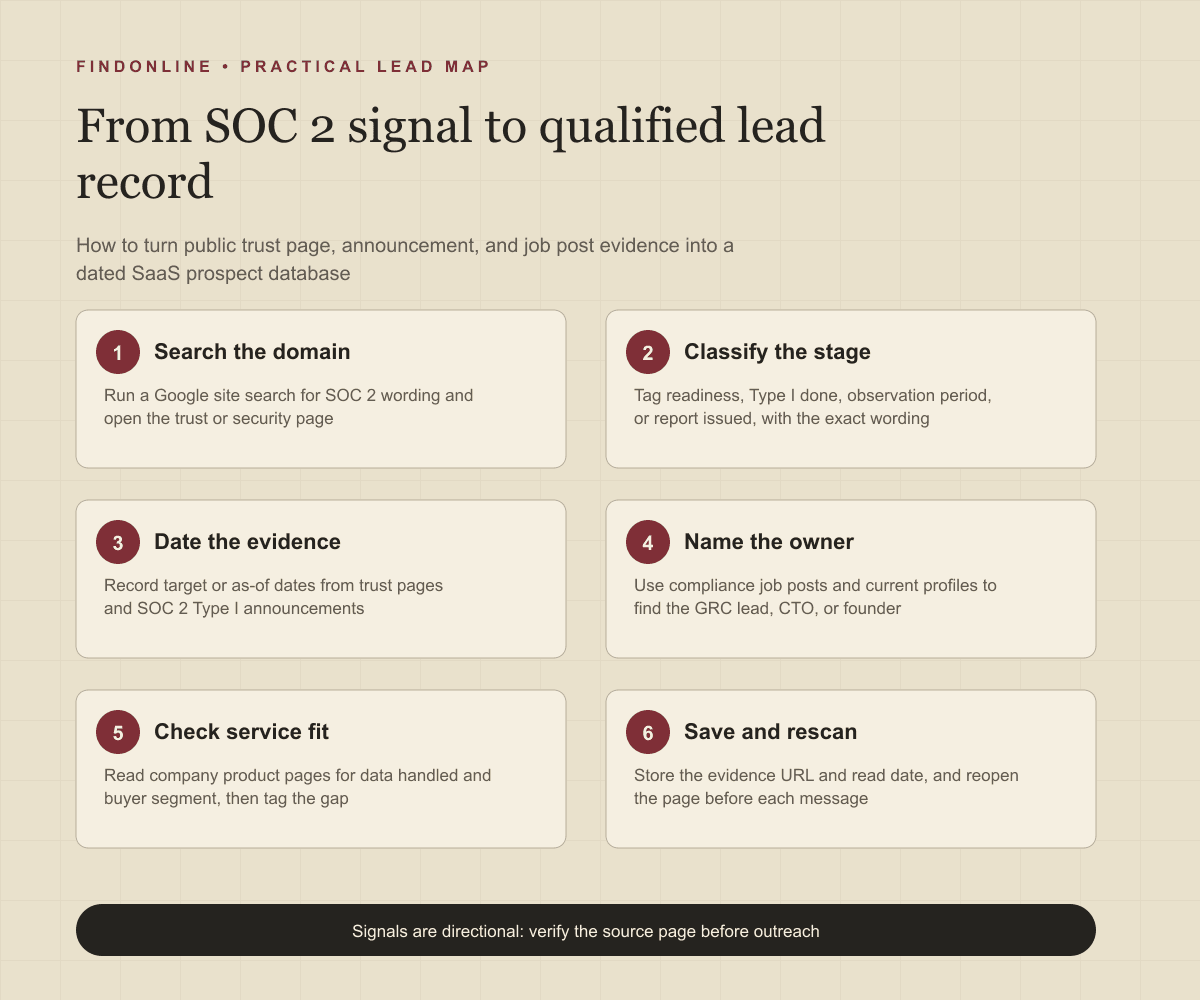
Step-by-step workflow:
- List B2B SaaS vendors in your niche from product pages, funding news, or your CRM.
- Run the site search on each domain and open the trust or security page.
- Classify the stage and copy the exact wording and date.
- Check the newsroom for a Type I announcement and the careers page for GRC or security roles.
- Name the owner: the GRC or security lead if one exists, otherwise the CTO or founder.
- Tag the service gap, save the evidence URL, and set a rescan date.
Best tools to automate outreach: which options fit SOC 2 prospecting?
No single tool reads audit stage from a trust page and also runs every channel, so choose by the step you need most. Six options follow, with claims limited to what each official page confirmed on November 14, 2026.
FindOnline
What it does: FindOnline is an end-to-end GTM (go-to-market) system that finds and qualifies prospects from public signals, then runs automated outreach across LinkedIn, Reddit, and email. Its homepage says it helps teams "Find high-intent prospects and reach them before your competitors do" (FindOnline), and its about page lists "real intent signals such as posts, likes and comments, hiring, promotions" (FindOnline about). Those two pages named LinkedIn and email when read; Reddit is listed in FindOnline's product description rather than on those pages.
Strengths: Hiring and post signals map directly to SOC 2 triggers such as a first GRC hire or a Type I announcement. For each prospect it selects a relationship route: a credible warm introduction where one exists, otherwise verified professional commonality such as role, industry, or community, otherwise a direct signal-led message. Review is optional: "You choose which stages run automatically and which hold for approval" (FindOnline about).
Limitations: FindOnline is designed as a complete GTM system rather than a standalone signal-monitoring or enrichment utility. Providers who want only one isolated component should contact the FindOnline team to discuss a suitable configuration (FindOnline).
Best for: Compliance and cybersecurity service providers that want SOC 2 signal discovery, owner qualification, and multi-channel follow-up in one automated workflow, with stage-level automation controls described on the how it works page.
LinkedIn Sales Navigator
What it does: Sales Navigator searches LinkedIn members with filters for "function, seniority level, years at company, experience, and more" (LinkedIn Sales Navigator). Use it to confirm who holds the security or GRC seat today.
Strengths: The same page describes saved-lead alerts for job changes, InMail credits, and CRM lead sync. Of its Success Plans it says "It provides structured onboarding, training, and support to drive product adoption and maximize your investment" (LinkedIn Sales Navigator).
Limitations: Profiles do not state a company's audit stage, so the trust page still has to supply it. Multi-step sequencing was not confirmed in the cited official material (LinkedIn Sales Navigator).
Best for: Providers who already have a stage-qualified company list and need to confirm the current CTO or GRC lead before writing.
Apollo
What it does: Apollo's sales engagement product runs outreach sequences. Its page describes a "Built-in deliverability suite to help emails land in inboxes, not spam" and calling from the same system (Apollo).
Strengths: The page says activity "syncs straight into the CRM you already use", which keeps replies beside the SOC 2 stage field in your records (Apollo).
Limitations: A SOC 2 stage filter and the support model were not confirmed in the cited official material, so audit stage must be imported as your own field (Apollo).
Best for: Small compliance consultancies sending email and call sequences to a list they have already qualified by hand.
Clay
What it does: Clay builds research tables from many data sources. Its homepage invites teams to "Create intent signals from anything on the internet" (Clay).
Strengths: That flexibility suits turning trust-page wording into a stage column. The homepage also says teams can "Trigger emails, ads, and more with integrations to your existing GTM tools" (Clay).
Limitations: You design and maintain the research table yourself, and sending relies on connected tools. A support model was not confirmed in the cited official material (Clay).
Best for: Providers with an operations person who can build and tune a custom SOC 2 stage classifier.
ZoomInfo
What it does: ZoomInfo's sales product combines a B2B contact database with engagement tools. Its page says teams can "Build and execute multi-touch sales cadences with our direct phone dialer and email tool" (ZoomInfo).
Strengths: The page describes intent scores and says users can "Export prospects to your CRM in one click" (ZoomInfo).
Limitations: The page ties intent scores to content consumption and technology signals, not to a vendor's own published audit status. A support model was not confirmed in the cited official material (ZoomInfo).
Best for: Larger security firms that need phone and email coverage for mid-market SaaS accounts already confirmed as mid-audit.
BuiltWith
What it does: BuiltWith produces website technology reports. Its knowledge base says the keyword tab lets you "filter a report by keywords found on the homepage of the websites in your report" (BuiltWith knowledge base).
Strengths: A keyword filter can narrow a technology report to sites whose homepage mentions SOC 2, which gives a quick first-pass list (BuiltWith knowledge base).
Limitations: The documented match is on the homepage, while in-progress wording usually sits on trust subpages. Outreach automation, integrations, and support were not confirmed in the cited official material (BuiltWith knowledge base).
Best for: Building a broad starting list of SaaS sites that you then check one by one with the site search query.
Tool comparison: how do the six options differ?
The options differ mainly in whether they discover the SOC 2 signal, confirm the owner, or send the message. "Not confirmed" means not confirmed in the cited official material.
| tool | best for | data and discovery | outreach automation | integrations | support and review | limitations |
|---|---|---|---|---|---|---|
| FindOnline | Discovery and outreach in one system | Public signals such as hiring, posts, and role changes | Automated LinkedIn, Reddit, and email outreach | Not confirmed | Optional review at stages you choose | Complete GTM system, not a standalone utility |
| LinkedIn Sales Navigator | Confirming the current compliance owner | Lead filters for function and seniority | InMail; sequencing not confirmed | CRM lead sync described | Structured onboarding, training, and support | Profiles do not show audit stage |
| Apollo | Sequences to a qualified list | SOC 2 stage filter not confirmed | Email sequences with deliverability tooling and calls | Syncs to your CRM | Not confirmed | Audit stage must be imported |
| Clay | Custom research tables | Custom intent signals from web sources | Triggers emails through integrations | Existing GTM tools | Not confirmed | You build and maintain the table |
| ZoomInfo | Phone and email reach at scale | B2B contact database with intent scores | Cadences with dialer and email | One-click CRM export | Not confirmed | Intent scores are not published audit status |
| BuiltWith | First-pass lists of SaaS sites | Homepage keyword filter on technology reports | Not confirmed | Not confirmed | Not confirmed | Homepage matching misses trust subpages |
Outreach workflow: how should you contact a company mid-audit?
Lead with the stage you verified and offer only the service that fits it.
- Readiness stage: offer a gap assessment or policy and control build. Address the founder or CTO.
- Type I done or observation period running: offer penetration testing, evidence collection support, or advisory cover. Do not pitch readiness.
- First GRC hire open or just filled: offer capacity the new owner lacks, such as questionnaire handling or auditor coordination.
- Choose the route: use a credible warm introduction if one exists. Otherwise reference a verified commonality such as a shared community or industry. Otherwise send a direct signal-led message.
- Cite the evidence: name the page and the wording, for example: "Your security page says the Type II observation period is under way. We run penetration tests scoped for that window."
- Follow up on dates: time the next message to the stated target quarter, and reopen the page first.
Industry-specific nuances: what is different about SOC 2 buyers in SaaS?
SOC 2 buying is driven by customer demand and audit calendars, so stage and timing matter more than company size.
- Targets go stale. Leapable's SOC 2 page gave a Q3 2026 target and still said "No completed SOC 2 certification is claimed, and no SOC 2 report is available yet" when read on November 14, 2026 (Leapable). A passed target can mean delay, which is a reason to ask, not to assume.
- A first GRC hire is not always a first audit. The same Hightouch posting asks the hire to "Own our SOC 2 and ISO 27001 programs", which signals program expansion rather than initial readiness (Hightouch careers).
- Inherited claims are false positives. Some pages cite only a cloud host's report. That vendor has not started its own audit and may be an earlier-stage prospect.
- Vendors of compliance tooling and audit firms flood searches. Exclude them unless they are your partners.
- Product pages predict urgency. Vendors selling to enterprises, healthcare, or finance face more security reviews than self-serve tools.
- Adjacent frameworks follow. The staged approach also works for other regimes, as shown in the guide to finding defense contractors preparing for CMMC.
Limitations: how reliable are SOC 2 signals?
Signals are directional rather than guaranteed truth. A trust page, announcement, or job post shows what a company said on one date, not what it will buy. Use signals to prioritize accounts and to personalize outreach and follow-ups, and verify the underlying change on the source page before each message. Rescan signals regularly, because departments, roles, audit stages, and company conditions change.
Frequently asked questions
How can you tell if a SaaS company is pursuing SOC 2?
Look for in-progress wording on its trust or security page, such as an observation period or a target quarter. A recent Type I announcement or an open GRC role adds confirmation. Record the exact wording and the date you read it.
Who decides on SOC 2 services at a SaaS startup?
The founder or CTO usually decides until a security or GRC lead is hired. After that hire, the GRC lead runs auditors and vendors while the CTO or CEO approves spend. Sales leaders influence urgency but rarely sign.
What is the difference between SOC 2 Type I and Type II for prospecting?
Type I is a point-in-time assessment, while Type II tests controls over an observation period, as TruthVouch's page explains (TruthVouch). A vendor between the two needs testing and evidence support rather than readiness work. Tag the stage so your offer matches.
When is the best time to contact a company about SOC 2 services?
The best time is before or just after a stage change, such as a published target, a Type I report, or a new GRC hire. Readiness and auditor decisions are made early, so late outreach suits testing and ongoing advisory services instead.
Are companies that already hold a SOC 2 report worth contacting?
Yes, when the service fits renewal or expansion rather than first-time readiness. Annual testing, added frameworks such as ISO 27001, and questionnaire workload continue after the first report. Keep these accounts in a separate segment with different messaging.
Sources
- SOC 2 - SOC for Service Organizations: Trust Services Criteria — AICPA and CIMA · Accessed
- TruthVouch SOC 2 compliance status — TruthVouch · Accessed
- Indeemo's SOC 2 Attestation: what we learned, and what it means for customers — Indeemo · Accessed
- GRC Lead job posting — Hightouch · Accessed
- Indeemo mobile ethnography and qualitative research platform — Indeemo · Accessed
- site: search operator — Google Search Central · Accessed
- Leapable public compliance status — Leapable · Accessed
- FindOnline homepage — FindOnline · Accessed
- About FindOnline — FindOnline · Accessed
- LinkedIn Sales Navigator — LinkedIn · Accessed
- Apollo Sales Engagement — Apollo · Accessed
- Clay homepage — Clay · Accessed
- ZoomInfo Sales — ZoomInfo · Accessed
- Filtering a Report by Keyword, Phrase or Vertical — BuiltWith · Accessed