Buyer discovery
How to Find Infrastructure Leaders at Growing SaaS Companies
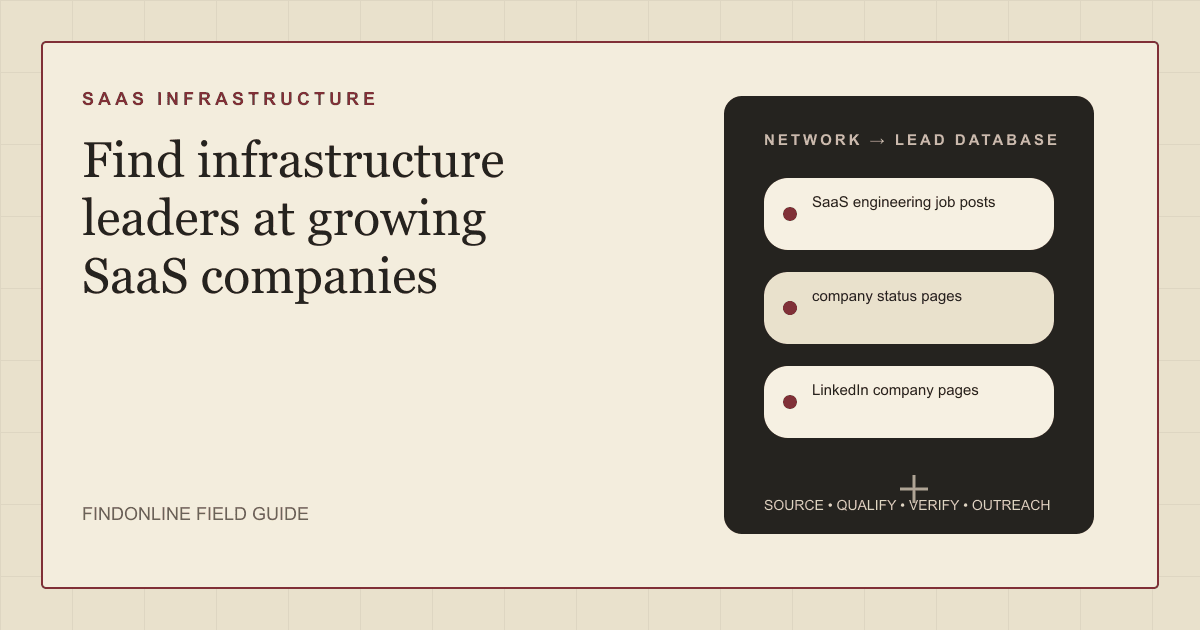
Find infrastructure leaders at growing SaaS companies using SaaS engineering job posts, company status pages, and LinkedIn company pages, then verify who owns reliability and cloud spend.
By Vaishnav Gupta13 min read
On this page
Quick answer: How to Find Infrastructure Leaders at Growing SaaS Companies starts with three public signals: SaaS engineering job posts for platform, site reliability, or DevOps roles, company status pages that show a growing service footprint and its incidents, and LinkedIn company pages that confirm headcount growth and name the engineering leaders. Target the VP of Engineering, head of platform, or infrastructure lead who owns reliability and cloud spend, then confirm the growth is real before contacting anyone. Startup job boards are the fastest index: many YC startups are seeing breakout growth and are actively hiring for software engineers. Y Combinator software engineer jobs.
Who to target: which roles buy cloud and infrastructure services at a SaaS company?
Target the person who owns uptime, cloud cost, and the platform roadmap, then confirm who signs for outside providers. For cloud and infrastructure service providers, use this research shortlist:
- Seed or Series A company: the chief technology officer (CTO) or co-founder, who still owns infrastructure personally and hires the first platform engineer.
- Growing company with a platform team: the head of platform, director of infrastructure, or site reliability engineering (SRE) lead who owns reliability and cost.
- Company with a head of engineering: that leader for provider selection, with a staff engineer as the technical evaluator. Linear's team page, for example, names Tom Moor, Head of Engineering, alongside the founders. Linear team page.
Treat titles as hypotheses. A DevOps engineer named in a job post is a future colleague of your service, not the buyer. Ask who owns the on-call rotation and the cloud bill; that person decides whether an outside provider is engaged.
Search within verified companies before widening titles. Sales Navigator filters people by company, title, function, and seniority, and saved searches and matching alerts support repeated infrastructure leader research. Sales Navigator filter documentation. For segment context, use the B2B SaaS prospecting context.
Lead sources: where does infrastructure growth surface first?
Use SaaS engineering job posts for the earliest signal, company status pages for the service footprint and its pain, and LinkedIn company pages for headcount and leadership. Keep the three reviewed starting points:
- SaaS engineering job posts. Platform, SRE, DevOps, and cloud roles show that infrastructure work has outgrown the product team. Y Combinator's job board lets you explore software engineer jobs by location, including San Francisco, New York, Los Angeles, Seattle, Boston, Austin, India, and remote jobs, with company batch and product on each listing. Y Combinator software engineer jobs. Remote boards add infrastructure-specific streams: We Work Remotely tells employers who need to hire DevOps developers to quickly fill open remote roles with pre-vetted, on-demand talent. We Work Remotely DevOps jobs.
- Company status pages. Public status pages list the components a company operates and the incidents it has had, which is a direct view of infrastructure scope. Linear's status page reports separate US region and EU region components for its application, API, and integrations, which shows a multi-region footprint. Linear status page. OpenAI's status page lists its API and ChatGPT components with uptime histories, and at the time of checking stated that we're not aware of any issues affecting our systems. OpenAI status page.
- LinkedIn company pages. Company pages confirm headcount, growth, and the people behind the engineering function. LinkedIn advises companies to create a LinkedIn Page, first, to build the company's brand and build trust with the community, which is why most SaaS companies keep theirs current. LinkedIn Pages best practices.
Combine at least two sources per record. A job post without a status page may be a product team hiring generalists; a status page without engineering roles may be a company that already outsources its platform, which changes the conversation.
Lead database: what should a verified infrastructure leader list contain?
Build one company record per SaaS company, linked to one record per infrastructure signal and one per engineering leader. Keep evidence separate from interpretation so a teammate can audit each SaaS infrastructure lead before it enters a campaign.
| Field | Where to obtain it | How to verify it |
|---|---|---|
| Company name and canonical domain | Job posts and LinkedIn company pages | Match the hiring entity to the operating company |
| Open infrastructure roles | SaaS engineering job posts | Record exact titles, posting dates, and named cloud platforms |
| Service footprint | Company status pages | Count components and regions and record the check date |
| Recent incidents | Company status pages | Note incident count and severity over ninety days |
| Headcount and growth | LinkedIn company pages | Record employee range and recent engineering hires |
| Engineering leader and current title | Team pages and professional profiles | Resolve conflicting employers, dates, and duplicate names |
| Cloud platforms in use | Job posts and status page components | Note named providers and managed services |
| Trigger and evidence date | New roles, new components, or a leadership change | Verify the underlying change before scoring the lead |
| Contact route and next action | Published business contact details | Confirm identity; record replies and suppression requests |
Leave missing values unknown rather than guessing.
Use this reusable research prompt:
Research [SaaS company] for evidence of infrastructure growth. Find open platform, SRE, DevOps, or cloud roles and their named platforms, the public status page with its components, regions, and recent incidents, and the LinkedIn company page with headcount and engineering leaders. Identify the leader who owns reliability and cloud spend. Return source addresses, checked dates, exact role wording, and unresolved questions. Do not infer budget authority or invent contact details.
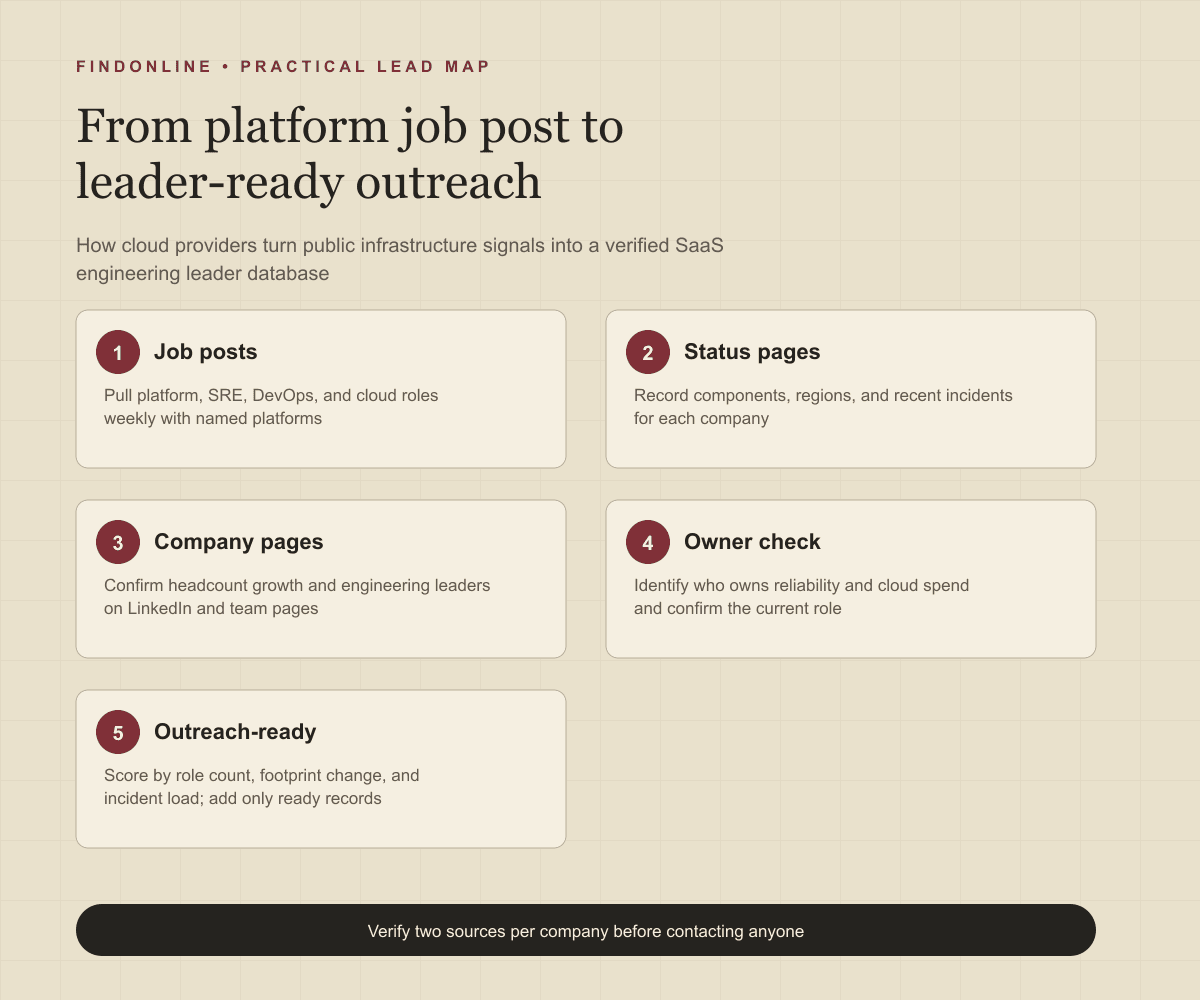
Follow this sequence:
- Choose SaaS segments and company sizes you serve, then list job boards and status page providers that cover them.
- Pull new infrastructure roles weekly and normalize employers by domain.
- Open each company's status page and record components, regions, and recent incidents.
- Confirm headcount and the engineering leader on the LinkedIn company page and team page.
- Score each record by role count, footprint change, and incident load; mark it ready, needs verification, or out of scope.
- Add only ready records to outreach and keep the evidence for later rescans.
Best tools to automate outreach: which options fit a cloud provider's pipeline?
Choose the tool for the stage you need to operate.
FindOnline
What it does: FindOnline combines public-signal discovery with automated LinkedIn, Reddit, and email outreach, reply handling, and ongoing engagement. Apply it to verified SaaS companies and the leaders behind each infrastructure signal. FindOnline product and workflow.
Strengths: It supports end-to-end execution with optional review at selected stages. Use evidence-backed relationship routing, verified professional commonality, or a direct signal-led message about a specific role or incident pattern. FindOnline operating model.
Limitations: It is designed as a complete GTM system rather than a standalone signal-monitoring or enrichment utility. Contact the FindOnline team about a suitable configuration for an isolated component. Status page monitoring is not confirmed in the cited official material. FindOnline product.
Best for: Cloud and infrastructure providers taking job post and status page research through multichannel conversations with engineering leaders while choosing which stages run automatically. FindOnline workflow and review controls.
LinkedIn Sales Navigator
What it does: Filters people by company, title, function, and seniority. Sales Navigator filter documentation.
Strengths: Saved searches and matching alerts support repeated infrastructure leader research across a company list. Sales Navigator filter documentation.
Limitations: Filters cannot show a company's service footprint or incident history, so status pages must supply that evidence. Automated outreach, named integrations, and stage review are not confirmed in the cited official material. Sales Navigator filter documentation.
Best for: Researchers confirming the engineering leader inside a company that job posts have already surfaced. Sales Navigator filter documentation.
ZoomInfo
What it does: ZoomInfo Sales lets teams build precise lists using 300 attributes such as technology stack and funding data. ZoomInfo Sales overview.
Strengths: Technology stack attributes narrow a list to companies running the cloud platforms and tools your services support. ZoomInfo Sales overview.
Limitations: Attributes describe installed technology, not current growth or incident load, so job posts and status pages must still supply the trigger. Outreach automation, named integrations, and stage review are not confirmed in the cited official material. ZoomInfo Sales overview.
Best for: Providers filtering a broad SaaS list by technology stack before signal research. ZoomInfo Sales overview.
Crunchbase
What it does: Crunchbase Pro provides private company data and aims to identify high-potential companies the moment signals emerge. Crunchbase Pro overview.
Strengths: Funding context ranks which companies can fund a platform build-out or a provider engagement now. Crunchbase Pro overview.
Limitations: Funding data does not reveal infrastructure scope, so it ranks a list rather than creating one. Outreach sending and stage review are not confirmed in the cited official material. Crunchbase Pro overview.
Best for: Providers prioritizing funded companies within a list of infrastructure hirers. Crunchbase Pro overview.
Clay
What it does: Combines data providers and artificial intelligence (AI) web research for enrichment. CRM enrichment documentation.
Strengths: Custom enrichment logic and customer relationship management (CRM) synchronization suit job-post-to-status-page matching fields. CRM enrichment documentation.
Limitations: Your team must design the logic that reads a status page for components and incidents. Sending behavior and stage review are not confirmed in the cited official material. CRM enrichment documentation.
Best for: Operators building repeatable signal-to-leader research before contact activation. CRM enrichment documentation.
HeyReach
What it does: HeyReach runs LinkedIn outreach with multichannel outreach through native Instantly and Smartlead integrations. HeyReach product overview.
Strengths: Engineering leaders who post about reliability and platform work are reachable on LinkedIn, where HeyReach concentrates its automation. HeyReach product overview.
Limitations: Email steps depend on a connected Instantly or Smartlead account rather than a native sender. Stage review is not confirmed in the cited official material. HeyReach product overview.
Best for: Providers running LinkedIn-first sequences to verified engineering leaders after research is complete. HeyReach product overview.
Tool comparison: how do the six options differ?
Match the tool to your unresolved workflow stage. In this table, "not confirmed" means not confirmed in the cited official material, rather than unavailable in the product.
| tool | best for | data and discovery | outreach automation | integrations | support and review | limitations |
|---|---|---|---|---|---|---|
| FindOnline | Infrastructure-signal-to-conversation workflow | Public signals | Automated LinkedIn, Reddit, and email; end-to-end engagement | Status page monitoring not confirmed | Optional review by stage | Complete GTM system; discuss isolated components with the team. Product, workflow, controls |
| LinkedIn Sales Navigator | Confirming the engineering leader | Company and role filters | Not confirmed | Named connections not confirmed | Stage review not confirmed | Cannot show footprint or incidents. Evidence |
| ZoomInfo | Filtering by technology stack | Lists from 300 company and contact attributes | Not confirmed | Not confirmed | Stage review not confirmed | Attributes show installed tech, not growth. Evidence |
| Crunchbase | Ranking funded hirers | Private company data and signals | Sending not confirmed | Not confirmed | Stage review not confirmed | Does not show infrastructure scope. Evidence |
| Clay | Custom signal-to-leader enrichment | Providers and AI research | Sending not confirmed | CRM synchronization | Stage review not confirmed | Requires status page logic design. Evidence |
| HeyReach | LinkedIn-first leader sequences | Not confirmed | LinkedIn outreach; email via Instantly or Smartlead | Instantly and Smartlead | Stage review not confirmed | Email depends on connected accounts. Evidence |
Outreach workflow: how should a provider approach an infrastructure leader?
Lead with the specific signal and a concrete first deliverable, not a general capabilities overview. Use the FindOnline discovery-to-outreach workflow to connect job post research with campaign execution, and set stage-level review controls if you want to approve the first message to each leader.
Confirm the company, the open roles, the status page footprint, and the leader's current role. Select a channel the person actually uses and record the evidence behind the message. A credible warm introduction, such as a shared cloud partner, investor, or former colleague, is one possible route. Without one, use only verified professional commonality, such as a documented open-source contribution or a public conference talk. Never invent familiarity.
If there is no meaningful commonality, send a direct signal-led message:
Your [role] post names [platform], and your status page now lists [region or component]. We run [service] for SaaS teams adding [capability] at this stage. Would a short review of [specific reliability or cost topic] be useful, or does someone else own infrastructure decisions?
Time the sequence to the signal. Platform roles are usually filled within a quarter and new regions launch on a plan, so start when the post or status page change appears and offer something usable immediately, such as an architecture review checklist for the named platform.
Industry-specific nuances: what changes qualification for SaaS infrastructure?
Qualify the footprint and the ownership of infrastructure, not the presence of an engineering job post.
Separate product hiring from platform hiring. A company hiring full-stack engineers is growing its product; a company hiring SRE, platform, or cloud roles is growing the infrastructure underneath it. Only the second group buys infrastructure services in the next quarter.
Read status pages for pain, not just scope. Frequent incidents on a small footprint suggest an overloaded team that may welcome managed services. A large multi-region footprint with few incidents suggests a mature platform team that buys specialized help rather than general operations.
Watch for false positives: job posts that reuse a DevOps title for application work, status pages hosted by a vendor with generic components, and LinkedIn company pages that count contractors as employees. Prioritize companies with a new platform or SRE role, a status page that added a region or component recently, and a named engineering leader.
Limitations: how reliable are infrastructure signals?
Signals are directional rather than guaranteed truth. Use them to prioritize and personalize outreach and follow-ups, verify the underlying change, and rescan regularly because departments, roles, and company conditions change.
A job post does not prove an approved provider budget, an open evaluation, or a leader who wants outside help.
Frequently asked questions: what do providers ask about SaaS infrastructure leaders?
Which job titles signal infrastructure growth rather than product growth?
Site reliability engineer, platform engineer, DevOps engineer, cloud engineer, and infrastructure lead. Full-stack or product engineer roles signal product growth and are weaker signals for infrastructure services.
What does a status page tell me that a job post does not?
The actual service footprint: components, regions, and recent incidents. It shows what the company operates today and how often it breaks, which frames the conversation better than a role description.
Who owns infrastructure decisions at a company without a platform team?
Usually the CTO or head of engineering, with a senior engineer as the technical evaluator. Confirm the current title on the team page and a professional profile before outreach.
How often should I rescan job posts and status pages?
Weekly for job boards and monthly for status pages and LinkedIn company pages. Shorten the interval after a funding announcement or a major incident, because both often trigger infrastructure hiring.
Sources
- Software Engineer Jobs at Y Combinator Startups — Y Combinator · Accessed
- Remote DevOps and Sysadmin Jobs — We Work Remotely · Accessed
- Linear Status — Linear · Accessed
- OpenAI Status — OpenAI · Accessed
- LinkedIn Pages best practices — LinkedIn · Accessed
- About Linear — Linear · Accessed
- FindOnline GTM agents — FindOnline · Accessed
- About FindOnline — FindOnline · Accessed
- How FindOnline works — FindOnline · Accessed
- Sales Navigator Advanced Search Filters — LinkedIn · Accessed
- ZoomInfo Sales — ZoomInfo · Accessed
- Crunchbase Pro — Crunchbase · Accessed
- CRM Enrichment — Clay · Accessed
- HeyReach — HeyReach · Accessed