Buyer discovery
How to Find Defense Contractors Preparing for CMMC
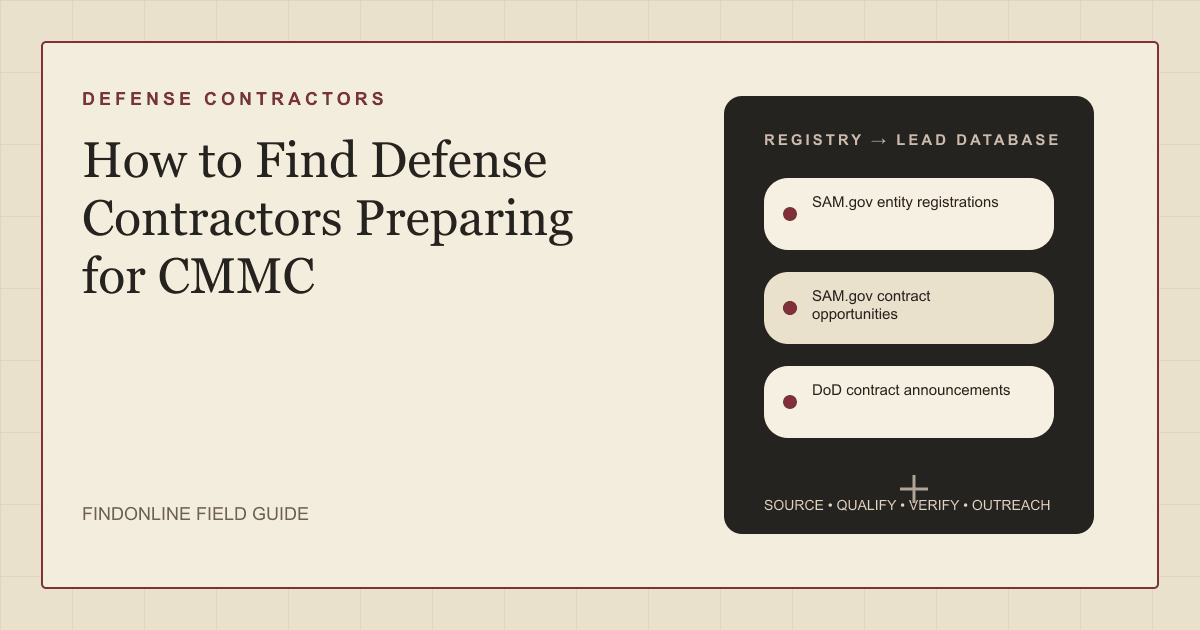
Find defense contractors preparing for CMMC using SAM.gov entity registrations, SAM.gov contract opportunities, SBIR.gov awards, and compliance job posts, then verify the CMMC level and the decision-maker.
By Vaishnav Gupta13 min read
On this page
Quick answer: Target the owner, IT director, or Information System Security Officer at small and mid-sized defense subcontractors that handle Controlled Unclassified Information and have not announced a CMMC Level 2 certificate. The strongest discovery sources are SAM.gov entity registrations, SAM.gov contract opportunities naming a CMMC level, SBIR.gov award search, and compliance job posts. Start by exporting SAM.gov registrants in defense NAICS codes and tagging each by its CMMC evidence.
Who to target: which roles own the CMMC decision at a defense contractor?
At small contractors the owner or president approves the spend and the IT director or a lone Information System Security Officer (ISSO) runs the work. At larger subcontractors and primes, a director of information security owns the program and a CIO or CISO signs. Resolve one approver and one operator per company.
The Cybersecurity Maturity Model Certification (CMMC) is the Department of Defense program that checks whether contractors protect Federal Contract Information (FCI) and Controlled Unclassified Information (CUI). The clause requires contractors, before awarding a subcontract, to "ensure that the subcontractor has a current CMMC" status (DFARS 252.204-7021). That flowdown is why the best prospects are often second- and third-tier suppliers, not the primes.
Qualification signals that matter:
- Its contracts or bids name CMMC Level 2, which means it handles CUI and must meet the 110 NIST SP 800-171 requirements.
- Its SAM.gov registration lists defense-heavy NAICS codes such as 336411 (aircraft manufacturing) or 332710 (machine shops).
- It is hiring an ISSO or compliance analyst, or it recently announced a Level 2 certificate and now needs sustainment.
False positives: sellers of only commercial off-the-shelf items, registrants whose defense NAICS codes have no awards behind them, and contractors already certified by a Certified Third-Party Assessment Organization (C3PAO) with no sustainment gap.
Lead sources: where can you find defense contractors preparing for CMMC?
Three reviewed starting points are retained and three added. Defense.gov, DoD CIO, eCFR, and Federal Register pages blocked the research browser today, so SAM.gov, acquisition.gov, Cornell Law School's regulation text, and a law-firm summary stand in.
- SAM.gov entity registrations identify every company registered to do federal business, with name, Unique Entity ID, address, and NAICS codes. SAM.gov lets you "Generate and download Entity Extracts" and warns that "You must sign in with your federal email address to view registrants who have opted out of public search" (SAM.gov entity information).
- SAM.gov contract opportunities are the procurement notices that now carry the CMMC level. "Opportunities include pre-solicitation notices, solicitation notices, award notices, and sole source notices" (SAM.gov contract opportunities). Search active notices for "CMMC Level 2" and record the awardees.
- DoD contract announcements list daily awards with awardee name, city, and value. The defense.gov page blocked the research browser today, so use SAM.gov award notices as the primary record; primes there are flowdown anchors and their suppliers are the prospects.
- SBIR.gov award search lists small businesses funded through the Small Business Innovation Research program. The portfolio page lets you "Search for information on all prior awards and companies" (SBIR.gov awards). Department of Defense Phase II awardees are small, technical, and frequently handle CUI.
- compliance job posts show which contractors are staffing the work now. Dynamic Aviation's live ISSO posting asks the hire to "Maintain continuous readiness for C3PAO and other cybersecurity assessments" (Built In job listing). A role like this signals an active program with budget and a named operator.
- contractor CMMC announcements separate prospects that need certification from those that need sustainment. W. L. Gore & Associates announced on February 23, 2026 that it achieved "Cybersecurity Maturity Model Certification (CMMC) Level 2 Final Certificate of Status" (Gore newsroom). Tag these companies as certified and pitch annual affirmation support, not gap assessments.
Lead database: which fields should a CMMC prospect list contain?
A useful record stores the company identity from SAM.gov, the level evidence from solicitations, the staffing signal, and the two people who decide, each with an evidence URL and date.
| Field | Where it comes from | How to verify |
|---|---|---|
| Legal name, UEI, NAICS codes | SAM.gov entity registrations | Match the UEI; confirm a defense code appears in an award |
| CMMC level required | SAM.gov solicitation or award notice | Read the clause fill-in for the level |
| Prime or subcontractor tier | Award notice, prime supplier pages | Awardee, or supplier to a named prime |
| Certificate status | Contractor newsroom, LinkedIn posts | Record announcement date and assessed scope |
| Compliance staffing signal | Careers page, job boards | Post is live and names CMMC or NIST SP 800-171 |
| Approver and operator | Leadership page, LinkedIn profile | Current titles on both profiles |
| Phase 2 exposure | Option and recompete dates | Flag dates after November 10, 2026 |
Reusable research prompt:
For [company name] (UEI [UEI]), using only public pages, report: defense NAICS codes on its SAM.gov record; any SAM.gov notice naming a CMMC level; prime awardee or supplier to [prime]; any certificate announcement with date; live job posts naming CMMC, NIST SP 800-171, or ISSO; the current owner, CIO, or IT director with source URL. Mark unknowns as not found.
Step-by-step workflow:
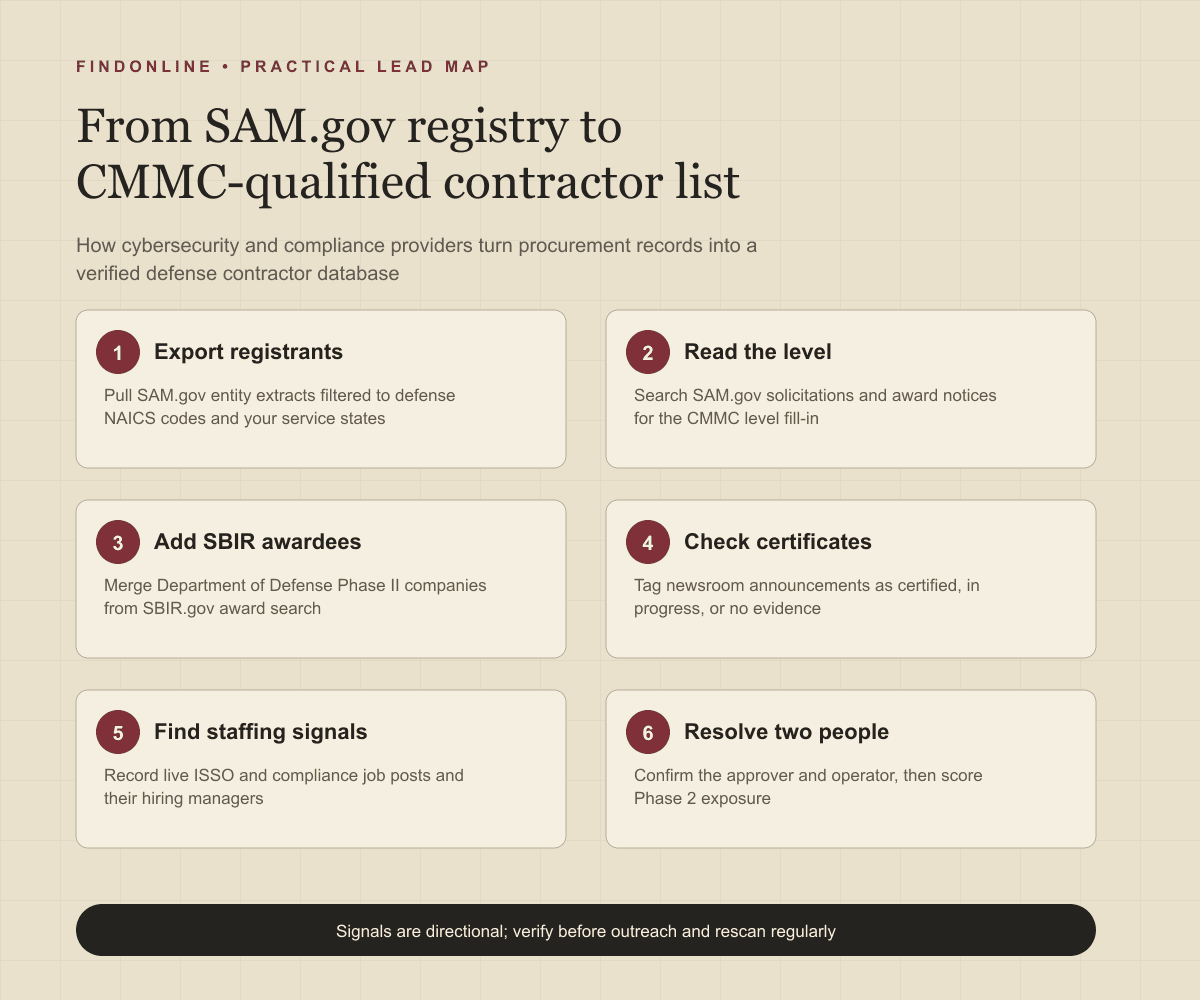
- Download a SAM.gov entity extract filtered to defense NAICS codes and your states; drop registrants with no award history.
- Search SAM.gov contract opportunities for notices naming a CMMC level; tag each matching company with level and date.
- Add Department of Defense Phase II awardees from SBIR.gov award search, merging on name and UEI.
- Check newsrooms and LinkedIn pages for certificate announcements; record certified, in progress, or no evidence.
- Record live CMMC, ISSO, or compliance job posts and the hiring manager where shown.
- Resolve the approver and operator, then score by level, tier, staffing, and Phase 2 exposure.
Best tools to automate outreach to defense contractors
FindOnline
What it does: FindOnline is an end-to-end AI go-to-market system that finds and qualifies prospects from public business and professional signals, then runs outreach and follow-up. Its site describes "AI GTM agents for LinkedIn, Reddit and Email" (FindOnline). Here it can watch ISSO hiring, CMMC posts, and role changes at listed subcontractors. Strengths: Signal discovery, relationship routing, and multi-channel outreach sit in one workflow. A credible warm introduction through a shared prime is one possible route; otherwise it uses verified professional commonality such as industry or role, or a direct signal-led message. Teams control automation per stage: "You choose which stages run automatically and which hold for approval" (FindOnline about). Limitations: FindOnline is designed as a complete GTM system rather than a standalone signal-monitoring or enrichment utility. A compliance firm that only wants a SAM.gov enrichment feed should contact the FindOnline team to discuss a suitable configuration. Best for: Cybersecurity and compliance providers that want one system to monitor subcontractor hiring and posts, qualify the approver and operator, and run LinkedIn, Reddit, and email outreach with optional review on chosen stages.
LinkedIn Sales Navigator
What it does: Sales Navigator is LinkedIn's prospecting product for finding people and companies. It lets you "Search with 50+ filters like function, seniority level, years at company, experience, and more" (LinkedIn Sales Navigator). Strengths: Strong for resolving the ISSO, IT director, and owner at a named contractor, with role-change alerts and the ability to "Add leads directly to your CRM" (LinkedIn Sales Navigator). The same page describes an AI-powered help assistant. Limitations: It has no concept of a UEI, NAICS code, or CMMC level, so company qualification must happen in SAM.gov first. Best for: Compliance consultants holding a SAM.gov-derived company list who need two decision-makers per contractor.
Apollo
What it does: Apollo is a sales engagement platform with a contact database and sequencing. It runs "Multi-channel sequence steps across email, call, and networking platforms" (Apollo sales engagement). Strengths: Contacts and cadences in one place, and it "syncs contacts, activities, and deal data with CRMs like Salesforce and HubSpot" (Apollo sales engagement). Support and review tooling is not confirmed in the cited official material. Limitations: Its database carries no federal procurement fields, so Phase 2 exposure and contract tier must be imported as custom fields. Best for: Providers running high-volume email and call cadences to a long tail of machine shops and component suppliers.
Clay
What it does: Clay is a data enrichment and workflow platform that pulls from many vendors and triggers actions. It can "Trigger emails, ads, and more with integrations to your existing GTM tools" (Clay). Strengths: Scrapes newsrooms and careers pages at scale; the page says it helps "Keep CRM records accurate, complete, and continuously refreshed with live data" (Clay). Support model is not confirmed in the cited official material. Limitations: It is a table-building tool, so sending and reply handling depend on connected sequencers rather than Clay. Best for: GTM operators at compliance firms automating the SAM.gov-to-newsroom-to-job-post enrichment chain before handing records to a sender.
ZoomInfo
What it does: ZoomInfo is a B2B contact and company data platform with intent features and built-in engagement. It can "Track website visitors and identify accounts researching solutions like yours" (ZoomInfo sales). Strengths: Broad contact coverage and built-in cadences: "Build and execute multi-touch sales cadences with our direct phone dialer and email tool" (ZoomInfo sales). Support and review model is not confirmed in the cited official material. Limitations: Its intent signals reflect web research, not procurement status, so a contractor may already be mid-assessment with a competitor. Best for: Larger security firms that want direct dials for IT directors at defense manufacturers and qualify procurement facts separately.
Lemlist
What it does: Lemlist is an outreach automation tool. It lets teams "Launch automated campaigns across email, LinkedIn, calls, WhatsApp, and SMS from one workflow" (Lemlist). Strengths: Simple multichannel campaigns with personalization, in-app chat support, and the statement that "lemlist connects seamlessly with tools like HubSpot and Salesforce" (Lemlist). Limitations: It does not discover procurement signals, so every CMMC qualification step happens outside the tool before import. Best for: Small compliance consultancies with a verified list of 100 to 300 contractors wanting a personal-feeling LinkedIn plus email sequence.
Tool comparison: how do the six options differ for CMMC prospecting?
| tool | best for | data and discovery | outreach automation | integrations | support and review | limitations |
|---|---|---|---|---|---|---|
| FindOnline | One system from signal to reply | Public signals: hiring, posts, role changes | Automated LinkedIn, Reddit, and email outreach | Not confirmed in cited material | Optional review per stage | Complete GTM system, not a standalone enrichment feed |
| LinkedIn Sales Navigator | Resolving ISSO and owner at named contractors | 50+ people and company filters, alerts | None; InMail is manual | Adds leads to CRM | AI-powered help assistant | No UEI, NAICS, or CMMC fields |
| Apollo | High-volume email and call cadences | Contact database, no procurement fields | Multichannel sequences | Salesforce and HubSpot sync | Not confirmed | Procurement data must be custom imported |
| Clay | Automating the enrichment chain | Multi-vendor enrichment, web scraping | Triggers connected tools | GTM tools, CRM refresh | Not confirmed | Sending depends on other sequencers |
| ZoomInfo | Direct dials at mid-sized manufacturers | Contacts, website visitor intent | Multi-touch cadences, dialer | CRM export | Not confirmed | Intent is research, not procurement status |
| Lemlist | Small consultancies with a verified list | Not confirmed in cited material | Email, LinkedIn, calls, WhatsApp, SMS | HubSpot and Salesforce | In-app chat support | Qualification happens entirely outside the tool |
Outreach workflow: how should you sequence CMMC outreach?
Lead with the specific contract fact you found, name the Phase 2 date, and ask one scoping question. The DFARS rule took effect November 10, 2025, and "Phase 1 will last 12 months and will therefore end in November 2026" (Squire Patton Boggs), so the coming weeks are the natural hook.
- Open on the operator. Message the ISSO or IT director on LinkedIn with the notice or job post you found and ask whether their System Security Plan is scoped for a C3PAO assessment.
- Email the approver. Send the owner or CIO three sentences: the level their contracts require, the Phase 2 start, and one risk such as subcontractor flowdown.
- Engage publicly. Comment on the company's CMMC or hiring posts with a useful point, not a pitch.
- Offer a defined first step. Propose a fixed-scope readiness review or a Supplier Performance Risk System (SPRS) score validation.
- Use warm paths only when verified. A shared prime customer, state manufacturing association, or former colleague is worth mentioning only when confirmed.
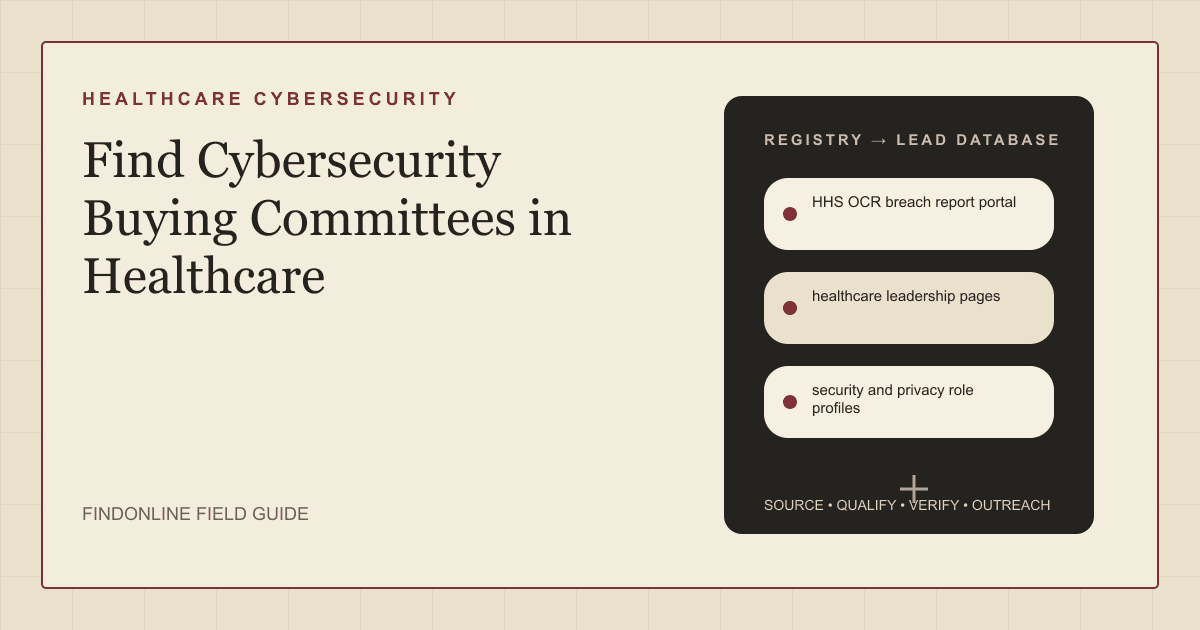
FindOnline can run these steps across LinkedIn, Reddit, and email automatically, holding the approver email for review if you prefer; the how it works page shows the stage controls, and the FindOnline for consultancies page covers advisory firms. The same registry-first logic appears in the guide to finding cybersecurity buying committees in healthcare.
Industry-specific nuances: what is different about selling CMMC services to defense contractors?
The phase schedule sets urgency more than any other trigger. Under 32 CFR 170.3, "Phase 2. Begins one calendar year following the start date of Phase 1" and adds Level 2 C3PAO certification as an award condition, while "Phase 3. Begins one calendar year following the start date of Phase 2" and extends it to option periods (Cornell Law School LII). Contractors with recompetes or options in 2027 feel the pressure now.
- Read the level, not the keyword. Level 1 self-assessment contractors need policy help, not a C3PAO engagement.
- Primes push flowdown. Suppliers often learn about CMMC from a prime's supplier letter, so citing the prime's awards lands better than citing the regulation.
- Certified does not mean done. A certificate covers a defined assessed environment and needs annual affirmation, so certified companies remain sustainment prospects.
- Export control overlaps. Many Level 2 prospects also carry ITAR obligations owned by the same compliance leader, which widens the conversation.
Limitations: how reliable are CMMC readiness signals?
These signals are directional rather than guaranteed truth. A solicitation naming Level 2 does not prove the bidder lacks a certificate, and a job post can be a backfill. Use signals to prioritize which contractors to contact first and to personalize the opening message and follow-ups, then verify the underlying change on the company's own pages or in conversation. Rescan the sources regularly, because departments, roles, and company conditions change, especially around the Phase 2 start.
Frequently asked questions
Which defense contractors need CMMC Level 2?
Contractors whose contracts involve Controlled Unclassified Information need Level 2, which maps to the 110 requirements in NIST SP 800-171. Level 1 applies to contractors handling only Federal Contract Information. Read the solicitation rather than assuming from company size.
How do I find subcontractors affected by CMMC flowdown?
Start with primes named in SAM.gov award notices and DoD contract announcements, then search supplier directories and LinkedIn for companies describing themselves as their suppliers. Primes must confirm a subcontractor's CMMC status before subcontract award, so suppliers face the same deadline.
Can I see a contractor's SPRS score or CMMC status publicly?
No. SPRS scores and CMMC status are visible only to the company and authorized federal users. Qualify from solicitations, award notices, job posts, and the contractor's own announcements, then confirm status in the first conversation.
When does CMMC Phase 2 start?
Phase 2 begins one year after the DFARS rule took effect on November 10, 2025, so it starts November 10, 2026. From then, contracting officers can require a C3PAO-issued Level 2 certificate as a condition of award.
Sources
- FindOnline — FindOnline · Accessed
- About FindOnline — FindOnline · Accessed
- DFARS 252.204-7021 Contractor Compliance with the Cybersecurity Maturity Model Certification Level Requirements — Acquisition.gov · Accessed
- Entity Information — SAM.gov · Accessed
- Contract Opportunities — SAM.gov · Accessed
- 32 CFR 170.3 Applicability — Cornell Law School Legal Information Institute · Accessed
- SBIR.gov Awards Portfolio — SBIR.gov · Accessed
- Information Systems Security Officer (ISSO) at Dynamic Aviation — Built In · Accessed
- W. L. Gore & Associates Achieves CMMC Level 2 Final Certificate of Status Following C3PAO Assessment — W. L. Gore & Associates · Accessed
- LinkedIn Sales Navigator — LinkedIn · Accessed
- Apollo Sales Engagement — Apollo · Accessed
- Clay GTM data platform — Clay · Accessed
- ZoomInfo Sales — ZoomInfo · Accessed
- lemlist outreach platform — lemlist · Accessed
- The CMMC DFARS Final Rule Goes Live: Ready or Not, Here It Comes — Squire Patton Boggs · Accessed