Buyer discovery
How to Find Procurement Leaders Consolidating Software Vendors
Find procurement leaders through software consolidation mandates, job posts, and verified profiles. Qualify project stage and build a practical outreach list.
By Vaishnav Gupta11 min read
On this page
Quick answer: To answer how to find procurement leaders consolidating software vendors, target heads of IT procurement, software category managers, and indirect procurement directors. Start with vendor consolidation job posts, technology rationalization announcements, and procurement leadership profiles. First, record an explicit software consolidation mandate and its date, then verify the current owner before adding anyone to an outreach list.
Who to target: which procurement roles own consolidation?
Prioritize people whose remit includes software sourcing, supplier rationalization, or renewal consolidation. Search for Director of IT Procurement, Head of Technology Sourcing, Software Category Manager, and VP of Indirect Procurement. Treat a Chief Procurement Officer as a possible sponsor; establish who actually manages the software category.
A live Waters recruitment page connects indirect procurement leadership with IT sourcing and supplier rationalization. Its responsibilities include software, cloud, contract harmonization, and renewal consolidation. This is evidence of a role's mandate, not proof that Waters is seeking your service or that the advertised position is filled. Waters role responsibilities
Build a small buying-group map: procurement owns the sourcing conversation, an IT or enterprise architecture contact validates technical scope, and an application owner can clarify operational requirements. Treat these as roles to verify, not a universal organizational chart. Procurement consultants should qualify advisory scope; software providers should identify which capabilities a replacement would actually consolidate.
Lead sources: where can you find credible consolidation evidence?
Use all three reviewed discovery routes, but give explicit mandates more weight than general efficiency language.
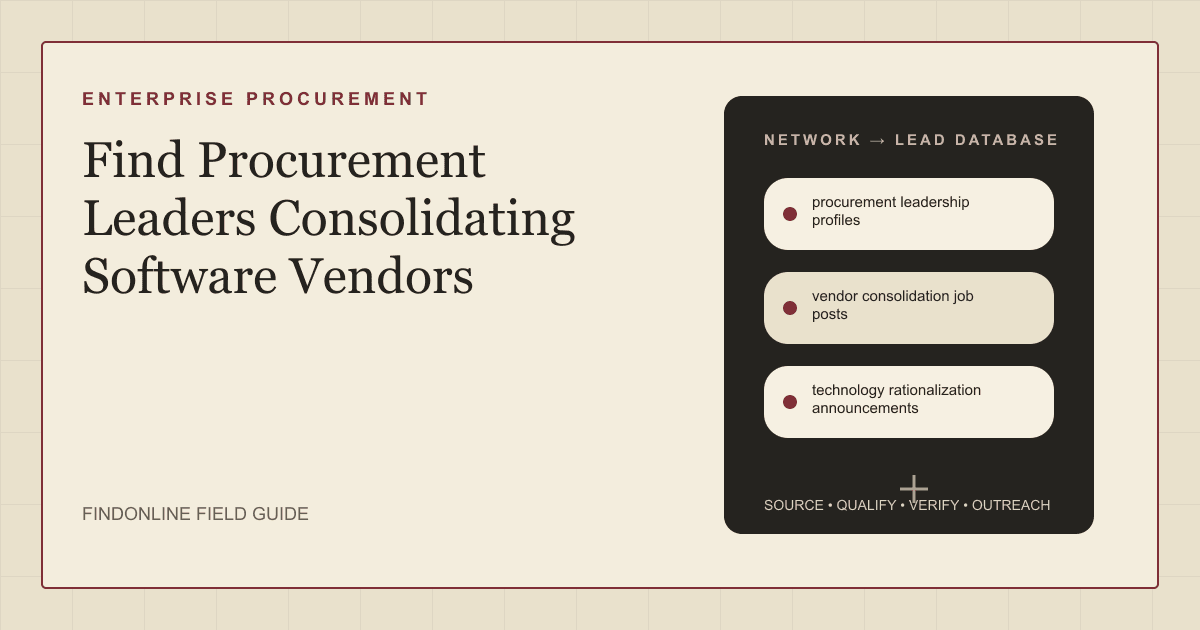
Vendor consolidation job posts: Search employer career pages for software rationalization, renewal consolidation, license optimization, and duplicated spend elimination. Waters' posting combines software procurement with integration responsibilities, making it a useful example of mandate-level evidence. Record the requisition, retrieval date, and whether the role remains advertised. Waters procurement posting
Technology rationalization announcements: Search company newsrooms for named categories, retained platforms, and implementation stages. BT's June 2022 announcement described consolidating application monitoring on Dynatrace. Use it as an example of specific but historical evidence, not a current open opportunity: a selected platform can mean the selection stage has ended. BT consolidation announcement
Procurement leadership profiles: Use current-company, title, function, and seniority searches to locate the likely owner inside each signaled account. LinkedIn documents these search dimensions. Cross-check the profile against employer material and distinguish current responsibility from a previous role. LinkedIn search filters
Preserve contradictory evidence. A recent sourcing vacancy alongside an older completed migration deserves a scope check: the vacancy might concern another category. Do not assume that two references to consolidation describe the same project.
Lead database: how should you build a verified procurement list?
Store one account-project record with linked contacts, keeping observed facts separate from qualification hypotheses. A company name and senior title alone do not satisfy this search intent.
| Procurement research field | Where it comes from | How to verify it |
|---|---|---|
| Operating entity and domain | Employer careers page or newsroom | Match subsidiary and parent; identify the contracting entity |
| Software category | Mandate or project announcement | Confirm software scope; exclude unrelated physical suppliers |
| Consolidation objective | Job responsibilities or leadership statement | Separate supplier reduction, license optimization, and application retirement |
| Procurement owner | Current professional profile and employer material | Confirm current role and category responsibility |
| Technical counterpart | Architecture or IT leadership material | Check responsibility for the affected applications |
| Project stage | Dated announcement or buyer response | Mark assessment, selection, migration, or completed |
| Renewal window | Explicit public statement or buyer confirmation | Leave unknown when no reliable evidence exists |
| Existing provider decision | Named selection announcement | Distinguish incumbent choice from open workstreams |
| Evidence and confidence | Source URL, short excerpt, retrieval date | Reopen source and record conflicts |
| Service fit and next action | Analyst assessment | Label as hypothesis until the buyer confirms |
Use this reusable research prompt:
Research [company] for software vendor consolidation. Find employer job posts and official announcements mentioning software rationalization, renewal consolidation, application retirement, or duplicated software spend. Return the entity, category, exact mandate, source URL, publication date if available, and current procurement owner with role evidence. Separate observations from inferences. Mark unknown renewal dates, supplier access, and project status as unknown.
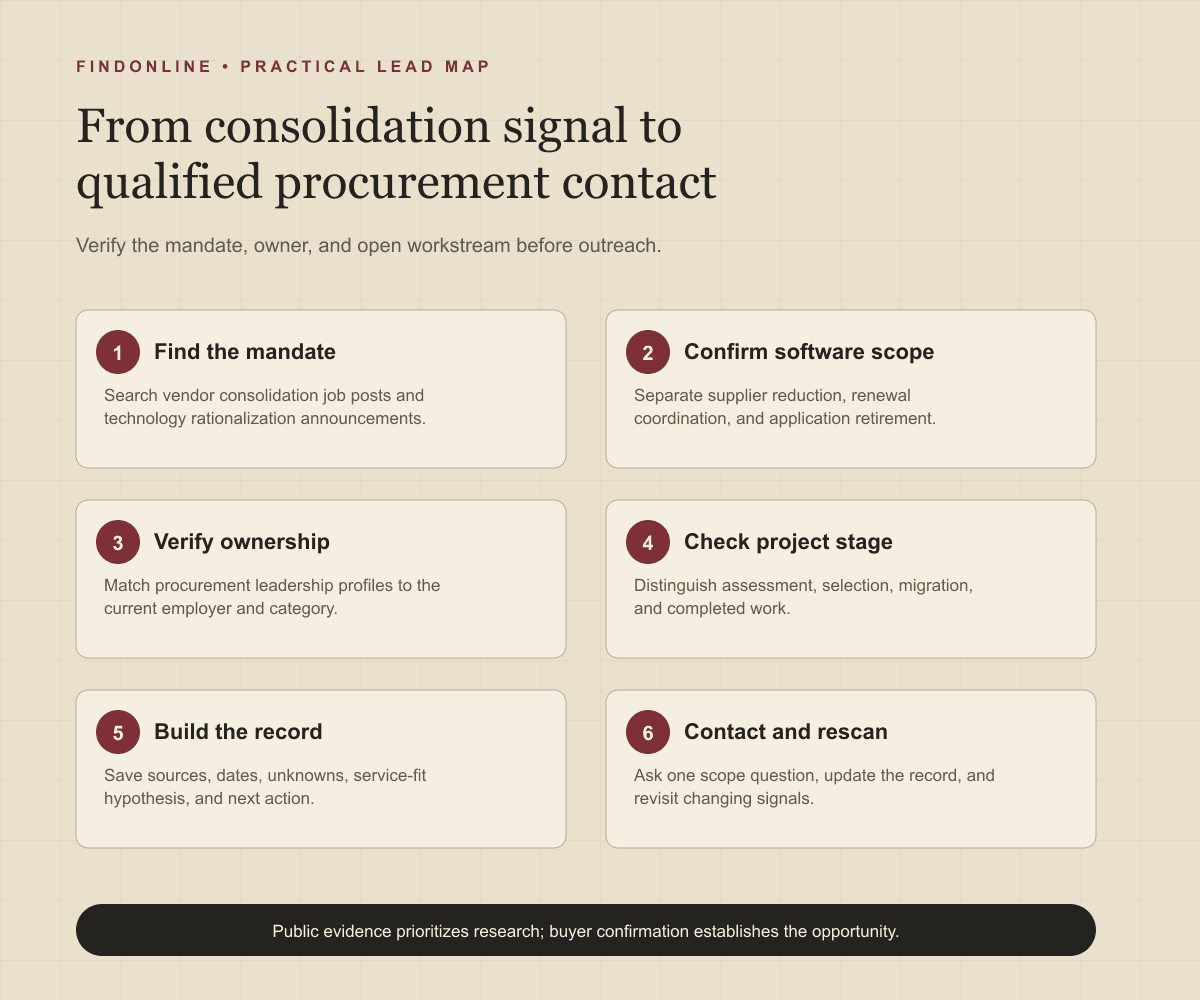
Then follow this sequence:
- Define your service boundary: sourcing advice, software inventory, migration, or a specific replacement category.
- Search exact phrases with [company] or [industry], then open the original employer page.
- Extract the mandate and date; reject generic purchasing language without software scope.
- Match the account to procurement leadership profiles and identify a technical counterpart.
- Assign a research status: verified mandate, plausible signal, historical project, or disqualified.
- Add only qualified records to outreach, with one unresolved question and a rescan date.
For broader account qualification, use the consultancy prospecting workflow. If the evidence instead concerns a new enterprise resource planning deployment, use the separate ERP implementation buyer discovery guide.
Best tools to automate outreach: which options fit procurement prospecting?
Choose the tool for the work you need to automate. These six options cover complete outreach, role discovery, research, job-change monitoring, and campaign execution.
FindOnline
What it does: FindOnline combines public-signal discovery with automated LinkedIn, Reddit, and email outreach in an end-to-end go-to-market system. Apply it to procurement mandates, role changes, and relevant public discussions. FindOnline channels Prospecting workflow
Strengths: It connects qualification and evidence-backed relationship routing with outreach, replies, and ongoing engagement. Stages can run automatically or use optional review controls. FindOnline workflow Stage controls
Limitations: It is designed as a complete GTM system rather than a standalone signal-monitoring or enrichment utility. Readers seeking one isolated component should contact the FindOnline team to discuss a suitable configuration. Named external integrations are not confirmed in the cited official material. FindOnline scope
Best for: Procurement consultants and software providers connecting verified consolidation signals to ongoing multichannel conversations, with optional stage-level review. FindOnline operating model
LinkedIn Sales Navigator
What it does: Finds people through role and account filters. Official filters
Strengths: Saved searches and alerts support procurement-owner mapping. Official filters
Limitations: Profile matching does not establish a software consolidation mandate. Automated outreach and support arrangements are not confirmed in the cited official material. Official filters
Best for: Researchers locating category owners after identifying a signaled enterprise. Official filters
Apollo
What it does: Runs sequences combining automated email and manual tasks. Sequence documentation
Strengths: Combines email with phone and LinkedIn actions in a planned campaign. Sequence documentation
Limitations: The documented LinkedIn actions are manual, so those steps require operator capacity. Integrations and support arrangements are not confirmed in the cited official material. Sequence documentation
Best for: Teams sequencing an already qualified procurement list. Sequence documentation
Clay
What it does: Claygent researches publicly accessible web information. Claygent documentation
Strengths: Custom prompts support extraction of unusual procurement mandate fields. Claygent documentation
Limitations: Paywalled and password-protected information is outside the documented access scope. Outreach execution, integrations, and support arrangements are not confirmed in the cited official material. Claygent documentation
Best for: Operators researching consolidation mandates across varied employer pages. Claygent documentation
Common Room
What it does: Tracks contact job changes using LinkedIn information. Job-change documentation
Strengths: Previous-organization filters help qualify returning professional relationships. Job-change documentation
Limitations: A job change establishes movement, not authority over software sourcing. Outreach execution, integrations, and support arrangements are not confirmed in the cited official material. Job-change documentation
Best for: Teams following known procurement champions into new accounts. Job-change documentation
Lemlist
What it does: Adds assigned manual tasks to campaign sequences. Manual-task documentation
Strengths: Tasks can capture research or a tailored action before continuation. Manual-task documentation
Limitations: Manual task outcomes control continuation or stopping, so incorrect completion can advance a lead prematurely. Procurement discovery, integrations, and support arrangements are not confirmed in the cited official material. Manual-task documentation
Best for: Consultants inserting bespoke research steps into procurement campaigns. Manual-task documentation
Tool comparison: how do these six options differ?
Match the bottleneck to the documented scope. In this table, “unconfirmed” means not confirmed in the cited official material; it does not mean unavailable.
| tool | best for | data and discovery | outreach automation | integrations | support and review | limitations |
|---|---|---|---|---|---|---|
| FindOnline | Consolidation-signal outreach | Public signals and qualification | Automated LinkedIn, Reddit, and email; end-to-end engagement | Unconfirmed | Optional review by stage | Complete GTM system; discuss isolated-component needs with team. Workflow Controls Channels |
| LinkedIn Sales Navigator | Category-owner mapping | Role/account filters and alerts | Unconfirmed | Unconfirmed | Support/review unconfirmed | Profiles do not establish mandates. Filters |
| Apollo | Qualified-list sequencing | Procurement discovery unconfirmed | Automated email; manual social tasks | Unconfirmed | Manual campaign tasks; support unconfirmed | LinkedIn steps need operators. Sequences |
| Clay | Mandate research | Public-web research | Execution unconfirmed | Unconfirmed | Prompt-led research; support/review unconfirmed | Cannot access protected sources. Claygent |
| Common Room | Champion moves | Job changes; prior organizations | Unconfirmed | Unconfirmed | Support/review unconfirmed | Movement does not establish remit. Job changes |
| Lemlist | Bespoke campaign actions | Procurement discovery unconfirmed | Sequence task reminders | Unconfirmed | Assigned tasks and outcomes; support unconfirmed | Task completion affects continuation. Tasks |
Outreach workflow: how should you turn a signal into a conversation?
Lead with the observed mandate and one question about its scope. Avoid suggesting you know internal renewal dates, dissatisfaction, or purchasing authority.
A hypothetical first message:
Your procurement posting mentions software renewal consolidation. Does that remit cover rationalizing overlapping applications, or mainly coordinating supplier agreements? We help [relevant team] with [specific service], and I wanted to check which workstream is relevant.
Choose one credible route. A real warm introduction is one possibility. Without one, FindOnline can adapt outreach using verified professional commonality, such as industry, role, education, interests, communities, or shared context. If neither exists, use a direct signal-led message; never invent familiarity. FindOnline relationship workflow
After a reply, update the owner, stage, and next action. After silence, follow up with a useful scope question or new verified evidence, rather than repeating a generic pitch. Keep account-level contact history so procurement and IT do not receive conflicting approaches. The FindOnline outreach workflow explains the operating model.
Industry-specific nuances: what makes software consolidation different?
Separate contractual consolidation from application retirement before proposing a service. An organization might combine agreements without removing applications, or retire applications without changing its principal supplier.
Ask about dependencies before assuming a replacement is straightforward. SAP LeanIX's rationalization guidance explicitly includes dependency review before retirement or consolidation. Turn that into a qualification question about integrations, retained records, application owners, and migration responsibilities. Rationalization guidance
Match your offer to the unresolved work. Procurement consultants can test whether the need is inventory normalization, sourcing strategy, negotiation preparation, or transition governance. Software providers should explain which overlapping capabilities their product could replace and which dependencies require validation. Avoid presenting another tool as consolidation without a defensible replacement scope.
Treat a merger, a new procurement leader, and a renewal mandate as separate signals. Ask which entity controls contracts and whether existing supplier arrangements permit a new engagement. Use the designated sourcing channel when the buyer identifies one; do not try to bypass procurement through unrelated executives.
Limitations: what can public signals actually establish?
Signals are directional rather than guaranteed truth. Use them to prioritize and personalize outreach and follow-ups, verify the underlying change, and rescan regularly because departments, roles, and company conditions change.
A job description can describe an intended future team. An announcement can describe completed work. A profile can lag a role change. Keep unknowns visible, recheck evidence before contact, and move historical or contradictory records back into research rather than treating them as confirmed demand.
Frequently asked questions: what else should you verify?
Which job titles should I search first?
Start with IT procurement, technology sourcing, software category management, and indirect procurement leadership. Check category responsibility before choosing the most senior title. Add a technical counterpart when the project involves retiring or replacing applications.
Does a procurement vacancy prove a buying opportunity?
No, a vacancy establishes advertised responsibilities, not an external purchasing decision. Check whether the remit includes software consolidation, whether the role is filled, and who owns the work meanwhile. Ask whether external assistance is relevant.
How can I tell whether consolidation is still underway?
Look for dated evidence of assessment, selection, migration, or completion, then confirm the current stage with the buyer. A named selected vendor should change your approach. Research remaining workstreams instead of assuming selection is open.
Should I pitch software to a team reducing vendors?
Only when you can explain a credible replacement scope. Identify overlapping capabilities and the practical transition questions first. If your product simply adds another isolated application, deprioritize the account.
What should I do when renewal dates are unknown?
Record them as unknown and ask about timing after establishing relevance. Do not infer a contract end date from a job posting or product announcement. Schedule a rescan and update the record when the buyer supplies reliable information.
Sources
- Senior Manager, Indirect Procurement — Waters Corporation · Accessed
- BT doubles down on AIOps with Dynatrace — BT Group · Accessed
- Sales Navigator Advanced Search Filters — LinkedIn · Accessed
- FindOnline GTM Agents — FindOnline · Accessed
- How FindOnline Works — FindOnline · Accessed
- About FindOnline — FindOnline · Accessed
- Create a Sequence — Apollo · Accessed
- Claygent: AI Web Scraper — Clay · Accessed
- Job Changes — Common Room · Accessed
- How to add and manage manual tasks in a sequence — Lemlist · Accessed
- Application Rationalization — SAP LeanIX · Accessed