Buyer discovery
How to Find Nonprofit Finance Directors Preparing for Audits
Find nonprofit finance directors through IRS records, annual reports, and leadership pages, then verify audit timing and qualify preparation or advisory needs.
By Vaishnav Gupta10 min read
On this page
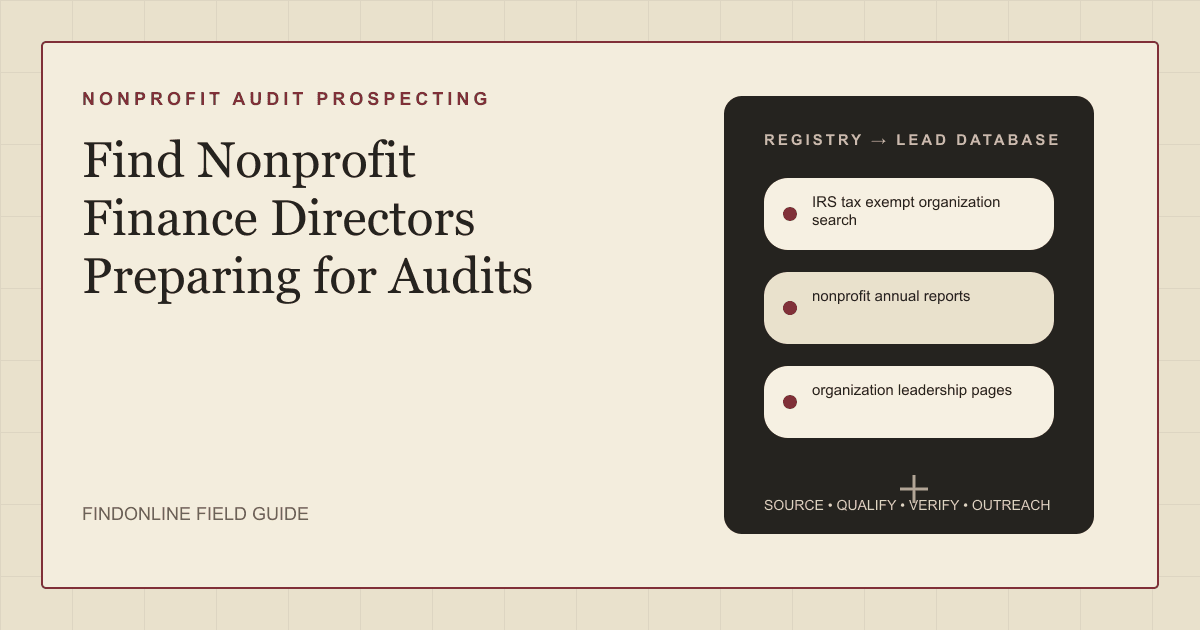
Quick answer: How to Find Nonprofit Finance Directors Preparing for Audits starts with finance directors, controllers, and chief financial officers at nonprofits with a verifiable audit-related change. Use IRS tax exempt organization search, nonprofit annual reports, and organization leadership pages. First, match the legal organization to its public records, then confirm the current finance owner and upcoming need.
Who to target: which nonprofit finance roles belong on your list?
Target the person responsible for preparation, then identify who approves the engagement. Treat titles as search terms, not proof of authority.
Start with finance director, director of finance and administration, controller, and chief financial officer (CFO). For smaller organizations, investigate the executive director or outsourced finance lead. Record the audit committee contact separately from the staff coordinator.
The National Council of Nonprofits describes both staff and board roles in the audit process. Ask who owns preparation, selects the auditor, and signs the engagement. Nonprofit audit guide
Keep separate segments for independent-auditor selection and preparation support for an existing auditor. Use the accounting-firm prospecting workflow for broader account selection.
Lead sources: where can you find nonprofit audit prospects?
Combine the three reviewed sources to establish identity, reporting history, and current responsibility. None independently proves buying intent.
IRS tax exempt organization search provides tax-exempt status and filing information. Match the legal organization before researching people. IRS organization search guidance
Nonprofit annual reports provide reporting context. Feeding America's financials page groups annual reports, Form 990 filings, and auditor reports. Treat this as a disclosure-hub example, not evidence that Feeding America needs services. Feeding America financial disclosures
Organization leadership pages help distinguish employees from trustees. Feeding America's leadership page distinguishes its executive team from its board. Read section labels before treating a finance title as an employee role. Feeding America leadership
Search each prospect's website for audit requests for proposals, finance vacancies mentioning audit coordination, and dated leadership announcements. Confirm the event remains active. A historical audit establishes prior activity; an open request with a future deadline supports a stronger timing hypothesis.
Try [organization] audit request for proposals and site:[organization-domain] finance director. Keep the nonprofit's mission separate from evidence of service demand.
Lead database: what should a verified nonprofit audit record contain?
Build one organization record with linked people and dated evidence. Separate observed facts from your service-fit interpretation.
| Field | Discovery source | Verification rule |
|---|---|---|
| Legal entity and employer identification number (EIN) | IRS record and official website | Match legal identity; separate affiliates. |
| Fiscal year and reporting period | Organization financial disclosures | Record the covered period, not just publication date. |
| Audit event and deadline | Official procurement or announcement page | Confirm it remains open and applies to this entity. |
| Current finance owner | Leadership page and professional profile | Reconcile title, employer, and recent changes. |
| Preparation owner and approver | Biographies; direct confirmation | Separate operating and approval roles. |
| Existing auditor | Organization disclosures | Mark historical engagements as historical. |
| Service hypothesis | Audit request or finance-role description | Distinguish audit delivery, readiness, and interim support. |
| Evidence and next review | Source URL and observation date | Save the passage and schedule a recheck. |
Use this reusable research prompt:
Research [nonprofit legal name] in [state] for audit-readiness advisory fit. Return its official domain, published EIN, reporting period, current finance leader, audit-related event, event date, source URL, and supporting passage. Separate confirmed facts from hypotheses. Do not infer an upcoming audit from tax-exempt status or an old report. Mark missing timing, procurement ownership, and scope unknown.
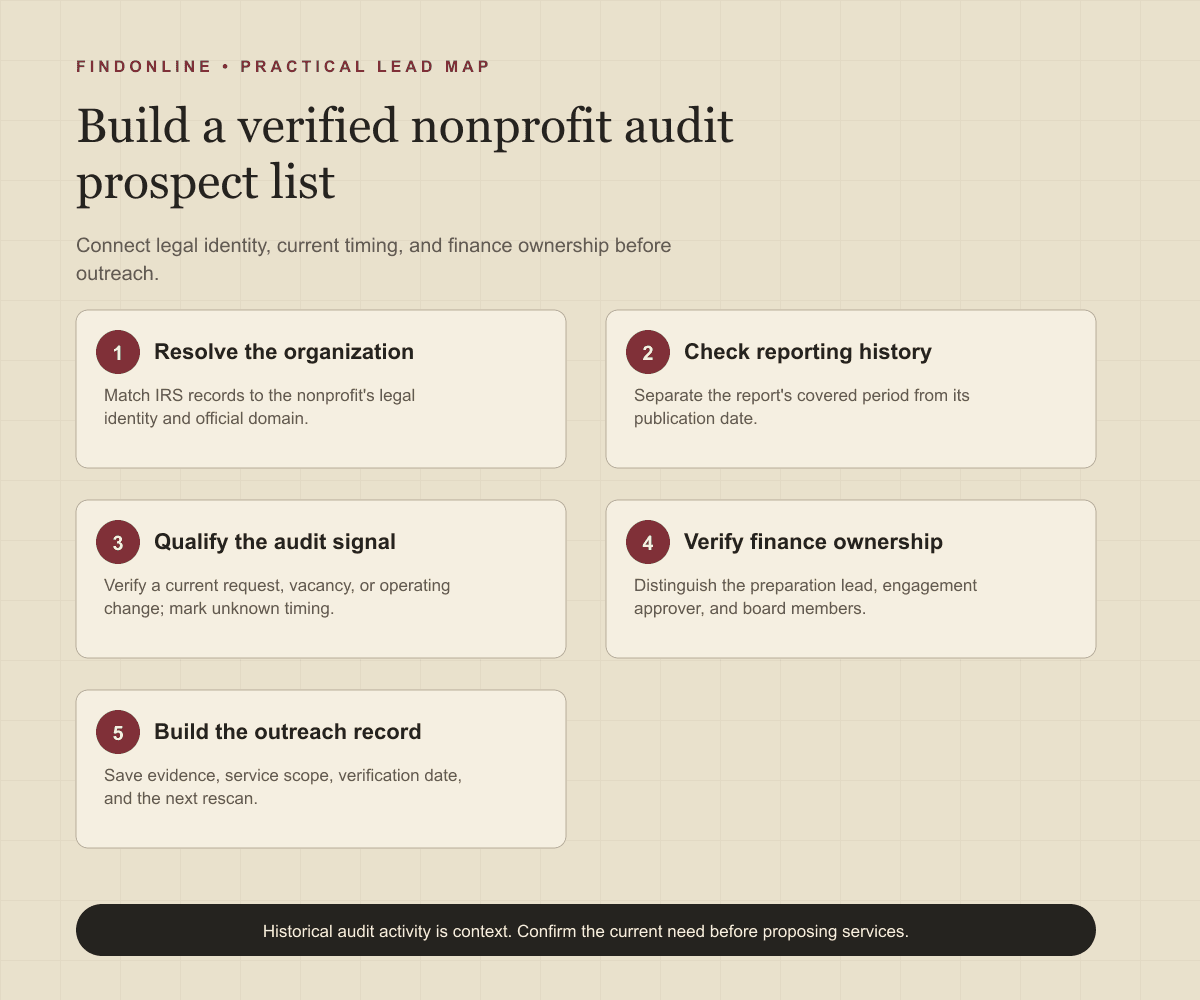
Follow this sequence:
- Define geography, nonprofit subsector, and services your team can deliver.
- Resolve the legal organization through IRS records and its website.
- Inspect reporting history and announcements for an audit-related change.
- Verify the finance owner through current leadership evidence.
- Classify service fit and unresolved questions before enrollment.
- Save evidence, choose an outreach route, and assign a rescan date.
Keep incomplete accounts in research. Promote them when a verified owner and an evidenced reason to ask about timing are present.
Best tools to automate outreach: which options fit nonprofit audit research?
Choose by the bottleneck: discovery and engagement, role research, public-page enrichment, campaign execution, task management, or partner overlap. These fit judgments do not establish native IRS integrations.
FindOnline
What it does: FindOnline combines public-signal discovery with automated LinkedIn, Reddit, and email outreach for verified nonprofit finance prospects. FindOnline channels Discovery and engagement
Strengths: Its end-to-end go-to-market (GTM) system connects qualification, evidence-backed relationship routing, replies, and ongoing engagement. Teams can run stages automatically or use optional review at selected stages. Workflow Automation controls
Limitations: It is designed as a complete GTM system rather than a standalone signal-monitoring or enrichment utility. For one isolated component, contact the FindOnline team to discuss a suitable configuration. IRS integrations are not confirmed in the cited official material. Product scope
Best for: Accounting firms connecting audit-related public signals to continuing multichannel engagement with optional stage-level review. Workflow Review controls
LinkedIn Sales Navigator
What it does: Searches professional profiles using filters including function and seniority. Search documentation
Strengths: Saved searches and matching-lead alerts support repeatable finance-owner research. Search documentation
Limitations: Role filters do not establish an organization's audit timetable; pair results with nonprofit disclosures. Filter scope
Best for: Partners mapping nonprofit finance ownership. Outreach automation, specific integrations, and approval controls are not confirmed in the cited official material. Documentation
Clay
What it does: Claygent researches publicly available web information. Claygent documentation
Strengths: Its research prompts suit extracting nonprofit disclosure links and qualification evidence. Research guidance
Limitations: Its documented research scope excludes information behind paywalls or passwords, so private audit requests remain outside this route. Access boundaries
Best for: Operators assembling evidence across nonprofit websites. Sending automation, specific integrations, and approval controls are not confirmed in the cited official material. Documentation
Apollo
What it does: Runs sequences across email, calls, and networking platforms. Sales engagement documentation
Strengths: Contact and account context supports message drafting for qualified finance owners. Messaging documentation
Limitations: As of September 29, 2026, prioritized daily task flow is marked coming soon; do not build your audit campaign around it. Feature availability
Best for: Firms sequencing nonprofit follow-ups. Salesforce and HubSpot synchronization is documented; approval controls are not confirmed in the cited official material. Integration documentation
Lemlist
What it does: Organizes follow-ups, calls, LinkedIn actions, and manual outreach in task queues. Task documentation
Strengths: Sequences can generate tasks; users can inspect completed and ignored work. Task documentation
Limitations: Default task views must be duplicated to create customized shared column setups, adding configuration work for an audit-team queue. View configuration
Best for: Partners assigning personalized audit-scope follow-ups. Registry discovery, specific integrations, and approval controls are not confirmed in the cited official material. Documentation
Crossbeam
What it does: Maps account overlaps between a firm and its partners. Matrix documentation
Strengths: Shared overlaps can suggest an optional relationship route to a qualified nonprofit. Overlap documentation
Limitations: Where data has not been shared, the matrix exposes overlap counts rather than underlying account detail. Sharing boundaries
Best for: Firms with established referral partners checking possible introductions. Outreach automation, specific integrations, and approval controls are not confirmed in the cited official material. Documentation
Tool comparison: how do the six options differ?
Match the tool to the work required. “Not confirmed” means not confirmed in the cited official material, not necessarily unavailable.
| tool | best for | data and discovery | outreach automation | integrations | support and review | limitations |
|---|---|---|---|---|---|---|
| FindOnline | Continuing nonprofit engagement | Audit-related public signals | End-to-end automated LinkedIn, Reddit, and email | IRS integration not confirmed | Optional review by stage | Complete GTM system; discuss isolated components with the team. Channels Workflow Controls |
| LinkedIn Sales Navigator | Finding finance owners | Role filters; saved-search alerts | Not confirmed | Not confirmed | Approval controls not confirmed | Role filters do not establish audit timing. Documentation |
| Clay | Researching disclosures | Public-web research | Sending not confirmed | Not confirmed | Approval controls not confirmed | Paywall and password exclusions. Documentation |
| Apollo | Sequencing nonprofit follow-ups | Contact and account data | Multichannel sequences | Salesforce and HubSpot | Approval controls not confirmed | Prioritized daily task flow marked coming soon on September 29, 2026. Documentation |
| Lemlist | Assigning audit-scope follow-ups | Registry discovery not confirmed | Sequence-generated tasks | Not confirmed | Completed/ignored task review | Customized shared columns require duplicating default views. Documentation |
| Crossbeam | Checking partner routes | Shared account overlaps | Not confirmed | Not confirmed | Approval controls not confirmed | Unshared data shows counts only. Documentation |
Outreach workflow: how should you approach a qualified finance director?
Lead with one verified change and one scoped question. Finding public records does not establish that the nonprofit needs an audit.
A credible warm introduction is one possible route. Without one, FindOnline should use only verified professional commonality, such as nonprofit subsector experience or a shared professional community. Never invent familiarity, relationships, education, or interests. If meaningful commonality is absent, use a direct signal-led message.
For a hypothetical organization with a current audit-coordination vacancy:
Your finance posting mentions coordinating the annual audit. Our nonprofit team helps organize reconciliations and supporting schedules before fieldwork. Are you considering outside preparation support, or will the new hire own that work?
Use this only when the posting supports it. For formal solicitations, follow the stated communication route. Record replies as confirmed scope, wrong person, later timing, or no interest; suppress declined outreach.
Avoid simultaneous messages from several partners. Connect research and follow-up using the discovery-to-engagement workflow.
Industry-specific nuances: how do you qualify the actual audit service?
Separate preparation workload, auditor selection, and reporting requirements before choosing an offer. Requirements vary with circumstances, including funding and applicable law; tax-exempt status alone is insufficient. Nonprofit audit requirements
Ask about the reporting entity, funder requirements, procurement process, and engagement scope. Do not infer a federal audit requirement from total donations or the word grant. Confirm the applicable requirement with qualified staff.
For preparation support, ask whether the bottleneck concerns reconciliations, grant documentation, restricted-fund schedules, or coordination with an existing auditor. These are diagnostic questions, not presumed deficiencies.
For auditor selection, establish the solicitation deadline and decision process. Route potential independence questions through your firm's engagement acceptance process before proposing combined preparation and audit work.
Watch for expired requests, completed audits described in annual reports, trustees' corporate CFO titles, and replacement vacancies without new outsourcing needs. For federated organizations, verify whether the national body or local affiliate would contract.
Limitations: how reliable are nonprofit audit signals?
Signals are directional rather than guaranteed truth. Use them to prioritize and personalize outreach and follow-ups, verify the underlying change, and rescan regularly because departments, roles, and company conditions change.
Preserve reporting period, publication date, and observation date separately. Historical context should not become a claim about today's procurement window. Current engagement terms, staffing capacity, and approval preferences may require a conversation; missing evidence means unknown.
Frequently asked questions: what should you clarify before outreach?
Does tax-exempt status mean a nonprofit needs an audit?
No. The National Council of Nonprofits says not every charitable nonprofit is required to conduct an independent audit. Verify the organization's circumstances before using that claim in outreach. Nonprofit audit guide
Can an annual report prove an audit is coming?
No, a historical report does not establish a future engagement. Look for a dated solicitation or current operating change, then confirm timing.
Who should I contact without a finance director?
Investigate the controller, executive director, or outsourced finance lead. Ask who coordinates preparation and who approves outside support instead of assuming one person does both.
Should I exclude nonprofits with an existing auditor?
Not automatically. Separate auditor replacement from preparation support, and confirm scope and engagement acceptance before proposing either service.
How should I handle an outdated finance contact?
Return the account to research and verify the replacement through current organizational evidence. Preserve the previous role as history, but stop addressing the former employee as the current owner.
Sources
- Search for tax exempt organizations — Internal Revenue Service · Accessed
- Annual Reports and Financials — Feeding America · Accessed
- Our Leadership — Feeding America · Accessed
- Nonprofit Audit Guide — National Council of Nonprofits · Accessed
- FindOnline GTM Agents — FindOnline · Accessed
- About FindOnline — FindOnline · Accessed
- How FindOnline Works — FindOnline · Accessed
- Sales Navigator Advanced Search Filters — LinkedIn · Accessed
- Claygent: AI Web Scraper — Clay · Accessed
- Sales Engagement Software — Apollo · Accessed
- Manage tasks effectively — Lemlist · Accessed
- Account Mapping Matrix — Crossbeam · Accessed