Buyer discovery
How to Find Marketing Leaders at Expanding Dental Groups
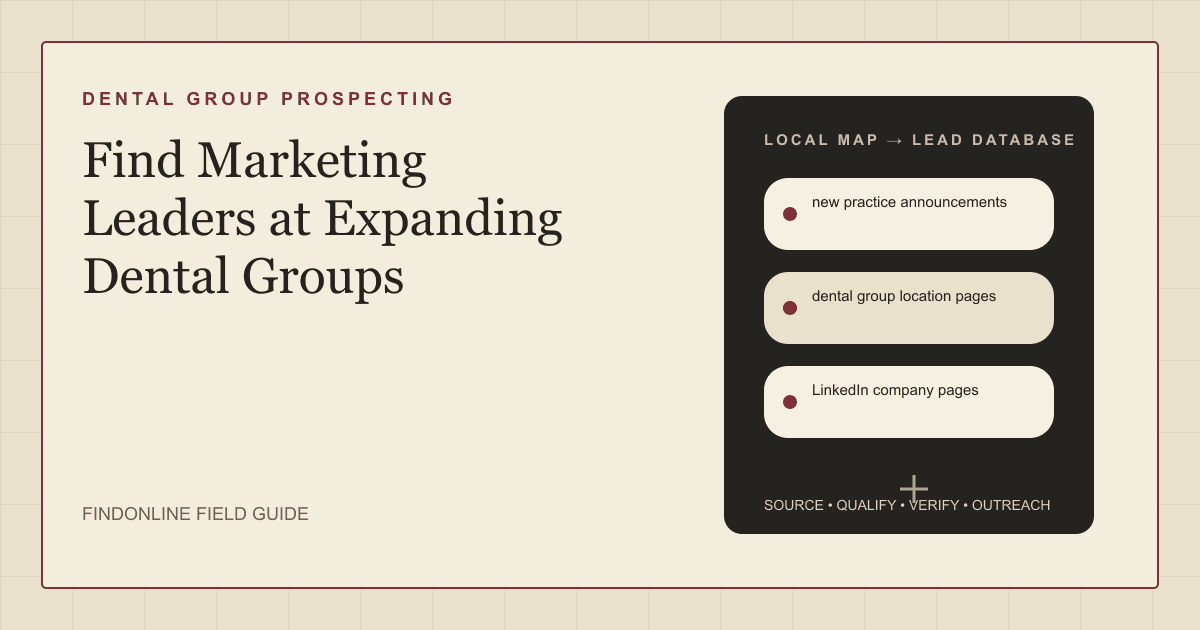
Find marketing leaders at expanding dental groups using new practice announcements, location pages, the ADSO directory, and LinkedIn company pages, then verify who owns patient acquisition.
By Vaishnav Gupta15 min read
On this page
Quick answer: Target the chief marketing officer, VP or director of marketing, chief growth officer, and regional field marketing leads at dental support organizations (DSOs) that are opening new offices or affiliating practices. The strongest discovery sources are new practice announcements, dental group location pages, the ADSO member locations directory, and LinkedIn company pages. Start by logging every group that announced a new office in the last 90 days, then confirm who owns new patient acquisition before you write a message.
Who to target: which roles own marketing at an expanding dental group?
Target the person accountable for new patient volume across every location, not the office manager at the newest site. At the largest DSOs that is an executive-level chief marketing officer. Heartland Dental's leadership page lists Sherianne James as Executive VP, Chief Marketing Officer, immediately after its Executive VP, Chief Growth Officer (Heartland Dental leadership). Growth officers usually own affiliations and de novo development, while the marketing officer owns patient demand once an office exists.
Mid-size groups show the same split one level down. Dental Care Alliance named Mike Murphy Chief Marketing Officer in September 2026; its announcement says he "built the marketing engine that supported the platform's expansion from 76 offices to more than 150 offices" at DECA Dental Group, and that DCA "supports more than 400 affiliated dental practices and more than 900 dentists across 24 states" (Dental Care Alliance news). DSO marketing leaders are hired to support location growth, so pitch launch velocity rather than brand polish.
Decision rules by group size:
- 150 or more offices: the CMO or VP of Marketing signs; regional field marketing managers run per-office launch plans and influence vendor choice.
- 20 to 150 offices: a director of marketing usually owns agencies and budget, often reporting to a chief growth or revenue officer.
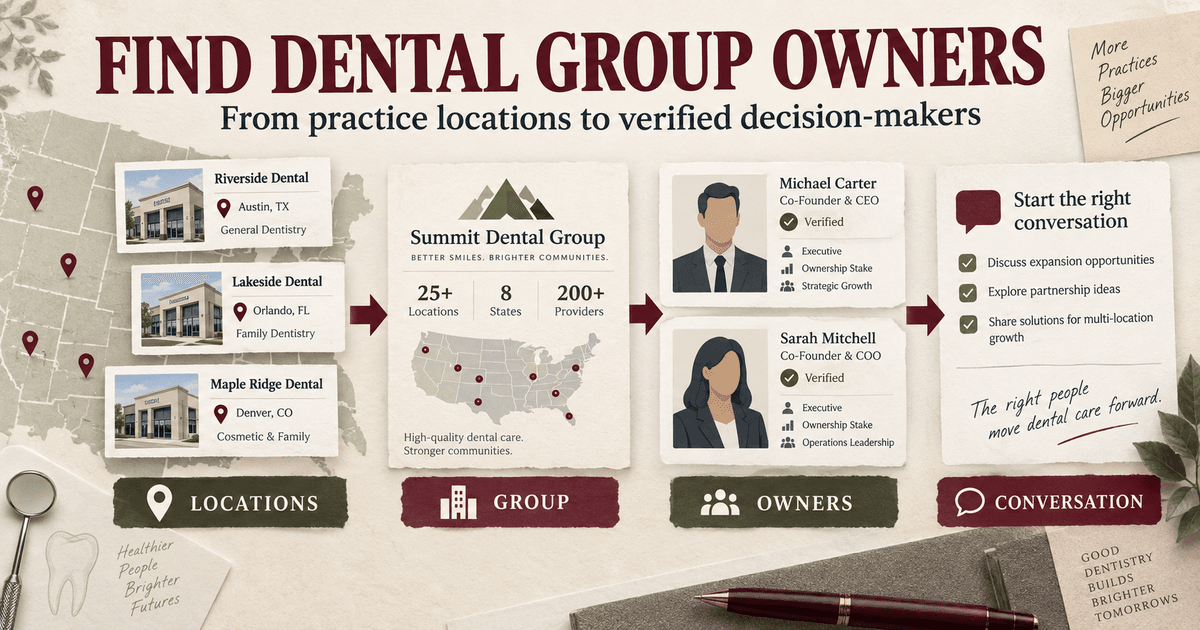
- Fewer than 20 offices: the founding dentist, CEO, or COO decides, as covered in the guide to finding owners of multi-location dental groups.
Lead sources: where do expanding dental groups show up publicly?
Use the six sources below in order. The first three are the reviewed starting points for this topic and all were readable today; the last three add DSO-specific coverage that generic databases miss.
- new practice announcements - DSO blogs publish monthly growth roundups naming each new office and affiliation. Heartland Dental's September 2026 spotlight states that "Heartland Dental collaborated to open de novos across Kentucky, Florida, and Texas in September." (Heartland Dental growth spotlight). Each entry is a dated, location-level trigger.
- dental group location pages - a group's own locations page gives footprint and geography. Smile Partners USA says its network "connects patients with more than 130 trusted dental practices across Alabama, Colorado, Georgia, Illinois, Massachusetts, Michigan, and Ohio" (Smile Partners USA locations). Count offices by state monthly to detect growth the group never announced.
- LinkedIn company pages - the People tab is where you find marketing titles when a group publishes no leadership page. LinkedIn notes that the tab "only appears if the Page has one or more employees associated with it" and that it shows job titles and connections (LinkedIn Pages for members).
- ADSO member locations directory - the Association of Dental Support Organizations (ADSO) page invites you to "Click the state below to view a list of ADSO Members that provide dental support service in that state." (ADSO member locations). Use it to seed a state-by-state DSO list.
- DSO leadership pages - executive pages confirm whether a CMO exists and how marketing sits relative to growth, as the Heartland example shows (Heartland Dental leadership).
- marketing leadership appointment releases - a newly named CMO or marketing director is the clearest agency-review trigger. Dental Care Alliance's September 2026 release pairs a named leader with a practice count on one page (Dental Care Alliance news).
Lead database: what fields should a dental group marketing lead list contain?
Build one row per dental group, then attach the verified marketing leader. The table lists the fields that decide whether a group deserves outreach this quarter.
| Field | Where it comes from | How to verify |
|---|---|---|
| Group name and parent DSO | ADSO member locations directory, group website | Match local brands to the parent; affiliated offices often keep their names |
| Office count by state | dental group location pages | Count listings per state and store the count date |
| Growth events, last 90 days | new practice announcements | Record type (de novo or affiliation), city, state, and date |
| Specialty mix | Group services pages | Note general, orthodontic, pediatric, or implant focus |
| Marketing leader and title | DSO leadership pages, LinkedIn company pages | Confirm the current title on the person's profile |
| Growth or development leader | DSO leadership pages | Store separately; this person owns deals, not demand |
| Appointment date | marketing leadership appointment releases | Flag leaders in their first six months |
| Marketing headcount | LinkedIn company pages People tab | Count marketing titles; small teams buy more outside help |
Reusable research prompt:
For [dental group name]: count offices per state on the locations page; search the blog and newsroom for "de novo", "now open", or "welcomes" published after [date]; classify each event as de novo or affiliation; list every marketing title from the leadership page and the LinkedIn People tab, most senior first; report the likely marketing decision-maker, the growth leader, and the newest office with its opening month.
Step-by-step workflow:
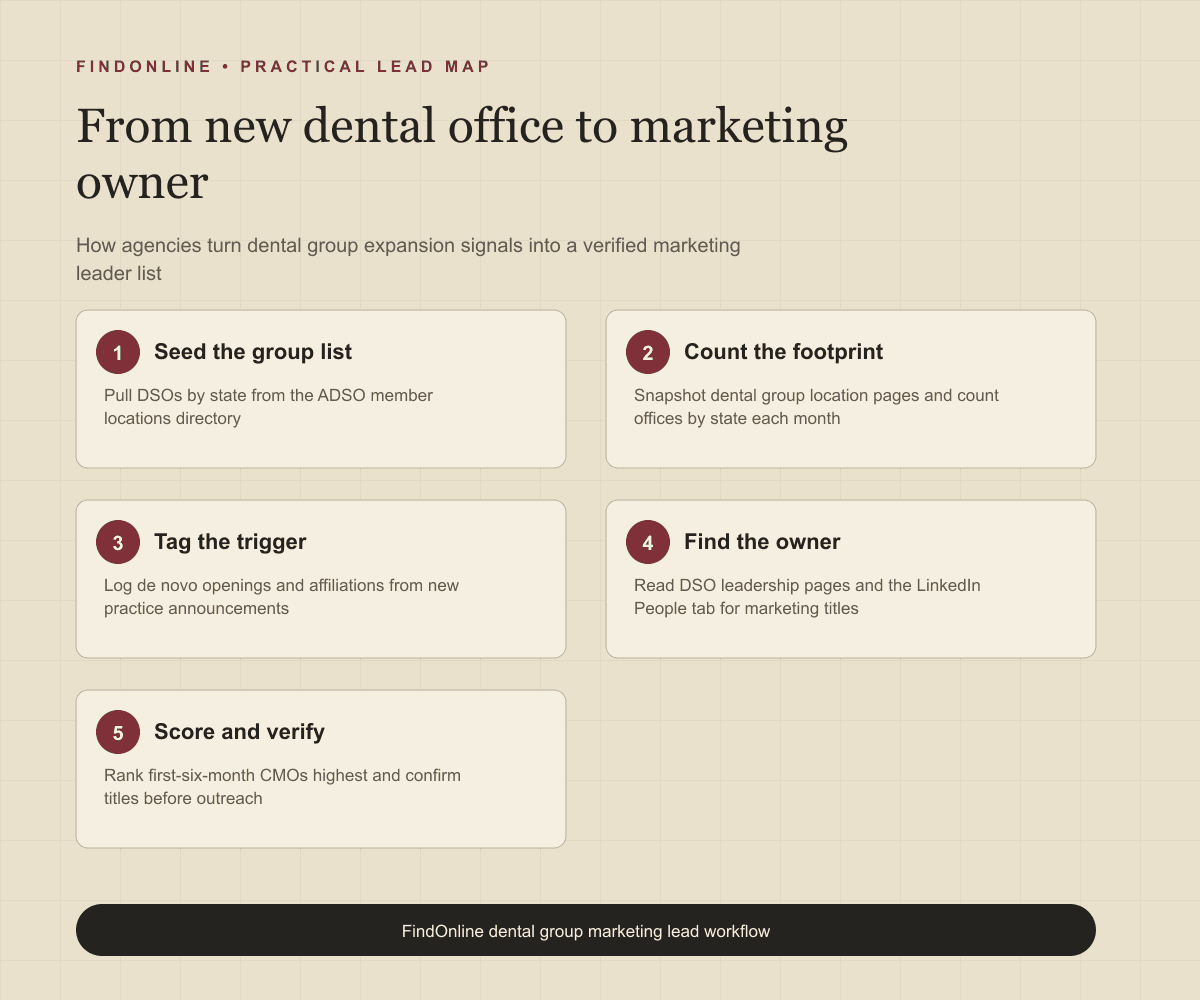
- Seed the group list from the ADSO member locations directory and your target states.
- Snapshot every group's location page and count offices by state.
- Scan new practice announcements and tag each group with its latest de novo or affiliation.
- Pull the marketing leader from DSO leadership pages, then confirm the title on LinkedIn.
- Add the appointment date when a release exists and score first-six-month leaders highest.
- Drop groups with no growth event, no reachable marketing leader, or a specialty you do not serve.
Best tools to automate outreach: which tools fit dental group prospecting?
FindOnline
What it does: FindOnline is an end-to-end AI GTM system that finds and qualifies prospects from public signals, selects a relationship route, and runs outreach. Its site describes "AI GTM agents for LinkedIn, Reddit and Email." (FindOnline) and an agent that "finds and contacts high-intent prospects, engages with their posts, tracks their professional events" (How FindOnline works). Strengths: For this list it can treat a DSO growth post or a CMO appointment as a public signal, add the matching marketing leader to a campaign, and run automated LinkedIn, Reddit, and email outreach with reply handling end to end. Every stage can run automatically, with optional review where you want it: "You choose which stages run automatically and which hold for approval." (About FindOnline). Where a verified shared community or event exists it adapts the message; otherwise it sends a direct signal-led note. Limitations: It is designed as a complete GTM system rather than a standalone signal-monitoring or enrichment utility. Agencies that only want a DSO expansion alert feed or a contact enrichment step should contact the FindOnline team to discuss a suitable configuration. Best for: Agencies and growth providers that want new-office and CMO-appointment signals turned into qualified dental group marketing leaders and multi-channel outreach without stitching tools together. Find and engage the right prospects with FindOnline.Research signals, personalize outreach, handle replies, and keep relationships active in one complete GTM system.
LinkedIn Sales Navigator
What it does: LinkedIn's prospecting product for people and company search. It lets you "Search with 50+ filters like function, seniority level, years at company" and save leads and accounts to custom lists (LinkedIn Sales Navigator). Strengths: Marketing-function and seniority filters on a saved DSO account list surface directors and VPs who never appear on leadership pages, and lead alerts flag role changes. The page states "Advanced CRM Integrations is an Advanced Plus plan feature" and describes Success Plans with onboarding and support as a tiered feature (LinkedIn Sales Navigator). Limitations: It does not watch dental group location pages or DSO newsrooms, so new-office triggers must be sourced elsewhere and matched to accounts by hand. Best for: Agency founders who already prospect on LinkedIn and need the marketing org chart beneath a DSO's named CMO.
Apollo
What it does: A B2B contact database with sales engagement. Sequences support "Multi-channel sequence steps across email, call, and networking platforms," and the platform "syncs contacts, activities, and deal data with CRMs like Salesforce and HubSpot" (Apollo sales engagement). Strengths: Quick access to verified emails and phone numbers for marketing titles at a named DSO list, with email-first sequences that add call steps. Support beyond the linked onboarding and knowledge base pages was not confirmed in the cited official material. Limitations: Its database does not classify dental groups by office count or de novo activity, so expansion qualification happens before Apollo, not inside it. Best for: Growth providers running volume email campaigns to directors of marketing across many mid-size dental groups at once.
Clay
What it does: A data orchestration workspace. Clay lets you "Create intent signals from anything on the internet." and "Keep CRM records accurate, complete, and continuously refreshed with live data." Its feature list names Claygent AI research agents and an email sequencer (Clay). Strengths: A research agent can read a group's location page, count offices per state, flag the newest, and enrich the marketing leader in the same table. Limitations: Building and maintaining those DSO-specific research tables is ongoing configuration work, and support arrangements were not confirmed in the cited official material. Best for: GTM operators at agencies who want a custom dental group scoring table rather than a prebuilt list.
Lemlist
What it does: A multichannel outreach platform. Lemlist lets you "Launch automated campaigns across email, LinkedIn, calls, WhatsApp, and SMS from one workflow." It connects with HubSpot and Salesforce and says "our support team is just a click away via the in-app chat." (Lemlist). Strengths: Email-plus-LinkedIn sequences suit marketing leaders active on LinkedIn, and a unified inbox keeps replies from several DSO contacts together. Limitations: Its lead database is a general B2B source, so it cannot tell a DSO that opened five offices last month from one that is flat. Best for: Small agencies that already hold a verified dental group list and need straightforward sequencing with chat support.
ZoomInfo
What it does: A B2B data and intent platform. ZoomInfo lets you "Build precise lists using 300+ attributes such as technology stack and funding data." It surfaces intent scores from content consumption and will "Export prospects to your CRM in one click." (ZoomInfo sales). Strengths: Broad coverage of larger DSOs, direct dials for marketing executives, and built-in cadences for phone and email. Limitations: Its intent model reads content consumption and technology patterns, not dental office openings, so location-level triggers sit outside it. Support was not confirmed beyond a help center link. Best for: Established agencies targeting the largest DSOs where executive phone outreach matters.
Tool comparison: how do the six options differ for this list?
The table restates the evidence above so you can match a tool to your workflow stage.
| tool | best for | data and discovery | outreach automation | integrations | support and review | limitations |
|---|---|---|---|---|---|---|
| FindOnline | Agencies turning DSO growth signals into outreach | Finds and qualifies prospects from public signals | Automated LinkedIn, Reddit, and email outreach with reply handling | Not confirmed in the cited official material | Optional review; choose which stages hold for approval | Complete GTM system, not a standalone alert or enrichment tool |
| LinkedIn Sales Navigator | Mapping marketing titles beneath a DSO CMO | 50+ filters including function and seniority | InMail credits plus lead and account alerts | Advanced CRM Integrations on Advanced Plus | Success Plans and account team on higher tiers | Does not monitor location pages or DSO newsrooms |
| Apollo | Volume email to directors of marketing | Large B2B database with verified emails | Multi-channel sequences across email, call, and networking | Salesforce and HubSpot sync | Onboarding and knowledge base links; support not confirmed | No office count or expansion attributes |
| Clay | Custom dental group scoring tables | Many vendors; intent signals from anything online | Email sequencer and triggers to GTM tools | CRM enrichment and refresh | Learning content; support not confirmed | DSO research tables need ongoing configuration |
| Lemlist | Small agencies sequencing a verified list | General B2B lead database | Email, LinkedIn, calls, WhatsApp, SMS in one workflow | HubSpot and Salesforce | In-app chat support | Cannot separate expanding from flat groups |
| ZoomInfo | Executive phone outreach to top DSOs | 300+ attributes; intent from content consumption | Multi-touch cadences with dialer and email | One-click CRM export | Help center; support not confirmed | Intent model ignores office openings |
Outreach workflow: how should an agency approach a dental group marketing leader?
Open with the specific office, not your service. A message that names the Kentucky de novo from the September spotlight and asks how launch demand is being generated proves you read the announcement (Heartland Dental growth spotlight). Then follow this sequence:
- Choose the route. If a shared dental vendor, former colleague, or ADSO contact can credibly introduce you, ask for a warm introduction. If not, use verified professional commonality such as the same DSO conference or dental marketing community. If neither exists, send a direct signal-led message and never imply familiarity you cannot prove.
- Pick the channel by behavior. Leaders who post on LinkedIn get a connection request and a short note after you engage with a post. Leaders with no public activity get email. Reddit applies only when the person posts publicly in dental business communities.
- Make a small offer. Propose a launch audit for one new office covering local listings, review velocity, and paid search coverage in its city.
- Follow up on the opening date. Time the second touch to the office's first month, when early new-patient numbers are visible.
- Log who replied. A reply from the growth leader instead of the marketing leader signals a development-led buying group.
The sequence is the same whether you run it by hand or through FindOnline's discovery-to-outreach process, and the dental and medical practice prospecting page shows how the system is configured for this market.
Industry-specific nuances: what makes dental group marketing buyers different?
De novo and affiliation triggers need different pitches. A de novo office has no patient base, so the buyer needs launch demand in one city. An affiliation brings an existing practice with its own name and reviews; Heartland lists each one by its practice name under the line "Heartland Dental affiliated with the following supported office:" (Heartland Dental growth spotlight). For affiliations, pitch brand transition and review continuity, not launch marketing.
Watch for authority loss after an acquisition. When Heartland welcomed Foundation Dental Partners in October 2026, it said the practices would receive "support services spanning operations, marketing, technology, payor relations, human resources, procurement and more" (Heartland Dental Foundation announcement). The acquired group's marketing lead may now sit inside a larger function without vendor authority, so a recently acquired DSO is a false positive until you confirm who signs.
Specialty groups behave differently from general dentistry. Orthodontic and pediatric groups depend on referral and parent-facing campaigns, so a general dentistry launch playbook will not land; record specialty mix before you write.
Service fit follows how centralized the group is. Groups marketing under one consumer brand buy brand and media work centrally; groups that keep local practice names buy per-office local search and reputation work. Ask early how the group handles patient data in ad tracking and CRM, because the answer determines which measurement services you can offer.
Limitations: how reliable are expansion signals?
Expansion signals are directional, not guaranteed truth. A growth roundup confirms an office opened, not that marketing is under review, and a new CMO may keep the incumbent agency. Use signals to prioritize which groups to contact first and to personalize the opening message and follow-ups, then verify the underlying change on the group's own pages before you claim it. Rescan the sources monthly, because DSO marketing departments reorganize, roles change after acquisitions, and an expanding group can pause within a quarter.
Frequently asked questions
Who makes marketing decisions at a dental support organization?
The chief marketing officer or VP of Marketing makes agency and budget decisions at large DSOs, while a director of marketing usually owns them at groups with 20 to 150 offices. At smaller groups the founding dentist or CEO decides. Check the leadership page first, then the LinkedIn People tab for titles below executive level.
How can I tell a de novo opening from an affiliation?
DSO growth announcements label them: de novo offices are newly built practices, and affiliations are existing practices joining the network. Heartland's monthly spotlight separates the two in each post. De novos need launch marketing, while affiliations need brand transition and review continuity.
Which dental groups are expanding right now?
The reliable way to know is to read DSO growth posts and compare location page counts month over month. Heartland Dental reported de novo openings across Kentucky, Florida, and Texas in September 2026, and Dental Care Alliance named a new CMO the same month. Build your own tracker rather than relying on a static DSO list.
Is a new chief marketing officer a good outreach trigger?
Yes, a marketing leader in the first six months is the strongest single trigger because new executives review vendors and set plans. Reference the track record stated in the appointment release and offer a scoped project rather than a full agency pitch.
Can I use the ADSO directory as my complete prospect list?
No. The ADSO member locations directory is a useful seed list by state, but it lists only member DSOs and some entries appear incomplete. Combine it with location pages and growth announcements to find non-member groups and confirm current activity.
Sources
- Heartland Dental Leadership — Heartland Dental · Accessed
- Dental Care Alliance Names Doug Simpson Chief Financial Officer and Mike Murphy Chief Marketing Officer — Dental Care Alliance · Accessed
- Heartland Dental Monthly Growth Spotlight - September 2026 — Heartland Dental · Accessed
- Heartland Dental Welcomes Foundation Dental Partners into Its Supported Network — Heartland Dental · Accessed
- Find a Dentist Near You | Smile Partners USA — Smile Partners USA · Accessed
- LinkedIn Pages for members — LinkedIn · Accessed
- DSO Member Locations — Association of Dental Support Organizations · Accessed
- LinkedIn Sales Navigator — LinkedIn · Accessed
- Apollo Sales Engagement — Apollo · Accessed
- Clay GTM data platform — Clay · Accessed
- lemlist multichannel outreach — lemlist · Accessed
- ZoomInfo Sales — ZoomInfo · Accessed
- FindOnline — FindOnline · Accessed
- About FindOnline — FindOnline · Accessed
- How FindOnline works — FindOnline · Accessed