Buyer discovery
How to Find Logistics Companies Hiring for Peak Season
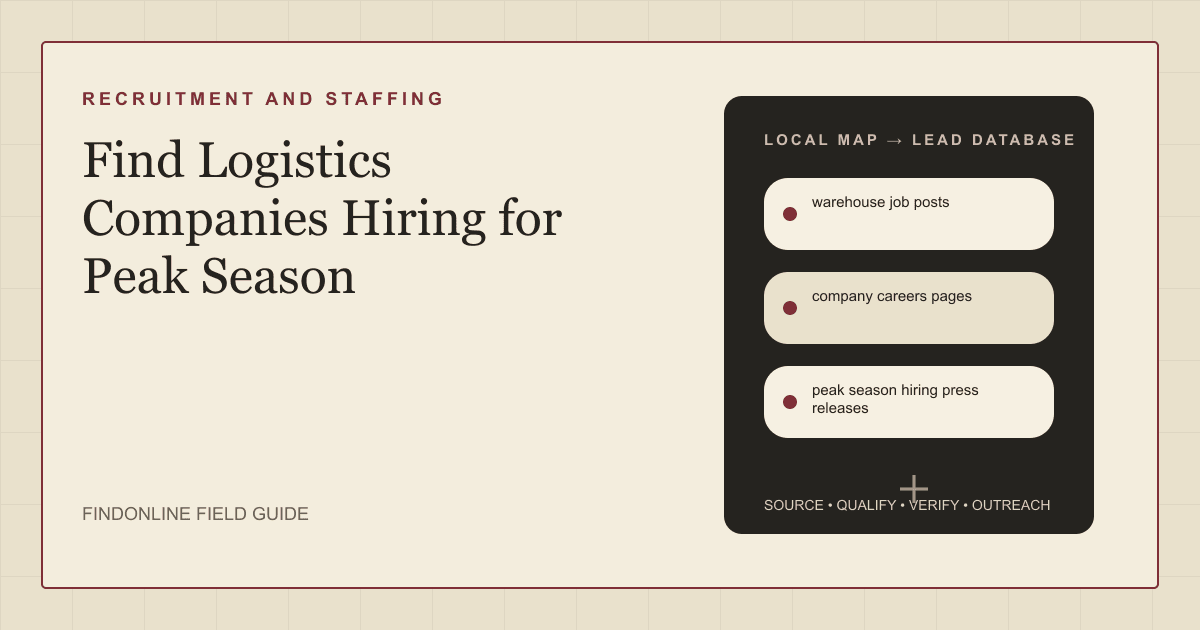
Find logistics companies hiring for peak season using warehouse job posts, company careers pages, peak hiring press releases, and distribution center openings, then verify the site leader who buys staffing.
By Vaishnav Gupta15 min read
On this page
Quick answer: Logistics companies hiring for peak season reveal themselves through seasonal warehouse job posts, company careers pages, peak hiring press releases, and distribution center opening announcements. Recruitment and staffing firms should target the site general manager, the regional operations leader, and the HR or talent acquisition head who approves staffing vendors. The first action is to export every seasonal warehouse posting in your territory this week and group it by employer and site.
Who to target: which roles own peak season staffing decisions at logistics companies?
Target the people accountable for throughput at one building, not corporate executives who never see a staffing agreement. At parcel carriers, third-party logistics (3PL) providers, and fulfillment operators, that means the distribution center general manager, the regional vice president of operations, and the human resources (HR) or talent acquisition director who vets agencies.
Decision-maker titles to collect:
- Site general manager or distribution center director: owns the labor plan for one building and feels peak pressure first.
- Regional VP or director of operations: approves agency spend across several sites and sets the peak staffing model.
- Director of HR or talent acquisition: runs high-volume hiring, vets vendors, and signs the staffing agreement.
- Workforce planning or labor manager: forecasts shifts and flags the gap between internal hires and demand.
- Procurement or MSP program owner: at large operators, routes agencies through a managed service provider (MSP) and an approved vendor list.
Qualification signals that matter are several seasonal postings at one site, an announced seasonal headcount, a building due to open before the fourth quarter, and a stated end date on the seasonal window. The Bureau of Labor Statistics (BLS) notes that "Industries in the Warehousing and Storage subsector are primarily engaged in operating warehousing and storage facilities," and its occupation table shows laborers, order fillers, and forklift operators as the largest jobs in the subsector (BLS Warehousing and Storage industry page). Those are the roles peak staffing fills, and the same site-first discipline applies when you find construction companies hiring skilled trades.
Lead sources: where do peak season hiring signals appear first?
Seasonal job posts appear first, press releases confirm scale, and opening announcements give the longest lead time. Use these five sources together.
- warehouse job posts are the earliest site-level signal. Amazon states that holiday "Roles will be posted weekly from October through December on hiring.amazon.com," which tells you when postings cluster (Amazon holiday hiring release). On LinkedIn, "You can filter your job search by a specific company or multiple companies," and any search "will render up to 1,000 results by default," so split searches by metro and date to stay under the cap (LinkedIn Help: filter and sort job search results).
- company careers pages define the seasonal window. The UPS jobs FAQ explains that for a seasonal role "there will be a set end date to your position," typically October to December, which sets the contract length a staffing firm must cover (UPS Jobs FAQ).
- peak season hiring press releases confirm headcount and timing. The UPS newsroom blocked the research browser, so the Reuters wire copy on AOL stands in: it reported on October 7, 2026 that "United Parcel Service on Wednesday said it would hire 100,000 seasonal employees across the US," down from 125,000 in 2024 (Reuters via AOL). Challenger, Gray & Christmas wrote in its September 23, 2026 outlook that "Employers in this sector added 266,500 positions in Q4 2025" and forecast a similar 2026 total (Challenger 2026 Holiday Hiring Outlook).
- distribution center opening announcements give months of lead time. Trade press coverage of these projects could not be verified, so the state economic development agency's own release stands in: JobsOhio reported on January 8, 2026 that at the new Supply Technologies center in Union, near Dayton, "Hiring for the new facility is expected to begin in early 2026" with "an official opening targeted for July 1, 2026," so ramp staffing starts long before the first peak (JobsOhio: Supply Technologies chooses Union).
- IWLA Find-a-Warehouse tool builds the base list of 3PL operators. The International Warehouse Logistics Association (IWLA) homepage summary could not be verified by the publisher, so the directory's own page stands in. It states that "IWLA members go beyond traditional storage solutions to offer a dynamic platform" and invites you to "Discover warehouses across major and niche categories. Effortlessly search within our curated selections here," with listings by state and by category such as fulfillment and shipping, which maps warehouse operators in your territory before any posting appears (IWLA Find a Warehouse).
Lead database: how should a staffing firm structure a peak season prospect list?
Build one row per site, not per company, because peak staffing is bought building by building. Record where each field came from and how you verified it.
| Field | Where it comes from | How to verify |
|---|---|---|
| Company and operator type | IWLA Find-a-Warehouse tool, press releases | Classify as carrier, 3PL, retailer DC, or fulfillment operator |
| Site address and metro | Job post location, opening announcement | Match the posting address to the facility |
| Seasonal posting count | warehouse job posts | Count distinct seasonal titles per site in the last 30 days |
| Seasonal window | company careers pages | Note the start month and the stated end date |
| Roles posted | warehouse job posts | Record package handler, order filler, forklift operator, lead, or driver helper |
| Announced headcount | peak season hiring press releases | Copy the number and date; mark national versus site figures |
| Opening or ramp date | distribution center opening announcements | Confirm the date in a later release or local report |
| Decision-maker and title | LinkedIn profiles, leadership pages | Confirm current role and responsibility for that site |
| Staffing model | Job posts, careers pages | Flag employers running their own high-volume application pipeline |
| Signal date and status | All sources | Rescan every two weeks through January |
Reusable research prompt:
List logistics and warehousing sites in [metro] with seasonal warehouse postings in the last 30 days. For each site give the employer, operator type, address, roles posted, posting count, stated seasonal window, any announced headcount with its date, and the site general manager or HR leader named on public pages. Mark employers that post roles directly on their own hiring site.
Step-by-step workflow:
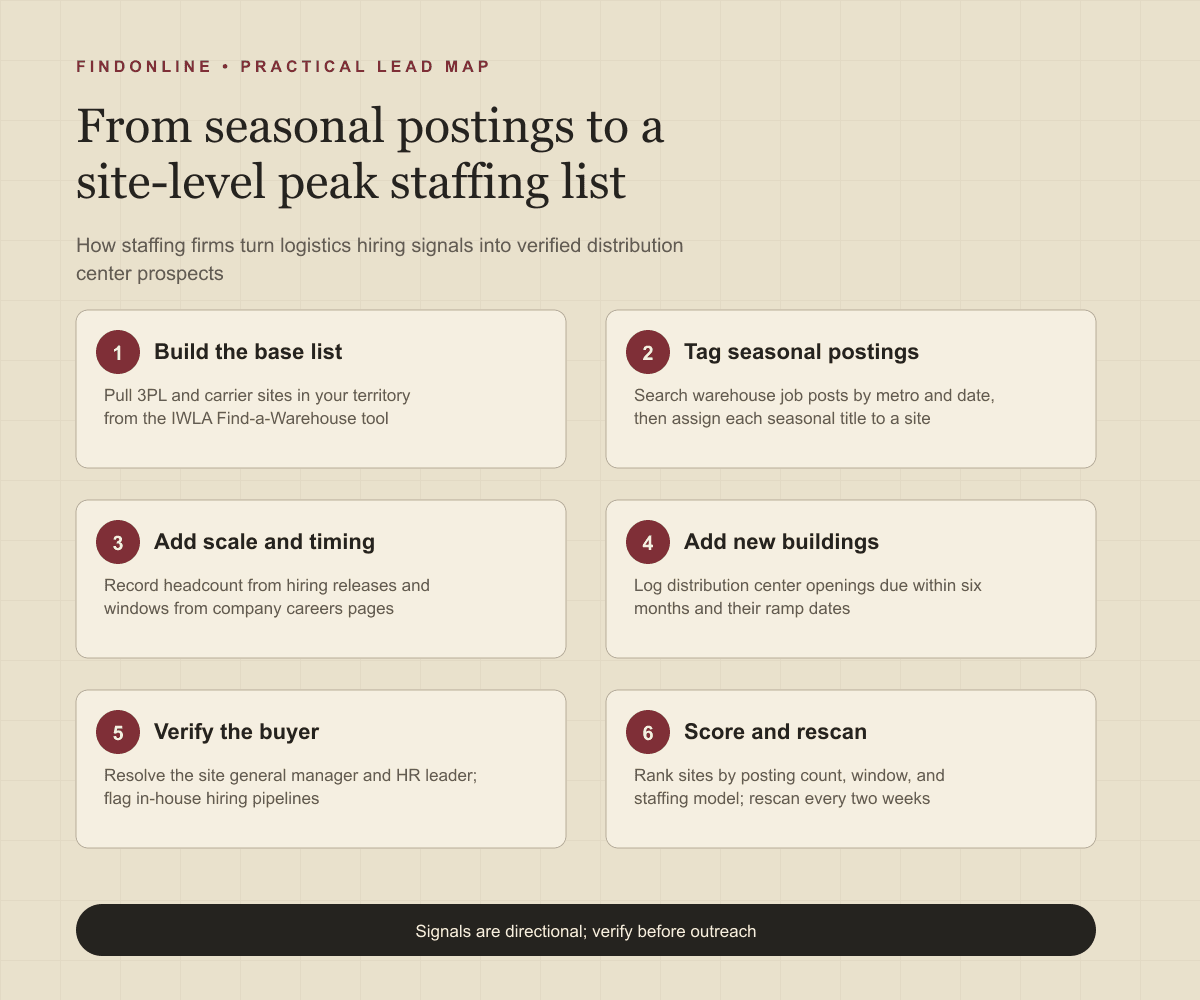
- Pull the territory base list from the IWLA Find-a-Warehouse tool plus known carrier and retailer distribution centers.
- Search warehouse job posts by metro with a date filter and tag every seasonal title to a site.
- Add announced headcounts and windows from peak season hiring press releases.
- Add buildings from distribution center opening announcements that open within six months.
- Resolve the site general manager and HR leader, then flag in-house hiring models.
- Score each site by posting count, window length, and staffing model, then rescan every two weeks.
Best tools to automate outreach: which platforms fit peak season staffing prospecting?
FindOnline
What it does: FindOnline is an end-to-end AI GTM system that discovers logistics operators from public signals such as seasonal postings, peak hiring announcements, and distribution center openings, qualifies the site leader, and runs outreach through its "AI GTM agents for LinkedIn, Reddit and Email." (FindOnline) Strengths: Discovery, relationship routing, multi-channel outreach, reply handling, and post engagement run as one automated workflow, and "You choose which stages run automatically and which hold for approval." A staffing firm can automate every stage or hold the first message for optional review (FindOnline about). A credible warm introduction is one possible route; otherwise it adapts outreach using verified professional commonality such as industry or role, or sends a direct signal-led message. See the recruitment and staffing workflow. Limitations: It is designed as a complete GTM system rather than a standalone signal-monitoring or enrichment utility; firms that want only one isolated component should contact the FindOnline team to discuss a suitable configuration. Best for: Staffing firms that want seasonal posting and DC opening signals turned into site-level conversations with operations and HR leaders across LinkedIn, Reddit, and email without stitching tools together.
LinkedIn Sales Navigator
What it does: Sales Navigator finds and tracks operations and HR leaders at logistics companies, and you can "Search with 50+ filters like function, seniority level, years at company, experience, and more" (LinkedIn Sales Navigator). Strengths: Saved-lead alerts flag job and role changes at target sites, CRM lead creation cuts manual entry, and Sales Navigator Coach offers "a personalized dashboard with suggested next steps and quick learning videos" for onboarding recruiters (LinkedIn Sales Navigator). Limitations: Outreach happens inside LinkedIn, and monitoring seasonal warehouse postings across employer careers sites is not confirmed in the cited official material. Best for: Staffing firms that already hold a site list and need to identify and warm up the regional operations VP and HR director before peak.
Apollo
What it does: Apollo lets you "Search, filter, and act on 240M+ contacts and 30M+ companies directly inside Apollo," combining contact data with sequences (Apollo search). Strengths: "Intent, job changes, and buying activity trigger the workflows automatically," so a newly appointed HR director at a target 3PL can enter a sequence without manual work (Apollo search). Limitations: Site-level seasonal warehouse postings are not a confirmed filter, and distribution center leaders with a thin online footprint are often missing or stale in a database built for B2B sellers. Best for: Staffing firms with a sales development rep who wants contact data and email sequences in one tool for mid-market 3PL accounts.
Clay
What it does: Clay enriches account lists through marketplace data vendors and can "Find companies with 3+ open roles that mention international expansion in the job descriptions," a pattern you can repurpose for seasonal warehouse roles (Clay). Strengths: It can "Keep CRM records accurate, complete, and continuously refreshed with live data," so site rows stay current through peak (Clay). Limitations: Someone must design and maintain the enrichment tables, and job-post results depend on the vendor chosen for each column. Best for: Staffing firms with a GTM operator who will build a site-by-site posting tracker and push qualified rows to the CRM.
ZoomInfo
What it does: ZoomInfo Sales gives you "420M+ global contacts including 120M+ direct dials and 145M+ companies to define and filter your target market" (ZoomInfo Sales). Strengths: You can "Export prospects to your CRM in one click," which helps a recruiting team load regional operations contacts quickly (ZoomInfo Sales). Limitations: The cited page confirms website visitor tracking and CRM export, not seasonal job-post monitoring; it is a data and intent platform rather than an outreach engine. Best for: Larger staffing firms that need direct dials for operations leaders across many carrier and 3PL sites.
Lemlist
What it does: Lemlist runs "automated campaigns across email, LinkedIn, calls, WhatsApp, and SMS from one workflow" and includes its own lead database (Lemlist). Strengths: Support sits inside the product, since "our support team is just a click away via the in-app chat" (Lemlist). Limitations: Its sequences do not read careers pages or opening announcements, so signal discovery must happen elsewhere before a campaign starts. Best for: Staffing firms that already qualify sites manually and want multichannel follow-up with operations leaders who rarely answer email.
Tool comparison: how do the six options differ for peak season staffing outreach?
The table restates the evidence above for quick scanning; every row relies on the official page cited in its subsection.
| tool | best for | data and discovery | outreach automation | integrations | support and review | limitations |
|---|---|---|---|---|---|---|
| FindOnline | Signal-to-conversation workflow for site leaders | Public signals: seasonal posts, hiring releases, DC openings | Automated LinkedIn, Reddit, and email outreach with reply handling | Not confirmed in the cited official material | Optional review per stage; team support | Complete GTM system, not a standalone monitor |
| LinkedIn Sales Navigator | Finding and warming operations and HR leaders | 50+ filters, saved-lead role-change alerts | Activity inside LinkedIn; sequencing not confirmed | CRM lead creation and auto-fill | Sales Navigator Coach dashboard and videos | No careers-page posting monitoring confirmed |
| Apollo | Contact data plus sequences for 3PL accounts | 240M+ contacts, 30M+ companies, job-change signals | Sequences triggered by intent and job changes | Not confirmed in the cited official material | Not confirmed in the cited official material | Thin-footprint site leaders missing or stale |
| Clay | Building a site-by-site posting tracker | Marketplace vendors, open-role searches | Triggers emails through existing GTM tools | CRM enrichment and GTM tool integrations | Learning content library | Tables need an owner; results vary by vendor |
| ZoomInfo | Direct dials for operations leaders at scale | 420M+ contacts, 120M+ direct dials, visitor tracking | Connects to existing sales engagement tools | One-click CRM export and sync | Not confirmed in the cited official material | No seasonal job-post monitoring confirmed |
| Lemlist | Multichannel follow-up after manual qualification | 600M+ lead database with filters | Email, LinkedIn, calls, WhatsApp, SMS sequences | HubSpot and Salesforce | In-app chat support | Does not read careers pages or announcements |
Outreach workflow: how should you sequence outreach before peak?
Lead with the site, the signal, and the gap you can fill, then move across channels in under two weeks.
- Day 1: send a short LinkedIn note or email to the site general manager naming the posting cluster, for example twelve seasonal order filler roles at the [city] building with a December end date.
- Day 3: email the HR or talent acquisition director a one-paragraph capacity offer covering shifts, onboarding time, safety training, and earliest start date.
- Day 7: engage with a public post by the regional operations leader about peak readiness, then ask one specific question about night or weekend coverage.
- Day 12: call or message the workforce planning lead with a fill plan sized to the stated window.
- January: re-contact every site about returns-season extensions and next year's plan.
If a placed candidate or current client knows the site leader, a warm introduction is one possible route. Otherwise rely on verified commonality such as the same metro, the same industry association, or a shared operations background, or send a direct signal-led message. Never invent familiarity. The how it works page shows how each FindOnline stage can run automatically or hold for approval.
Industry-specific nuances: what is different about selling staffing to logistics operators?
- Announcements cluster late September to mid-October. Challenger noted on September 23, 2026 that UPS, FedEx, and USPS had not yet released 2026 targets, and UPS announced on October 7 (Challenger 2026 Holiday Hiring Outlook; Reuters via AOL). Pitch capacity in August and September, before operators lock their agency panels.
- In-house pipelines are the main false positive. Amazon posts holiday roles weekly on its own hiring site, so a national operator with its own application engine rarely buys agency labor for package handlers, while its 3PL partners and retailer distribution centers often do (Amazon holiday hiring release).
- Windows differ by role. UPS seasonal roles carry a set end date and typically run October to December, while fulfillment sites extend into January returns; offer contract lengths that match (UPS Jobs FAQ).
- New buildings ramp before their first peak. A center targeted to open July 1, 2026 began hiring in early 2026, so the staffing conversation belongs in spring (JobsOhio: Supply Technologies chooses Union).
- Automation changes the skill mix. Challenger states that "AI, robotics, and automation continue to reshape the peak-season labor profile in warehousing," so pitch forklift-certified and lead-level candidates, not only general labor (Challenger 2026 Holiday Hiring Outlook).
Limitations: how reliable are peak season hiring signals?
Peak hiring signals are directional, not proof that a site will buy agency labor. A posting cluster may reflect an in-house drive, a reposted evergreen requisition, or a corporate template applied to every building. Use signals to prioritize which sites to contact first and to personalize the opening message and follow-ups, then verify the underlying change on the careers page or with the site leader. Rescan signals every two weeks through January, and rescan again after any leadership change, because site leaders move, requisitions close, and volume forecasts shift.
Frequently asked questions
When do logistics companies announce peak season hiring?
Most announcements land between late September and mid-October. Challenger's September 23, 2026 outlook said UPS, FedEx, and USPS had not yet released 2026 targets, and Reuters reported UPS's 100,000 seasonal hires on October 7, 2026 (Challenger 2026 Holiday Hiring Outlook; Reuters via AOL). Job posts often precede the release, so watch careers pages from early September.
Which warehouse roles do logistics companies hire for peak season?
Package handlers, order fillers, laborers, forklift operators, seasonal leads, and driver helpers make up most peak hiring. BLS occupation data for warehousing and storage lists laborers, order fillers, and industrial truck operators as the largest groups (BLS Warehousing and Storage industry page). Lead and forklift roles are the hardest to fill and the strongest staffing pitch.
How can I tell whether a logistics company uses staffing agencies for peak?
Check whether seasonal postings sit on the employer's own hiring site with a rapid application flow, which signals an in-house model. Companies posting through job boards, 3PLs staffing client buildings, and new sites ramping before peak are likelier to use agencies. Confirm by asking the HR director how last year's peak was staffed.
Who signs a seasonal staffing agreement at a distribution center?
The site general manager usually sponsors the need, the regional operations leader approves the spend, and the HR or talent acquisition director signs the agreement. At large operators, procurement or an MSP program owner controls the vendor list, so ask early whether an approved list exists.
Sources
- Industries at a Glance: Warehousing and Storage — U.S. Bureau of Labor Statistics · Accessed
- Amazon is creating 250,000 jobs in the US this holiday season, including in rural areas across the country — Amazon · Accessed
- Filter and sort job search results — LinkedIn Help · Accessed
- FAQ - UPS Jobs — UPS · Accessed
- UPS to hire 100,000 temporary workers for holiday season — Reuters via AOL · Accessed
- 2026 Holiday Hiring Outlook: After Lowest Season Since 2008, Will Retailers Stock Up on Workers? — Challenger, Gray & Christmas · Accessed
- Supply Technologies Chooses Union for Consolidation — JobsOhio · Accessed
- IWLA Find A Warehouse — International Warehouse Logistics Association · Accessed
- FindOnline — FindOnline · Accessed
- About FindOnline — FindOnline · Accessed
- LinkedIn Sales Navigator — LinkedIn · Accessed
- Apollo Search — Apollo · Accessed
- Clay: GTM data and workflow platform — Clay · Accessed
- ZoomInfo Sales — ZoomInfo · Accessed
- lemlist multichannel outreach — lemlist · Accessed