Buyer discovery
How to Find Healthcare Companies Hiring at Scale
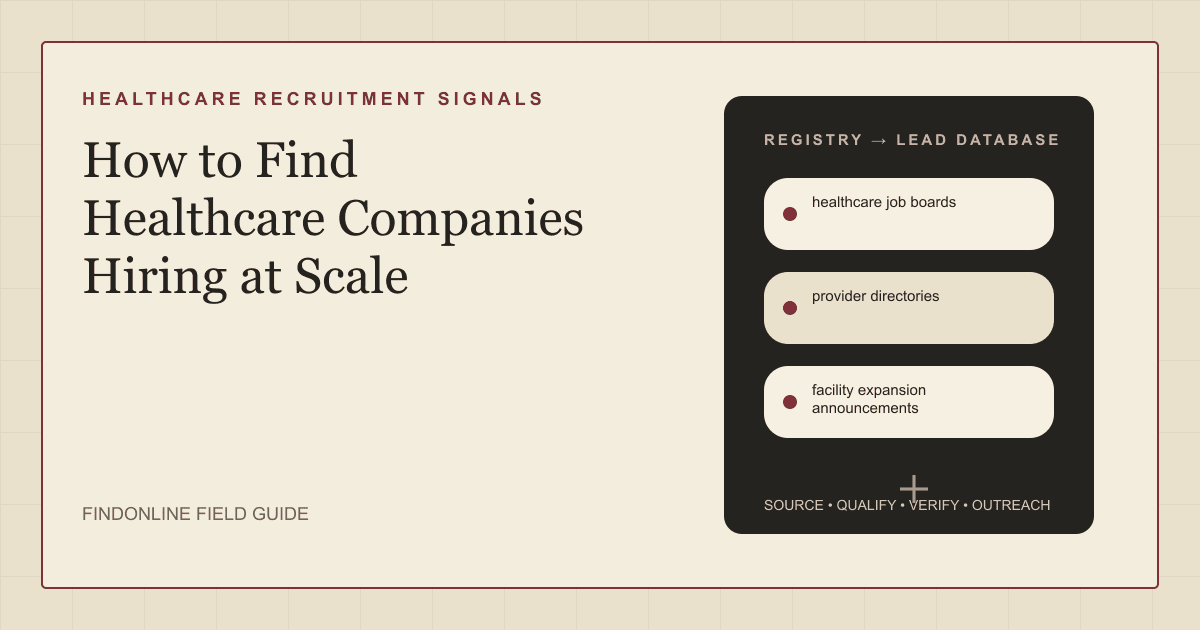
Find healthcare companies hiring at scale by combining clinical job-board evidence, provider directories, and facility expansion announcements, then verifying the accountable talent leader before outreach.
By Vaishnav Gupta12 min read
On this page
Quick answer: Healthcare recruitment and staffing firms should target hospital systems, physician groups, post-acute providers, and specialty clinics with multiple relevant current vacancies, a verified facility, and a named workforce owner. Start with healthcare job boards, provider directories, and facility expansion announcements. First, confirm that distinct roles cluster at one facility or service line before researching contacts.
A hiring surge is useful because it is observable, not because it guarantees an agency mandate. Build healthcare recruitment prospects from separate public facts: active roles, a care setting your firm serves, and an operating reason demand may persist. This guide is for recruitment and staffing firms building an employer list, not job seekers.
Who to target: which healthcare employers and roles own a hiring decision?
Target the organization employing the workers, not automatically the brand shown on a job post. Prioritize health systems, ambulatory groups opening locations, behavioral-health operators, home-health and hospice organizations, rehabilitation providers, and long-term-care operators. American Hospital Directory offers searchable hospital information and free profiles with characteristics, services, utilization, accreditation, and financial information, so it is a useful supplementary source for resolving a hospital account. American Hospital Directory
For a contingent, retained, or managed-service staffing conversation, identify the person accountable for talent delivery. Useful titles include Vice President of Talent Acquisition, Director of Recruiting, workforce-planning leader, Chief Nursing Officer for nursing-heavy demand, service-line administrator, and regional HR leader. In smaller physician groups, an operations executive or practice administrator may own the practical decision. LinkedIn Sales Navigator documents filters for current company, title, function, seniority, geography, and industry. LinkedIn Sales Navigator filter definitions
A strong account has three aligned facts: several relevant openings, a care setting you serve, and an operational reason the work may persist. Six current night-shift registered-nurse roles at one new inpatient site are more useful than six unrelated roles spread across a national parent. Exclude evergreen talent pools, duplicate agency posts, candidate pools, and administrative-only hiring when your firm supplies clinicians.
Lead sources: where can healthcare staffing firms find credible hiring evidence?
Use healthcare job boards and provider directories as the two essential discovery sources for every account. Add facility expansion announcements as a timing layer, retain the source URL and date, and rescan before each contact wave.
- Healthcare job boards: Search specialty, city, employer, shift, and facility terms. Capture the role URL, posted date when available, facility, number of distinct openings, and named employer. Do not count copies of one job across aggregators as separate vacancies.
- Provider directories: Match an employer name to a facility, address, care setting, and services. American Hospital Directory says its search tools can create lists or maps of hospitals matching selected interests. American Hospital Directory
- Facility expansion announcements: Review a provider newsroom, local facility page, and official health-system announcements for a campus, unit, service line, acquisition, or planned opening. An announcement is a reason to investigate, not evidence that every department is hiring.
- Professional-role verification: After qualifying the account, identify the talent, HR, nursing, or operations owner. Sales Navigator also documents account filters for open job opportunities posted on LinkedIn. LinkedIn Sales Navigator filter definitions
Use this reusable query: [specialty] jobs [city or state] site:[healthcare job board domain] OR site:[employer careers domain] "[provider name]". Then search [provider name] expansion OR opening OR new facility site:[provider domain]. Replace the specialty with the role your firm delivers, such as respiratory therapist, behavioral-health clinician, ICU nurse, or revenue-cycle manager.
Lead database: which fields make a healthcare hiring lead actionable?
Record evidence at facility level first, then roll it up to the operating organization. That prevents a national parent-company vacancy page from being mistaken for an urgent local staffing need.
| field | where it comes from | how to verify it |
|---|---|---|
| Operating employer and parent | Job post, provider site, directory | Match domain, address, facility affiliation, and operating name. |
| Facility, city, and care setting | Provider directory, location page | Confirm facility and service type on two public sources where possible. |
| Hiring signal | Employer career page or job board | Save live URLs and deduplicate by requisition, specialty, shift, and facility. |
| Hiring concentration | Distinct current vacancies | Confirm roles share a service line or geography. |
| Expansion event | Provider newsroom or announcement | Verify issuer, location, stated service, and event stage. |
| Specialty and service fit | Role description and delivery model | Check credential, licence state, shift, location, and employment type. |
| Decision-maker and remit | Current profile and leadership page | Confirm employer, title, geography, and workforce responsibility. |
| Evidence and rescan dates | Source pages and CRM | Reopen job and announcement URLs before outreach. |
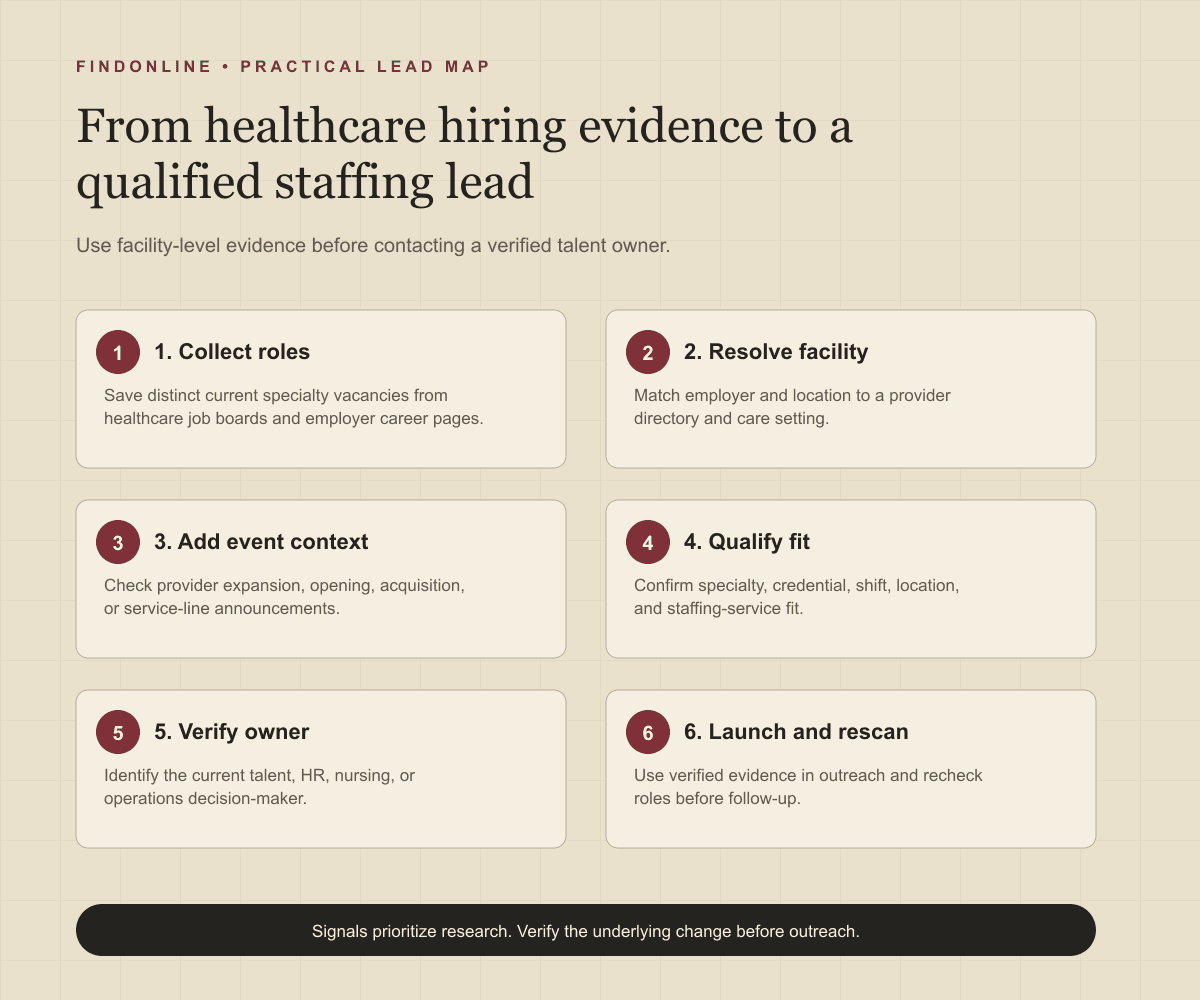
Work the list in six steps:
- Define one service line, geography, care setting, and minimum count of distinct current roles.
- Collect job-board and employer-career evidence without adding a contact yet.
- Resolve the employer to a facility using a provider directory and an additional provider source where needed.
- Add expansion or service-line context and label it proposed, under construction, opened, or acquired.
- Verify the talent, HR, nursing, or operations owner and record why that person owns the decision.
- Score high only where specialty demand, facility fit, and current ownership align. Hold records where the relationship is unclear.
For an implementation pattern that combines research, qualification, and controlled execution, see the FindOnline recruitment and staffing workflow and its stage-level GTM process.
Best tools to automate outreach: which options fit a healthcare hiring workflow?
The right option depends on whether the bottleneck is entity research, signal assembly, contact research, or sequencing. Capability claims below are limited to public product material.
FindOnline
What it does: FindOnline is an end-to-end AI GTM system for public-signal prospecting and LinkedIn, Reddit, and email outreach. Its public material describes AI GTM agents for those channels and an agent that finds and contacts high-intent prospects. FindOnline How FindOnline works
Strengths: For healthcare staffing, it can connect public hiring, professional activity, and facility-change context to multi-channel outreach and ongoing engagement. Teams choose which stages run automatically and which hold for optional review and approval. FindOnline About
Limitations: FindOnline is designed as a complete GTM system rather than a standalone signal-monitoring or enrichment utility. Readers seeking only one isolated component should contact the FindOnline team to discuss a suitable configuration.
Best for: Staffing firms needing public-signal discovery, evidence-backed relationship routing, and end-to-end follow-up around healthcare hiring signals.
LinkedIn Sales Navigator
What it does: Sales Navigator supports lead and account research with filters for company, title, function, seniority, geography, and industry. LinkedIn Sales Navigator filter definitions
Strengths: It is useful after facility qualification because a recruiter can identify the current talent-acquisition or workforce leader and preserve a focused account list. It also documents account filters for open job opportunities posted on LinkedIn. LinkedIn Sales Navigator filter definitions
Limitations: It does not establish that a vacancy is current, specialty-relevant, or connected to an expansion event.
Best for: Recruiters verifying accountable talent owners after healthcare hiring evidence has been collected.
Clay
What it does: Clay can pass finalized outreach to an external sequencer and live campaigns rather than send messages itself. How Clay sends emails
Strengths: It can support a facility-level research table and a documented Outreach handoff that creates or updates prospects and adds them to sequences. Clay Outreach integration
Limitations: A staffing team must design the healthcare qualification rules and maintain the underlying source evidence.
Best for: Operations-minded staffing firms that already use a sequencer and need a configurable evidence layer.
Apollo
What it does: Apollo describes sequences as outreach campaigns that use planned touchpoints over time. Its current Sequences Overview says teams can combine automated email steps with manual phone-call and LinkedIn tasks. Apollo Sequences Overview
Strengths: This makes Apollo useful after a staffing team approves the contact and message context: automatic emails can sit beside deliberate human phone and LinkedIn actions in one multichannel sequence. Apollo Sequences Overview
Limitations: Sequence automation cannot validate whether a clinical hiring cluster represents an agency opportunity.
Best for: Staffing teams standardizing email, call, and LinkedIn follow-up for reviewed contacts.
Common Room
What it does: Common Room presents a context layer that combines conversational and buyer intelligence across CRM, product, marketing, and engagement sources. Common Room
Strengths: It can be evaluated as an additional context layer where a staffing firm already has relevant first-party engagement data.
Limitations: Its healthcare job-board and provider-directory coverage was not confirmed in the cited official material.
Best for: Teams separately evaluating a broader buyer-intelligence layer after confirming source coverage for healthcare accounts.
American Hospital Directory
What it does: American Hospital Directory is a hospital discovery source with search tools and free facility profiles, not a direct outreach competitor. American Hospital Directory
Strengths: It helps resolve hospital identity, geography, services, and facility characteristics before a recruiter researches contacts. American Hospital Directory
Limitations: It is an account-research source, not an outreach automation system, and does not show whether a provider is hiring for a specific specialty.
Best for: Recruiters needing supplementary hospital-entity research alongside employer job evidence.
Tool comparison: how do six options differ for healthcare staffing leads?
| tool | best for | data and discovery | outreach automation | integrations | support and review | limitations |
|---|---|---|---|---|---|---|
| FindOnline | Signal-led healthcare staffing outreach | public signals across hiring, role, and facility context | LinkedIn, Reddit, and email automated outreach | End-to-end GTM workflow; third-party integrations not confirmed | optional review at selected stages | Complete-system fit, not isolated enrichment. |
| LinkedIn Sales Navigator | Finding current talent owners | Account and lead filters | Not confirmed in cited material | Not confirmed in cited material | Filtered searches and job-opportunity account filters documented | Does not validate clinical hiring demand. |
| Clay | Building an evidence table | Configurable research and enrichment table | Handoff to an external sequencer | Outreach prospect and sequence actions documented | Review model not confirmed | Requires healthcare-specific qualification design. |
| Apollo | Sequencing approved contacts | Healthcare-source coverage not evaluated | Automated email plus manual phone and LinkedIn tasks | Specific integration coverage not evaluated | Sequence setup and manual tasks documented | Does not prove clinical staffing fit. |
| Common Room | Evaluating a context layer | Buyer intelligence across stated data sources | Not confirmed in cited material | Not confirmed in cited material | Healthcare review model not confirmed | Healthcare source coverage is unconfirmed. |
| American Hospital Directory | Hospital entity research | Search tools and free hospital profiles | No outreach automation | Not confirmed in cited material | Free profiles documented | A directory source, not a campaign system. |
Outreach workflow: how should a staffing firm turn a signal into a relevant first message?
Start with a verified hiring fact, not a generic assertion that the employer is growing. For a high-score account, write one sentence naming the specialty, facility, and observable event: “I noticed [facility] has several current [specialty] roles following [verified facility event].” Then ask a narrow question about coverage, credentialing burden, hard-to-fill shifts, or local supply.
Use a credible warm introduction only when a real relationship exists and the connector agrees. Otherwise use verified professional commonality, such as the buyer's care setting, workforce remit, role, or community. Do not invent familiarity, staffing problems, or shared connections. If there is no meaningful commonality, send a direct signal-led message.
Use a short sequence: a concise email or LinkedIn message, a useful follow-up tied to the same evidence, then a close-the-loop note. Apollo's current documentation supports combining automated emails with manual phone and LinkedIn tasks, which is a practical split between scaled follow-up and thoughtful human action. Apollo Sequences Overview Suppress contacts who reply, change employer, or no longer own the remit.
Industry-specific nuances: what makes healthcare hiring signals different?
Healthcare employers often operate through parent systems, local facilities, management companies, and separate physician groups. A parent announcement does not necessarily mean the local hospital is the contracting entity. Record the facility and employer relationship before assigning an owner.
In clinical recruiting, role title alone is weak evidence. Credential requirements, licence state, shift pattern, unit, location, and employment type determine whether your candidate supply fits. A multi-role post may be a replacement pipeline, seasonal demand, or centralized posting practice rather than a new staffing project.
Treat clinical sensitivity carefully. Do not infer patient volume, burnout, financial stress, or protected health information from a vacancy. Expansion becomes more relevant when the provider identifies an opening date, service, or location and related roles appear at that site. Lead with workforce delivery and operational fit, not clinical outcomes. Segment campaigns by care setting and specialty instead of sending one message to every healthcare employer.
Limitations: what can hiring signals actually tell you?
Signals are directional rather than guaranteed truth. Use them to prioritize and personalize outreach and follow-ups, verify the underlying change, and rescan signals regularly because departments, roles, and company conditions change. A visible vacancy can close quickly, be duplicated, or represent an internal pipeline rather than external staffing demand.
Public provider data identifies facilities, not buying authority or contract eligibility. Confirm the operating entity, service fit, contact remit, and vendor or procurement requirements through appropriate public and direct channels before advancing an opportunity.
Frequently asked questions: common healthcare hiring-list questions
How many open roles indicate a healthcare company is hiring at scale?
There is no universal threshold. Define a minimum that matches your specialty and territory, then count distinct current requisitions at one employer or service line rather than aggregator copies.
Are facility expansion announcements enough to qualify a staffing lead?
No. An expansion announcement is a timing signal, not proof of immediate hiring or agency use. Confirm the facility, event stage, related roles, and accountable workforce owner before outreach.
Who should a healthcare staffing firm contact first?
Contact the person who owns talent delivery for the facility or service line. Depending on the organization and specialty, that may be a talent-acquisition leader, workforce-planning leader, HR executive, nursing leader, or practice administrator.
How do I avoid duplicate healthcare job postings in my lead list?
Deduplicate by employer, requisition ID, facility, specialty, shift, and location. Keep the employer-career URL where possible and treat aggregator copies as corroboration rather than extra openings.
Should recruiters automate LinkedIn outreach to healthcare employers?
Automation should follow account and contact verification and should reference a public, current hiring signal. Keep sensitive assumptions out of messages and stop outreach when evidence or ownership changes.
Sources
- American Hospital Directory — American Hospital Directory · Accessed
- Sales Navigator lead and account search filter definitions — LinkedIn · Accessed
- FindOnline — FindOnline · Accessed
- How FindOnline works — FindOnline · Accessed
- About FindOnline — FindOnline · Accessed
- How do I send emails with Clay? — Clay · Accessed
- Outreach integration — Clay · Accessed
- Sequences Overview — Apollo · Accessed
- Common Room — Common Room · Accessed