Buyer discovery
How to Find HR Leaders at Companies Announcing Layoffs
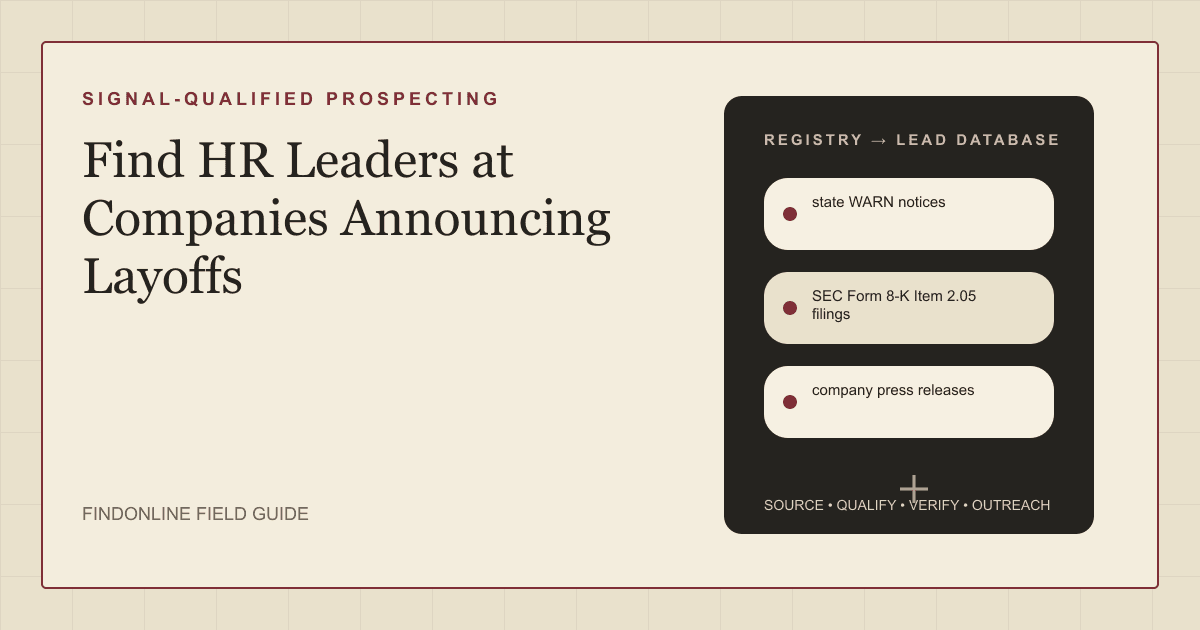
Find HR leaders at companies announcing layoffs using state WARN notices, SEC Form 8-K Item 2.05 filings, company press releases, and leadership pages, then verify the CHRO before outplacement outreach.
By Vaishnav Gupta15 min read
On this page
Quick answer: To find HR leaders at companies announcing layoffs, target the Chief Human Resources Officer (CHRO), Chief People Officer, or VP of People at employers that appear in state WARN notices, SEC Form 8-K Item 2.05 filings, or layoff press releases within the last 60 days. Download your target states' WARN reports this week, then confirm each company's HR leader on its leadership page and LinkedIn before outreach.
Who to target: which HR roles own the outplacement decision?
Target the most senior people leader first, because outplacement, severance design, and manager coaching are approved at the CHRO or Chief People Officer level and executed by total rewards and HR business partner teams. HubSpot, which announced a team reduction in October 2026, describes that seat on its executive biography page: "As chief people officer at HubSpot, Helen Russell has global responsibility for the company" and "She leads recruiting; learning and talent management; total rewards; culture;" among other teams (HubSpot).
Use this role map when the top seat is unclear:
- CHRO or Chief People Officer: approves the outplacement vendor, severance terms, and communication plan. Primary target above roughly 500 employees.
- VP or Head of People: the equivalent decision-maker at mid-sized companies and startups, often with no total rewards layer beneath.
- Director of Total Rewards or Benefits: scopes outplacement tiers by employee level and compares providers.
- VP of HR Business Partners: runs notification logistics and manager training, and sponsors change-management consulting.
Qualify the account before the person. The federal WARN rule applies to a "mass layoff" that "results in an employment loss at the single site of employment during any 30-day period" meeting the headcount tests, and to plant closings "for 50 or more employees, excluding any part-time employees" (Cornell LII, 20 CFR 639.3). Smaller reductions never appear in WARN data, so pair the registries with filings and press releases.
Lead sources: where do layoff announcements and HR contacts surface first?
The fastest sources are the ones the employer is legally required to update. Three of the five below are reviewed starting points; the two filing-based sources catch reductions under WARN thresholds. Texas's WARN page did not resolve for the research browser, so California and Washington stand in as registry examples.
- state WARN notices - Each state workforce agency publishes the notices employers file 60 days before a covered layoff. California posts a downloadable report and requires the notice to include the "Name, phone number, and email of a company contact" plus job titles and headcount (California EDD). Washington's table shows the "Name of the employer and location(s) of layoff or closure." and confirms "You can subscribe to WARN notifications from Employment Security" (Washington ESD). The named contact is frequently an HR director.
- SEC Form 8-K Item 2.05 filings - Public companies disclose restructuring plans under Item 2.05, Costs Associated with Exit or Disposal Activities. Fair Isaac's October 2026 filing states, "This plan involves the elimination of approximately 15% of positions across the Company." and that "Affected employees were notified beginning the week of October 5, 2026." (SEC EDGAR). Filings often precede the WARN notice.
- company press releases - CEO messages give scale, reason, and the support already promised. HubSpot's October 2026 update announced a plan to "reduce the size of our team by ~7%" and promised departing employees "six months of career transition outplacement services to help with their job search" (HubSpot). A named outplacement commitment means the primary vendor is chosen, which changes your offer.
- company leadership pages - Confirm the current HR executive and exact title here before trusting any database. HubSpot's Chief People Officer biography is the pattern to look for (HubSpot).
- HR leadership profiles - LinkedIn Pages include a People tab that "only appears if the Page has one or more employees associated with it" (LinkedIn Help). Use it to find the VP of People, Total Rewards director, and HRBP lead beneath the CHRO.
For an adjacent HR-leader workflow built on expansion signals, see how staffing firms find HR leaders at manufacturers opening new facilities.
Lead database: how should a layoff-signal lead list be structured?
Structure the list around the layoff event, not the company, because one employer can file several notices across sites and waves. Each row should answer: how big, how soon, who decides, and what has already been bought.
| Field | Where it comes from | How to verify |
|---|---|---|
| Employer name and site | WARN report or 8-K cover page | Match the site to the parent on the leadership page |
| Affected headcount and titles | WARN columns; 8-K percentage | Prefer the notice figure |
| First separation date | Notice date plus 60 days; 8-K timeline | Reopen the notice for amendments |
| Permanent or temporary | WARN type column | Deprioritize temporary or furlough rows |
| Named company contact | WARN contact field | Check title on LinkedIn; often HR, sometimes legal |
| HR decision-maker and title | Leadership page, then LinkedIn People tab | Confirm the role is current and company-wide |
| Outplacement already promised | CEO message or press release | Record the provider or duration if named |
| Reason stated | 8-K or press release | Classify as restructuring, AI, closure, or acquisition |
| Trigger stage | Derived | Announced, notified, or separating |
Reusable research prompt:
For [company], find the most recent state WARN notice, 8-K Item 2.05 filing, or newsroom post about a workforce reduction. Return affected headcount, first separation date, sites, permanent or temporary, any outplacement terms named, and the current CHRO or VP People with a leadership page or LinkedIn source.
Step-by-step workflow:
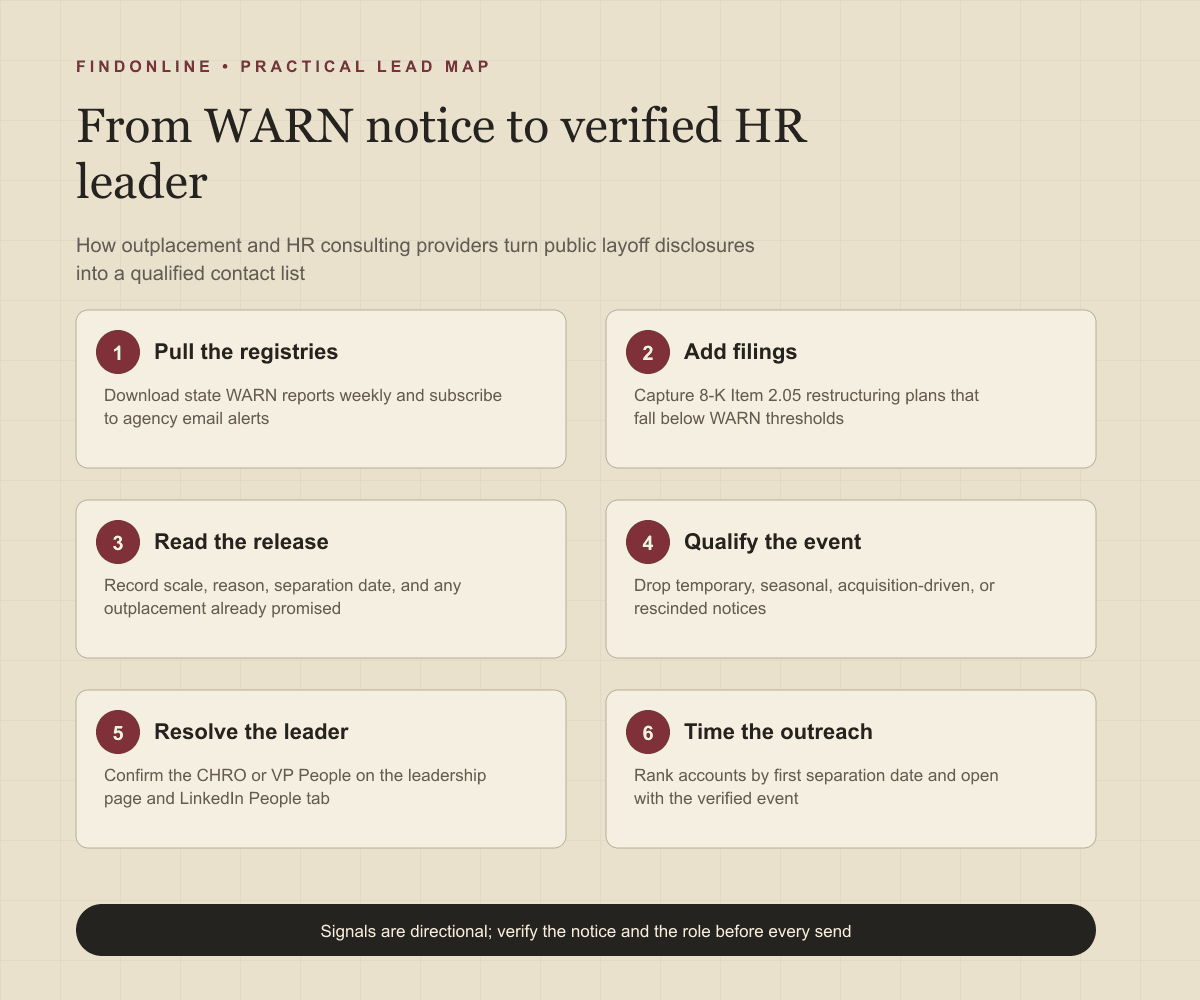
- Download the WARN report for each target state weekly and subscribe to email alerts where offered.
- Add public companies from 8-K Item 2.05 filings, which capture reductions below WARN thresholds.
- Read the press release and record scale, reason, and any outplacement already promised.
- Resolve the HR leader on the leadership page, then map the Total Rewards and HRBP layer on LinkedIn.
- Tag trigger stage and separation date, and rank accounts whose first separations are more than 30 days out.
Best tools to automate outreach: which tools fit a layoff-signal workflow?
No tool below replaces the registries; each speeds a different step between a notice and a conversation.
FindOnline
What it does: FindOnline runs an end-to-end GTM system with "AI GTM agents for LinkedIn, Reddit and Email." It finds and qualifies prospects from public signals such as leadership posts and role changes, selects an evidence-backed relationship route, and runs outreach and reply handling (FindOnline).
Strengths: A provider can load WARN-derived accounts and let the agent watch HR leaders' posts and role changes, then adapt outreach to what is publicly verifiable. Stage controls are explicit: "You choose which stages run automatically and which hold for approval." (FindOnline). Review is optional, which suits sensitive layoff timing.
Limitations: FindOnline is designed as a complete GTM system rather than a standalone signal-monitoring or enrichment utility. Providers who want only a WARN feed or only enrichment should contact the FindOnline team to discuss a suitable configuration.
Best for: Outplacement and HR consulting firms that want layoff-triggered discovery, LinkedIn, Reddit, and email outreach, and follow-up in one automated flow with approval holds on the first touch.
LinkedIn Sales Navigator
What it does: Sales Navigator finds and tracks the people layer. You can "Search with 50+ filters like function, seniority level, years at company" and receive "alerts when saved accounts add new decision-makers or saved leads change jobs" (LinkedIn Sales Solutions).
Strengths: Saving every WARN-listed employer as an account surfaces the CHRO, Total Rewards, and HRBP seats, and alerts flag when a people leader departs after the reduction. The page also describes CRM lead creation and a dedicated account team option (LinkedIn Sales Solutions).
Limitations: It does not surface the layoff event itself; no WARN or restructuring filter is confirmed on the cited page, so the account list must come from registries first.
Best for: Providers who already maintain a WARN watchlist and need to map and monitor HR decision-makers at each employer.
Apollo
What it does: Apollo combines a contact database with automated plays. Its job-change play describes a continuous process: "When it finds matching contacts, it enriches their data, notifies you, and queues them up for immediate engagement." (Apollo).
Strengths: HR leaders often move within months of running a reduction, and the play can catch a known CHRO landing at a new employer, enrich the new email, and start a sequence with email and Slack alerts (Apollo).
Limitations: The play triggers on contact title changes, not company layoff events, so a WARN notice must be imported as a list first.
Best for: Outplacement firms re-engaging HR leaders they met during a prior reduction who have since changed companies.
Clay
What it does: Clay is a workflow and enrichment builder. Its homepage states you can "Create intent signals from anything on the internet." and "Trigger emails, ads, and more with integrations to your existing GTM tools." (Clay).
Strengths: A provider can paste a WARN report, enrich each employer with headcount and the HR leader, score by separation date, and push qualified rows to a sequencer. A formal support model is not confirmed in the cited official material (Clay).
Limitations: Clay supplies no layoff dataset of its own; the WARN signal depends on which provider you configure, and the table logic must be built and maintained by your team.
Best for: HR consulting teams with an operator who can build a weekly WARN-to-enrichment table and route qualified accounts into outreach.
ZoomInfo
What it does: ZoomInfo's General News Signal play uses its Scoops feature to "Identify news signals within specific category types for your ICP" and "Filter companies to meet specific criteria based on news category" before enrolling accounts in a campaign (ZoomInfo).
Strengths: The play names company-wide layoffs as an example of news that should prompt outreach, so a provider can filter Scoops to layoff events and attach HR contacts (ZoomInfo). Support details are not confirmed in the cited official material.
Limitations: The cited page does not state how quickly a state WARN filing becomes a Scoop or how fully small private employers are covered.
Best for: Larger outplacement providers already running ZoomInfo that want layoff news routed into existing campaigns.
Lemlist
What it does: Lemlist is a multichannel sequencer. Its site says you can "Reach leads via email, LinkedIn, calls, WhatsApp, and SMS." and connects with HubSpot and Salesforce (Lemlist).
Strengths: Simple to run a three-touch sequence per WARN cohort with manual LinkedIn steps for senior HR leaders, and "our support team is just a click away via the in-app chat" (Lemlist).
Limitations: Lemlist is an outreach layer only; no WARN, filing, or news trigger is confirmed, so every cohort must be qualified and uploaded by hand.
Best for: Boutique HR consultancies that qualify a handful of layoff accounts each week and want straightforward sequencing.
Tool comparison: how do the six options differ for layoff-triggered outreach?
ZoomInfo doubles as a signal source because its news signals can feed discovery, not only outreach.
| tool | best for | data and discovery | outreach automation | integrations | support and review | limitations |
|---|---|---|---|---|---|---|
| FindOnline | Layoff-signal to outreach flow for outplacement providers | Public signals: HR leader posts, role changes, communities | Automated LinkedIn, Reddit, and email outreach with replies | Not confirmed in the cited official material | Optional review per stage; approval holds configurable | Complete GTM system, not a standalone signal utility |
| LinkedIn Sales Navigator | Mapping HR seats at WARN-listed employers | 50+ people filters; alerts on saved leads and accounts | Not confirmed in the cited official material | CRM lead and contact creation | Help Assistant; dedicated account team option | No layoff or WARN filter; needs external account list |
| Apollo | Re-engaging HR leaders who changed companies | Contact database with job-change plays | Sequences queued automatically from plays | Email and Slack alerts described | Not confirmed in the cited official material | Triggers on title changes, not company layoff events |
| Clay | Building a weekly WARN enrichment table | Build signals from internet sources; marketplace data | Triggers emails through connected tools | Integrations with existing GTM tools | Community and learning content; support model unconfirmed | No native layoff dataset; workflow built in-house |
| ZoomInfo | Routing layoff news into existing campaigns | Scoops news signals filtered by category | Enroll in news-triggered campaigns | Not confirmed in the cited official material | Not confirmed in the cited official material | WARN-to-Scoop lag and small-employer coverage unconfirmed |
| Lemlist | Simple sequences per qualified cohort | Lead database; no layoff signal | Email, LinkedIn, calls, WhatsApp, SMS campaigns | HubSpot and Salesforce | In-app chat support | Outreach only; no WARN or news trigger confirmed |
Outreach workflow: how do you contact HR leaders during a reduction?
Contact the HR leader after the public announcement and before the first separation date, and lead with the specific event rather than a generic pitch. The window is usually the 60-day WARN period.
- Open with the verified event. Reference the filing or notice by date and scale, for example a 15% reduction disclosed on a given date.
- Choose the relationship route. A warm introduction through a shared former colleague is one possible route when it genuinely exists. Otherwise, use only verified professional commonality such as HR association membership or a public post the leader wrote about the transition. If neither exists, send a direct signal-led message.
- Offer one concrete next step. Propose a 20-minute review of their notification timeline, manager talking points, or coverage for levels the primary vendor excludes.
- Sequence across channels. A LinkedIn note, then email, then a follow-up tied to the separation date. FindOnline can run these stages automatically and hold the first touch for approval (FindOnline).
- Follow up on the survivors. After separations, shift the message to retention and manager coaching for remaining teams.
How this maps to FindOnline's stages is described on how FindOnline works, and the consultancy use case on the FindOnline for consultancies page.
Industry-specific nuances: what is different about selling into a layoff?
Outplacement is often bought before the notice is public, so the earliest signals win. Challenger, an outplacement firm, advises CHROs to plan "a conversation with your outplacement provider before the first separation happens, not after" (Challenger, Gray & Christmas). Practical consequences:
- A named provider is not a dead end. HubSpot's message promised six months of outplacement, so the executive tier is covered but manager coaching, retention programs, and alumni support may not be (HubSpot).
- Multi-site notices signal multi-wave programs. An employer filing in several states usually has a central Total Rewards owner; sell at headquarters.
- The 8-K gives you the clock. Fair Isaac's filing stated notification began the week of October 5, 2026, so the practical window for a first conversation was the days after the filing (SEC EDGAR).
- False positives to exclude. Temporary layoffs, seasonal closures, relocations after an acquisition, and rescinded notices rarely buy outplacement. Government and school district notices usually follow procurement rules rather than a CHRO decision.
- HR leaders are the affected population too. People teams are often reduced in the same event, so verify the leader's current role immediately before sending.
Limitations: how reliable are layoff signals?
Layoff signals are directional rather than guaranteed truth. A WARN notice shows a legal obligation was triggered, not that budget exists for outplacement or consulting, and a filing percentage can change before separations begin. Use these signals to prioritize which accounts to work first and to personalize the opening message and follow-ups, then verify the underlying change on the company's own pages and rescan the registries and filings regularly, because notices are amended, HR leaders change roles, and companies announce second waves.
Frequently asked questions
How soon after a WARN notice should outplacement providers reach out?
Reach out within the first week after the notice posts. Federal WARN requires 60 days' notice before a covered layoff, so most vendor decisions are finalized during that period. Waiting until separations begin usually means the primary provider is already contracted.
Do WARN notices name the HR contact at the company?
Often, yes. California requires the notice to include the name, phone number, and email of a company contact, frequently an HR or employee relations leader. Confirm the title on LinkedIn, because some employers list legal or operations contacts.
What if a layoff is too small to appear in WARN data?
Use SEC Form 8-K Item 2.05 filings for public companies and newsroom or CEO messages for private ones. These capture reductions below the 50-employee site threshold and often state the percentage affected and the notification timeline.
Is it appropriate to contact HR leaders during a layoff?
Yes, when the message is specific, respectful, and offers help with the work they are doing that week. Lead with the public event and a concrete offer such as reviewing notification plans, and avoid language that presumes distress or references private details.
Sources
- 20 CFR 639.3 - Definitions — Cornell Law School Legal Information Institute · Accessed
- Worker Adjustment and Retraining Notification (WARN) Information for Employers — California Employment Development Department · Accessed
- Worker Adjustment and Retraining Notification (WARN) — Washington State Employment Security Department · Accessed
- Fair Isaac Corporation Form 8-K, Item 2.05 — U.S. Securities and Exchange Commission EDGAR · Accessed
- A message from our CEO: Important HubSpot team and business changes — HubSpot · Accessed
- Helen Russell, Chief People Officer — HubSpot · Accessed
- Budgeting for Outplacement When Terminations Are Part of Business as Usual — Challenger, Gray & Christmas · Accessed
- LinkedIn Pages for members — LinkedIn Help · Accessed
- LinkedIn Sales Navigator — LinkedIn Sales Solutions · Accessed
- Engage decision-makers who just changed jobs — Apollo · Accessed
- Clay - Go to market with unique data and the ability to act on it — Clay · Accessed
- General News Signal play — ZoomInfo · Accessed
- lemlist - Multichannel outreach platform — Lemlist · Accessed
- FindOnline - AI GTM agents — FindOnline · Accessed
- About FindOnline — FindOnline · Accessed