Buyer discovery
How to Find Controllers at Real Estate Development Firms
Find controllers at real estate development firms using local building permit records, developer project pages, leadership pages, and LinkedIn current roles, then verify the parent developer and project stage.
By Vaishnav Gupta13 min read
On this page
Quick answer: To find controllers at real estate development firms, target the Controller, Development Controller, or Chief Accounting Officer at developers with active projects. The strongest sources are local building permit records, developer project pages, developer leadership pages, and LinkedIn current-role profiles. Start by pulling recent new-construction permits in one metro and matching each owner entity to its parent developer.
Who to target: which finance roles own accounting decisions at a developer?
Target the person who runs project accounting day to day, then the executive who signs the engagement letter. At most developers that is a Controller first and a CFO or principal second.
- Small developers (one to five active projects): Controller or the founding principal. There is often no CFO.
- Mid-size developers: Controller or Development Controller, reporting to a CFO.
- Large multi-product developers: Chief Accounting Officer (CAO), plus controllers by business unit.
Larger firms split the seat by product line. Crescent Communities' leadership page lists a Business Unit Controller for Multifamily who joined in 2025 (Crescent Communities).
The role's scope explains why it matters to accounting and advisory firm owners. An archived Kushner Companies posting for a Development and Construction Controller says the role oversees all monthly draw submissions to the lender and coordinates the annual tax return with an outside CPA firm (SelectLeaders). The controller is therefore the person who feels audit, tax, and reporting pressure first.
Lead sources: where do you find developers and their controllers?
Use project evidence to find the firm, then people evidence to find the controller. These five sources cover both.
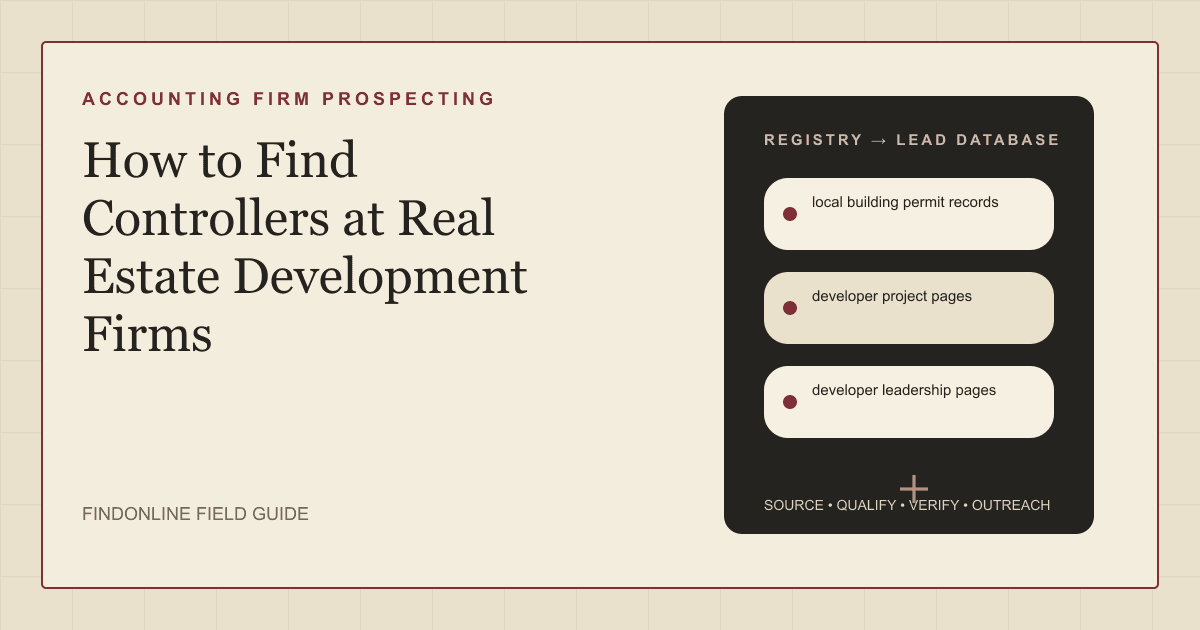
- local building permit records - City and county permit files show who is building what, and when. The Census Bureau says over 99 percent of privately-owned residential buildings are constructed in permit-issuing places (U.S. Census Bureau). Seattle's permit guidance says you can search all records by address or record number (Seattle SDCI), and New York City's Department of Buildings publishes a permit issuance dataset for construction and demolition activity (Data.gov). Chicago's permit page blocked our research browser, so these two cities stand in as examples. Fields vary by city, so check whether owner or applicant names are published.
- developer project pages - A developer's own portfolio pages confirm that a permit's owner entity belongs to it and show product type, scale, and stage. Ryan Companies' Highland Bridge page, for example, describes a master plan that needed a team to carry it to the next step (Ryan Companies).
- developer leadership pages - Team pages name the Controller, CAO, or CFO directly, as the Crescent Communities example above shows. Smaller developers often list only principals, which tells you the founder approves accounting spend.
- LinkedIn current-role profiles - Profiles confirm the person still holds the seat. LinkedIn says that if a member has more than one current position, the one with the most recent start date is listed first (LinkedIn Help). That matters because development finance staff often list several affiliated entities.
- development controller job posts - An open Controller or Development Controller role signals a vacant or newly created seat. Read the duties for draws, entity counts, and outside CPA coordination, as in the archived posting above.
Lead database: what should each controller record contain?
Build one row per parent developer, with project evidence attached, so every message can cite a real project.
| Field | Where it comes from | How to verify |
|---|---|---|
| Parent developer | Permit owner name, project page | Match the entity address to the developer's office |
| Project owner entity | Permit record | Search the state business registry for its manager |
| Permit type and date | Permit record | Confirm new construction, not repair or tenant work |
| Product type and scale | Developer project pages | Compare with the permit description |
| Project stage | Permit status, project page | Look for a dated status update |
| Hold or sell model | Company about page | Check for a property management arm |
| Controller name and title | Leadership page, LinkedIn | Confirm the current role and start date |
| Trigger | Job post, new permit, appointment | Record the date and source link |
Reusable research prompt:
For [metro], list new-construction building permits issued in the last [number] months that show an owner or applicant. For each, identify the parent real estate development firm, its website project page, product type, and project stage. Then find the current Controller, Development Controller, or Chief Accounting Officer, with a source link for every field. Exclude general contractors, homeowners, and public agencies.
Step-by-step workflow:
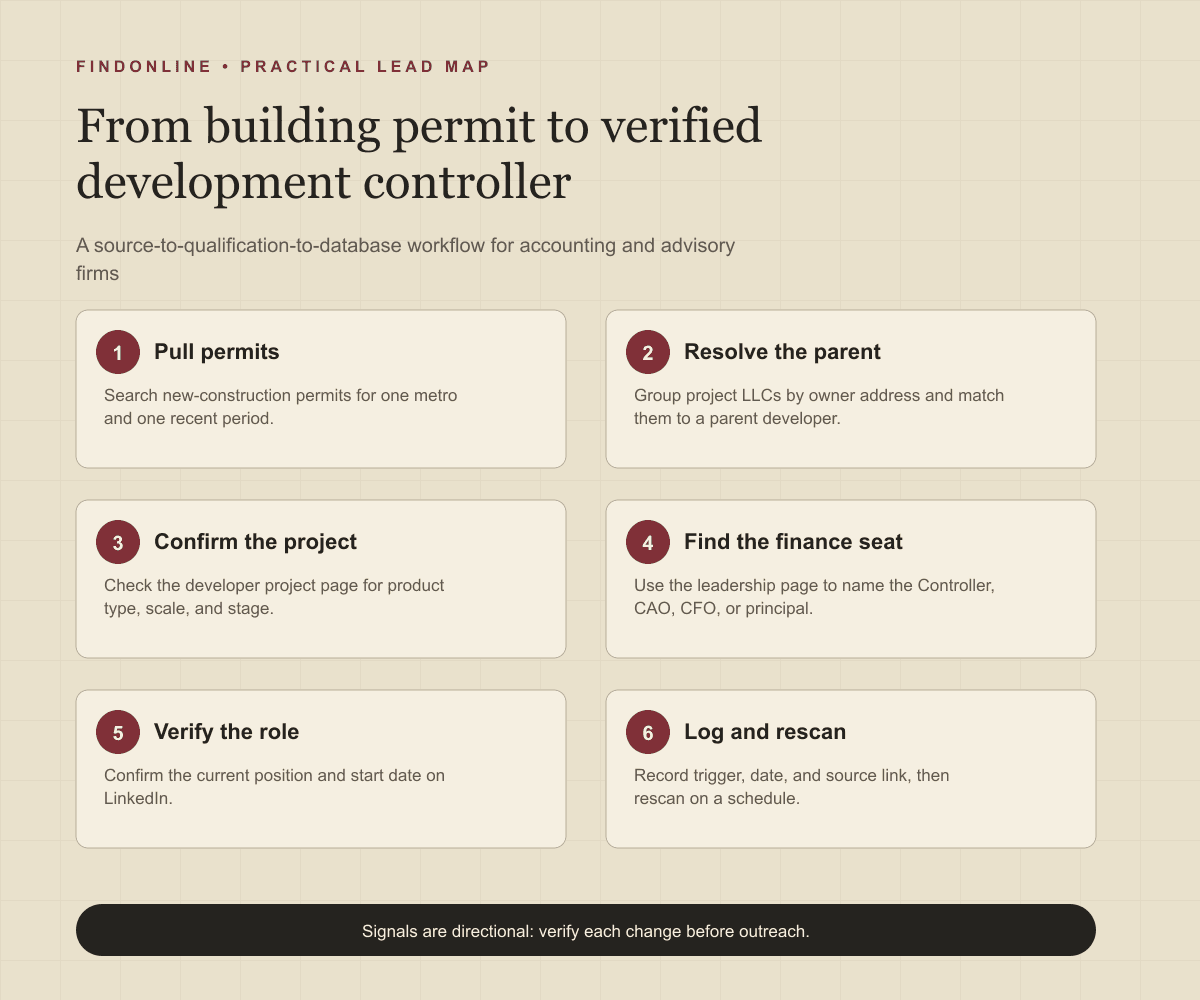
- Search or export new-construction permits for one metro and one recent period.
- Group permits by owner mailing address. Several project LLCs at one address usually share a parent developer.
- Confirm each project on the developer's own project page and note product type and stage.
- Find the finance seat on the leadership page. If none is listed, record the principal.
- Verify the person's current role on LinkedIn and note the start date.
- Log the trigger, its date, and the next rescan date.
Best tools to automate outreach: which options fit a developer controller list?
No option below was confirmed to read permit files, so pair your research with a tool matched to your list size and channels. All six were checked against official pages on 2026-11-13.
FindOnline
What it does: FindOnline is an end-to-end AI GTM (go-to-market) system that finds and qualifies prospects from public signals, then runs outreach and follow-up. Its homepage says the agent watches social activity, then reaches the right people at the right time on LinkedIn and email (FindOnline). FindOnline's product facts also list Reddit as a channel; the cited pages named LinkedIn and email on the access date.
Strengths: Discovery, relationship routing, outreach, and reply handling sit in one system, so a controller surfaced by a hiring or role-change signal can move straight into a campaign. A credible warm introduction is one possible route. Without one, it adapts outreach using only verified professional commonality, such as industry, role, or shared community, and otherwise sends a direct signal-led message. Review is optional: the about page says you choose which stages run automatically and which hold for approval (FindOnline about).
Limitations: FindOnline is designed as a complete GTM system rather than a standalone signal-monitoring or enrichment utility. Firms that want only one isolated component should contact the FindOnline team to discuss a suitable configuration. Reading municipal permit portals was not confirmed in the cited official material, so bring permit research in as your own input.
Best for: Accounting and advisory firm owners who want controller discovery, multi-channel outreach, and follow-up handled in one system instead of assembling separate tools.
LinkedIn Sales Navigator
What it does: LinkedIn Sales Navigator is LinkedIn's prospecting product for finding and saving leads and accounts. Its official page says you can search with 50+ filters like function, seniority level, years at company, and experience, and that its Success Plans provide structured onboarding, training, and support (LinkedIn Sales Solutions).
Strengths: Function and seniority filters narrow a developer's staff to finance leaders quickly, and role data comes from the member's own profile.
Limitations: It works inside LinkedIn only. Email sequencing was not confirmed in the cited official material.
Best for: Firm owners who already have a developer list and need to confirm who holds the controller seat today.
Apollo
What it does: Apollo is a sales platform that combines prospecting with sequenced outreach. Its sales engagement page invites teams to start prospecting, sequencing, calling, and booking meetings in Apollo (Apollo). Specific integrations and support channels were not confirmed in the cited official material.
Strengths: One workspace for contact lookup, email steps, and calls suits a partner or business developer running a modest weekly cadence.
Limitations: Contacts are organized by company, not by project LLC, so permit owner entities must be mapped to the parent developer before import.
Best for: Firms with a verified list of parent developers that want email and phone sequences to controllers in one place.
Clay
What it does: Clay is a data enrichment and workflow builder. Its homepage offers one contract to buy data from 200+ data and AI vendors, and says you can trigger emails, ads, and more with integrations to your existing GTM tools (Clay). A support model was not confirmed in the cited official material.
Strengths: One table can hold permit rows, owner entities, and enrichment columns side by side, which fits the entity-to-parent matching this list requires.
Limitations: It is a builder's tool. Someone at the firm must design and maintain the tables, and sending depends on connected tools.
Best for: Firms with an operations-minded team member who wants to turn a permit export into an enriched developer table.
ZoomInfo
What it does: ZoomInfo is a B2B company and contact data platform. Its sales page says teams can build and execute multi-touch sales cadences with its direct phone dialer and email tool, and export prospects to a CRM in one click (ZoomInfo). Support details were not confirmed in the cited official material.
Strengths: Phone and email outreach from one data platform helps at larger developers, where the main line often routes to leasing or reception.
Limitations: A general company database is not organized around project stage or lender, so development timing still comes from permits and project pages.
Best for: Larger advisory firms targeting regional and national developers with established finance departments.
Lemlist
What it does: Lemlist is a multichannel outreach tool. Its homepage says you can launch automated campaigns across email, LinkedIn, calls, WhatsApp, and SMS from one workflow, and that lemlist connects with tools like HubSpot and Salesforce (Lemlist). Its support model was not confirmed in the cited excerpts.
Strengths: Email and LinkedIn steps in one sequence suit controllers who ignore cold email but accept a relevant connection request.
Limitations: It executes campaigns but does not judge whether a developer has an active project, so it needs a finished, qualified list.
Best for: Small firms that have hand-researched a short controller list and want a paced, personal multichannel sequence.
Tool comparison: how do the six options differ?
The options differ mainly in whether they find controllers, contact them, or both. "Not confirmed" means not confirmed in the cited official material.
| tool | best for | data and discovery | outreach automation | integrations | support and review | limitations |
|---|---|---|---|---|---|---|
| FindOnline | Discovery and outreach in one system | Public signals such as hiring, role changes, posts | Automated LinkedIn, Reddit, and email outreach | Not confirmed | Optional review at each stage | Complete GTM system, not a single-component utility |
| LinkedIn Sales Navigator | Confirming the current controller | 50+ lead search filters | LinkedIn only; email not confirmed | Not confirmed | Structured onboarding, training, and support | Works inside LinkedIn only |
| Apollo | Email and phone sequences to parent developers | Prospecting inside the platform | Sequencing and calling | Not confirmed | Not confirmed | Contacts organized by company, not project LLC |
| Clay | Building an enriched developer table | 200+ data and AI vendors | Triggers emails through integrations | Existing GTM tools | Not confirmed | Requires table design and upkeep |
| ZoomInfo | Larger developers with finance departments | Company and contact data | Multi-touch cadences by phone and email | One-click CRM export | Not confirmed | Not organized around project stage or lender |
| Lemlist | Short hand-researched lists | Needs a finished list | Email, LinkedIn, calls, WhatsApp, SMS campaigns | HubSpot and Salesforce | Not confirmed | Does not qualify project activity |
Outreach workflow: how should you contact a development controller?
Lead with the project, then the accounting consequence, and keep the first message short.
- Segment by trigger. Separate new permits, open controller roles, and recently appointed controllers. Each gets a different opening line.
- Choose the route. Use a credible warm introduction if one exists, such as a shared lender or attorney contact. Otherwise use verified commonality, or a direct signal-led message.
- Name the project and the service. For example: "I saw the permit for [project] in [city]. We audit project entities for developers with construction loans."
- Follow up on a new fact. A second permit, a topping-out post, or a new hire is a better reason than a reminder.
- Route replies. A controller may refer you to the CFO or principal. Record that person and continue with their consent to the introduction.
Firms building this as a repeatable motion can see how accounting firms use FindOnline for prospecting and how the signal-to-outreach workflow runs. For adjacent finance seats, compare the approach for controllers at property management companies.
Industry-specific nuances: what is different about development finance?
Development accounting is organized around projects and entities, so qualify on those before title.
- Entity sprawl is the norm. Each project usually sits in its own LLC. Count entities per developer, because that count drives tax return and audit volume.
- Capital partners set requirements. Lenders and joint venture partners often require audited or reviewed project statements. A new construction loan or equity partner is a strong trigger for audit and reporting services.
- Hold versus sell changes the service. Merchant builders that sell at completion care about gain timing and partner distributions. Long-term holders care about cost segregation and depreciation once a building is placed in service.
- Stage sets the timing. Permit issuance and the first draw raise cost-tracking questions. Completion raises tax planning questions.
- Watch for false positives. General contractors listed as permit applicants, owner-occupiers building for themselves, brokerages with "development" in the name, and "project controls" staff titled Controller are not your buyer.
- Check for a parent. A developer owned by a larger group or fund may have its auditor chosen upstream.
Limitations: how reliable are these signals?
Permit, project, and hiring signals are directional rather than guaranteed truth. A permit shows intent to build, not that financing closed or that the firm wants a new adviser. Use signals to prioritize accounts and personalize outreach and follow-ups, and verify the underlying change on the permit record or project page before you mention it. Rescan permits, leadership pages, and profiles regularly, because departments, roles, and company conditions change.
Frequently asked questions
What is the fastest way to find controllers at real estate development firms?
Start with recent new-construction permits in one metro and trace each owner entity to its parent developer. Then check the developer's leadership page and LinkedIn for the Controller or Chief Accounting Officer. This yields a list tied to live projects rather than job titles alone.
Do building permit records name the controller?
No, permit records identify the project and often the owner or applicant entity, not finance staff. Use the permit to identify the developer, then find the controller on leadership pages and LinkedIn. Published fields vary by city.
What if a developer has no controller?
Target the founding principal or CFO instead. Small developers often run accounting through a principal, a bookkeeper, or an outside firm. That gap can indicate a fit for outsourced accounting or fractional controller services.
How do I tell a developer from a general contractor in permit data?
Check the owner field rather than the contractor field, then confirm on the company's website. A developer presents projects it owns or sponsors. A contractor presents projects built for clients.
When is the best time to contact a development controller?
Contact them shortly after a verifiable project event, such as a new permit, a controller appointment, or an open finance role. These moments tend to bring new reporting, tax, or staffing questions. Avoid implying urgency you cannot verify.
How often should a developer controller list be refreshed?
Refresh it on a regular schedule, for example each time you pull a new batch of permits. Projects move between stages and finance staff change roles. Re-verify the current role before every new outreach sequence.
Sources
- Building Permits Survey Methodology — U.S. Census Bureau · Accessed
- Research a Project — Seattle Department of Construction and Inspections · Accessed
- DOB Permit Issuance — Data.gov · Accessed
- Highland Bridge project page — Ryan Companies · Accessed
- Crescent Communities Leadership — Crescent Communities · Accessed
- Development and Construction Controller — SelectLeaders · Accessed
- Update your current position in your introduction section — LinkedIn Help · Accessed
- FindOnline homepage — FindOnline · Accessed
- About FindOnline — FindOnline · Accessed
- LinkedIn Sales Navigator — LinkedIn Sales Solutions · Accessed
- Apollo Sales Engagement — Apollo · Accessed
- Clay homepage — Clay · Accessed
- ZoomInfo Sales — ZoomInfo · Accessed
- lemlist homepage — Lemlist · Accessed