Buyer discovery
How to Find Construction Subcontractors Winning Public Contracts
Find construction subcontractors winning public contracts using SAM.gov subcontract reports, state DOT award tables, state DBE directories, and company pages, then verify the owner or controller before outreach.
By Vaishnav Gupta14 min read
On this page
Quick answer: To find construction subcontractors winning public contracts, target the owner, president, or controller at specialty trade firms named in SAM.gov subcontract reports, state procurement award notices, and state DBE directories. Start by pulling first-tier subcontract reports on SAM.gov for construction work, confirm each firm's trade and states of performance on its company page, then verify who runs finance before accounting outreach.
Who to target: which roles at a public-contract subcontractor choose an accounting firm?
Target the owner or president at subcontractors with fewer than roughly 100 employees, and the controller or CFO once the firm is large enough to have one. Electrical, mechanical, concrete, paving, and site-work subcontractors usually decide at the top, because the owner signs the bond indemnity, the certified payroll statement, and the tax return.
- Owner, president, or managing member where an office manager runs the books. This person feels every certified payroll deadline and retainage delay.
- Controller or CFO at subcontractors with several crews and states of performance. They own job costing and the work-in-progress schedule a surety reviews.
- Office or contracts manager who prepares subcontract reports and compliance paperwork. They rarely sign the engagement but often raise the problem first.
Buying triggers include a first federal subcontract, a new Disadvantaged Business Enterprise (DBE) certification, a jump in award size, and work in a new state. Each adds reporting an owner-run back office has not handled before.
False positives are common: prime contractors dominate SAM.gov award records, material suppliers appear in first-tier subcontract reports, and national subcontractors already employ finance teams. Qualify size and trade before adding anyone.
Lead sources: where do subcontractors winning public contracts appear?
The strongest sources are federal subcontract reports, state award tables, DBE directories, and the subcontractors' own pages, used in that order. The Tennessee DOT letting page, the Florida UCP directory, and Helix Electric's project filter blocked retrieval today, so Connecticut, Iowa, and Bergelectric stand in as worked examples.
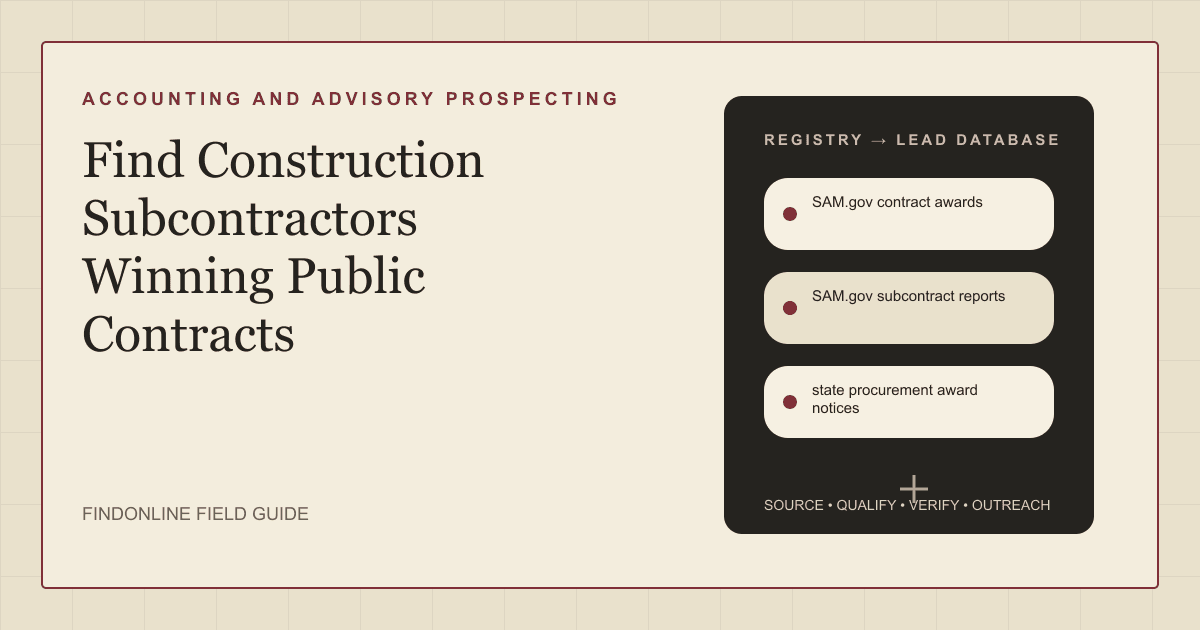
- SAM.gov contract awards list federal prime contract actions. SAM.gov says contract data provides "detailed information on all contract actions that are required to be reported by federal agencies," covering "actions with an estimated value of $10,000 or more" (SAM.gov contract data). Filter by construction codes and place of performance to find primes whose subcontractors you want, plus small subcontractors holding direct awards.
- SAM.gov subcontract reports name the subcontractors themselves. Under FAR clause 52.204-10, a prime reports each qualifying first-tier subcontract by "the end of the month following the month of award of a first-tier subcontract," including the subcontractor's "primary performance location including street address, city, state" (FAR 52.204-10). The system changed: "FSRS.gov was retired, and all subaward reporting data and functionality are now on SAM.gov," and "There is a public subaward API and public subcontract API" for bulk downloads (SAM.gov subaward reporting).
- state procurement award notices list state-funded construction awards and often the certified subcontractor. Connecticut DOT publishes a table where "you can find all the 2026 CTDOT project awards categorized by bid opening month," with columns for bid opening date, project number, contractor, and DBE or SBE firm (Connecticut DOT project awards). Many states publish only PDF letting reports, so prefer HTML tables like this one.
- state DBE directories list certified small subcontractors with trade codes and contacts. Iowa DOT describes its directory as "in real time with additions, removals, and changes in information being made as they are approved," listing each firm's name, address, contact details, and NAICS codes (Iowa DOT DBE Directory). Certified firms are usually big enough to need a CPA and too small to employ one.
- subcontractor company pages confirm trade, markets, and scale. Bergelectric's federal page says it "is a go-to contractor for federal and municipal work across the country" and "We have built border facilities from California to Texas" (Bergelectric federal and municipal). That signals a national firm with in-house finance; a page listing three courthouse jobs in one state signals the opposite.
Lead database: which fields make a subcontractor list ready for outreach?
A useful list records the award, the certification, the footprint, and the finance owner for every subcontractor, each tied to the record that proved it.
| Field | Where it comes from | How to verify |
|---|---|---|
| Legal name and UEI | SAM.gov subcontract reports, DBE directory | Match the company page and state registry |
| Trade and NAICS code | Subcontract report, DBE directory | Read services on the company page |
| Latest subcontract: date, amount, agency, prime | SAM.gov subcontract reports | Open the report; note the filing month |
| State award role: prime or DBE/SBE firm | State DOT award table | Confirm the firm column on the project row |
| DBE or SBE status and certifier | State DBE directories | Check the status date |
| States of performance | Report performance location, project pages | Count distinct states across awards |
| SAM registration status | SAM.gov entity search | Note expiry |
| Finance lead and title | Company page, LinkedIn | Confirm current role and company |
| Trigger and date | Award, certification, or state change | Record the source URL |
Reusable research prompt:
For [company], a [trade] subcontractor in [state]: find its most recent first-tier
subcontract on SAM.gov (date, amount, agency, prime), any DBE or SBE certification,
the states where it performed public work in the past 24 months, and the person
who runs finance. Cite the record URL for each answer and flag suppliers.
Workflow:
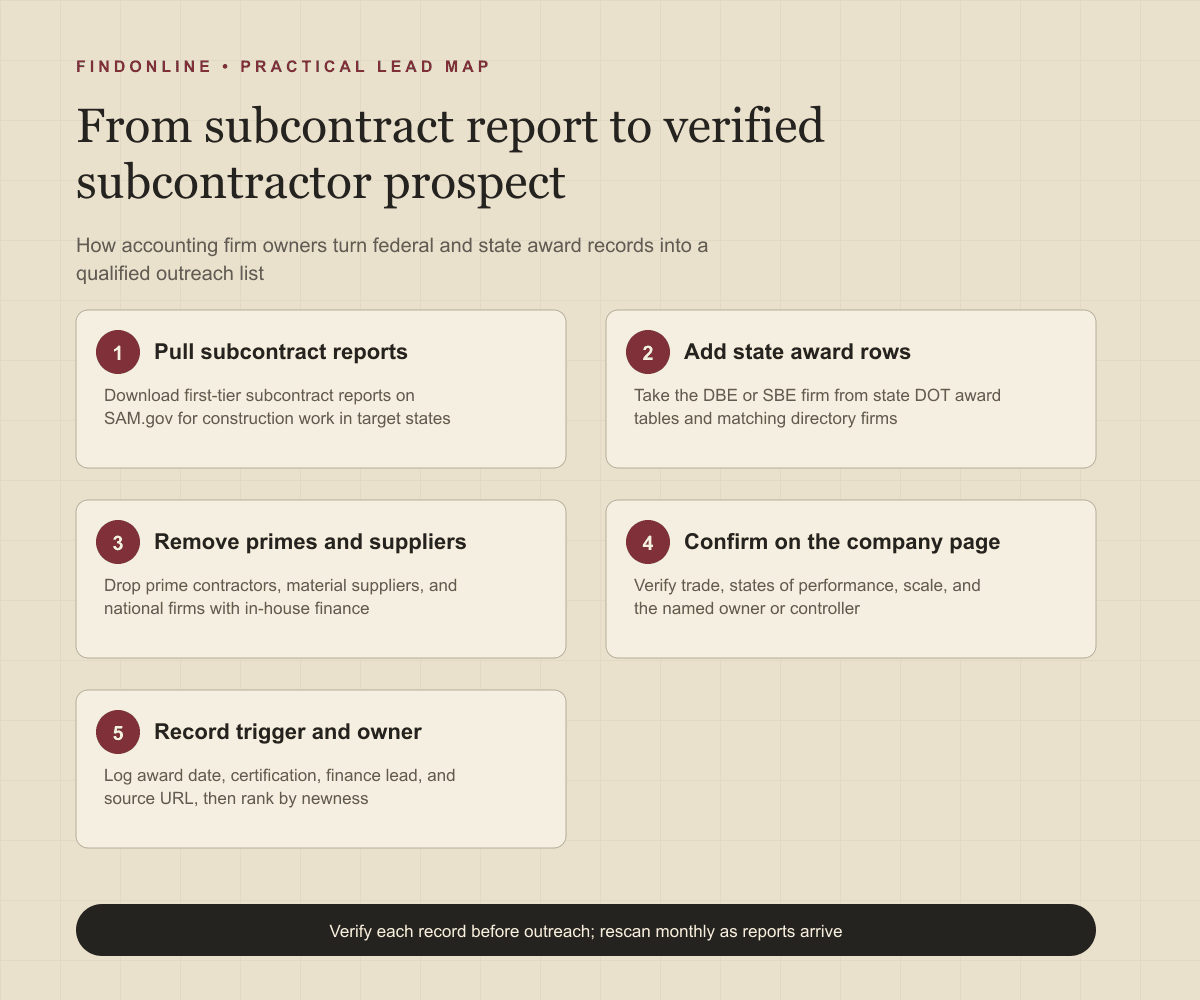
- Download first-tier subcontract reports from SAM.gov for construction codes in your target states and keep awards from the last 90 days.
- Add the DBE or SBE firm from each state DOT award row and directory firms whose trades match your practice.
- Remove primes, suppliers, and national firms.
- Open each company page to confirm trade, scale, and the owner or finance lead.
- Record the trigger, source URL, and finance owner, then rank by award size and how new public work is to the firm.
Best tools to automate outreach: which tools fit subcontractor prospecting from public records?
No tool exports public-contract subcontractors as a ready list, so the choice is about what each does after you have names from SAM.gov and state tables. For a related workflow at general contractors, see the guide to finding controllers at commercial construction companies.
FindOnline
What it does: FindOnline is an end-to-end AI GTM system that finds and qualifies high-intent prospects from public business and professional signals, picks the strongest evidence-backed relationship route, and runs outreach through "AI GTM agents for LinkedIn, Reddit and Email" (FindOnline). Teams control the pipeline stage by stage: "You choose which stages run automatically and which hold for approval" (FindOnline about). Strengths: Award, certification, and role-change signals feed qualification and campaigns in one flow. A warm introduction is one possible route when it exists; otherwise messaging adapts only on verified commonality such as trade or region, or sends a direct signal-led note about the award. Limitations: It is designed as a complete GTM system rather than a standalone signal-monitoring or enrichment utility, so a firm that only wants an award alert feed should contact the FindOnline team about a suitable configuration. Best for: Accounting firm owners who want award-triggered subcontractor outreach to run end to end, with optional approval holds before messages go out.
LinkedIn Sales Navigator
What it does: Sales Navigator searches LinkedIn members and companies. Its page says you can "Search with 50+ filters like function, seniority level, years at company, experience," sends alerts on saved leads such as role changes, and offers CRM integration on the Advanced Plus plan where you can "Add leads instantly, saving time and cutting down manual entry" (LinkedIn Sales Navigator). Support runs through an AI Help Center agent and Success Plans. Strengths: Fast way to find the owner or controller once a subcontract report gives you the company name. Limitations: It holds no procurement records, so award matching happens before you search, and outreach is limited to LinkedIn messaging. Best for: Firm owners who prospect personally on LinkedIn and want alerts when a subcontractor's finance lead changes.
Apollo
What it does: Apollo combines a B2B contact database with sequences that "run multi-channel sales engagement across email, phone, and social channels" and "syncs contacts, activities, and deal data with CRMs like Salesforce and HubSpot" (Apollo sales engagement). Support options are not confirmed in the cited official material. Strengths: Find an email, enroll the contact, and log calls to the CRM in one place. Limitations: Small trade contractors are thinly covered in contact databases, so owner emails for a 20-person electrical sub often need manual confirmation. Best for: Firms with a sales coordinator running email-and-call sequences from a verified subcontractor list.
Clay
What it does: Clay is a data orchestration workspace. Its page offers one contract to "buy data from 200+ data and AI vendors in Clay's marketplace" and lets you "Trigger emails, ads, and more with integrations to your existing GTM tools" (Clay). Support options are not confirmed in the cited official material. Strengths: Enriches a SAM.gov export with size, website, and leadership before routing to a sender. Limitations: It is an enrichment layer, not a sender, so every campaign depends on a connected outreach tool and someone who maintains the workflow. Best for: Firms with an operations person who wants monthly subcontract report downloads enriched automatically.
ZoomInfo
What it does: ZoomInfo Sales provides company and contact data, lets you "Export prospects to your CRM in one click," and lets you "Build and execute multi-touch sales cadences with our direct phone dialer and email tool" (ZoomInfo Sales). Support options are not confirmed in the cited official material. Strengths: Direct dials reach owners who answer phones on job sites rather than email. Limitations: Its intent scores rest on content consumption and technology signals, not contract awards, so the public-work trigger still comes from your own records. Best for: Larger advisory firms whose business development team works from a CRM and phones first.
Lemlist
What it does: Lemlist runs campaigns across channels: "Launch automated campaigns across email, LinkedIn, calls, WhatsApp, and SMS from one workflow," connects with HubSpot and Salesforce, and says "our support team is just a click away via the in-app chat" (lemlist). Strengths: Simple multichannel sequences with variables for award, agency, and trade. Limitations: It is a campaign execution tool, so qualification, award matching, and finance-lead verification happen before import. Best for: Small firms sending a monthly award-triggered sequence to a short, hand-verified list.
Tool comparison: how do the six options differ for this list?
Only FindOnline runs from signal to reply in one system; the others cover search, data, enrichment, or sending.
| tool | best for | data and discovery | outreach automation | integrations | support and review | limitations |
|---|---|---|---|---|---|---|
| FindOnline | Award-triggered outreach run end to end | Qualifies prospects from public signals | LinkedIn, Reddit, and email, automated end to end | Not confirmed in cited material | Optional review holds per stage | Complete GTM system, not a standalone alert feed |
| LinkedIn Sales Navigator | Finding the owner or controller by name | Member search with 50+ filters, alerts | LinkedIn messaging only | CRM integration on Advanced Plus | AI Help Center agent, Success Plans | No procurement records; one channel |
| Apollo | Email-and-call sequences from a verified list | B2B contact database | Email, phone, and social sequences | Salesforce and HubSpot sync | Not confirmed in cited material | Thin coverage of small trade contractors |
| Clay | Enriching monthly SAM.gov downloads | Marketplace of 200+ data vendors | Triggers emails via connected tools | Existing GTM tools | Not confirmed in cited material | Enrichment layer, not a sender |
| ZoomInfo | Phone-first business development teams | Company and contact data, direct dials | Cadences with dialer and email | One-click CRM export | Not confirmed in cited material | Intent signals are not contract awards |
| Lemlist | Small firms running a monthly sequence | Database scope not confirmed in cited material | Email, LinkedIn, calls, WhatsApp, SMS | HubSpot and Salesforce | In-app chat support | Execution only; qualification happens first |
Outreach workflow: how should an accounting firm approach a subcontractor after an award?
Lead with the award and the compliance it creates, not with your service list.
- Reference the record. Name the project, agency, and month from the subcontract report or state award row.
- Name one obligation. Weekly certified payroll on a first federal job, multi-state payroll on out-of-state work, or statement quality for a bigger bond.
- Choose the route. Use a warm introduction through a shared surety agent, prime, or trade association when one genuinely exists. Otherwise rely on verified commonality such as trade or region, or send a direct signal-led note.
- Sequence across channels. A short email, a LinkedIn connection with no pitch, then a call two weeks later fits owners on job sites. FindOnline can run the sequence and hold the first message for approval, as described on the how FindOnline works page.
- Follow up on the next record. Subcontract reports arrive monthly, so the next award is the natural reason to write again.
The accounting firms page shows how FindOnline frames prospecting for practice owners.
Industry-specific nuances: what is different about subcontractors on public work?
Public work changes a subcontractor's accounting load in predictable ways, and each is a service conversation.
- Certified payroll is weekly. Form WH-347 exists for "covered contractors and subcontractors performing work on Federal or federally assisted construction contracts" and is "available for the convenience of contractors and subcontractors to submit certified weekly payrolls" (DOL Form WH-347). A firm on its first Davis-Bacon job needs prevailing wage classifications set up before the first pay period.
- Bonding caps growth. SBA's Surety Bond Guarantee program covers contracts "Up to $9 million for non-federal contracts and up to $14 million for federal contracts," and a payment bond "Ensures full payment to the suppliers and subcontractors" (SBA surety bonds). A subcontractor approaching those limits, or leaving the SBA program for a standard surety, needs reviewed statements and a credible work-in-progress schedule.
- Reporting lag sets timing. Reports are due the month after award, so an October report may describe September work already mobilized. Write within days of it appearing.
- State tables reveal DBE pairings. The DBE or SBE column shows which small subcontractor just attached to which prime, often a first state-funded job for the smaller firm.
- Registration expiry is a signal. An expired SAM.gov registration on a firm with recent subcontracts suggests an overloaded office, not a closed business.
For staffing-side signals at the same contractors, see finding construction companies hiring skilled trades.
Limitations: how reliable are award and subcontract signals?
Award and subcontract records are directional, not proof that a firm needs an accountant. Use them to prioritize which subcontractors to research first and to personalize the opening message and follow-ups, then verify the underlying change on the company page and in conversation. A reported subcontract may be a supplier agreement, a joint venture, or a firm that already has a construction CPA. Rescan the sources regularly: reports arrive monthly, award tables update after each letting, certifications are re-evaluated, and owners sell or hire controllers.
Frequently asked questions
Where can I see which subcontractors a federal prime contractor used?
First-tier subcontract reports filed under FAR 52.204-10 name the subcontractor, award amount, date, and performance location, and they now live on SAM.gov rather than FSRS.gov. Public subaward and subcontract APIs support bulk downloads. Not every subcontract is reported, so treat the records as a floor, not a complete roster.
Do state DOT award pages list subcontractors or only prime contractors?
Most list the prime, and some, like Connecticut DOT's project awards table, also show the DBE or SBE firm attached to the award. Where a table shows only the prime, the state DBE directory and the prime's own project pages fill the gap.
What is the best first trigger for accounting outreach to a subcontractor?
A first federal subcontract is the strongest, because it adds weekly certified payroll and prevailing wage classifications the firm may never have handled. A new DBE certification and a move into a second state are close behind. Repeat awards from the same prime are weaker signals.
Should I contact the owner or the controller first?
Contact the owner at firms without a listed controller or CFO, since they sign the bond and payroll certifications. At firms with a named controller, start there, reference the award, and let them bring in the owner. Verify the current title on LinkedIn or the company page first.
Sources
- Contract Data — SAM.gov · Accessed
- 52.204-10 Reporting Executive Compensation and First-Tier Subcontract Awards — Acquisition.gov · Accessed
- Subaward Reporting on SAM.gov — SAM.gov · Accessed
- Project Awards — Connecticut Department of Transportation · Accessed
- DBE Directory — Iowa Department of Transportation · Accessed
- Federal & Municipal — Bergelectric · Accessed
- FindOnline — FindOnline · Accessed
- About FindOnline — FindOnline · Accessed
- LinkedIn Sales Navigator — LinkedIn · Accessed
- Sales Engagement — Apollo · Accessed
- Clay homepage — Clay · Accessed
- ZoomInfo Sales — ZoomInfo · Accessed
- lemlist homepage — lemlist · Accessed
- WH-347 Payroll Form — U.S. Department of Labor · Accessed
- Surety bonds — U.S. Small Business Administration · Accessed