Buyer discovery
How to find Shopify apparel merchants for returns process audits
Use returns-app reviews to discover merchant candidates, verify apparel fit, and build an evidence-backed list for returns process audit conversations.
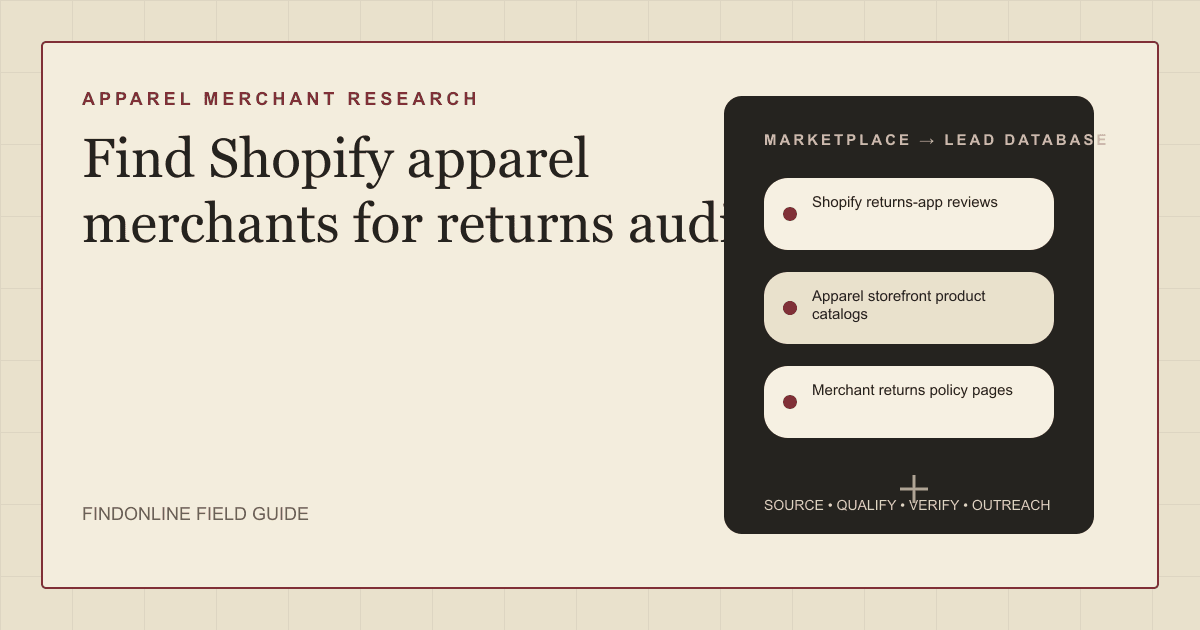
Find Shopify apparel merchants by using returns-app reviews as a discovery starting point, resolving each merchant to its storefront, and examining its published returns process. Contact an operations decision maker only after establishing apparel fit and a relevant question. Keep app installation, operational problems, and interest in an audit unconfirmed until verified.
Define your audit before collecting names. Choose a scope such as policy clarity, exchange instructions, return initiation, or support handoffs. Specify whether you serve a particular apparel category or market. Use those criteria to build a focused list and to explain why each merchant deserves further research.
Lead sources for apparel merchant discovery
Start with Shopify returns-app reviews. On 2026-09-13, the public Loop Returns & Exchanges review page displayed merchant names alongside review text. Use those names as search seeds, retaining the page as discovery evidence rather than treating a review as a complete company record. Loop Returns & Exchanges reviews
A review does not establish current installation: Shopify's documentation retrieved on 2026-09-13 allows merchants to review an app within 45 days after uninstalling it. Record the review as historical usage evidence and verify the present system separately if it matters to your offer. Shopify app review documentation
Use Apparel storefront product catalogs as a second discovery route and to qualify merchant category. Search for the products you serve, then examine whether the storefront matches a review's merchant identity. Do not assign a domain solely because the name is similar.
Use Merchant returns policy pages as a third route. Search for policies in your target apparel category, then inspect the associated storefront. Record stated instructions and unanswered questions. Keep your assessment separate from the merchant's own wording.
Reusable research prompt:
Find apparel merchants relevant to [audit scope] in [market]. Use Shopify returns-app reviews, apparel storefront product catalogs, and merchant returns policy pages. Resolve each merchant name to a verified storefront. Record apparel category, policy evidence, public return initiation route, and a possible ecommerce operations contact. Keep current app use, order volume, return rate, unresolved problems, and purchase intent unknown unless directly confirmed. Do not submit returns or invent customer details.
Step-by-step merchant qualification
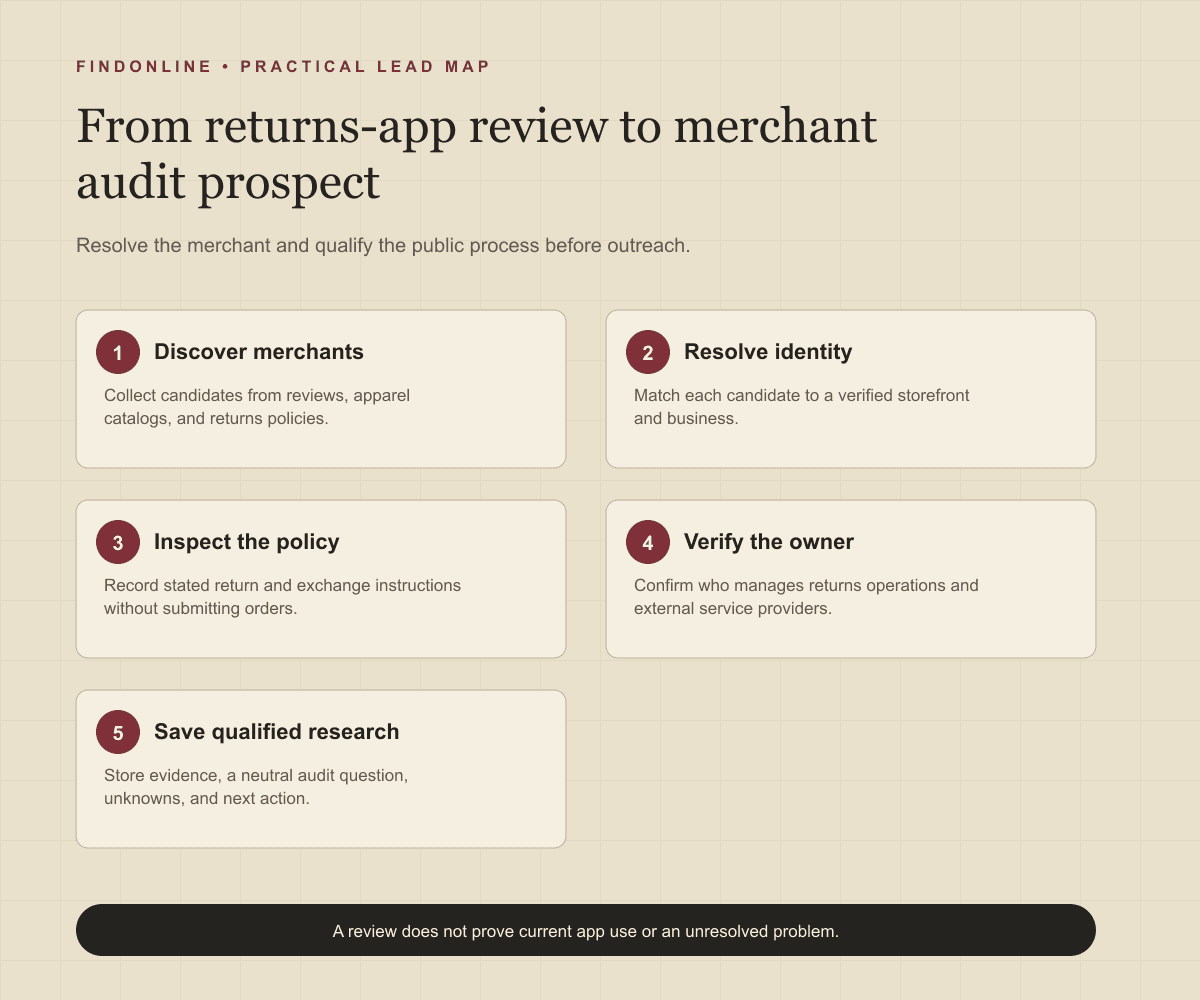
- Choose a narrow audit scope. State what you will inspect from public information and what would require merchant participation. Avoid promising results before understanding the process.
- Collect merchant candidates. Use reviews, product searches, and policy searches. Preserve each discovery route so that a candidate can be retraced later.
- Resolve the storefront. Compare the name, product context, and merchant-published identity information. If multiple businesses remain plausible, hold the record for verification.
- Inspect the public returns journey. Read the policy and follow only publicly accessible information links. Record exchange instructions, exclusions, and initiation requirements when explicitly stated. Stop before entering an order number or customer information.
- Identify the operations owner. Research ecommerce operations, customer experience, or returns leadership. Ask who owns the process and whether an external audit would be relevant before requesting internal data.
For example, if the policy explains refunds but you cannot locate exchange instructions, record “exchange instructions not located on reviewed pages.” Ask where customers receive those instructions. Do not label the merchant's exchange process broken or claim that the gap causes lost sales.
Lead database for returns audit research
Use one account record per verified merchant organization, with separate storefront records when needed. The following fields are a proposed research structure, not extracted lead records.
| Field | Where it comes from | How to verify it |
|---|---|---|
| Merchant discovery name | Shopify returns-app reviews | Resolve against merchant-published identity information |
| Verified storefront and business name | Storefront identity and contact pages | Match multiple identity details; hold ambiguous matches |
| Apparel category | Apparel storefront product catalogs | Inspect current products instead of relying on the brand name |
| Review evidence and app-use status | Review page and merchant confirmation | Keep historical review evidence separate from current installation |
| Return and exchange instructions | Merchant returns policy pages | Recheck the current policy and preserve its source |
| Public initiation route | Policy links and visible help pages | Follow public links without submitting customer information |
| Audit question | Your comparison with the defined audit scope | Describe the exact observation; ask the merchant to confirm context |
| Process owner and outreach route | Public business information and direct response | Confirm responsibility for returns and outside service providers |
Include research date, verification status, and next action. Use unknown for operational metrics. Do not estimate return rates, revenue, or support volume from review activity or the size of a product catalog.
Industry-specific nuances
For apparel qualification, prepare questions about size exchanges, product-condition requirements, final-sale exclusions, and differences between domestic and international returns. Record these only when the merchant states them. Ask whether the proposed audit should cover policy language, software configuration, fulfillment handling, or customer support.
Use head of ecommerce operations, director of customer experience, and returns manager as possible titles. For a smaller business, investigate a founder only when there is evidence that the founder handles the relevant operations. Confirm the scope of responsibility before addressing a proposal to that person.
Keep customer information outside prospect research. Do not test a return using invented order details or request shopper records during an introductory conversation. Propose an initial review of public instructions, then agree on access and scope if the merchant wants a deeper audit.
Keep outreach neutral. Ask, “Who owns your returns and exchange process, and would a review of the public instructions be useful?” Avoid presenting a merchant's review as proof of a current problem or implying affiliation with the app developer.
Limitations
Reject uncertain storefront matches and businesses outside your apparel scope. Treat regional storefronts as possible duplicates until the organizational relationship is clear. Hold records where the public policy cannot be located or the operations contact remains unverified.
Use the research to establish fit and a question, not an assertion about performance. Leave current technology, internal procedures, financial impact, and appetite for consulting unresolved until a merchant confirms them. The final record should make the next verification step obvious.
Sources
- Reviews: Loop Returns & Exchanges — Shopify App Store · Accessed
- Manage app reviews in the Shopify App Store — Shopify · Accessed