Buyer discovery
How to find education training providers for course localization services
Find educator training providers, qualify their course audiences and language requirements, and verify who can commission localization work.
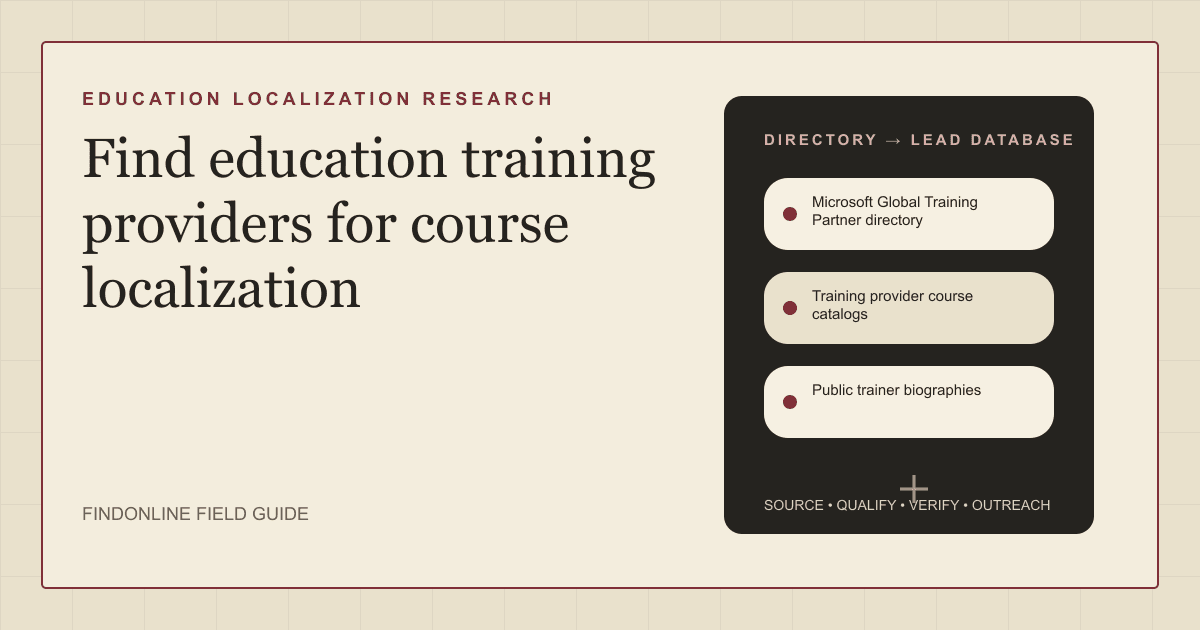
Find education training providers by starting with an education-specific directory, examining their courses, and verifying who controls learning content. Qualify the audience, language, and rights for a particular course before proposing localization. Keep demand unconfirmed until the provider identifies a project or agrees to discuss one.
Choose a narrow offer first: translated facilitator guides, localized slide decks, subtitles, or adaptation of classroom examples. Specify your language pair and subject expertise. That gives you a practical reason to investigate one provider over another without assuming that every international organization needs translation.
Lead sources for education training providers
Start with the Microsoft Global Training Partner directory. Microsoft describes this program as serving educators and school leaders and organizes its provider directory by country or region. The public HTML retrieved on 2026-09-13 contained the directory entries. Find a Global Training Partner
Use Training provider course catalogs as an independent discovery route. Search for educator workshops in your target subject and language market. Record the named audience, course format, learning outcomes, and any explicitly stated delivery language. If you discover a provider through its catalog, use the directory only to check a claimed program relationship.
Use Public trainer biographies to find additional providers and understand who develops or delivers their courses. Follow explicit employer or training-company references. Keep an instructor's teaching role separate from authority to commission localization.
Do not automatically include every technical training organization. Microsoft's broader Training Services Partners page describes training across AI, cloud, security, and productivity, including localized instructor-led learning. Require specific evidence of an educator audience for this prospect list. Microsoft Training Services Partners
Reusable research prompt:
Find providers of professional development for teachers or school leaders in [market], focused on [subject]. Use the Microsoft Global Training Partner directory, training provider course catalogs, and public trainer biographies. Record the provider, course, audience, explicitly stated delivery language, content owner if named, and potential curriculum contact. Separate observed facts from localization hypotheses. Do not infer language ability, outsourcing demand, or purchasing authority from country or job title.
Step-by-step course qualification
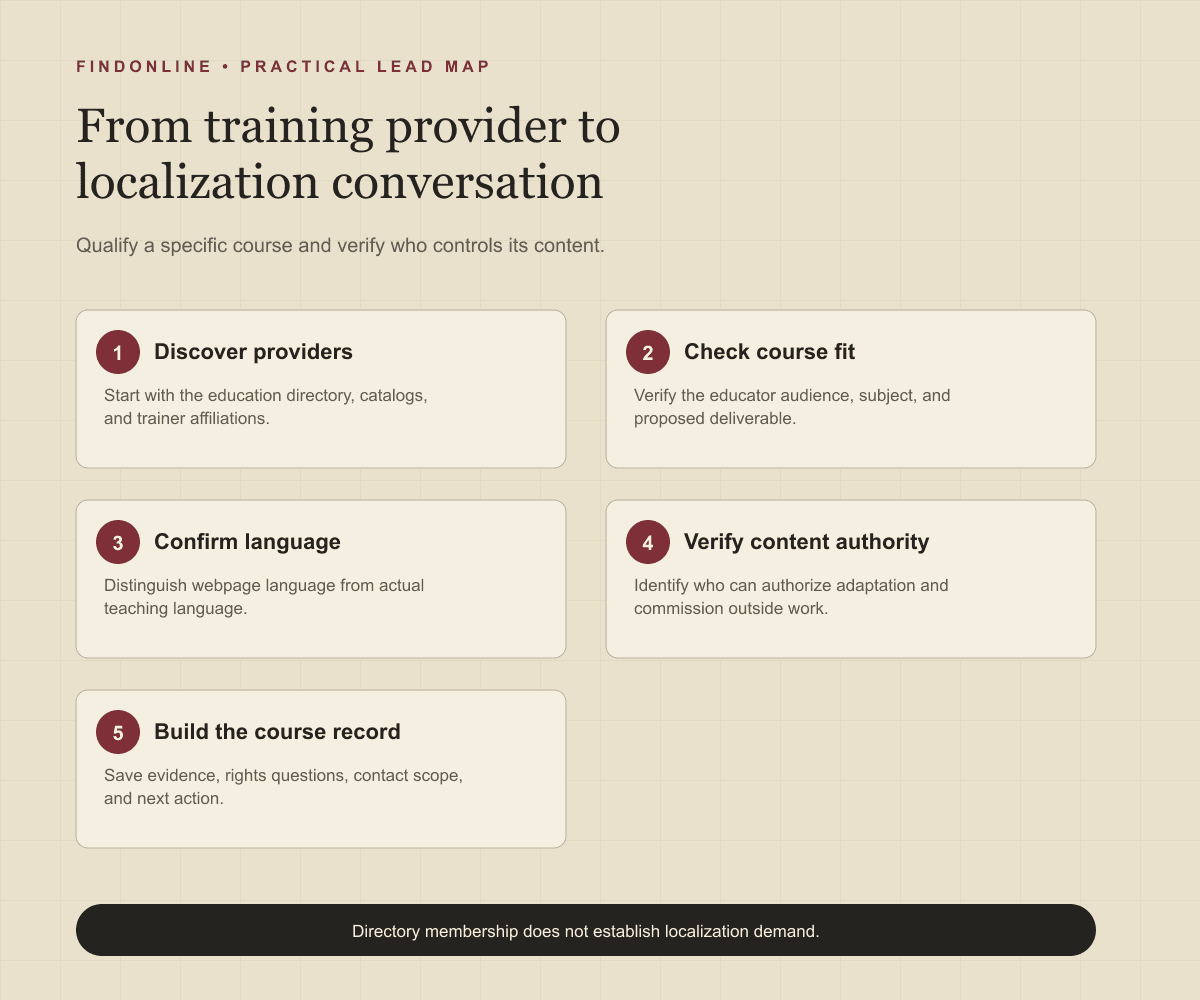
- Define the audience and deliverable. Select teachers or school leaders, one subject area, and the material you can adapt. Write down what would make a course unsuitable.
- Discover providers through separate routes. Review the directory, search course catalogs, and investigate public trainer affiliations. Preserve the discovery source for each organization.
- Qualify a specific course. Record its audience and stated language. Read the syllabus before deciding whether your subject expertise fits. Mark absent language information unknown.
- Establish content control. Ask whether the provider owns the material, licenses it, or delivers material controlled by someone else. Obtain confirmation before proposing adaptation of that material.
- Find the commissioning role. Research curriculum, learning content, academic programs, or localization leadership. Ask the provider who approves external content work and record the answer.
For example, if a provider publishes an English-language description of a teacher workshop, record “English description observed.” Do not turn that into “course available only in English.” Ask whether another delivery language or facilitator version already exists.
Lead database for localization qualification
Create one provider record with linked course records. This lets you investigate several courses without treating each course as a separate company.
| Field | Where it comes from | How to verify it |
|---|---|---|
| Provider name and directory context | Microsoft Global Training Partner directory | Match the entry to the provider's own identity |
| Course title and educator audience | Training provider course catalogs | Check the current syllabus and intended participants |
| Stated delivery language | Course description or enrollment information | Confirm with the course team; distinguish page language from teaching language |
| Material proposed for localization | Catalog description and your proposed scope | Ask which slides, guides, videos, or exercises are in scope |
| Content owner and adaptation approval | Provider's explicit statement or direct response | Confirm who can authorize the proposed changes |
| Instructor affiliation | Public trainer biographies | Cross-check against the provider's current course information |
| Curriculum contact and authority | Provider team information and direct response | Verify responsibility for this course and outside suppliers |
| Localization hypothesis and status | Your analysis, followed by a qualification conversation | Label it proposed, confirmed, declined, or unknown |
Attach the supporting page and verification date to each material field. Record contradictions explicitly instead of choosing whichever version makes the prospect look more attractive.
Industry-specific nuances
Use head of curriculum, director of learning content, academic director, and program manager as starting titles. Verify whether the person can commission work, approve terminology, or only coordinate delivery. Ask for the relevant owner when those responsibilities sit elsewhere.
Build a sample scope around educational meaning. Propose checking classroom terminology, instructions, examples, captions, and facilitator notes. Ask who will review the educational accuracy of the adaptation and whether assessments belong in the project. Treat these as scoping questions, not deficiencies you have diagnosed from a public page.
Before requesting course files, establish the provider's authority to share and adapt them. For an initial example, offer to work with a provider-approved excerpt. Keep student names, classroom recordings, and learner submissions outside the prospect database.
A useful opening question is: “Who manages language adaptation for your teacher workshops, and is there a course you are considering for another delivery language?” Avoid implying that directory membership endorses your agency or establishes a partnership with you.
Limitations
Exclude corporate-only courses when the list is intended for educator development. Hold records where the provider identity is unclear, the course is no longer confirmed, or the biography describes a past affiliation. Keep country coverage separate from language capability.
Neither a directory entry nor a multilingual website is sufficient for your qualification decision. Require a specific course fit and a verified route to the content owner. Keep budget, timing, rights, and willingness to outsource unknown until the provider supplies that information.
The final research output should identify a provider, a relevant course, the evidence for audience fit, and one next question. That is enough to support a focused conversation without presenting a localization hypothesis as an established need.
Sources
- Find a Global Training Partner — Microsoft Learn · Accessed
- Training Services Partners — Microsoft Learn · Accessed