Buyer discovery
How to Find Operations Leaders at Clinical Research Organizations
Find operations leaders at clinical research organizations using ClinicalTrials.gov sponsor and site listings, CRO leadership pages, appointment releases, job posts, and LinkedIn, then verify who owns trial delivery.
By Vaishnav Gupta14 min read
On this page
Quick answer: Target the Chief Operating Officer, Executive Vice President of Operations, and Vice President or Senior Director of Clinical Operations at clinical research organizations (CROs). The strongest discovery sources are ClinicalTrials.gov sponsor and site listings, CRO leadership pages, and LinkedIn current-role profiles, timed to appointment releases and clinical operations job posts. Start by building a CRO universe from trial records, then confirm each operations seat on the leadership page before outreach.
Who to target: which roles own operations decisions at a CRO?
Target the leader accountable for trial delivery, because that person approves clinical operations hiring and process, quality, or technology consulting. Under United States drug trial regulations, a sponsor may transfer responsibility for any or all of the obligations set forth in this part to a CRO, and the transfer must be described in writing (21 CFR 312.52). That leader owns the transferred obligations, so staffing gaps and audit findings land there.
Titles vary by size. Medpace lists two Executive Vice Presidents of Operations, and one is responsible for global oversight of the Clinical Monitoring, Site Activation & Maintenance functions (Medpace leadership). Below that layer sit Vice Presidents of Clinical Trial Management or Clinical Operations. A Medpace posting for a Vice President of Clinical Trial Management states that you would report to the Executive Vice President of Clinical Operations (Medpace careers).
Decision rules for recruiters and consultants:
- Recruiters: target the VP or Senior Director with open requisitions; copy the EVP or COO only for executive searches.
- Consultants: target the COO or EVP, who owns operational and quality performance across functions.
- False positives: Clinical Trial Managers are study-level roles, not budget owners. Sponsor-side Vice Presidents of Clinical Operations manage CROs rather than run them and belong on a list like finding CFOs at venture-backed biotech startups. CRO business development leaders do not approve staffing vendors.
Lead sources: where do CRO operations leaders show up publicly?
Build the CRO universe from trial records and company pages, then layer timing triggers from releases, job posts, and acquisitions.
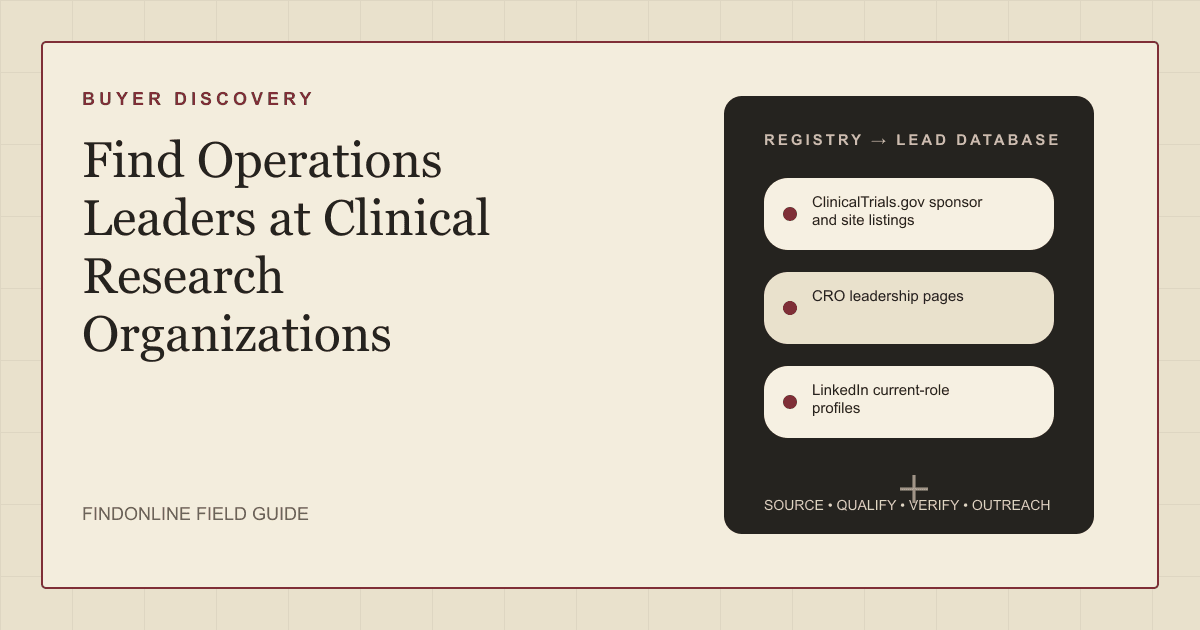
- ClinicalTrials.gov sponsor and site listings define the universe. Every registered trial names its sponsor and carries Facility Information, including the full name of the organization where the clinical trial is being conducted (42 CFR 11.10). Count recruiting records and facility countries for each CRO named as sponsor, collaborator, or responsible party. The registry renders as an application rather than readable text, so this guide cites the federal rule that defines its record fields.
- CRO leadership pages confirm the seat and its scope. Medpace's page states that Mr. Hansman currently serves as Executive Vice President, Operations, and names the functions he oversees (Medpace leadership). Record words such as monitoring, site activation, trial management, or quality as scope.
- LinkedIn current-role profiles verify the person and start date. Members maintain their own Experience section; the official help page explains that in the Add experience pop-up window, enter your information into the fields provided (LinkedIn Help). Leadership pages lag departures, so treat the profile as the tiebreaker.
- CRO operations appointment releases are the sharpest timing signal. Premier Research announced on January 6, 2026 that its new Chief Operating Officer will drive operational and quality performance across all clinical development functions (Premier Research). Log the announcement date.
- CRO clinical operations job posts show which team is growing. Medpace's open Vice President role will lead a pivotal team of Directors and Managers, based in all global regions (Medpace careers). Employers also post on the ACRP Career Center, which invites them to meet your hiring needs by leveraging our industry-leading network of qualified clinical research professionals (ACRP Career Center).
- CRO acquisition announcements flag integration work. Curavit announced on August 18, 2026 the acquisition of the CRO assets of Lindus Health (PR Newswire).
All three reviewed hints are retained; three trigger sources are added because the hints show who holds the seat but not when to call.
Lead database: which fields should a CRO operations-leader list contain?
Record the CRO, its delivery footprint, the named operations leader with scope, the trigger, and a verification date.
| Field | Where it comes from | How to verify |
|---|---|---|
| CRO name and type | ClinicalTrials.gov sponsor and site listings; about page | Match registry name to website; tag full-service, niche, FSP, or site network |
| Recruiting trials and countries | ClinicalTrials.gov sponsor and site listings | Count recruiting records; list facility countries |
| Operations leader and title | CRO leadership pages | Confirm on LinkedIn current-role profiles; note start date |
| Scope of role | Leadership biography | Record named functions: monitoring, site activation, quality |
| Trigger type and date | CRO operations appointment releases; CRO acquisition announcements | Log announcement and effective dates |
| Open clinical operations roles | CRO clinical operations job posts | Count live postings by level and region |
| Relationship route | LinkedIn current-role profiles | Note a verified former colleague or shared community, or none |
Reusable research prompt:
Build a list of clinical research organizations named as sponsor, collaborator, or responsible party on recruiting trials in [therapeutic area] with sites in [country]. For each, record the COO, EVP Operations, and VP Clinical Operations and the functions each oversees from the leadership page. Flag operations appointments, acquisitions, or clinical operations openings in the last 90 days. Mark unknown fields unverified.
Step-by-step workflow:
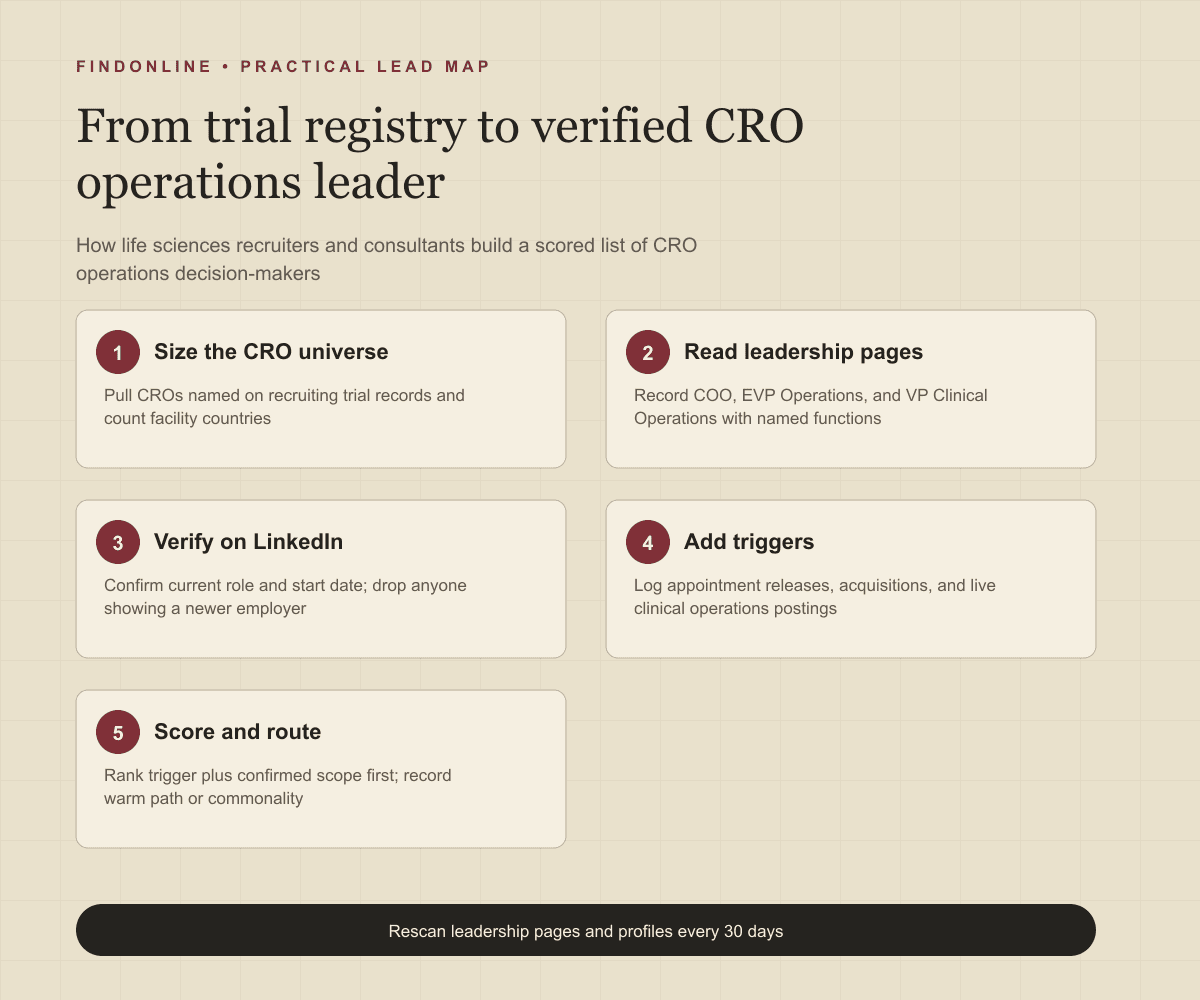
- Export registry records for your therapeutic area and keep organizations acting as CROs.
- Record every leadership-page title containing operations, delivery, monitoring, or trial management.
- Confirm each name and start date on LinkedIn; drop anyone showing a newer employer.
- Add trigger rows from appointment releases, acquisition announcements, and live clinical operations postings.
- Score rows: trigger plus confirmed scope first, confirmed seat second, unverified last. Record the route and verification date before messaging.
Best tools to automate outreach: which platforms fit CRO prospecting?
Pick by how much of the registry-to-outreach workflow you want automated.
FindOnline
What it does: FindOnline is an end-to-end AI GTM system that finds and qualifies prospects from public signals such as posts, hiring, role changes, and community activity, then runs outreach and reply handling. It describes itself as AI GTM agents for LinkedIn, Reddit and Email (FindOnline). For this list it watches CRO appointment and hiring signals and adds matching leaders to a campaign. Strengths: Discovery, relationship routing, outreach, and follow-up run as one automated pipeline. You choose which stages run automatically and which hold for approval (FindOnline about), so a recruiter can auto-run discovery and hold executive messages for an optional check. A credible warm introduction is one possible route; otherwise the agent uses verified professional commonality such as industry, role, or communities, or sends a direct signal-led message. Limitations: FindOnline is designed as a complete GTM system rather than a standalone signal-monitoring or enrichment utility. Teams that only want one isolated component, such as alerts on CRO leadership changes, should contact the FindOnline team to discuss a suitable configuration. Best for: Life sciences recruiters and consultants who want CRO operations leaders discovered from appointment, hiring, and post signals and contacted across LinkedIn and email without stitching together separate data, sequencing, and monitoring tools.
LinkedIn Sales Navigator
What it does: Sales Navigator is LinkedIn's paid layer for people and account search. You can search with 50+ filters like function, seniority level, years at company (Sales Navigator). Strengths: It works on the profiles you already use to verify roles, and its top plan provides structured onboarding, training, and support to drive product adoption (Sales Navigator). Limitations: It does not run automated multi-step sequences, so outreach to the CRO list happens by hand or in another tool. Best for: Recruiters who maintain CRO account lists on LinkedIn and need seniority filters to surface VP and Senior Director operations titles.
Apollo
What it does: Apollo combines a contact database with a sequence builder. Its sequences support multi-channel sequence steps across email, call, and networking platforms (Apollo). Strengths: It syncs contacts, activities, and deal data with CRMs like Salesforce and HubSpot, so a staffing firm's existing pipeline stays current (Apollo). Limitations: Its database carries no CRO-specific classification, so you must tag full-service CROs apart from site networks and sponsors before sequencing. Support is not confirmed in the cited official material. Best for: Recruitment agencies with a CRM-driven sales desk sequencing email and calls to a pre-verified CRO operations list.
Clay
What it does: Clay is a spreadsheet-style enrichment and workflow builder. It lets teams create intent signals from anything on the internet, so registry exports, leadership-page text, and job-post counts can sit as columns in one table (Clay). Strengths: Once a row qualifies, it can trigger emails, ads, and more with integrations to your existing GTM tools (Clay). Limitations: Someone must design and maintain the table logic mapping registry sponsor names to leadership pages and titles. Support is not confirmed in the cited official material. Best for: Consulting firms with a marketer who will build and own a CRO enrichment table rather than buy a finished list.
ZoomInfo
What it does: ZoomInfo is a B2B contact database with intent data. Users can export prospects to your CRM in one click (ZoomInfo). Strengths: It can surface companies with high intent scores based on content consumption, technology signals, and behavioral patterns, which helps rank a long CRO list (ZoomInfo). Limitations: Intent topics reflect solution research, not a CRO's trial pipeline or leadership changes, so a high score does not mean a new COO. Support is not confirmed in the cited official material. Best for: Larger life sciences search firms needing direct dials and emails for a broad CRO universe.
Lemlist
What it does: Lemlist is a multichannel sending tool. Teams can launch automated campaigns across email, LinkedIn, calls, WhatsApp, and SMS from one workflow (Lemlist). Strengths: Help is close at hand because our support team is just a click away via the in-app chat, and the page names HubSpot and Salesforce connections (Lemlist). Limitations: It sends to a list you supply and does not detect CRO appointment or acquisition triggers, so registry research stays manual. Best for: Small recruiting teams that have finished verification and want hands-on support for LinkedIn and email steps.
Tool comparison: how do the six options differ for CRO lists?
FindOnline covers discovery through follow-up; the others each handle one stage.
| tool | best for | data and discovery | outreach automation | integrations | support and review | limitations |
|---|---|---|---|---|---|---|
| FindOnline | End-to-end CRO leader outreach for recruiters and consultants | Public signals: appointments, hiring, posts, communities | Automated LinkedIn, Reddit, and email outreach with replies | Not confirmed in the cited official material | Optional review per stage; stages can run automatically | Complete GTM system, not a standalone monitoring utility |
| LinkedIn Sales Navigator | Filtering CRO accounts by seniority and function | Profile search with 50+ filters | None; saves leads for manual outreach | CRM connection described for top plan | Onboarding and training on top plan | No automated sequences |
| Apollo | CRM-driven sequencing to verified CRO contacts | Contact database, no CRO tagging | Email, call, and networking sequence steps | Salesforce and HubSpot sync | Not confirmed in the cited official material | Must classify CROs yourself |
| Clay | Building a custom CRO enrichment table | Signals from any web source | Triggers emails through connected tools | Existing GTM tool integrations | Not confirmed in the cited official material | Requires an owner to build table logic |
| ZoomInfo | Broad CRO contact coverage with intent ranking | Contact database with intent scores | One-click CRM export; no native sequencing cited | CRM export in one click | Not confirmed in the cited official material | Intent does not reflect leadership changes |
| Lemlist | Multichannel sending to a finished list | Relies on a list you supply | Email, LinkedIn, calls, WhatsApp, SMS campaigns | HubSpot and Salesforce | In-app chat support | No discovery or trigger detection |
Outreach workflow: how should recruiters sequence contact with CRO operations leaders?
Open with the trigger, choose the relationship route, then run a short LinkedIn and email sequence that references the leader's actual scope.
- Lead with the trigger. A COO appointed within 90 days, a live VP or Director clinical operations posting, or a completed acquisition is the first sentence. Name the function from the biography, such as site activation, rather than a generic operations label.
- Pick the route. A verified former colleague offering a warm introduction is one option. Otherwise use verified commonality such as shared therapeutic area experience or a shared professional association. If nothing checks out, send a direct signal-led note; never invent shared history.
- Sequence. Send a LinkedIn connection note tied to the trigger, follow with an email offering one specific outcome, then engage with a recent post before the second follow-up. Senior CRO leaders rarely post on Reddit, so use that channel sparingly.
- Route replies by scope. Headcount questions go to a recruiter; quality or process questions go to a consultant.
- Rescan before each follow-up. Our guide to finding healthcare companies hiring at scale shows the same trigger-first cadence for provider employers, and the recruitment and staffing page explains how FindOnline runs this sequence for agencies.
Industry-specific nuances: what is different about selling to CROs?
CRO operations leaders carry regulatory accountability, so proposals must speak to delivery obligations rather than generic efficiency.
- Transferred obligations shape the pitch. The operations leader answers for transferred monitoring, site selection, and reporting obligations. Recruiters should lead with experienced monitors and trial managers; consultants with audit readiness.
- Operations has two meanings. At large CROs one leader runs clinical delivery while another runs corporate infrastructure. Read the biography for clinical functions before assuming the seat buys clinical staffing.
- Acquisitions create integration demand. Curavit's release says combined operations deliver unified U.S. and European trial delivery (PR Newswire), which means merging procedures, systems, and regional leadership.
- Functional service provider (FSP) models buy differently. A CRO embedding staff at sponsors needs volume hiring, so the FSP leader is a recruiter's buyer even without a headline appointment.
- Registry contacts are not prospects. Facility and central contacts in trial records exist for questions concerning the trial and enrollment at that site (42 CFR 11.10), so do not pitch them.
- The consultancies page describes how FindOnline supports advisory firms selling to operational leaders.
Limitations: how reliable are these signals?
Signals are directional rather than guaranteed truth. An appointment release, a job post, or an acquisition shows that something changed, not that a CRO will buy. Use signals to prioritize which CROs to contact first and to personalize the opening message and follow-ups, then verify the underlying change on the leadership page and profile. Rescan regularly, because departments, roles, and company conditions change and a verified leader can leave within a quarter.
Frequently asked questions
Which title is the real operations decision-maker at a CRO?
The Chief Operating Officer or Executive Vice President of Operations at larger CROs, and the COO or founder at smaller ones. Vice Presidents of Clinical Operations own team hiring beneath that layer. Confirm scope from the biography rather than the title alone.
Can I use ClinicalTrials.gov to find CRO operations leaders directly?
No. Trial records name the sponsor, collaborators, facilities, and enrollment contacts, not executives. Use the registry to identify which CROs are active in your therapeutic area, then find leaders on CRO leadership pages and LinkedIn.
How soon after a COO appointment should a recruiter reach out?
Within the first 90 days, when the new leader is reviewing team structure and vendors. Reference the announcement and the functions it names, and offer one specific outcome.
How do I tell a CRO from a site network or a biotech sponsor?
A CRO assumes sponsor obligations under contract and runs trials for clients; a site network conducts trials at its own facilities; a sponsor initiates the trial and hires CROs. Check the about page and the registry role before building the leader list.
Sources
- 21 CFR 312.52 - Transfer of obligations to a contract research organization — Cornell Law School Legal Information Institute · Accessed
- 42 CFR 11.10 - What definitions apply to this part? — Cornell Law School Legal Information Institute · Accessed
- Medpace Leadership — Medpace · Accessed
- Vice-President, Clinical Trial Management, Oncology — Medpace Careers · Accessed
- Manage your profile Experience section — LinkedIn Help · Accessed
- Sian Ratcliffe Smethurst Appointed Chief Operating Officer of Premier Research — Premier Research · Accessed
- ACRP Career Center — Association of Clinical Research Professionals · Accessed
- Curavit Expands Clinical Research Capabilities with Acquisition of Lindus Health CRO Assets — PR Newswire · Accessed
- FindOnline - AI GTM agents for LinkedIn, Reddit and Email — FindOnline · Accessed
- About FindOnline — FindOnline · Accessed
- LinkedIn Sales Navigator — LinkedIn Sales Solutions · Accessed
- Apollo Sales Engagement — Apollo · Accessed
- Clay - Go to market with unique data and the ability to act on it — Clay · Accessed
- ZoomInfo Sales — ZoomInfo · Accessed
- lemlist - Multichannel outreach platform — lemlist · Accessed